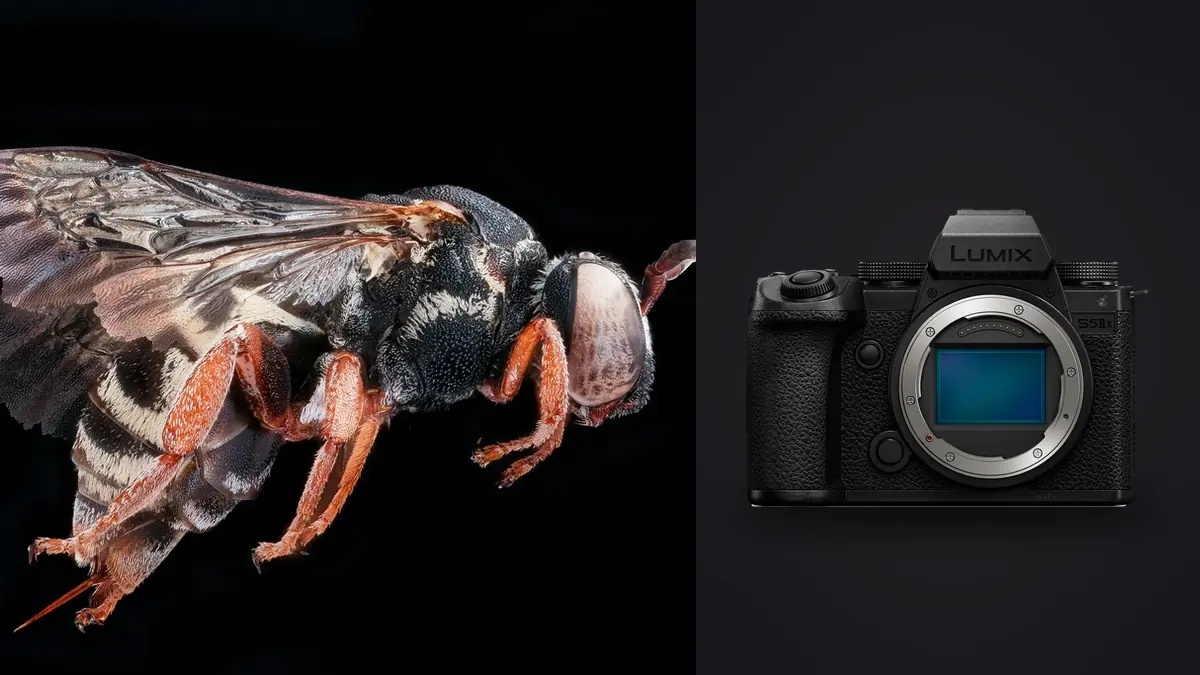
I did not buy the S5IIx for bugs. I bought it for the 4K ALL-Intra footage off an external SSD, and the camera happened to also be sitting in my bag three weeks later when a hawkmoth landed on the buddleia outside my window. What surprised me was not that it could shoot the moth. Cameras with a 100mm macro lens can shoot a moth. What surprised me was how little I fought the autofocus to get there, which is not something I expected from a Panasonic body given how the original S5 behaved at close range.
This is a practical writeup, not a spec sheet. I have spent a chunk of this spring and early summer with the S5IIx and three different macro lenses, chasing dragonflies at a reservoir edge, photographing jumping spiders on a fence post at 1:1, and doing slower tripod work with beetles in a cold garage before sunrise. Some of it worked well. Some of it exposed real limits that Panasonic's marketing does not dwell on.
A hybrid camera that wasn't built for this, and why that matters
The S5IIx exists mainly to serve videographers who want ProRes RAW to an external drive and wired live streaming without a capture card. Panasonic aimed it at run-and-gun video shooters, not macro photographers standing still over a leaf for twenty minutes. That context matters because the single biggest upgrade the S5II generation brought over the original S5 was the switch from contrast-detect DFD autofocus to phase-hybrid autofocus with on-sensor phase detection points spread across nearly the whole frame.
The original S5 hunted at close focusing distances in a way that made it genuinely frustrating for macro work. DFD relies on comparing successive frames to estimate direction, and at 1:1 with a few millimeters of depth of field, that comparison falls apart fast, especially when a subject's antennae are twitching. The S5IIx does not have that problem in the same way. It still is not as fast to lock as a mirrorless camera built around insect and eye detection from the ground up, but it commits to a focus point instead of pulsing back and forth, which is the behavior that actually matters when a robber fly is only going to sit still for four seconds.
What the autofocus actually gets you at 1:1
Panasonic never marketed insect-eye detection on this body the way some competitors advertise bird-eye or insect-eye AF as a named mode. The S5IIx's subject recognition covers humans and animals (it will lock onto a dog or cat's eye reliably), but it does not have a dedicated insect-detection algorithm. In practice this means that for true macro work, I am placing a single small AF point manually on the compound eye or the leading edge of the wing, not relying on the camera to find the subject for me.
Where the phase-detect system earns its keep is in continuous AF tracking once that point is placed. Photographing a damselfly perched on a reed swaying slightly in the wind, the camera holds focus through small movements far better than the old DFD system did, and it does not visibly pulse the aperture or breathe focus while hunting, which used to be a giveaway on the original S5 in video mode too. For static or slow subjects like a resting moth or a beetle on bark, single-shot AF with a small AF point is accurate close to 1:1, though I still nudge focus with the focus ring for the final few millimeters more often than I would with a dedicated macro-focused body, simply because depth of field at f/8 and 1:1 magnification on full frame is measured in fractions of a millimeter and any AF confirmation box is a compromise.
Choosing L-mount glass for insects
The S5IIx's L-mount gives you three real macro options today plus two manual-focus specialists, and which one you want depends heavily on how skittish your subject is. Working distance, meaning the physical gap between the front of the lens and the bug, is the number that actually decides whether you scare something off before you get the shot. Longer focal length at the same magnification buys you more working distance, which is why the 100mm and 105mm options tend to be the default choice over the 70mm for live insects rather than static subjects like flowers or product macro.
| Lens | Max magnification | Working distance at 1:1 | Focus type | Best for |
|---|---|---|---|---|
| Panasonic Lumix S 100mm F2.8 Macro | 1:1 | Roughly 14 cm | Autofocus, body IBIS only | General insect work, native AF speed |
| Sigma 105mm F2.8 DG DN Macro Art | 1:1 | Roughly 14 cm | Autofocus, body IBIS only | Sharper corners, heavier build |
| Sigma 70mm F2.8 DG Macro Art | 1:1 | Roughly 10 cm | Autofocus, body IBIS only | Static subjects, tighter budget |
| Laowa 100mm F2.8 2X Ultra Macro APO | 2:1 | Roughly 6 cm at 2:1 | Fully manual | Extreme magnification on cooperative subjects |
| Voigtlander Macro APO-Lanthar 65mm F2 | 1:2 | Moderate | Fully manual | Half-life-size work, environmental portraits of larger insects |
I run the Panasonic 100mm most days. It is the lightest of the autofocus options, it balances well on the S5IIx's grip for handheld work, and the autofocus is quick enough for dragonflies that land and take off repeatedly. The Sigma 105mm resolves a hair more detail at f/5.6 in my side-by-side files, but it is noticeably front-heavy and I feel it after an hour of handheld shooting along a reservoir bank. The Laowa is a different tool entirely: gorgeous at 2:1 on a jumping spider that will sit still, nearly useless on anything that reacts to a lens getting within 6 centimeters of it, which in my experience is most active insects on a warm afternoon.
Aperture, diffraction, and what I actually dial in
At high magnification, depth of field collapses to almost nothing regardless of aperture, which pushes most macro shooters toward smaller apertures than they would ever use for anything else. On the S5IIx's 24.2MP full-frame sensor, I start seeing softening from diffraction creep in past roughly f/11, and it becomes visually obvious by f/16 at 100% on screen. For a single-frame handheld insect shot, I mostly work between f/8 and f/11, accepting a thin focus slice rather than chasing sharpness everywhere, because the insect moving is a bigger threat to the shot than diffraction is.
Shutter speed handheld at 1:1 needs to be higher than instinct suggests, because magnification amplifies any camera shake the same way it amplifies the subject. I rarely go below 1/500s for a handheld insect shot even with the IBIS engaged, and closer to 1/1000s for anything with wings that might twitch mid-exposure. Panasonic rates the 5-axis Dual I.S. system at up to 8 stops with a compatible stabilized lens, and body-alone it is closer to 6 or 6.5 stops in my hand, which is genuinely useful for framing and focus confirmation, but it does nothing for subject motion, and subject motion is the actual enemy in insect macro, not camera shake.
For flash work I run a small diffused off-camera speedlight to the left of the lens rather than a ring flash, because a ring light on a metallic beetle produces a flat halo reflection I don't like. This lets me hold f/11 with ISO 200 and a fast shutter to freeze wing motion without the noise penalty a fully ambient exposure at that aperture and shutter combination would demand.
High-resolution mode and focus stacking, tripod only
The S5IIx's sensor-shift high resolution mode, which composites eight shifted exposures into a single image around 96 megapixels, is genuinely striking on a motionless subject: dew-cooled insects at first light, before the sun warms them enough to move, are the best candidate I have found for it. Any subject motion between the eight sub-exposures shows up as smearing or ghosting, so this mode is tripod-only and effectively useless on anything that might twitch a leg mid-capture, which rules out most insects most of the day.
Focus bracketing works better for the depth-of-field problem specific to macro. The camera will step focus through a defined range and fire a sequence automatically, and current firmware supports compositing that sequence into a stacked image in-camera rather than requiring a separate merge in Helicon Focus or Photoshop afterward. I still merge externally for anything with more than about fifteen frames, because the in-camera composite handles simple stacks well but struggles with fine detail like antennae or leg hairs crossing between frames. On a cooperative subject like a resting weevil, a 12-frame stack at f/5.6 with roughly 0.3mm step increments gets me a sharp insect from the front of the head to the back of the thorax that no single frame at any aperture could match.
The pile of files nobody warns you about
Nobody tells you before you start focus stacking that a single decent insect subject on a good morning will generate 400 to 600 frames by lunchtime once you count every bracket sequence, every burst where the subject shifted mid-stack and you restarted, and every duplicate angle you tried because the light changed. That volume is the actual bottleneck in macro work now, not the camera. I sort through it on the same laptop I shoot from, using imagic to get through bracket sequences without opening every single frame by hand. Its local sharpness scoring flags which frame in a stack has the compound eye in critical focus before I decide whether the whole sequence is even worth merging, and the burst and duplicate clustering groups the fifteen near-identical frames from a bracket sequence together instead of making me scroll past all of them individually in a flat grid.
One thing that matters more in insect macro than most genres: a meaningful share of what I shoot involves locations I do not want geotagged and uploaded anywhere, either because a private garden calls for discretion or because some of the rarer species I've photographed have collectors who go looking for exact coordinates once a location leaks online. imagic processes everything locally on the machine, nothing goes to a server, so I am not weighing that privacy question against convenience every time I want faster culling. That is a bigger deal for macro and nature shooters than it sounds like on paper. If you want the background on how the sharpness scoring actually works under the hood, I wrote more detail in how AI photo culling works.
Once I've picked keepers, I lean on imagic's apply_my_style preset feature, which trains on edits I've already made rather than shipping a generic macro preset pack. After editing a dozen insect shots the way I actually want them (slightly cooler shadows, restrained saturation on greens so leaves don't fight the subject for attention), applying that same trained look across a new batch saves real time compared to rebuilding the edit from scratch on every subject, and it is a one-time purchase rather than a subscription, which matters when you are already budgeting for lenses and diffusers.
Weather sealing, battery, and other field notes
The S5IIx is rated dust and splash resistant and Panasonic lists freeze resistance down to negative 10 Celsius, which covers early spring mornings chasing the first emerging dragonflies without much worry. I have had condensation form on the lens front element more often than I've had any concern about the body itself in damp reservoir-edge conditions. Battery life with the DMW-BLK22 is fine for a normal shoot, but focus bracketing sequences and reviewing 96-megapixel high-res files on the rear screen both drain it faster than stills shooting alone would suggest, and I carry two spares rather than one on any full-day macro outing.
The fully articulating rear screen turns out to matter more for macro than I expected going in. Getting the camera down to ground level for a beetle on a low leaf, with the screen flipped out and angled up, saves my knees and my back in a way a tilt-only screen never would, and it's a detail that only became obvious once I was actually lying in wet grass trying to compose through an EVF at an awkward angle.
Frequently Asked Questions
Does the S5IIx's autofocus actually lock onto an insect's eye, or am I focusing manually the whole time?
There is no dedicated insect-eye detection mode on this camera, only human and animal (dog/cat) subject recognition. For true macro work you are placing a small AF point on the eye yourself and letting continuous AF hold it through minor movement. It tracks well once placed, but it will not find the subject for you the way bird-eye AF does on some competing bodies.
Is the high resolution mode worth using for insect photography?
Only for genuinely motionless subjects on a tripod, which in practice means dew-cooled insects at first light before they warm up enough to move, or dead specimens photographed for documentation. Any movement during the eight-shot sequence produces visible smearing, so it is not a mode you reach for during active daytime shooting.
Which L-mount macro lens should I pair with the S5IIx for skittish subjects like dragonflies?
The Panasonic 100mm F2.8 Macro or the Sigma 105mm F2.8 DG DN Macro, both of which give roughly 14 centimeters of working distance at 1:1, autofocus, and body stabilization support. The Laowa 100mm 2X gets you higher magnification but its working distance shrinks to a few centimeters at full magnification, which is fine for a cooperative jumping spider and useless for anything that flies off when a lens gets close.
Does the S5IIx overheat during long focus-stacking sessions?
Not in still-photo focus bracketing, which is what most macro shooters use. The overheating concerns you read about with this camera almost always relate to extended 4K or 6K video recording, where the internal fan and heat management get pushed much harder than a bracket sequence of a few dozen stills ever will. I have run stacking sessions of over an hour in a warm garage without the camera flagging a thermal warning.