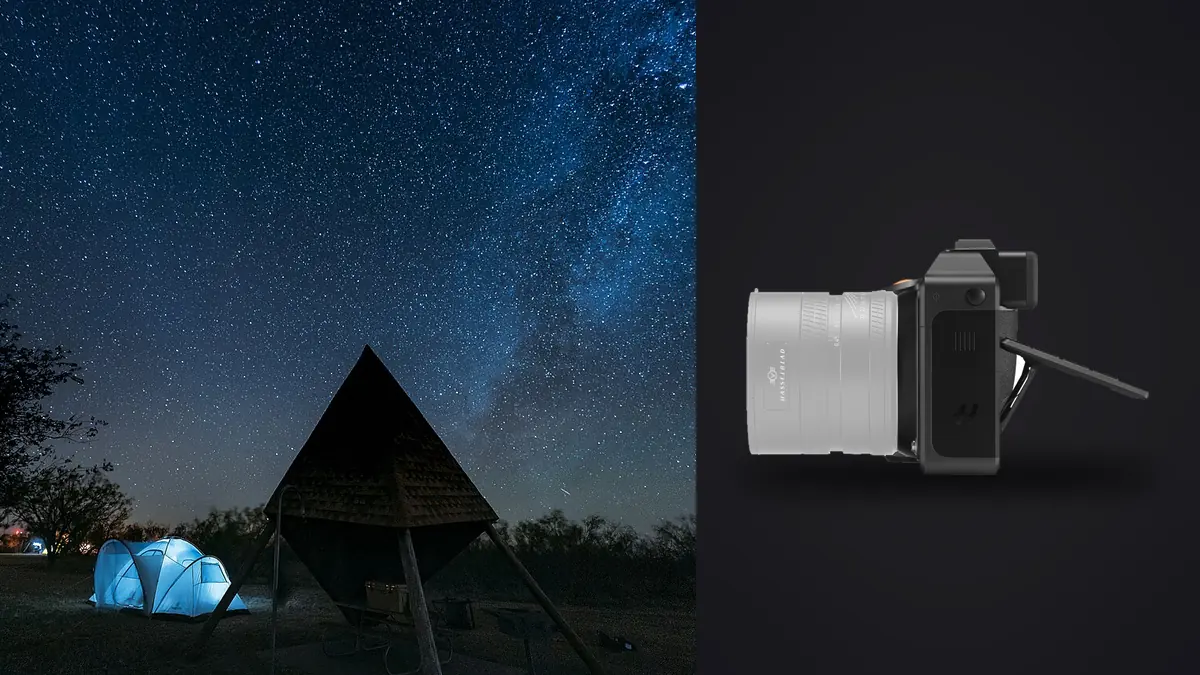
The Hasselblad X2D 100C offers a 100-megapixel medium-format sensor, in-body stabilization, phase-detection autofocus, a tilting rear display, a one-terabyte internal SSD, and CFexpress Type B expansion. Those features are appealing for detailed night landscapes, but astrophotography tests a system beyond resolution. Lens corner behavior, reliable interval capture, power, dew, tracker balance, file volume, and software compatibility determine whether the camera is a practical field choice.
The X2D is best considered for deliberate static or tracked landscape work where a large final image justifies the method. It is less obvious for lightweight hiking, rapid multi-camera time-lapse production, or a workflow built around a broad range of specialist astro lenses. This buying guide focuses on fit and limitations rather than assuming the largest file is the best night file.
Match focal length, foreground, and darkness
This Lens and Location Guide starts with the relationship between sky coverage and foreground scale. A wide lens includes more landscape and tolerates shorter untracked exposures, but corner stars and nearby foreground edges demand careful testing. A longer lens isolates constellations or deep-sky regions while increasing tracker, alignment, and framing demands. At the site, confirm a safe level support area, an unobstructed view in the intended direction, manageable artificial light, and a foreground that remains readable without trespass or damage. Test the chosen XCD lens at working apertures before travel, because maximum aperture, corner behavior, filter compatibility, and tracker balance matter more than a focal-length label alone.
Decide whether the final output uses 100 megapixels
Very large prints, fine landscape detail, and flexible crops can benefit from the sensor. A small web image often cannot. Stacking also combines several files, so the computer must decode, align, and process a large data set before the resolution reaches the final output.
Make a realistic sample stack from X2D RAW files and export at the largest normal delivery. Compare it with a lower-resolution source at that size. The question is not whether the X2D contains more pixels; it is whether the complete lens, sky, focus, tracker, and output preserve a visible advantage.
A severe crop can enlarge a constellation or foreground detail, but it also magnifies star elongation, noise, and optical corner defects. Compose with the intended sky scale in camera. Resolution is best used to preserve detail, not to replace a missing focal length.
Examine the XCD lens path before choosing the body
Astrophotography exposes coma, astigmatism, field curvature, vignetting, and decentering. A bright maximum aperture is useful only if stars remain acceptable across the frame. Test the exact XCD lens at several apertures and focus positions under a real star field.
Inspect all four corners, not only the center. If every corner stretches similarly, stopping down may improve the result. If one corner is consistently worse, check lens seating and possible alignment. A high-resolution sensor makes unequal corners easy to see.
The XCD ecosystem is more limited than some full-frame mounts, particularly for inexpensive specialist astro choices. Adapters may open manual-lens options, but the lens must cover the larger sensor image circle. Test infinity focus, corner illumination, aperture control, and mount stability before relying on an adapted combination.
Separate central-shutter benefits from night needs
XCD lenses use central shutters, which are valuable for flash synchronization and quiet operation. Neither is a primary advantage for ordinary star fields. Long night work depends more on stable exposure timing, low vibration, and reliable sequence control.
The central shutter remains a moving mechanism within the lens. Use a remote release, timer, or supported interval method and let the setup settle. Inspect a test sequence for any pattern of vibration with the exact focal length and support.
Electronic shutter may be available for particular needs, but slow sensor readout can distort moving subjects and interact with artificial lights. For stars on a stable tripod, ordinary supported shutter operation is the simpler baseline unless testing proves another mode beneficial.
Do not treat stabilization as a replacement for support
The X2D's in-body stabilization helps handheld dusk scouting and may support a quick foreground reference. It cannot hold stars stationary through a long exposure because the sky appears to move relative to the camera. A tripod or tracker remains necessary for controlled astrophotography.
Follow Hasselblad and lens guidance for stabilization on a fixed support, then verify a magnified frame. A sturdy tripod needs a head and plate that handle the medium-format body and lens without slow sag. Keep the center column low and protect the setup from wind and footfalls.
A star tracker adds another load limit. Include the body, lens, plate, dew heater, and cable pull when checking capacity. Balance around the actual center of gravity and confirm that the camera clears the mount through the planned sky path.
Use the internal SSD as capacity, not backup
One terabyte of internal storage can hold a substantial session and removes dependence on a card for every sequence. It is still inside the camera. If the body is lost, damaged, or cannot power on, the internal copy may be unavailable. Storage location and backup are different concepts.
Use the CFexpress Type B slot according to the current camera options and the planned redundancy workflow. Confirm whether files are on the SSD, card, or both before leaving a long interval. A mistaken destination discovered after dawn cannot be corrected in the field.
At ingest, copy each source into a clearly named folder and make another copy on a separate device. Keep tracked sky, static foreground, tests, and calibration files distinct. Do not erase internal storage merely because one folder appeared on the computer.
Check interval and power behavior on current firmware
Camera features can change with firmware, so verify the installed X2D version and current Hasselblad instructions for interval, long exposure, and external control. Do not build a remote night session around a menu option remembered from another camera.
Run the intended number of frames at home with the exact exposure time, delay, storage destination, and power arrangement. Confirm that long-exposure noise-reduction choices do not insert unwanted gaps and that the camera does not sleep between frames.
Cold conditions and rear-screen use affect battery endurance. Carry protected charged batteries or a supported external-power solution, and route cables so they cannot pull the tracker. A power bank hanging from the camera can ruin alignment even when it keeps the body on.
Focus manually and revisit it as temperature changes
Magnify a bright star on the rear screen, adjust until it is smallest, and approach final focus consistently. Infinity markings are approximate. Secure the focus ring carefully and avoid touching it while fitting a heater or hood.
Recheck after the lens cools, after a major temperature change, and after any contact. Inspect center and corners. A central star can remain sharp while field curvature or tilt puts corners outside the same plane.
The tilting screen makes a low tripod easier to use, but screen brightness can damage dark adaptation and make an underexposed frame look brighter than it is. Dim it responsibly, then rely on histogram and magnified stars rather than visual impression alone.
Plan stacking as a separate software stage
Record consistent RAW sky frames with manual exposure and fixed white balance. A stack can reduce random noise and reject some transient artifacts, but it cannot repair dew, lost focus, clipped stars, or a tripod movement. Inspect an early and late frame before dismantling the setup.
Tracked sky and static foreground require different movement. A tracker follows the stars, so the landscape shifts. Capture a separate untracked foreground from the same composition when needed, label the sets, and combine them only in suitable external software with credible alignment and light.
imagic does not merge star stacks, HDR brackets, or panoramas. It can help manage local still files, apply non-destructive adjustments, and export JPEG or TIFF after the component workflow has produced an image. A star field can confuse ordinary sharpness scoring, so manual inspection remains necessary.
Consider field size, weather, and travel
The X2D body is compact for medium format, but the complete kit may include a substantial lens, tripod, tracker, counterweight, power, heater, and backup storage. Weigh and pack that complete system. A camera left behind on a difficult hike has no resolution advantage.
The operating plan should include dew, wind, cold, and condensation. Place cold equipment in a closed bag before entering a warm humid space and let it equalize. Do not remove the lens while moisture is likely to form.
Visit the site in daylight, confirm legal access, and keep an offline route. The tilting display and clean interface are pleasant at night, but they do not replace safe footing, weather awareness, and a contact plan.
Use a fit matrix before committing
| Priority | X2D fit | Limitation to test |
|---|---|---|
| Large detailed night landscape prints | Strong | Lens corners and complete stacking workflow |
| Long static tripod sessions near transport | Good | Power, interval behavior, and dew |
| Lightweight backcountry kit | Conditional | Total support and tracker weight |
| Broad adapted astro-lens collection | Conditional | Image-circle coverage and infinity focus |
| Fast high-volume night sequences | Limited | Large-file processing and workflow pace |
Rent or borrow the body with the intended lens before a remote trip. Make a full sequence, ingest from both storage paths, stack it in the chosen software, and print or export at the real destination size. That end-to-end trial reveals fit more reliably than an isolated sample RAW.
Verify RAW and metadata compatibility before travel
The chosen RAW converter, stacking application, and archive tool must all understand X2D files from the installed firmware. Support can differ between applications and versions. Open representative files, apply lens corrections, export an intermediate if the stacker requires one, and confirm that bit depth and color remain appropriate throughout the chain.
Do not assume that an application which previews the file can process every camera setting correctly. Check black levels, hot-pixel handling, lens metadata, orientation, and color under a neutral conversion. A workaround that silently converts to a smaller or compressed format may discard the reason for choosing the camera.
Metadata also keeps components understandable. Record lens, tracker state, exposure sequence, foreground or sky role, and any calibration-frame method. If the stacking program strips metadata from its output, preserve a sidecar note that links the composite back to its sources.
Test storage throughput on the field laptop or desktop. One hundred-megapixel sequences can exceed available scratch space even when the archive drives are large. Leave room for previews, temporary alignment files, and the final rendered image in addition to the original RAW folder.
Repeat the compatibility check after major firmware or software updates. Preserve one known reference sequence so a changed demosaic, lens profile, or export setting can be recognized before it affects a remote night's complete take.
See the local desktop workflow for still management and Camera Hardware for additional buying context.
Frequently asked questions
Is 100 megapixels automatically better for astrophotography?
No. Lens quality, tracking, focus, sky conditions, processing, and output size determine whether the detail survives. The files also require more storage and computing work.
Can the X2D stabilization track stars?
No. Stabilization reduces camera shake; it does not follow the sky for long exposures. Use a stable tripod for short untracked frames or a properly aligned star tracker.
Is the internal SSD a backup?
It is high-capacity storage inside the camera, not an independent physical backup. Copy files to separate devices and verify them before clearing the camera or card.
Can this workflow combine X2D star frames?
No. Use dedicated stacking software for the merge. The app can manage and edit local stills before or after that external stage without uploading the photos.