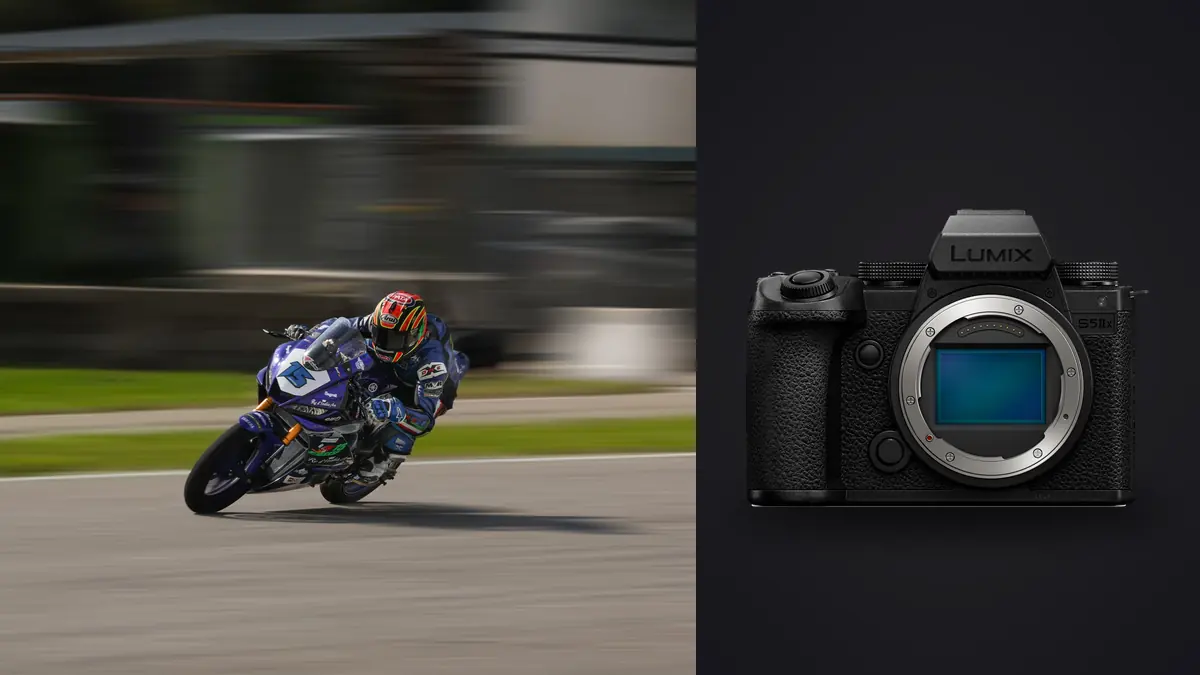
The Panasonic Lumix S5IIx was not built with a stopwatch in mind. Panasonic pitched it squarely at hybrid shooters doing video-heavy work, with the active cooling fan and ProRes output as the headline reasons to pick it over the cheaper S5II. But a fair number of working photographers already own L-mount glass, and when a school athletics meet or a regional track invitational lands on the calendar, the question isn't "should I buy a dedicated sports body," it's "can the camera I already have handle this." I've shot three full outdoor seasons of track and field with an S5IIx as my primary body, alongside an older Sony a7 III as backup, and this is what actually happened at the trackside rail, not what the spec sheet promises.
What the S5IIx actually gets right for this sport
Track and field is a strange genre to shoot because it's really six or seven different sports stitched into one meet. A 100m final asks for a fast horizontal pan and split-second timing. A pole vault clearance asks for patience and pre-focus on a fixed plane. Distance events are almost the opposite of action photography, long stretches of nothing punctuated by a pack thinning out on the final lap. No single camera nails every discipline equally, and the S5IIx doesn't either, but the phase-detect autofocus system Panasonic finally shipped on this generation (after years of contrast-based DFD autofocus that genuinely struggled with fast, erratic subjects) is the reason this body is usable at all for the sport. The older S5 and S1 series would hunt visibly on a sprinter breaking from the blocks. The S5IIx mostly doesn't.
The other thing that matters more than people expect is in-body stabilization. Track infields are often gravel, mud, or uneven grass, and you're frequently shooting handheld with a long lens because there's nowhere flat to plant a monopod between the rail and the fence. The IBIS on this body (rated around 6.5 stops with a stabilized lens) makes handholding a 100-400mm through a full relay leg genuinely comfortable in a way it wasn't on my old gear.
Autofocus at the blocks and down the straight
Human detection and eye/body tracking work reasonably well on sprinters once they're upright and moving in a fairly straight line. Where it gets shakier is the actual start: eight athletes crouched low, mostly obscured by each other and by starting blocks, and the camera occasionally locks onto the wrong lane or jumps between bodies when they're still bunched together in the first ten meters. I've had better luck switching to a single, manually placed AF area rather than trusting wide-area human detection for the gun-to-first-stride sequence, then letting tracking take over once the field has separated and my subject is isolated in the frame.
For the back half of a sprint, once the field has strung out, continuous AF tracking on a single locked subject is solid. It holds through minor occlusion (a competitor briefly crossing into frame at the finish) far better than I expected going in. Middle-distance and distance events are the easiest AF scenario the sport offers: subjects moving at a consistent, moderate speed, plenty of time for the system to lock and hold. If you've only ever tested this camera's autofocus on a distance runner and concluded it's "great for sports," you haven't tested it on the parts of the sport that are actually hard.
Shutter choice is the decision that matters most
This is the part that trips people up because it isn't obvious from a spec sheet. The S5IIx has no stacked sensor, which means the electronic shutter reads the sensor line by line rather than all at once, and that shows up as skew on fast-moving subjects, particularly when you're panning horizontally across the frame (which is exactly what you do for a sprint on the straight). Shoot a runner crossing left to right at speed on electronic shutter and you'll sometimes get a subtly slanted athlete, verticals leaning, torso stretched slightly out of true. On the mechanical shutter this problem mostly disappears, at the cost of a lower top burst rate.
My rule after a few meets of trial and error: mechanical shutter for anything with a fast horizontal or diagonal component (sprints, relay handoffs, long jump takeoff, hurdles), electronic shutter for anything rotational or largely stationary relative to the frame (shot put, discus, most of a distance race where the pack isn't sprinting). Electronic shutter is also worth switching to at quieter meets, indoor especially, where a mechanical shutter slapping away next to the blocks draws looks from athletes trying to focus.
| Event | Shutter mode | Shutter speed | AF approach | Field note |
|---|---|---|---|---|
| 100m / 200m straight | Mechanical | 1/2000 to 1/2500 | Continuous, single tracked subject | Electronic shutter skew is visible on a fast lateral pan at this speed |
| 400m / 800m backstretch | Mechanical (or electronic if distant) | 1/1600 to 1/2000 | Continuous, wide tracking zone | Subject fills less of the frame, so skew is less obvious even on electronic |
| Relay exchange zone | Mechanical | 1/2000 | Small manual AF zone | Two athletes crossing confuses subject recognition, pin the zone to the exchange point |
| Long jump / triple jump | Mechanical | 1/2500 | Continuous, pre-focus on board | Motion is fast and changes direction at takeoff, pre-focus beats tracking here |
| High jump / pole vault | Mechanical | 1/2000 to 1/3200 | Single-shot, pre-focused on the bar plane | Fixed plane of action makes manual pre-focus more reliable than AF tracking |
| Shot put / discus / hammer | Electronic (silent) | 1/1000 to 1/1600 | Continuous | Rotational motion in place, not translating fast across the frame, so skew rarely shows |
| Distance / cross country pack | Electronic (silent) | 1/1000 | Continuous, wide zone | Moderate speed and long duration make silent shooting the comfortable default |
Buffer, cards, and what actually happens during a heat
The S5IIx takes two UHS-II SD cards, no CFexpress slot. That's a meaningful difference from a body like a Sony a9 II or a Nikon Z9, and it shows up specifically in how long you can hold the shutter down before the camera slows. In the mechanical shutter mode at roughly 9fps with continuous AF, a fast UHS-II card gives you several solid seconds of full-speed RAW shooting, enough to cover a sprint finish or a jump takeoff cleanly. What it will not give you is a full 400m held down continuously in raw, the buffer will fill and the frame rate will drop before the race is over.
In practice this isn't the handicap it sounds like, because you shouldn't be holding the shutter down for a whole race anyway. I shoot in short, deliberate bursts around the moments that matter: the break from the blocks, the mid-race stride at the point I've pre-planned to shoot from, and the finish. That discipline matters more on this body than it would on a stacked-sensor sports camera because the buffer punishes spray-and-pray shooting harder. The electronic high-speed burst mode (locked to single-shot AF, not continuous) climbs a lot higher, useful for a discus release or a pole vault bar clearance where you've already pre-focused and just need peak frame density around a split-second moment.
Glass that actually gets you close enough
Access at most track meets, especially anything below a professionally credentialed championship, is limited to the outer rail and a handful of designated zones near the field event pits. That means reach matters more than most people expect walking in. The Lumix S 100-400mm has been my primary lens for anything on the track itself, sprints, hurdles, relays, distance events on the backstretch. For field events, where you can often get closer (long jump runway, throws circle from behind the safety net, high jump apron), a 70-200mm f/2.8 covers most of it and handles low light better if you're shooting an evening session under stadium lights.
Sigma and Panasonic both make L-mount options in both focal lengths now, which is the actual upside of this system for a budget-conscious sports shooter: you're not locked into first-party glass at first-party prices the way Sony and Canon shooters often are. I've mixed a Panasonic body with Sigma glass at several meets without issue.
Field events are a different problem than the track
It's tempting to treat "sports photography" as one settings recipe, and track and field is the clearest place that assumption falls apart. A sprinter is a predictable, mostly linear subject. A long jumper is not: they accelerate down a runway, plant, and then move in an arc that changes both horizontal and vertical direction in under a second. Autofocus tracking that handles a 100m dash competently will sometimes lag behind a jumper's takeoff because the direction of travel itself is changing, not just the speed. My workaround is pre-focusing manually on the board and switching to single-area AF rather than trusting the tracking box to follow the arc.
Pole vault is its own category of difficult because the athlete moves toward the camera at speed, plants, and then the interesting part of the shot (the bar clearance) happens well above and behind the point where you focused during the approach. I pre-focus on the bar itself and wait, rather than trying to track the vaulter continuously through the whole approach and clearance. It's a slower, more deliberate way to shoot than machine-gunning a burst and hoping, but it's also more reliable with this AF system than expecting it to nail a subject accelerating toward the lens and then launching vertically.
After the meet: the part nobody photographs
A single track meet with the S5IIx set to mechanical burst can leave you with four to six thousand frames by the time finals wrap up, and a large chunk of those are near-duplicates from the same burst sequence, three or four frames of the same stride with only one actually sharp. This is where the shooting side of the day ends and the much less glamorous sorting side begins, usually at 9pm in a hotel room with a laptop and a coffee that's gone cold.
I run everything through imagic before I open Lightroom at all. Its local sharpness and focus scoring catches the frames where the AF locked onto a competitor in the background lane instead of my subject, which happens more often than I'd like to admit during a crowded relay exchange, and its burst clustering groups those near-identical sprint sequences together so I'm picking one frame from a cluster of eight instead of scrubbing through all eight individually. Because it runs entirely on the laptop with no cloud upload, it works fine on the spotty stadium wifi most venues actually have, which matters more than it sounds like when you're trying to turn around a gallery for a school the same night. If you haven't compared culling tools directly, our breakdown of how AI photo culling actually works covers the mechanics in more depth than I can here.
Once the culling pass is done, imagic's apply_my_style preset (trained on my own past edits rather than a generic look) gets me a consistent starting grade across a whole meet shot under three different lighting conditions, morning heats in flat overcast, afternoon finals in harsh sun, and an evening session under stadium lights. It doesn't replace finishing work in Lightroom, but it means I'm not manually rebuilding a white balance and contrast baseline three separate times in one edit session. For anyone shooting high-volume events regularly, our notes on speeding up the post-meet workflow pair well with this part of the process.
Is this the right camera to buy specifically for track and field?
Honestly, no, not if that's the only reason you're buying. If you shoot track meets as your main business and nothing else, a body with a stacked sensor and a genuinely deep buffer (a Sony a9 II, a Nikon Z6III with its partial-stack sensor, or a Fujifilm X-H2S if you're fine with APS-C reach) will get you fewer missed frames on the fastest events and won't punish you for holding the shutter down through a whole race. Those cameras exist because sports is exactly the scenario a rolling shutter and a shallow buffer punish hardest.
Where the S5IIx makes sense is if you're already a hybrid shooter, doing portraits, weddings, or video work with L-mount glass, and track season is a few weekends a year rather than your entire calendar. The video-centric features that justify the price premium over the plain S5II (the fan, ProRes, unlimited recording) are genuinely useful if you're also cutting a highlight reel for a team or a school, shooting slow-motion B-roll of a sprint start between still bursts. As a dedicated sports body bought new for that purpose alone, I'd steer you elsewhere. As the camera you already own being asked to cover a meet well, it holds up better than its marketing suggests.
Frequently Asked Questions
Does the S5IIx's electronic shutter cause visible distortion on sprinters?
Yes, on a fast lateral pan across the straight you can get a subtle skew where verticals lean and the athlete looks slightly stretched, a classic rolling shutter artifact from the sensor's line-by-line readout. It's most visible when the subject fills a large part of the frame and is moving quickly left to right. Switching to the mechanical shutter for sprint events removes the problem at the cost of a lower maximum burst rate.
What burst rate can I actually count on for a race finish?
With continuous autofocus on the mechanical shutter you're looking at roughly 9fps, which is plenty to catch a clean finish-line frame if you time your burst to start just before the athletes hit the tape rather than holding the shutter down for the whole race. The electronic high-speed mode climbs much higher but locks focus to the first frame, so it's better suited to a moment you've already pre-focused for, like a discus release, than to a race finish where the subject's exact position is still changing.
Is the 100-400mm or the 70-200mm the better first lens for a track meet?
It depends entirely on where you're allowed to stand. If you only have rail access along the track itself, the 100-400mm earns its keep on backstretch action and distance events where you can't get physically close. If you can get near the field event pits or you're mostly shooting sprints from the finish straight, a 70-200mm f/2.8 is lighter to handhold all day and performs better once the sun goes down for an evening session.
How many frames should I expect to cull after a full day of meets?
On mechanical burst through several events, four to six thousand frames in a single day is common, and a large share of those are duplicate frames from the same short burst rather than genuinely distinct moments. That volume is exactly why a culling pass before you touch a full editor matters: sorting by focus accuracy first and grouping burst duplicates before you start rating images cuts the manual review time down substantially compared to scrubbing through every frame in sequence.