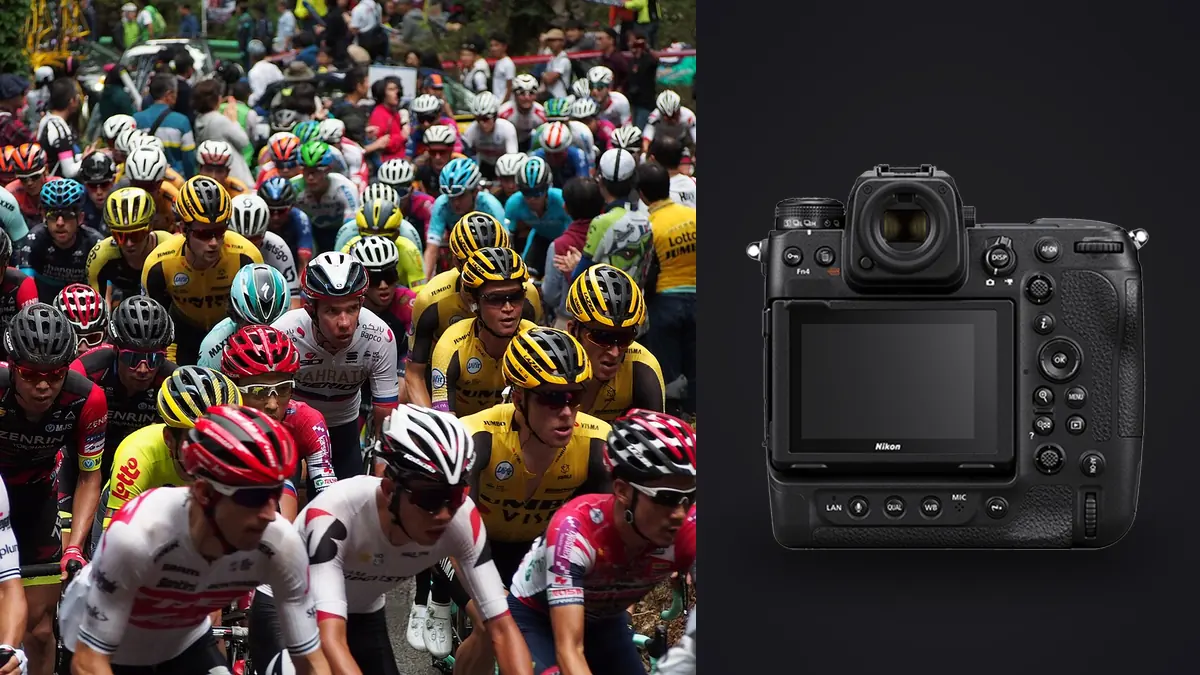
The first time I brought a Z9 to a track meet, I spent the entire 100m final doing something I never managed with my old DSLR rig: watching the runners the whole way down the straight instead of watching the viewfinder go dark between frames. That's the change this camera makes for track and field, and it's worth explaining before getting into settings, because it changes how you shoot, not just what you shoot with.
Why a stacked sensor matters more here than almost anywhere else
Track is one of the few sports where your subject is genuinely fast in a straight, predictable line, which sounds like it should make things easy. It doesn't, because the moments that separate a usable frame from a forgettable one (the exact instant a foot leaves the block, the split second a vaulter's pole unloads) last a few hundredths of a second. A camera that blacks out its viewfinder between shots, even briefly, means you're guessing at timing on the frames that matter most.
The Z9's sensor reads out the whole frame fast enough that Nikon dropped the mechanical shutter entirely. There's nothing to flap, nothing to black out the finder, and the electronic viewfinder keeps showing you a live, blackout-free feed while it's firing at full speed. For a 100m final that's over in under ten seconds, that matters more than any spec sheet number. You can actually track the runner's form through the whole sequence and know, in real time, whether you've got the lean at the line rather than finding out three hours later when you're back at a laptop.
The other quiet benefit is shutter speed ceiling and flash sync. Because there's no physical curtain, you get electronic-shutter shooting up to extremely fast speeds with none of the rolling shutter smear that plagued earlier mirrorless bodies on anything moving quickly across the frame, like a sprinter passing close to a low, wide lens. I've shot lane 1 with a 70-200 from field level on this body and gotten straight verticals with no banana-shaped distortion on the runner's legs, which was a real problem on cameras I used even three or four years ago.
Frame rate: the modes you'll actually reach for
The Z9 offers a stack of continuous shooting options and it's tempting to just leave it on the fastest one and let the camera sort it out. Don't. At a meet you're often shooting for six or seven hours across dozens of events, and frame rate choice is really a decision about how much culling you're setting yourself up for later.
For most track events I stay in the 20fps full-resolution RAW mode. It's fast enough to catch a foot strike or an arm swing at its peak without needing to fish through a hundred frames afterward, and you keep the full 45.7-megapixel file for crops, which matters when you're printing a hero shot of a distance runner you had to shoot wide because you couldn't get closer to the track.
The 30fps and 120fps high-speed capture modes exist and they're genuinely useful, but they shoot a cropped 11-megapixel JPEG, and I only reach for them in two specific situations: the pole vault clearance over the bar, where the exact peak of the arch happens in a blink and you'd rather have thirty extra frames of insurance, and relay baton exchanges, where the handoff zone is chaos and you want the option to pick the precise frame where both hands are on the baton without a gap. Everywhere else, full-resolution RAW at 20fps is the better trade.
One more thing worth knowing: pre-release capture buffering, which starts saving frames from just before you fully press the shutter, is a genuine advantage for the gun. Reaction time to a starter's pistol is not something any photographer beats reliably, and having the camera already buffering frames the moment you half-press means you don't need to.
Settings by event, because "sports mode" isn't specific enough
Track and field isn't one sport, it's a dozen different motion problems happening on the same infield, and treating a shot put throw like a sprint start will cost you frames. Here's roughly where I land for each, adjusted from a few seasons of shooting age-group and collegiate meets.
| Event | Shutter speed I start at | AF area mode | Frame rate | Why |
|---|---|---|---|---|
| 100m / 200m blocks and drive phase | 1/3200s | 3D-tracking, point placed on lead athlete | 20fps RAW | Leg speed out of the blocks is the fastest limb motion on the whole track; anything slower and you get motion smear on the trail leg. |
| 400m / 800m | 1/2000s | Auto-area AF with People detection | 20fps RAW | Slightly less limb speed than a sprint, and you often want the camera to re-acquire runners as the pack strings out around the bend. |
| Long jump / triple jump | 1/3200s | Wide-area AF (L), tracked from the runway | 20fps RAW | You need the takeoff frame with sand still airborne behind the heel; a stop that's too slow blurs the exact moment of extension. |
| Pole vault | 1/2500s | 3D-tracking, re-acquired at the box | 30fps (bar clearance only) | The pole's flex-and-release happens over roughly a third of a second; you want density of frames right at the top of the arc. |
| High jump | 1/3200s | Wide-area AF (L) | 20fps RAW | Athlete's back arches over the bar at an angle that changes fast; a fixed focus point drifts off them if you don't track. |
| Shot put / discus / javelin | 1/2000s | 3D-tracking from the circle | 20fps RAW | Release is explosive but the windup is slow, so you have time to lock focus early and just hold the shutter through release. |
| Relay exchange zone | 1/2500s | Auto-area AF, People detection | 30fps | Two athletes, two focus subjects, a baton passing between them in under half a second. Extra frames are cheap insurance here. |
None of these are rules carved in stone, they're starting points I adjust once I see the light at a given stadium. An indoor meet under mixed sodium and LED lighting will push me to widen the aperture and drop shutter speed slightly rather than let ISO climb past what I'm comfortable cleaning up later.
Autofocus: where most people leave performance on the table
The subject detection modes get most of the marketing attention, and for good reason, but they behave differently depending on how crowded the frame is. For a clean lane 8 sprinter with nobody else nearby, Auto-area AF with People detection is close to magic. It finds the runner, locks onto the torso, and holds through the whole straight without you doing anything beyond framing.
Where it gets less reliable is a crowded 800m field coming off the bend three-wide, or a long jump runway with officials and coaches standing near the sand pit. I've had Auto-area AF grab a coach's jacket instead of the athlete in exactly that kind of clutter. For anything with more than one person near the frame, I switch to 3D-tracking and place the initial focus point on the athlete myself before the action starts. It costs a half-second of setup but it means the camera stays locked on who I actually pointed it at, not whoever's closest or brightest.
Custom setting a3 (AF-C priority selection) is worth checking too. I run it on release priority rather than focus priority for sprints, because I'd rather get a marginally soft frame at the exact right instant than a tack-sharp frame a beat too late. For field events where the moment builds more slowly, like the wind-up before a shot put release, I'll flip to a more focus-biased setting since there's time for the camera to nail it before the moment that matters.
Glass that actually makes sense in a stadium
A 400mm f/2.8 with a teleconverter is the dream lens for track, and if you've got one, use it. But most of us aren't hauling that into a high school meet, and honestly a 100-400mm covers the vast majority of track situations from a normal photographer's position along the rail. It gets you tight on the finish line from a reasonable distance and pulls back for field events without a lens swap mid-meet. The 70-200mm f/2.8 earns its keep for anything close, like the start line if you've got infield access, or the long jump pit if you're allowed near the sand. I keep it on a second body rather than swapping lenses constantly, because the one thing you can't get back at a track meet is the heat that happened while you were unmounting glass.
A monopod is worth the hassle for anything past 300mm held for hours. Handheld 400mm work is doable with the Z9's in-body stabilization for short bursts, but by hour four of a meet your arms will disagree, and a shaky base undoes a lot of the sensor's speed advantage anyway.
The part nobody warns you about: what happens after the gun
Here's the trade-off that a lot of gear reviews skip. A body that shoots 20fps blackout-free for six hours across fifteen events produces an absurd number of frames. A single 100m final at 20fps can leave you with well over a hundred images of a race that lasted ten seconds, and multiply that across a full day of heats, semis, and finals and you're staring down thousands of nearly identical frames of the same stride repeated a dozen times. That's not a camera problem, it's a workflow problem, and it's the part that actually determines whether you enjoy shooting meets or dread the days after them. I run everything through imagic once I'm home, mainly because it does its sharpness and focus scoring locally on the machine rather than uploading a card's worth of RAW files somewhere first, which matters when you've got two hundred gigabytes of a single meet to sort through before dinner. The burst clustering is the feature that actually saves time here. Instead of scrolling through forty near-identical frames of a vaulter's clearance one at a time, it groups that whole burst together and surfaces the sharpest one or two, so you're making a real editorial choice instead of a squinting comparison between frame 214 and frame 215. For anyone who's tried to do this by eye at 1am after a meet, the difference is not subtle.
The other piece that's changed how I edit is the apply_my_style preset, which builds itself from edits you've already made rather than a canned look. Track photos have a particular color problem, stadium lighting is inconsistent, tracks are usually a saturated red or blue that fights with skin tones, and getting a consistent look across a hundred selects used to mean either a lot of manual tweaking or accepting inconsistency. Training a preset on how I actually edit sprint shots means new imports land closer to finished without starting from a generic default. If you're building out a repeatable process rather than a one-off edit, it's worth reading through how AI photo culling actually works to understand what's happening under the hood before you trust it with a meet's worth of images.
If you're shooting meets regularly and haven't tightened up the back half of your workflow yet, it's genuinely worth more time investment than another lens. A faster culling and editing routine pays off every single weekend, not just once.
Frequently Asked Questions
Do I need a 400mm f/2.8 to shoot track, or will a 100-400mm cover it?
For most rail positions at a typical meet, a 100-400mm is genuinely enough. The extra two stops of the f/2.8 prime matter most in dim indoor arenas or when you need to isolate a subject from a busy infield background, but plenty of usable, sellable track images get made every weekend on zooms in that range. Save the prime purchase for when you know exactly which stadiums and which light you're dealing with regularly.
Is 20fps overkill for something like the 400m or 800m?
It's more than you strictly need for the bulk of the race, but events with a bend and a pack that strings out benefit from the extra density right at the moments athletes pass each other or make a move, which happen unpredictably. I'd rather cull down from 20fps than realize afterward I dropped to 10fps and missed the pass that actually decided the race.
Should I shoot electronic shutter for everything, or keep switching back?
For track specifically, electronic shutter full time is fine. The rolling shutter risk that made older electronic shutters risky for fast lateral motion is largely a non-issue on the Z9's readout speed, and you gain silent operation, which matters more than people expect once you're shooting near a starting official who needs to hear the gun clearly.
How do I stop three days of meet photos from turning into a week of sorting?
Cull immediately and cull hard before you touch a single edit. Group your bursts first, pick your one or two selects per moment, and only then start color and exposure work. Trying to edit before you've cut the volume down is the single biggest time sink I see other meet photographers fall into, and it's the whole reason a local culling pass is worth building into your process rather than treating it as an afterthought.