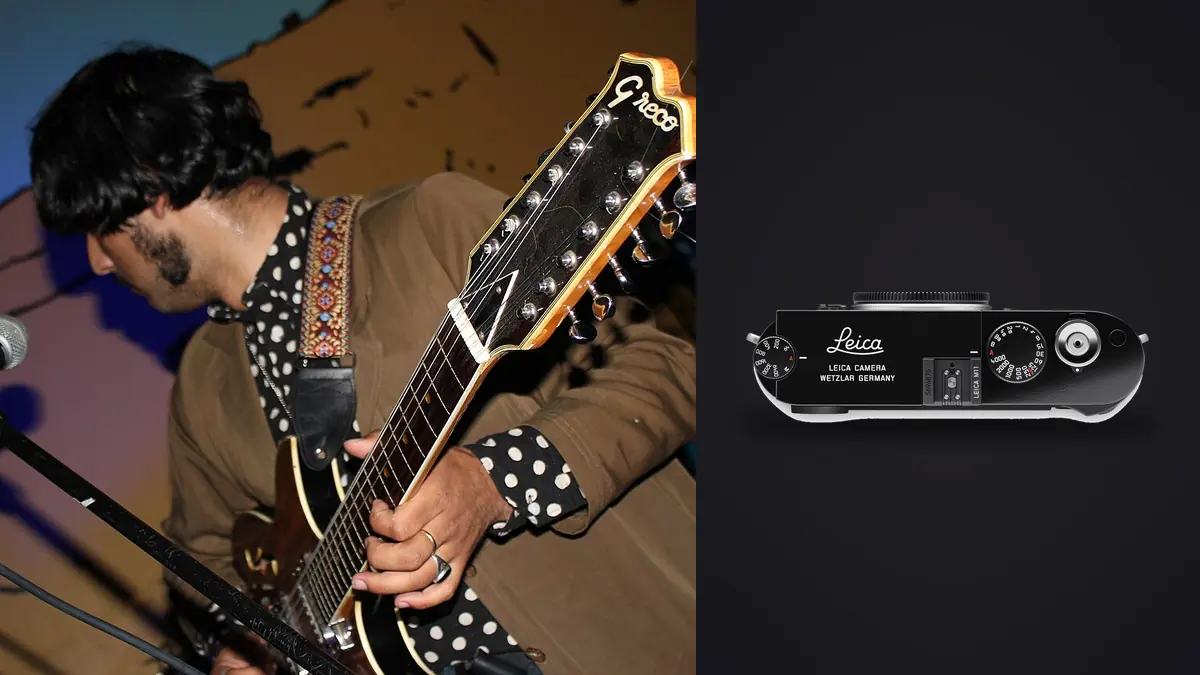
Every few months someone shows up to a photo pit with a Leica M11 slung on a wrist strap, no autofocus, no zoom, no motor drive, and the rest of the photographers with 70-200mm f/2.8 zooms and eye-tracking bodies give it a look somewhere between curiosity and pity. Then the M11 shooter nails the frame anyway, because they've been zone focusing punk shows since before eye-AF existed. This is not a camera that makes concert photography easier. It makes it different, and for a specific kind of photographer, different is the point.
I want to walk through what actually happens when you bring an M11 into a venue: the focusing reality, where the silent shutter genuinely earns its keep, which lenses make sense for pit work versus back-of-house shots, and where the files fall apart if you push them too hard. None of this is theoretical spec-sheet talk. It's the stuff that decides whether you come home with a card full of usable frames or a card full of soft ones you'll delete on the drive home.
Why bring a rangefinder to a gig at all
The honest answer is discretion and feel, not speed. The M11 body is small enough to disappear under a jacket between sets, it has no mirror slap, no autofocus motor whirring, and depending on how you set the shutter, no audible click at all. If you've ever shot a hushed acoustic set or a seated jazz trio where every camera click reads like a gunshot in a quiet room, you already understand the appeal. This is not a camera anyone buys to chase a drummer's stick twirl at 20 frames per second. It's a camera for photographers who want to be in the room without the room noticing them.
There's also a workflow argument that gets ignored in most gear reviews: shooting manual focus and manual exposure all night forces you to actually watch the light. Stage lighting at most small and mid-size venues swings wildly, warm tungsten wash on one song, a cold blue wash the next, then a strobe hit that blows out anything on auto. Photographers who cut their teeth on rangefinders tend to read that light faster than photographers who've leaned on matrix metering and AF-C their whole career, because the M11 simply won't do that work for you.
The manual focus problem, and how you actually solve it
Let's not pretend this isn't the elephant in the room. The M11 has zero autofocus. None. You focus by aligning the rangefinder patch, or by eye through the optional Visoflex EVF with focus peaking and magnification turned on. Doing that on a singer who's pacing the stage, backlit, moving toward and away from you in a two-second window, is genuinely hard. It gets harder the wider open your aperture is, because at f/1.4 or f/0.95 your depth of field at eight feet is measured in inches.
The trick that actually works is zone focusing combined with knowing your stage. Before the first band even plugs in, walk the pit, pick two or three spots you'll shoot from, and pre-focus your lens to the distance from each spot to the front of the stage. Stop down to f/2.8 or f/4 if the venue lighting allows it, because the extra depth of field buys you forgiveness on a singer who leans six inches closer than you expected. When a performer holds still, even for a second (a guitar solo, a held note, a pause between songs), that's when you switch to rangefinder-critical focus and shoot wide open for the shallow, cinematic look the fast Leica glass is known for.
If the venue allows the Visoflex EVF, use it for anything under really dim stage light. The optical rangefinder patch gets harder to read as ambient light drops and contrast disappears, and the EVF's focus peaking will catch edges the rangefinder patch can miss in a near-black room lit only by a single follow spot.
The silent shutter is the real reason to own one
Set the M11 to its electronic shutter and it makes no sound whatsoever. Not "quiet," not "muted," actually silent. For festival photo pits with a barrier between you and the stage this barely matters, the PA system drowns out any shutter noise anyway. But for small clubs, seated theaters, weddings with a live string quartet, or spoken-word and stripped-down acoustic sets, this changes what you can shoot without becoming part of the show. I've had venue managers specifically ask for a silent body for ceremony-adjacent performances where a mechanical clack during a quiet passage would be genuinely disruptive.
Two caveats worth knowing before you rely on it. First, the electronic shutter can produce banding or partial-frame artifacts under certain LED stage lighting that flickers faster than the sensor's readout can handle cleanly, so test it at the actual venue if you can, rather than assuming it behaves the same everywhere. Second, silent doesn't mean invisible: you're still holding a camera up to your eye, which reads as "taking a photo" to anyone watching regardless of what sound it makes.
Lens choices for the pit and beyond
M-mount glass is where the M11 either becomes a phenomenal concert tool or a frustrating one, depending on what you bring. There's no zoom option in any practical sense (Leica makes a couple of M-mount zooms, but nobody is racking manual zoom rings mid-song), so you're choosing primes and living with the focal length you picked before doors opened.
| Lens | Best for | Focus difficulty at wide open |
|---|---|---|
| 35mm Summilux f/1.4 | General admission floor, wide environmental shots, crowd context | Moderate, forgiving depth of field even close |
| 50mm Summicron f/2 or Summilux f/1.4 | Standard pit distance, portraits of the frontperson | Moderate to hard on a moving subject |
| 50mm Noctilux f/0.95 | Near-dark venues, dramatic shallow-DOF shots when the performer holds still | Hard, razor-thin plane of focus at close range |
| 75mm or 90mm Summicron/APO | No-pit-access shows, shooting from the crowd or a balcony | Hard, focus throw and DOF both work against you |
My honest recommendation for a first concert kit is a 35mm and a 50mm, nothing longer. The 35 covers the wide, atmospheric shots and gives you enough depth of field to survive a missed focus pull. The 50 is your workhorse for portraits and mid-distance frames. Save the Noctilux for nights when you have time to actually work the frame, a seated show, an intimate release party, somewhere the performer isn't sprinting across the stage.
ISO, the triple-resolution sensor, and where the noise shows up
The M11's 60-megapixel BSI sensor has a real trick that matters specifically for gig work: you can shoot DNG files at 60, 36, or 18 megapixels, chosen in-camera before you shoot, and the 18-megapixel mode isn't just a crop or a software downsize, it changes how the sensor reads out and produces noticeably cleaner files at high ISO. If you know you're walking into a dim basement venue lit by two par cans, dropping to the 18MP DNG mode before the first band even starts is worth doing. You're not printing these as 40-inch gallery prints; you're posting them and maybe running a magazine spread, and clean files beat resolution every time light gets scarce.
Native ISO runs from 64 up to 50000, but "goes to 50000" and "looks good at 50000" are different claims. In practice I stay under about ISO 12500 for anything I plan to deliver, and I treat 25000 and above as an emergency setting for a frame I'd rather have grainy than not have at all. There's no in-body stabilization on the M11, so at the shutter speeds you're forced into under stage lighting (often 1/125 or slower to keep ISO manageable), a steady hand and a lens with a bit of heft to dampen shake matter more than they would on a stabilized mirrorless body.
What a night of shooting actually looks like afterward
Here's the part nobody mentions in the spec-sheet reviews: manual focus at wide apertures means you miss more frames than you would with a modern AF tracking system, and the instinctive response most M11 shooters develop is to bracket focus by hand, firing two or three frames while nudging the focus ring a hair between each one, hoping one lands. That's a smart habit for keeping the shot, but it means your card fills up with clusters of nearly identical frames where only one or two are actually sharp.
That's exactly the kind of mess I built imagic to sort through. It scores focus and sharpness locally on the machine, no upload, nothing leaving your laptop, so a folder of 800 DNGs from a three-band bill gets ranked by what's actually in focus rather than you squinting at 800 thumbnails at 1am. The burst and near-duplicate clustering groups those focus-bracketed clusters together automatically, so instead of comparing five nearly-identical frames one at a time, you're looking at one group and picking the sharpest with a single click.
The other place it earns its spot in an M11 workflow is the look. Concert photographers tend to land on a consistent edit for a given venue's lighting (warm and filmic for a tungsten-lit dive bar, cooler and more contrasty for an LED-heavy festival stage), and imagic's apply_my_style feature trains on your own past edits rather than a canned filter, so once you've built that look on one gig, applying it across the next batch from the same venue takes a fraction of the time hand-editing would. If you want the mechanics of how that ranking and grouping actually works under the hood, this breakdown of AI photo culling covers it in more detail.
Is it actually worth it over a mirrorless AF body
I'll be straight with you: if your job depends on turning around a full gallery from a three-band bill by midnight, or you're shooting a festival where you need every crowd-surf and stage-dive frame in sharp focus at 15 frames per second, the M11 will frustrate you. It's genuinely slower to work with, the keeper rate on fast-moving subjects is lower than a modern AF mirrorless body, and there's no version of "just trust the camera" available to you.
But if your concert work leans documentary or editorial, if you value a small, quiet, unobtrusive presence over raw hit rate, and if you actually enjoy the process of reading a stage and pre-planning your focus rather than letting a tracking algorithm chase it for you, the M11 rewards that patience with a rendering character (particularly from the faster Leica glass) that AF zoom lenses at f/2.8 simply don't produce. It's a considered-shot tool in a genre that usually rewards volume, which is exactly why it's a minority choice, and exactly why the photographers who do use it tend to be opinionated about it.
Frequently Asked Questions
Can the Leica M11 autofocus at all for live music work?
No, the M11 has no autofocus system of any kind. Focus is done through the rangefinder patch or, with the optional Visoflex EVF attached, through focus peaking and magnified live view. Zone focusing at a stopped-down aperture is the standard workaround for fast-moving performers.
Is the M11's silent shutter reliable under stage lighting?
The electronic silent shutter is genuinely inaudible, which is its main draw for quiet venues, but some LED stage rigs can introduce banding or rolling-shutter artifacts because of how the sensor reads out compared to a mechanical shutter. Test it at the venue before relying on it for a paid gig.
Which M-mount lens is best for a general admission photo pit?
A 35mm f/1.4 for wide environmental shots and a 50mm for standard portrait distance cover most pit situations. Longer lenses like a 75mm or 90mm make more sense when you don't have pit access and are shooting from the crowd or a balcony.
How high can you push ISO before concert photos become unusable?
Native ISO goes to 50000, but usable image quality for delivery work generally holds up to around ISO 12500. Shooting in the camera's 18-megapixel DNG mode instead of the full 60-megapixel mode produces noticeably cleaner files when the venue lighting is especially dim.