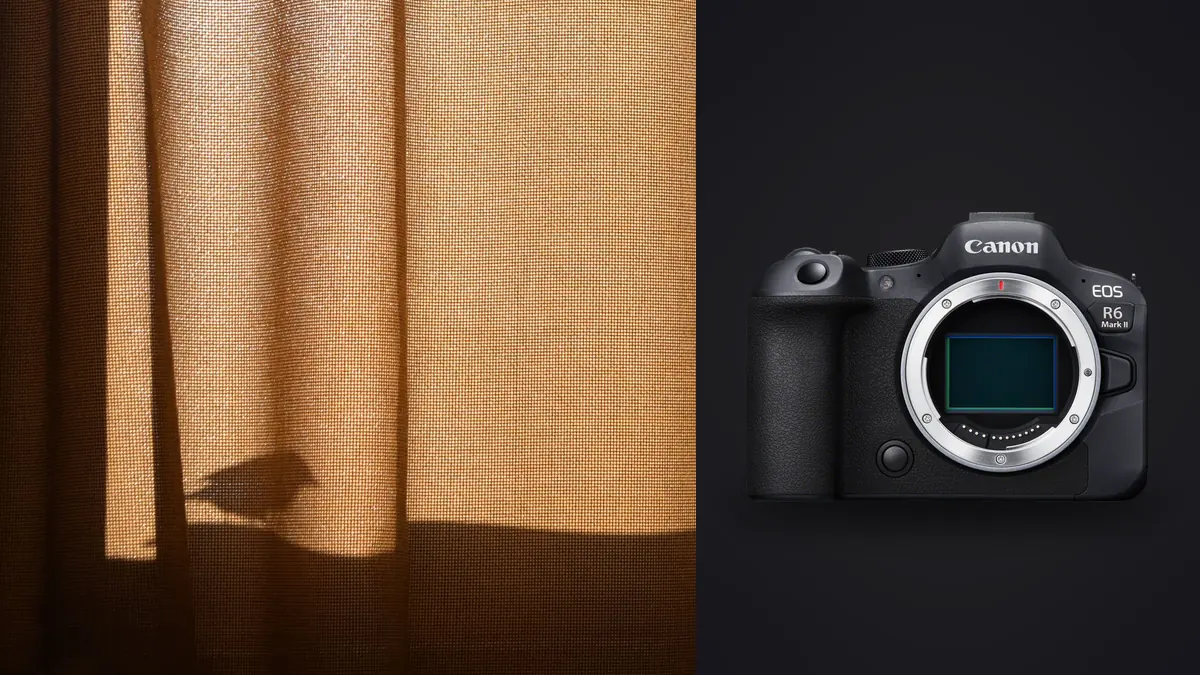
I picked up the EOS R6 Mark II specifically to replace an aging 5D-series body for boudoir and intimate portrait work, and something like ninety sessions later I still reach for it first. Boudoir is a strange thing to shoot technically. You're usually in a bedroom or a hotel room with mixed, low-level light, the client is nervous and clocking your every move, and you need the autofocus to nail an eye at f1.4 while you're half-crouched by a window with the camera off to one side. Most full-frame bodies can technically manage this. Very few make the session feel calm while doing it. The R6 Mark II gets that balance right in a handful of specific ways that matter more in this genre than they do shooting weddings or landscapes, and it comes up short in a couple of ways worth knowing before you build a kit around it.
The autofocus and sensor combination that actually matters here
Boudoir portraits live and die on shallow depth of field. You're rarely shooting at f5.6. Most of my keepers land somewhere between f1.4 and f2.2, which means the plane of focus is a couple of centimetres deep and the eye AF has to be right, not close. The Dual Pixel CMOS AF II system in the R6 Mark II tracks a face and locks to the near eye even when the subject is reclined, turned away from the lens, or partially obscured by a sheet or a shoulder, which happens constantly in this kind of work. On my old 5D Mark IV I was manually nudging a single AF point half the time. Here I frame, half-press, and trust it. That trust is worth more than any spec sheet number, because it means I spend my attention on posing and light instead of chasing focus.
The sensor itself is the other half of the story. Skin tone rendering out of camera is genuinely good, warmer and more forgiving than what comparable Sony bodies tend to give, and that matters when half your frame is skin under warm tungsten or window light. High ISO is clean enough to shoot handheld in a dim bedroom without a flash: I'm comfortable up to about ISO 6400 for finished images, and I'll push to 12800 for a moody, grainy look I sometimes want anyway. Dynamic range at base ISO gives enough room to hold detail in white bedding and pull back shadow under a jawline without banding, which saves a lot of time later since boudoir edits lean heavily on dodge and burn.
Why the silent shutter and IBIS change the feel of a session
This is the part that doesn't show up in a spec comparison but matters enormously in this genre. A loud mechanical shutter clack in a quiet bedroom, right after you've asked a nervous first-time client to relax, works against you. Switching to the fully electronic shutter mode drops the shutter sound to nothing. Sitters can forget the camera is even firing, which is exactly the state you want them in. I use the mechanical shutter only when I need flash sync above 1/200, otherwise I default to silent for the whole session.
In-body stabilization is the second piece. Boudoir sessions rarely leave room for a tripod, you're moving around a bed, working from a doorway, shooting low from the floor looking up. Handheld shutter speeds down around 1/15 to 1/30 with the RF 50mm f1.2 are usable more often than they have any right to be, which lets me keep ISO down in dim rooms instead of dragging in extra lighting that changes the mood of the shoot. The fully articulating touchscreen pulls its weight here too. A huge share of flattering boudoir angles come from shooting slightly above or well below eye level, and being able to flip the screen out and shoot from the hip or from a low crouch without contorting to see through the viewfinder speeds up a session that already has a limited window before a client's confidence starts to fade.
Building a lens kit that doesn't get in the way
I've settled on a small rotation of RF lenses for this work rather than carrying everything. What actually gets used changes room to room, so here's how I think about the four I keep coming back to.
| Lens | Max aperture | What it's actually good for in a session | Approx. street price |
|---|---|---|---|
| RF 50mm F1.2L USM | f1.2 | Tight bedrooms, three-quarter and full-length framing with very soft background separation | $2,299 |
| RF 85mm F1.2L USM | f1.2 | Close, intimate framing shot from across the room, keeps distance so the client doesn't feel crowded | $2,699 |
| RF 35mm F1.8 Macro IS STM | f1.8 | Detail shots (jewelry, lace, hands, fabric texture) and wider environmental frames in cramped rooms | $549 |
| RF 24-70mm F2.8L IS USM | f2.8 | The one-lens option when you need to reframe fast without swapping glass mid-session | $2,299 |
If I had to keep exactly one, it's the 50mm f1.2. It's heavy on the wrist after two hours and the focus breathing at close range takes getting used to, but the rendering is the closest thing to a signature look I have, and the working distance suits small bedrooms better than the 85mm does. The 35mm macro earns its place purely for detail shots, a garter clasp or a hand resting on fabric shot at f1.8 does more for a boudoir album than another full-body frame usually will.
The settings I actually dial in, scenario by scenario
Bedroom with one north-facing window, no strobe: f1.8 to f2.2, ISO 800 to 3200 depending on time of day, shutter around 1/125, auto white balance and correct in post rather than fight a preset in camera. Eye detect AF, single point expand, servo mode even for stills since posing shifts constantly.
Hotel room with only lamp light after sunset: f1.4, ISO 4000 to 8000, shutter down to 1/60 leaning on IBIS, and I'll set a custom white balance off a grey card once rather than trust auto in mixed tungsten and LED sources, since hotel rooms often mix bulb temperatures across two or three fixtures.
Single softbox at 45 degrees, studio or home setup: mechanical shutter for flash sync, f2.8 to f4 if I want more of the room in focus, ISO 100 to 400, shutter locked at 1/200. This is the only scenario where I'm not shooting nearly wide open, because the modifier is doing the mood work instead of the aperture.
What nobody mentions: what a session does to your edit queue
A two-hour boudoir session with two or three outfit and location changes can produce 800 to 1,400 frames, and a large chunk of those are near-duplicates: five or six versions of the same pose as an expression settles, three attempts at a hand placement before it looks natural. Sorting through that volume by eye, at 100% zoom, checking which frame actually has the sharpest eye, is the single most time-consuming part of the process, more than the shoot itself. I moved my culling into imagic mostly because of that duplicate problem. It clusters near-identical burst frames and flags the sharpest one by actual focus data rather than by file order, which on a folder full of five-frame pose variations saves a genuinely large chunk of an evening. If you haven't looked into how that kind of automated first pass works, this piece on how AI photo culling works covers the mechanics better than I can here.
The other reason imagic fits this specific genre is privacy. These are files a client has trusted you with and does not want sitting in a cloud processing queue on someone else's server. Everything runs locally on the machine, nothing gets uploaded to score sharpness or find duplicates, which is one less thing to explain in a client contract. I've also started using the apply_my_style preset feature to carry a consistent skin-tone and shadow treatment across a whole shoot once I've hand-edited a handful of hero frames, rather than reapplying the same six sliders four hundred times. It's trained on my own edits, not a generic filter pack, so it holds up across the mixed lighting a single session usually throws at me. For anyone whose backlog is the actual bottleneck rather than the shooting itself, these workflow notes are worth a read alongside whatever culling tool you land on.
Where the R6 Mark II actually struggles
It isn't perfect for this. Under LED lamps that flicker at certain frequencies, the fully silent electronic shutter can introduce faint banding you won't see on the LCD but will catch in a raw file at 100%, so I keep an eye out in hotel rooms with unfamiliar bulbs and switch to mechanical if I spot it. The buffer also fills faster than you'd expect if you're shooting 40fps electronic bursts to catch a natural laugh or a hair flip, on anything slower than a UHS-II card you'll feel the camera pause to write. And after two hours of handheld overhead and low-angle shooting with the 85mm f1.2 attached, the grip starts to feel small for how front-heavy the combination is. None of these are dealbreakers, but they're the kind of thing you only learn by shooting a real session, not by reading a spec sheet.
Frequently Asked Questions
Is the R6 Mark II fast enough for handheld low-light boudoir without flash?
Yes, within reason. Between the IBIS and clean high ISO output, I regularly shoot ambient-only sessions in dim bedrooms at 1/30 to 1/60 and ISO 4000 to 6400 and get sharp, usable files. Where it struggles is very dark rooms with a moving subject, in that case I'll bring in one small continuous light rather than push ISO past 12800.
Which RF lens should I buy first if I can only afford one?
The RF 50mm F1.2L USM, for most people shooting in typical bedroom-sized spaces. It handles full-length and close framing without needing to back into a wall, and the rendering at f1.2 does more of the creative work than any other single lens in this lineup. The 85mm is the better second lens once you have room to work with distance.
Does the silent shutter genuinely change how clients behave during a shoot?
In my experience, yes, though it's subtle. It's less that clients consciously notice the sound and more that removing one more mechanical cue of "you're being photographed right now" lets them settle into a pose instead of tensing at every click. It's not a magic fix for a nervous client, good direction still does most of that work, but it removes one small friction point.
How many images does a typical session produce and how do you deal with the edit backlog?
Between 800 and 1,400 raw files for a two to three hour session with outfit changes is normal for me. I run everything through an automated culling pass first to strip duplicates and soft-focus frames before I ever open a full editor, which usually cuts that number down to 150 to 250 real candidates before I start choosing final selects by eye.