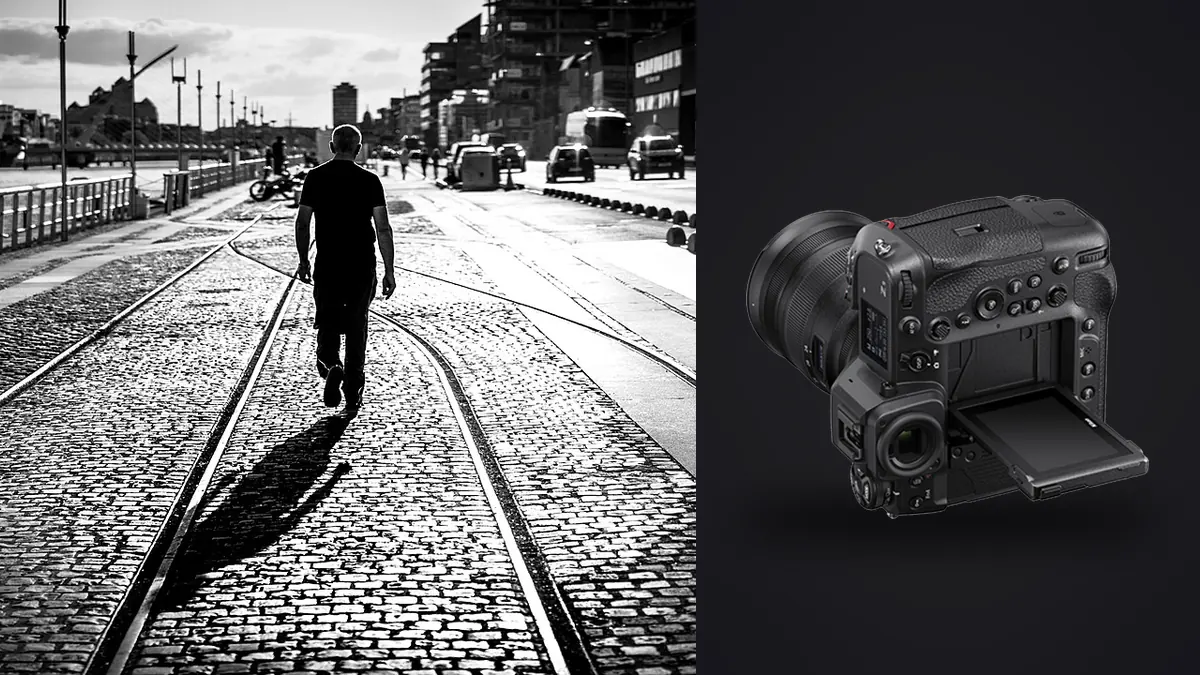
I spent six months shooting a documentary project inside a wholesale fish market that opens at 3:30am, and for most of that project my only camera was a Nikon Z9. That's an odd choice on paper. The Z9 was built and marketed as a sports and wildlife flagship, a camera for people who need 45.7 megapixels and 20 frames per second to track a goalkeeper diving across a box. It was not designed with a documentary photographer squeezing between fish crates in mind. But somewhere in the last two years it quietly became a common sight on the street and documentary beat too, and after a year of carrying one I understand why, along with why plenty of photographers I know still won't touch it for this kind of work.
A flagship body that ended up in an unlikely genre
The case for the Z9 in documentary work has nothing to do with its resolution and almost everything to do with two things: the fact that it has no mechanical shutter at all, and the fact that its autofocus rarely lets go of a moving, unpredictable human subject once it's found one. Those two traits matter more in a crowded market or a protest march or a school hallway than raw pixel count ever will. The market vendors I photographed for months stopped noticing the camera within about two weeks, not because it's small (it isn't) but because it doesn't make a sound when I fire it.
The weight tax you pay every single day
Let's not pretend the size is a non-issue, because it isn't. Body only, the Z9 is about 1,340 grams. Pair that with something like the 35mm f/1.8 S (roughly 415g) and you're carrying close to 1.8kg on a strap for a ten-hour shooting day, before you add a second lens, batteries, or a notebook. My shoulder knew about this project long after it ended. Photographers coming from a Fujifilm X100-series body or a Leica Q2 are used to something in the 480-720 gram range that disappears into a jacket. The Z9 does not disappear into anything. It announces itself the moment you lift it, which cuts both ways: some documentary subjects relax faster around a big, obviously "professional" camera because it reads as legitimate work rather than a phone held sideways, while others clam up specifically because it looks like press credentials walked into the room. Know your subject before you know your gear.
Why the electronic-only shutter is the actual headline feature
Nikon deleted the mechanical shutter from the Z9 entirely, which was a genuinely bold move for a first-generation flagship. Every exposure is read electronically off the stacked sensor, the viewfinder never blacks out between frames, and there is zero shutter noise unless you deliberately switch on the optional simulated shutter sound in the menu. I leave that sound off for almost everything, but I'll turn a quiet version of it back on for slower, more posed documentary sittings, like sitting down with a market elder for a portrait, because a few subjects genuinely want the audible confirmation that a frame was taken. Left off, you can shoot a burst of fifteen frames a foot away from someone mid-conversation and they simply won't clock it.
The tradeoff is rolling shutter. A fully electronic sensor reads line by line rather than all at once, so anything spinning or panning fast (bicycle wheels, a hand waving quickly across the frame, a flag snapping in wind) can skew or wobble slightly. On a 45.7MP sensor read at this speed it's much better controlled than on older mirrorless bodies, but it's not zero, and I've thrown away a handful of frames from a cycling messenger sequence where the wheel spokes bent in a way no amount of editing fixes. Indoors under certain LED or fluorescent lighting you'll also want the flicker-reduction shooting option turned on, or you'll get banding across frames shot at fast shutter speeds that you won't notice until you're looking at the files on a real monitor.
Autofocus for chaos, with real limits
The subject-detection system (people, eyes, and a few animal and vehicle modes) is the reason I trust the Z9 in situations I wouldn't trust an older body in: a fight breaking out, a kid running through a crowd, a fast handoff between two people. Nine times out of ten it locks onto the right face and stays there through partial occlusion. The tenth time, in a genuinely dense crowd with faces stacked three deep, it will occasionally jump to a closer or higher-contrast face in the background mid-burst, and you won't catch it until you're reviewing. For the densest scenes in the fish market I ended up switching out of full auto-area tracking and into a smaller zone AF with the joystick, recomposing manually rather than trusting the camera to pick my subject for me. It's a small workflow change but it fixed most of my missed-focus frustration.
| Camera | Body weight (approx.) | Shutter | Max silent continuous | Subject tracking on the move | RAW buffer depth |
|---|---|---|---|---|---|
| Nikon Z9 | 1,340g (body only) | Fully electronic, no mechanical option | 20fps full-res RAW | 3D subject/eye tracking, holds through partial occlusion | ~1,000+ frames, card-limited |
| Sony A9 II | 678g (body only) | Electronic silent mode available | 20fps blackout-free | Very strong real-time tracking | ~239 compressed RAW frames |
| Fujifilm X100V | 478g (fixed 23mm f/2) | Leaf shutter, near-silent | 11fps (electronic, cropped) | Face/eye detect, not built for erratic tracking | ~18 RAW frames |
| Leica Q2 | 718g (fixed 28mm f/1.7) | Hybrid mechanical/electronic | ~10fps electronic | Contrast-detect only, no continuous tracking | ~10 RAW frames before slowdown |
Prices swing with the secondhand market, but as a rough anchor: the Z9 sits around $5,500 body only, the A9 II around $4,500, the X100V historically closer to $1,400 (supply has been erratic), and the Q2 around $5,795 for its fixed lens. The point of the table isn't that one of these wins outright, it's that the Z9 is the only one in this group built to keep tracking focus through a chaotic, fast, unscripted scene at full resolution without the buffer running dry after a second and a half. Everything else on this list trades that away for size, discretion, or price.
What a real shooting day does to your card and your evening
On a normal market morning I'd come home with somewhere between 1,800 and 2,600 frames, shot mostly in 14-bit lossless-compressed RAW at full resolution. That's not a humble-brag number, it's a direct consequence of a camera that lets you burst freely because it's silent and the buffer basically never fills before you run out of card space. It also means the actual editing problem on a project like this was never "finding a good shot", it was wading through forty nearly identical frames of the same vendor mid-gesture to find the one where his hand and the fish and the light all lined up.
That's the part of owning a Z9 nobody mentions in the marketing copy, and it's where I lean on imagic rather than scrolling frame by frame in a browser window at 1am. Its duplicate and burst clustering groups those forty near-identical frames together automatically instead of making me compare them one at a time against the other 2,500 shots from the day, and its local sharpness and focus scoring flags which frame in that cluster is actually sharp on the eye versus the ones where tracking drifted half a step behind. For anyone running the same volume math I'd point to how AI photo culling actually works before assuming you can brute-force this by hand every night, because at Z9 file counts you genuinely can't sustain that for a multi-month project.
There's a second reason it fits this particular kind of work: everything runs locally on the laptop, with nothing uploaded anywhere to get culled or scored. For documentary and photojournalism work involving people who haven't necessarily agreed to appear anywhere public yet, market workers, minors in the background of a frame, anyone whose face shouldn't be sitting on a third-party server before an edit is even finalized, that offline-only processing isn't a nice-to-have, it's the reason I was comfortable running the whole take through software at all instead of just eyeballing thumbnails.
The settings I actually run in the field
Nothing exotic here, but specifics matter more than theory. Aperture priority most of the day, Auto ISO with a minimum shutter speed tied to roughly 1.5x the focal length in use, and an ISO ceiling around 12,800 for the pre-dawn market hours (it climbs to 25,600 without falling apart, but I'd rather underexpose slightly and recover in post than live with the noise floor up there for six months of frames). Back-button AF-ON separated from the shutter release, a custom bank saved specifically for low light with wide-area small zone AF as the default, and flicker reduction on for anything under the market's fluorescent tube lighting. I'll drop into DX crop mode occasionally with the 50mm to get effective extra reach without switching lenses, which costs some resolution but keeps the full 20fps burst rate intact.
None of this replaces a real edit pass later, and honestly the volume this camera produces makes a consistent post-processing routine non-negotiable rather than optional. Once I had a tone I liked established for this project (warmer shadows, pulled-back contrast, nothing that looked over-processed against the market's fluorescent palette), I trained imagic's apply_my_style feature on that batch of edits so each week's new take gets a first pass matching the look automatically instead of me re-deriving the same grade from scratch every Sunday night. It's not a replacement for judgment on the frames that matter, but it kills the repetitive part of the job. If your evenings are eaten by repetitive grading rather than actual editing decisions, tightening the workflow around the culling and grading steps tends to buy back more time than any new piece of glass will.
Where it works against you
Size and cost are the obvious ones and I won't belabor them again. Less obvious: the EN-EL18d battery is enormous and lasts an entire shooting day without a second thought, which is genuinely great, but the battery and its grip-integrated housing are a meaningful chunk of that 1,340 grams, so the "no need to carry spares" upside comes with a permanent weight cost rather than an occasional one. The tilting screen is tougher and more useful for low, ground-level shooting than a fully articulating one, but it does sit slightly proud of the body and I've knocked it against a market crate once. Weather sealing has held up fine through humid market mornings and one genuinely miserable rainstorm during a fire department documentary shoot I did on the side, so I'm not worried about durability. I am, on the honest days, still a little tired of how much this camera weighs by hour eight.
Frequently Asked Questions
Is the Nikon Z9 realistically too big for street photography, versus documentary work?
For pure street photography where discretion and a light bag are the whole point, most photographers are better served by something closer to the X100V or a Q2, both of which disappear into a jacket in a way the Z9 never will. Where the Z9 earns its size is longer-form documentary work where you need the autofocus and burst rate to survive fast, unscripted movement over hours, and where a slightly bigger presence doesn't cost you access. Different job, different tool, and it's worth being honest about which one you're actually doing before buying based on spec sheets.
Does the fully electronic shutter cause visible rolling shutter artifacts on moving subjects?
Occasionally, yes, though it's well controlled for a sensor this size compared to earlier electronic-shutter mirrorless bodies. Fast rotational motion (spinning wheels, quickly panned frames) is where you'll see it most, showing up as a subtle skew or wobble in straight lines. For typical walking-pace street and documentary subjects it's a non-issue in practice; it only became a real problem for me on a cycling-focused sequence where wheel spokes bent visibly in several frames.
What lens actually suits the Z9 for candid, close documentary work?
The 35mm f/1.8 S has been my default for close, conversational documentary work, it's light relative to the body, focuses fast, and sits at a focal length that doesn't force you to work from across the room. For tighter portrait moments within the same project I'll switch to the 50mm f/1.2 S, though at over a kilogram it makes an already front-heavy body noticeably more tiring to carry for a full shift.
How does shooting this much volume change the actual editing workflow afterward?
It forces you to stop treating culling as a manual, frame-by-frame task, because at 2,000+ RAW files a day that math simply doesn't close by hand over a multi-month project. The practical shift is grouping bursts and near-duplicates first, scoring sharpness within each group rather than across the whole take, and only then making the creative call on which frame actually tells the story. That's a fairly different workflow from a project shot at a few hundred frames a week, and it's worth building around before the backlog piles up rather than after.