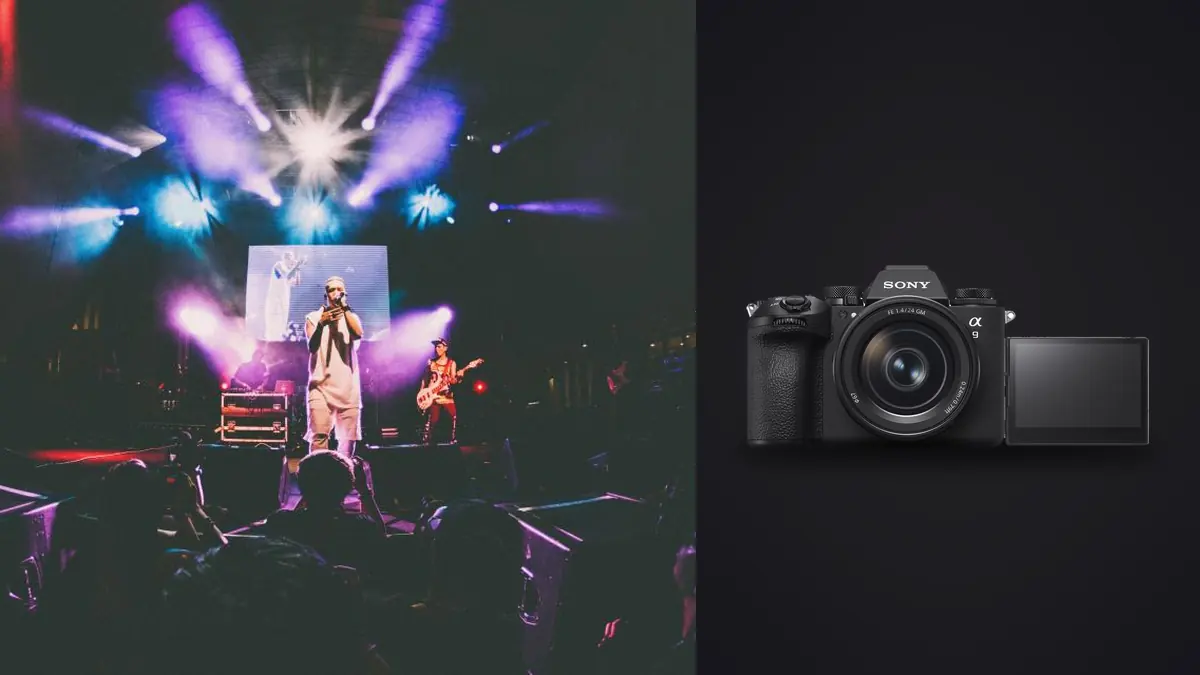
Picture a first arena run with the A9 III in February, two shows three days apart, two completely different lighting designers. By the second night you'd stop thinking about the camera, which is the highest compliment I can give a body built for pit work. Sony marketed this camera around one number, the global shutter, and on most forums that got flattened into a spec-sheet bullet point next to the megapixel count. If you've never fought banding off an LED video wall at 1/1000th of a second with a rolling-shutter body, it probably reads that way. If you have, it's not a bullet point. It's the difference between a usable frame and a bin of green-and-magenta stripes.
Why the global shutter is the actual headline for pit work
Every rolling-shutter sensor reads out row by row, top to bottom, over a span of anywhere from a few milliseconds to close to a fortieth of a second depending on the camera. Under constant daylight that's invisible. Under a pulsing LED wall, a strobe bank, or PWM-dimmed moving lights, the light source can change brightness mid-readout, so the top of your frame is exposed under one light level and the bottom under another. You get a soft horizontal band, sometimes two, drifting through the image. Anti-flicker modes help by timing the shutter to the flicker cycle, but they're a workaround, not a fix, and they don't do anything for fast horizontal pans, where a rolling readout skews vertical lines, a mic stand, a guitar neck, a drumstick mid-throw, into a lean that wasn't there in real life.
The A9 III reads the entire 24.6MP stacked sensor in one pass. There's no top-to-bottom scan to desync against a flickering light, so banding from LED walls and PWM fixtures simply doesn't happen, at any shutter speed, and pans stay geometrically honest even when you're swinging the camera hard to follow a guitarist running the lip of the stage. That's the real headline. It's also worth being precise about what it doesn't fix: if a light source is dark for its entire exposure window, the frame comes out dark or off-color, because that's an exposure problem, not a readout problem. You can still get a run of frames with inconsistent color under hard-strobed PWM lighting. The difference is that it's now frame-to-frame brightness variance you can filter out afterward, not a smear baked into a single unusable image.
Frame rate and buffer, used sparingly
120fps with full AF and AE tracking and a blackout-free viewfinder sounds like a mode you'd leave on for an entire set. I don't, and most photographers I've compared notes with don't either. At 120fps you generate an absurd number of near-duplicate frames in about two seconds, which is fine for a stage dive or a drumstick throw and a genuine problem for anything longer, because you're now the one who has to look at all of them later. I run a mid-speed continuous mode, somewhere in the 15fps range, for general performance coverage, and only punch up to the top speed for a specific, short, predictable action: a jump at the end of a chorus, a mic swing, a crowd surf pass. The buffer easily swallows those bursts, Sony rates it past a thousand frames in a single sequence, but the card has to keep up too. This is a CFexpress Type A camera, and if you're still running SD cards in the second slot expecting the same write speed, you'll watch the buffer counter climb during a long burst instead of clearing.
The other addition worth knowing about is pre-capture, added by firmware after launch, which buffers up to a second of frames before you fully press the shutter. For anything with a predictable trigger, a jump, a cue-based lighting hit, a drop, it's the closest thing to solving human reaction time that I've used on any body.
Does 24.6MP actually hold you back
This is the question I get most from photographers deciding between the A9 III and the 50MP A1 II. For most live music delivery, a wire photo, a festival recap gallery, a half-page magazine spread, a socials carousel, 24.6MP is not the limiting factor. What it buys you instead is a faster buffer clear, smaller files that don't choke your card or your laptop three hours after doors, and photosites that, generation for generation, tend to hold up a little better as ISO climbs, which matters more in a dim club than an extra ten megapixels of crop room does. In a side-by-side on the same tour dates against an A1 II, at ISO 6400 under warm tungsten wash, the A9 III files should need less noise work to get to a usable frame. Neither camera is unusable at that ISO, but if I had to pick one trade for consistent low-light concert work, I'd take the extra stop of comfortable ISO over the extra fifteen megapixels most of the time.
How the A9 III compares for pit work specifically
| Camera | Shutter type | Banding risk on LED walls / PWM lights | Approx. buffer at top speed | Native ISO ceiling | Body weight |
|---|---|---|---|---|---|
| Sony A9 III | Fully electronic, global | None, any shutter speed | 1000+ frames | 25600 | 702g |
| Sony A1 II | Mechanical + rolling e-shutter | Present in e-shutter, mitigated in mechanical | ~400 compressed RAW | 32000 | 743g |
| Nikon Z9 | Rolling, fast readout | Low but not zero, occasional edge cases | 1000+ frames | 25600 | 1340g |
| Canon EOS R3 | Rolling, fast readout | Low but not zero | ~150 RAW | 102400 | 1015g |
The Z9's readout is fast enough that most working photographers rarely see banding, but "rarely" and "never" are different guarantees when you've got a three-song window and no reshoot. The A9 III is the only body in that table where it's an architectural non-issue rather than a risk you're managing.
Lenses and rig choices by venue size
For club-sized rooms, barrier to stage might be six feet. A 24-70mm f/2.8 GM II covers most of a set from that distance and stays light enough for a three-hour night on one shoulder. Step up to a theater or small arena and I'm reaching for a 70-200mm f/2.8 GM OSS II for tight face shots from the photo pit, with the 24-70 as a second body slung for wides of the crowd and stage design. Full arena and stadium work, where the pit puts you thirty or forty feet back from center stage, is where a 400mm f/2.8 GM earns its weight, though it's genuinely heavy for a full set of handheld shooting and I don't bring it unless I know the barrier position in advance. A 20mm or 24mm f/1.4 prime is worth carrying in every bag for the wide shots that show the room, the lighting rig, the crowd with hands up, the kind of frame that sells a gallery even when none of the tight face shots are perfect.
Settings I actually run at the barrier
The A9 III has no mechanical shutter at all, it's electronic-only by design, so silent shooting isn't a toggle you remember to switch on, it's just how the camera works. That matters in a room where the between-song crowd noise sometimes drops enough that a mechanical shutter clack would be audible three rows back.
- Shutter priority or manual, 1/500 to 1/800 for general performance, 1/1000 or faster for anything with fast limb or instrument movement
- Auto ISO with a floor around 1000 and a ceiling near 12800, so exposure compensation does the fine work instead of me chasing ISO manually between songs
- Continuous AF with human eye priority, tracking through hard backlight and spinning gobos far more reliably than any rolling-shutter Sony body I've used before it
- Continuous shooting at a moderate speed by default, top speed reserved for specific, short bursts
After the set, the real work starts
A three-song no-flash pit set with even moderate use of the high-speed bursts leaves you with a genuinely large take, easily several thousand frames once you count the short 120fps sequences around the big moments. That's where I stopped trying to cull manually in Bridge at 1am in a hotel room and moved my triage into imagic instead. It runs entirely on the laptop, no upload queue, which matters more than it sounds like on a tour where some of the material is under embargo until the label or the artist's team releases it, and the last thing you want is unreleased pit photos sitting in someone else's cloud storage before you've even filed. The local sharpness scoring is genuinely useful on a night with hard backlight and fast-moving gobos, because even a camera this good in the eye AF department will still miss a frame here and there when a spot swings straight into the lens, and having those flagged automatically saves real time. The burst clustering is the bigger win on high-speed nights specifically, it groups those 120fps stage-dive sequences together instead of leaving you to scrub through forty nearly identical frames one at a time looking for the peak moment. Once I've built a look I like for a particular tour's lighting, warm stage wash, cool crowd fill, I save it and apply it across the rest of the run with apply_my_style rather than rebuilding a grade from scratch every venue. If you're new to building a culling pass around AI scoring rather than eyeballing every frame, how AI photo culling actually works is worth a read before your next shoot, and these workflow tips cover the file-management side that matters just as much once you're back at the hotel with a filing deadline.
Frequently Asked Questions
Does the 24.6MP sensor limit me for magazine spreads or festival wire photos?
Not in practice. Most concert delivery, editorial spreads included, tops out well under what 24.6MP provides, and you'll run out of usable light or a clean background before you run out of resolution. Where you'd feel it is aggressive cropping from a distant pit position, which is a lens problem more than a sensor problem.
Will the global shutter really stop banding off LED video walls?
Yes, for the banding artifact itself, because there's no row-by-row readout for a flickering source to desync against. What it doesn't fix is frame-to-frame exposure or color variance if a PWM-dimmed light happens to be in its dark phase for an entire exposure. That's a different, easier problem: bracket a stop or two if a venue's lighting looks aggressively strobed at soundcheck.
Is the A9 III worth it over an A9 II or A7 IV for someone shooting small local clubs?
Honestly, maybe not. If you're six feet from a stage with house lighting and no LED wall in sight, you may never hit the specific problem this camera solves. The buffer, AF tracking, and silent shooting are still nice, but they're a smaller upgrade over an A9 II than the marketing suggests for that specific room size. Where the A9 III earns its price is arenas, stadiums, and any venue running LED walls or heavy moving-light rigs.
What card setup keeps up with this camera through a full set?
CFexpress Type A in the primary slot, full stop. The buffer depth Sony advertises assumes a card that can actually sustain the write speed; drop an SD card into that slot expecting the same clearing time and you'll watch the buffer counter climb mid-burst instead of resetting. I run a CFexpress Type A primary with an SD backup for redundancy, not speed.