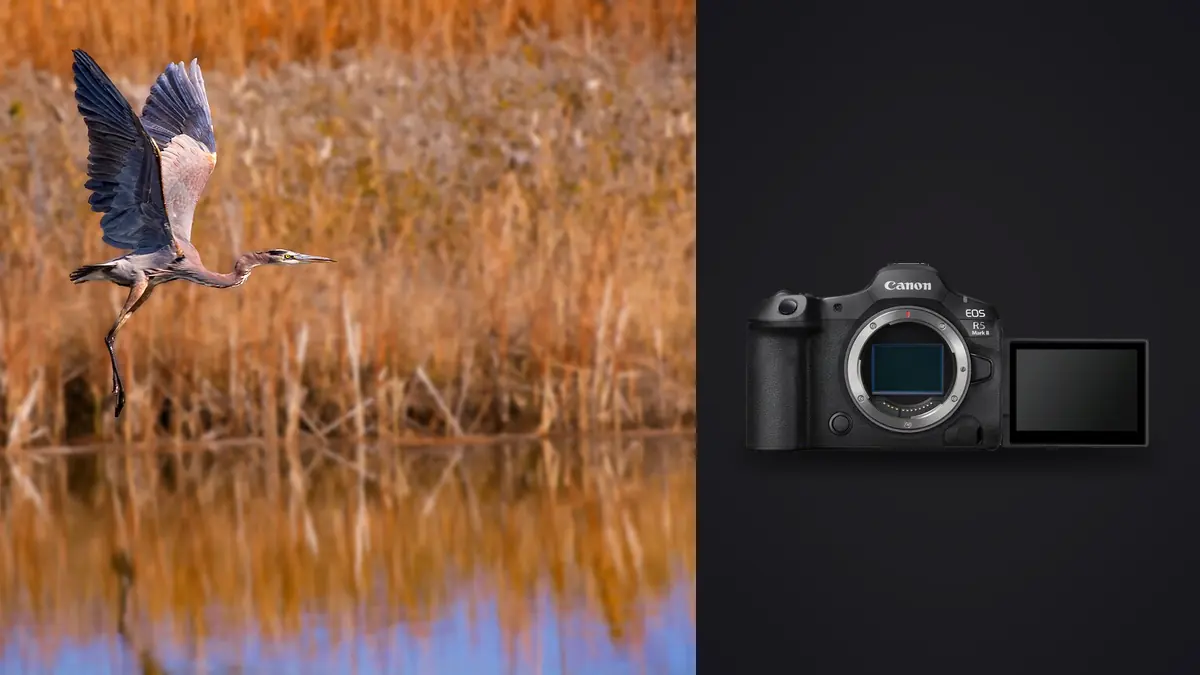
I spent most of a wet spring chasing ospreys off a reservoir bank with the Canon EOS R5 Mark II strapped to an RF 100-500mm, and the thing that stuck with me wasn't the megapixel count or the marketing language about "next-generation" anything. It was how rarely the camera made me think about the camera. That sounds like a small thing until you've missed a stoop because a buffer choked or an AF point wandered off the bird and onto a branch three metres behind it. The R5 Mark II mostly gets out of the way, which for bird-in-flight work is the only compliment that actually matters.
This isn't a spec-sheet regurgitation. I want to cover the parts of this camera that change how you actually shoot flight sequences: what the sensor readout speed buys you, how the autofocus behaves when a bird crosses clutter, what the crop modes are really for, which lenses make sense at which budget, and what happens to your card once you get home with four thousand frames on it.
The sensor readout is the whole story
The original EOS R5 was a fine stills camera but a mediocre bird-in-flight camera once you pushed the electronic shutter. At 20fps silent mode, fast wingbeats on something like a teal or a swift would show visible skew, that jello-like warp where the top and bottom of the frame were captured at slightly different moments. On a stationary heron it never mattered. On a peregrine folding into a stoop, it showed up as a subtly bent wing that no amount of sharpening fixes because it isn't a focus problem, it's a geometry problem.
The Mark II uses a stacked, back-illuminated 45MP sensor with a much faster readout, and that's the actual headline for anyone shooting flight. Rolling shutter distortion at 30fps electronic is now close to what you'd expect from a mechanical shutter on a lot of subjects. I've shot mute swans taking off directly toward me, wingtips moving faster than almost anything else in British birdlife, and stopped seeing the warping I used to get on the old body. It's not eliminated at the absolute extreme (very fast pans against hard verticals like a fence line will still show a trace of it if you go looking), but for the vast majority of flight work it's no longer something you plan around.
The practical upshot: you can leave the electronic shutter on all day, shoot at 30fps for a burst on takeoff, and not worry that you've traded reliability for a stack of unusable, warped frames. That wasn't true on the previous generation.
Autofocus that finds an eye through reeds isn't the same as sitting on it
Canon's subject detection on this body is genuinely good at picking a bird's eye out of open sky. Point it at a kestrel hovering against a grey November backdrop and it locks fast and stays locked. That's the easy case, though, and it's the case every manufacturer demos well.
Where it gets more honest is a bird crossing reed beds or coming off a perch through a screen of branches. Here the R5 Mark II is better than its predecessor but not magic. It will occasionally jump to a twig with a similar contrast edge to the bird's head, especially in low, flat light where there isn't much to differentiate the subject from the background. I've had it happen most with warblers moving through scrub, less with anything larger like a red kite or a heron where the size difference from the clutter is obvious to the algorithm. My workaround has been dropping the AF case to a setting with slower subject-switching sensitivity when I know I'm shooting near vegetation, which costs you a little responsiveness if the bird genuinely does change direction, but keeps the point from hopping to a leaf.
Eye Control AF, carried over and refined from the R3, is worth setting up if you haven't. For a mixed flock, say godwits and redshanks feeding together, it lets you glance at the specific bird you want and have the camera prioritise it rather than whatever the algorithm decided was the most prominent subject in frame. It needs a proper calibration session before it's trustworthy (do this indoors on a static target first, not on your first morning in a hide), but once it's dialled in it saves real time picking one bird out of a group without touching a joystick.
Action-priority style detection, which biases focus toward specific behaviours like a wing about to open on takeoff, works but I wouldn't build a whole technique around it. It's a nice-to-have that occasionally nails the exact frame you wanted and occasionally does nothing you'd have noticed if it were off.
Crop modes and how much reach you're actually buying
Because the sensor holds resolution well even when cropped, the in-camera crop modes are genuinely usable for flight work rather than being a marketing checkbox. Here's how I actually use the three options, paired against an RF 100-500mm as the reference lens most people will already own:
| Crop mode | Approx. resolution | Effective reach (RF 100-500mm) | When I reach for it |
|---|---|---|---|
| Full sensor (3:2) | ~45 MP (8192 × 5464) | 100-500mm as marked | Perched portraits, wide flight scenes with habitat, anything I want maximum feather detail on |
| 1.3x crop | ~27 MP (7128 × 4752) | ~130-650mm equivalent | Mid-distance flight where I want a bit more reach but still need room to reframe if the bird banks |
| 1.6x (APS-C) crop | ~18 MP (6000 × 4000) | ~160-800mm equivalent | Small, distant subjects like shorebirds on a mudflat, or any day I've left the longer glass at home |
The 1.6x crop is the one people underuse. Eighteen megapixels is still enough for a full-page print or a solid social crop, and turning your 100-500 into something that frames like an 800mm without adding weight to your shoulder is a real advantage on a long walk-in to a hide. The trade-off is a smaller buffer of pixels to crop into afterward, so if the composition might need adjusting later, full sensor with a tighter crop in post gives you more flexibility than baking the crop in at capture.
Lens pairings that actually make sense
The body is only half the system. A few honest notes on what I've paired it with:
- RF 100-500mm F4.5-7.1 is the default for a reason. It's light enough to hand-hold for hours, focuses fast on this body, and the variable aperture only really bites you past 400mm in dull light. This is what I'd tell most people to buy first.
- RF 200-800mm F6.3-9 gives real reach for distant subjects like raptors on pylons or gulls over open water, but the narrow aperture at the long end asks a lot of the autofocus system once light drops. On the R5 Mark II it still hunts less than I expected, but plan around golden hour rather than overcast dawn starts.
- RF 600mm F11 and RF 800mm F11 are the budget primes. Fixed aperture, no image stabilisation surprises, genuinely sharp, but the small maximum aperture means you're leaning on high ISO the moment the sun goes behind cloud. Fine for bright coastal days, frustrating in woodland.
- The 400mm F2.8 and 600mm F4 big whites are what the pros carry for a reason: autofocus speed in poor light is a different tier, and a 1.4x teleconverter barely costs you anything in AF performance on this body. Expensive and heavy is the honest trade-off.
Settings I actually run in the field
For anything with a wingbeat faster than a heron's, I default to 1/2000s or faster, shutter priority or manual with auto ISO. Ospreys diving I'll push to 1/3200s because the closing speed on the strike is deceptive and a slightly slower shutter turns talons into a blur. For soaring raptors like red kites riding a thermal, I'll drop to 1/1000s since the wings are barely moving and a lower shutter speed keeps ISO down on a grey day.
Aperture I keep around f/7.1 to f/8 on the zooms when light allows, mostly because depth of field on a bird angled toward or away from you matters more than people expect. Wide open on a 500mm lens, you can lose the far wing to blur even when the eye is tack sharp.
Drive mode is always the electronic high-speed option for flight work now, which wasn't a given on the previous body. Pre-Continuous Shooting is the setting I'd flag to anyone upgrading from the original R5: half-press the shutter and the camera buffers roughly half a second of frames before your full press registers, so the exact moment a bird lifts off a perch, which is almost always faster than human reaction time, gets caught retroactively. I leave it on by default now for anything perched that might bolt.
The bottleneck moves downstream
Here's the part camera reviews tend to skip. A good morning with this body at 30fps produces an absurd number of frames. A single ten-second burst on a tern diving is three hundred images, and most of a real outing is a dozen bursts like that plus the frames you fired at things that turned out to be nothing. You come home with four or five thousand files and a battery that's somehow only half drained.
That volume is where I actually lean on imagic now rather than scrubbing through Bridge or Lightroom's grid view frame by frame. It runs the sharpness and focus scoring locally on the machine, so a folder of osprey-dive bursts gets sorted by which frames are actually in focus on the eye before I've looked at a single one, and it clusters the near-duplicate frames from a burst so I'm not manually comparing forty near-identical wingbeats to find the one with the wings in a clean position. Because it's processing on-device rather than uploading anything, I can do the first pass in a hide with no signal, which matters more than it sounds like it should when you're three miles from the car and want to check you actually got the shot before you pack up.
The other piece that's become part of my actual workflow is the apply_my_style preset, which trains on edits I've already made rather than shipping a generic wildlife look. My flight shots tend to want a specific treatment (slightly cooler whites, punchier micro-contrast on feather detail) and having that applied automatically across a big batch means the editing time on a five-thousand-frame day drops from an evening to about forty minutes, leaving the actual selects for closer attention. If you haven't sat down and worked out how much of your editing time goes to genuinely creative decisions versus repetitive batch work, it's worth timing yourself once; the split is usually more lopsided than people assume, and there's a good breakdown of the culling side of that specifically in how AI photo culling actually works.
None of this replaces judgment. No software tells you that the slightly-soft frame is actually the better photograph because of the wing position or the light on the water. It just means you're not spending an hour finding that frame among four thousand near-duplicates first. If your current process is dragging on for days after a shoot rather than hours, it's worth comparing notes against a faster photo workflow before assuming the camera is the bottleneck. In my case, once the R5 Mark II stopped being the limiting factor, the sorting and editing pipeline very quickly became the next one.
Frequently Asked Questions
Is the RF 100-500mm enough, or should I save up for the RF 200-800mm?
For most people starting out, the 100-500 is the better first lens. It's lighter, focuses faster in low light thanks to the wider aperture, and the 1.6x crop mode on the R5 Mark II gets you most of the reach the 200-800 offers without the extra kilo on your shoulder or the autofocus penalty in dull conditions. The 200-800 earns its keep once you're regularly shooting subjects that are genuinely too small or too distant for 800mm equivalent to solve, which for most garden and reserve birding is a smaller list than you'd think.
Does 45 megapixels actually help with bird photography, or is it just a bigger file?
It helps specifically because you can crop hard after the fact without the image falling apart. A bird that fills a quarter of the frame at 45MP still leaves you with roughly 11 megapixels after cropping to fill it, which is plenty for web use and most prints. That flexibility is the real benefit, more than any difference in per-pixel detail at native size.
Will the autofocus lock onto a bird against a cluttered background like branches or reeds?
Most of the time, yes, and noticeably better than the original R5. It's not infallible against low-contrast clutter in flat light, where it can occasionally jump to a twig or leaf with similar tonal values to the bird. Slowing the AF case's subject-switching sensitivity when you know you're shooting near vegetation reduces this without costing much in the open.
How many keepers should I expect from a single bird-in-flight session?
It varies enormously with species and conditions, but as a rough baseline from raptor and wader sessions I've shot: out of a burst of thirty frames on a single flight pass, five to ten will be sharp on the eye, and maybe two or three will have a wing position and background worth a full edit. The rest are the cost of shooting at high frame rates, which is exactly why sorting tools matter as much as the glass you're carrying.