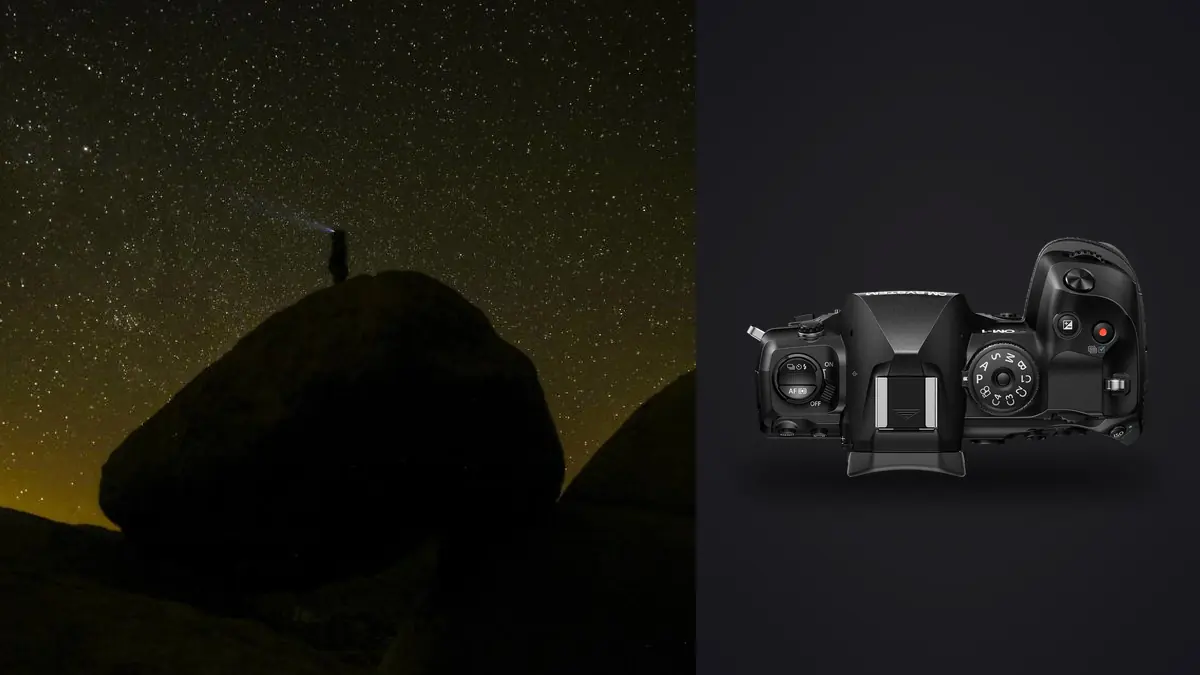
The sensor question people ask before they've even tried it
Every time I mention shooting the night sky with a Micro Four Thirds body, someone asks some version of "why not just use a full-frame camera and get it over with." Fair question. The OM System OM-1 Mark II has a 20.4-megapixel sensor that's roughly a quarter the surface area of a full-frame chip, and at high ISO it does show its size sooner than a Sony a7 IV or a Nikon Z6III would. I'm not going to pretend otherwise. But astrophotography, and star stacking in particular, is one of the few genres where a smaller sensor gets partially forgiven, because the whole technique is built around combining many exposures to manufacture the signal-to-noise ratio a single frame can't deliver. Stack twenty frames and you're recovering roughly two stops of clean shadow detail compared to one frame shot at the same settings. The OM-1 II just needs that trick more than a full-frame body does, not exclusively.
What the crop factor actually does to your exposure math
The 2x crop factor changes two things for star point calculations, and people usually only account for one of them. First, your effective focal length doubles for framing purposes, which everyone remembers. A 12mm lens frames like 24mm. Second, and this is the part that trips people up, the maximum exposure time before stars turn into short trails shrinks proportionally, because you're covering a wider slice of sky per pixel at that effective focal length than the same physical millimeters would on full frame. Run the numbers with the NPF rule instead of the old "500 rule" and you'll see the difference matters. On a full-frame body at 20mm f/2.8, NPF gives you somewhere around 13-14 seconds before trailing becomes visible at typical viewing sizes. Put a 10mm f/2.8 on the OM-1 II (20mm full-frame equivalent field of view) and NPF drops that ceiling to roughly 8-9 seconds, because the pixel pitch is tighter and the pixels are resolving finer angular movement.
That's the whole reason star stacking exists as a technique rather than an afterthought on this camera. You can't lean on one 25-second exposure at ISO 1600 and call it a night. You shoot shorter, cleaner subs and pile them up.
| Lens / effective focal length | Max single exposure (NPF, no trailing) | Typical ISO for a Milky Way sub | Subs needed for a clean stack |
|---|---|---|---|
| 8mm f/1.8 PRO (16mm equiv.) | ~11-13 sec | 3200-4000 | 15-20 |
| 12mm f/2.0 (24mm equiv.) | ~8-9 sec | 4000-5000 | 25-35 |
| 17mm f/1.2 PRO (34mm equiv.) | ~5-6 sec | 5000-6400 | 35-50 |
| 25mm f/1.2 PRO (50mm equiv.) | ~3-4 sec | 6400-8000 | 50-70 |
Those sub counts aren't decorative. At 30-plus subs per composition, times however many compositions you attempt in one night, times the test shots and the ones ruined by a gust of wind on the tripod, you can walk away from a three-hour session with 400-600 RAW files that all look nearly identical at a glance. That's the actual bottleneck of this workflow, and it has nothing to do with the camera's autofocus or dynamic range. It's sorting the pile afterward.
Live Composite versus shooting subs for external stacking
OM System bodies have carried Live Composite for years, and it's still the single best reason to own one of these cameras for star trail work specifically. Instead of one long bulb exposure that clips the moment a car headlight sweeps past, Live Composite takes a base exposure to set your ambient/foreground brightness, then keeps adding only the brighter pixels from each subsequent frame on top of it, live, on the rear screen. You watch the trails grow in real time and stop whenever the arc looks right. I've pulled the plug on a composite at eleven minutes because a plane went through the frame with its strobe on, saved the file, and started a fresh one rather than losing forty minutes of work to one bad pass.
That's fundamentally different from what you're doing when you shoot for a Milky Way stack. There, you're not compositing light additively for a trail effect, you're capturing near-identical short exposures of a static (well, barely moving) sky, aligning them in software afterward, and averaging out the read noise. Live Composite happens entirely in-camera and produces one finished JPEG or RAW. Stacking for noise reduction produces dozens of separate RAW files that need software like Sequator, Starry Landscape Stacker, or DeepSkyStacker to align and blend after the fact. People conflate the two because both involve "lots of exposures" but the pipeline and the goal are different, and the camera settings you'd choose for each are almost opposite: Live Composite wants a longer base exposure and a slower cadence, noise-reduction stacking wants the shortest clean sub you can get away with and as many of them as your battery allows.
Running a Live Composite session without wasting the night
A few things I do differently now after a handful of frustrating nights early on. I set the composite interval close to my base exposure length rather than padding it, because gaps between frames show up as small breaks in a trail if anything moves fast enough (satellites especially). I turn off any in-camera noise reduction that adds a dark-frame subtraction pass between shots, since that introduces a black gap where the sensor is busy reading out the dark frame instead of capturing light. And I always shoot a genuinely black dark frame at the same ISO and base exposure length before I start, because OM System's Live Composite implementation uses that reference to suppress hot pixels through the whole composite, and skipping it leaves you with a scattering of colored dots across a twenty-minute trail that are miserable to spot-heal out afterward.
Shooting the subs for a Milky Way stack
For actual deep-sky or Milky Way stacking, I lock white balance manually (auto white balance will drift subtly between subs and it shows as color banding after stacking), shoot uncompressed RAW rather than the lossy-compressed option, and disable any long-exposure noise reduction entirely, because that doubles your time per frame for a benefit that stacking already delivers more effectively. I also shoot 8-10 dedicated dark frames at the very end of the session, lens cap on, same ISO and exposure length, for the stacking software to use during calibration. Skipping darks is the single most common reason people get a disappointing stack out of this camera and blame the sensor for it.
Starry Sky AF, and where I still don't trust it
The OM-1 Mark II carries over Starry Sky AF from the original OM-1, with speed-priority and accuracy-priority modes depending on how much time you're willing to spend per lock. It genuinely works, and it's a real improvement over hunting manually with focus peaking in near darkness, especially accuracy-priority mode on a clear night with a decent star field to lock onto. Where it struggles is thin cirrus, light pollution domes near a city, or a Moon-heavy sky where there aren't enough sharp point sources for the algorithm to grab. On those nights I still fall back to manual focus: zoom the EVF or LCD to maximum magnification on the brightest star in frame, nudge the focus ring until the point shrinks to its smallest size, and lock it there with focus limiter or a piece of gaffer tape if the lens has focus-by-wire creep. I check focus again after changing the frame's tilt, because on a couple of my wider primes there's enough field curvature that a star sharp in the center goes slightly soft in a corner, and that only shows up once you pixel-peep a finished stack.
What handheld stacking mode is actually good for
OM System's in-camera handheld starry sky mode (part of the Handheld High Res / stacking family on this body) captures a burst of frames and aligns them internally to fake a longer effective exposure without a tripod. I want to like this more than I do. For a wide astro composition where you genuinely have no tripod, it's a real option and better than nothing, producing a usably clean JPEG straight off the card. But it can't beat a proper tripod session with external stacking for image quality once you pixel-peep, and the in-camera algorithm has less to work with than a purpose-built desktop stacker does when it comes to rejecting a bad frame from the burst. I use it for scouting compositions before I commit the tripod time, not for anything I plan to print large.
Sorting the aftermath
This is the part nobody warns you about before you get into star stacking seriously. A single clean composition, shot properly with 30-50 subs plus darks plus a handful of test exposures at different ISOs while you're dialing things in, easily produces 60-90 RAW files that are visually almost indistinguishable in a folder view. Multiply that by three or four compositions in one night and by the second or third outing of the season you're sitting on thousands of files that all look like "dark sky, some stars" at thumbnail size. Scrolling through that in a traditional catalog, zooming in one at a time to check which subs actually have pinpoint stars versus a slight tracking drift or a gust-induced wobble, is genuinely the least enjoyable part of this hobby.
I run the folder through imagic before it goes anywhere near a stacking app. Its local sharpness scoring flags the handful of subs where wind moved the tripod or where Starry Sky AF drifted half a step during a longer accuracy-priority lock, so I'm not feeding soft frames into a stack that would otherwise just blur the final result slightly. The duplicate and burst clustering groups the near-identical subs from each composition together automatically, since as far as file similarity goes, thirty exposures of the same static sky look a lot like a photographic burst even though I fired them one at a time with a wired remote. Everything runs on the laptop with no upload step, which matters more than it sounds like when you're culling a folder at a kitchen table with no signal three hours after getting back from somewhere with actual dark skies. If you haven't dealt with a folder this repetitive before, our piece on how AI photo culling actually works covers the sharpness and clustering logic in more depth than I can fit here.
Once the stack itself is done in dedicated software and I've got a handful of finished composites and trail shots, I lean on imagic's apply_my_style feature to carry my usual astro tone curve (a specific way I pull down the black point and hold star color rather than letting Lightroom's default deep-sky presets crush everything toward blue-purple) across the batch without re-building it by hand on every single file, since it's trained on edits I've already made rather than a generic look.
A few field notes that aren't really about the camera
Battery life at freezing temperatures is worse than the spec sheet implies, and that's true of basically every mirrorless camera, not something unique to OM System. I carry three batteries for a full night and keep the spares in an inside jacket pocket rather than the camera bag. The IP53 weather sealing has genuinely saved a session for me twice, once in unexpected drizzle and once when condensation formed heavily on everything as temperatures dropped through dew point, and the camera kept working through both while my notebook got damp enough to be annoying. Dual UHS-II card slots mean I write the whole session to two cards simultaneously and don't think about it again until I'm home, which matters more on a three-hour drive-out shoot than it would shooting astro from the back porch.
| Night sky mode on the OM-1 II | What it produces | Best suited to |
|---|---|---|
| Live Composite | One finished trail image, built live in-camera | Star trails, light-painted foregrounds, minimal post work |
| Manual bulb + external stacking | 30-70 separate RAW subs plus darks | Milky Way and low-noise deep-sky results, most post work |
| Handheld starry sky stacking | One JPEG/RAW, aligned internally | No-tripod scouting, quick compositions, casual use |
Frequently Asked Questions
Is the OM-1 Mark II's smaller sensor actually a problem for stacking the Milky Way?
It's a real limitation you're working around rather than a myth. Per-frame noise at ISO 4000-6400 is higher than a comparable full-frame exposure, which is precisely why stacking 25-50 subs matters so much on this body specifically. Treat the smaller sensor as the reason you stack rather than something stacking magically erases, and set expectations for higher ISOs and shorter subs than a full-frame astro shooter would need.
Do I need external software, or does Live Composite replace stacking?
They solve different problems. Live Composite is for star trails and produces one finished file with no external software needed. If you want a low-noise, pinpoint-star Milky Way image, you still need separate subs aligned and averaged in dedicated stacking software afterward. Neither replaces the other.
How many test shots should I budget for before the real subs?
I typically burn 5-10 test exposures per composition dialing in focus and framing before committing to a run of 30-plus subs, and that number climbs on unfamiliar terrain where I can't see the foreground well enough to compose confidently in the dark. Budget for those extras when estimating your total file count for the night, since they add up fast across several compositions.
What's the fastest way to find the sharpest sub in a stack of thirty near-identical frames?
Don't do it by eye at thumbnail size, since focus drift and wind-induced softness rarely show until you're zoomed to 100%. Run the folder through a local sharpness pass first (imagic scores focus per file without uploading anything) and cull the soft outliers before you ever open the stacking software, so you're not averaging a few blurry frames into an otherwise clean composite.