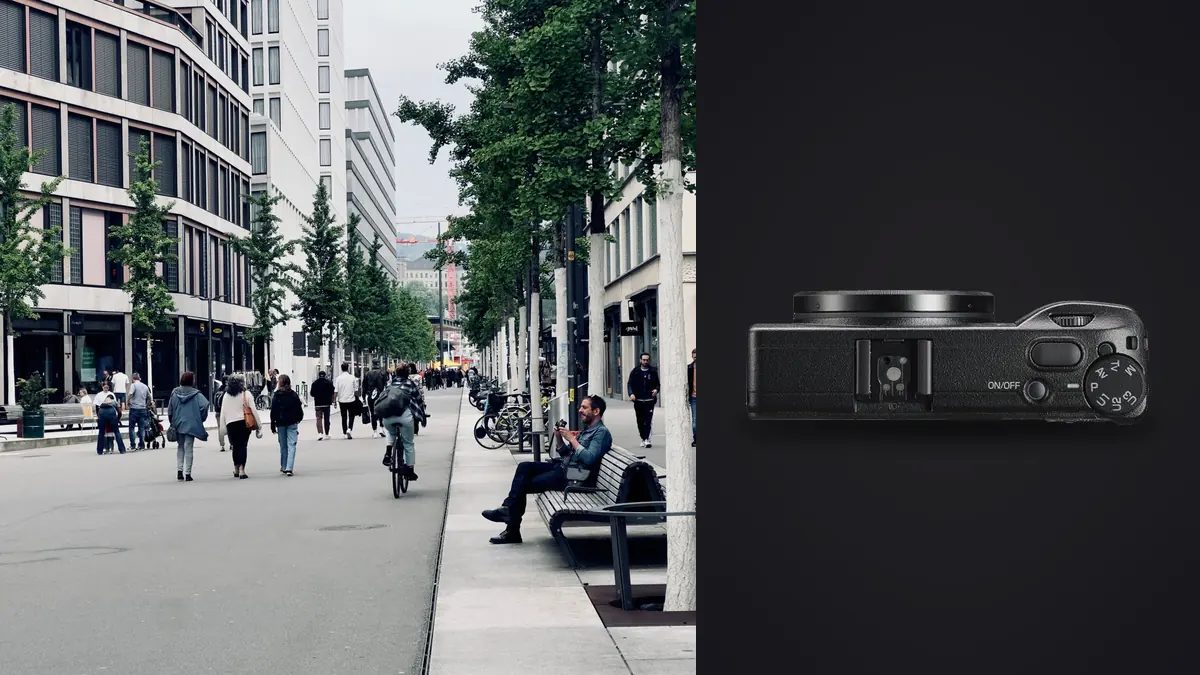
I bought a Ricoh GR IIIx for a three-week documentary project along the Adriatic coast, mostly because I was tired of hauling a mirrorless body with two lenses through fish markets, ferry terminals, and a refugee processing center where a big camera made everyone stiffen up. Close to two years and somewhere north of 30,000 frames later, it is the camera I reach for whenever the job is people rather than landscapes. It is not a camera you buy because you cannot decide on a lens. It is a camera you buy because you already know you shoot around 40mm and you are done pretending otherwise.
The 40mm field of view is the whole argument
Ricoh sells two versions of this camera and the difference is one number. The standard GR III uses a 28mm equivalent lens, the classic wide street focal length. The IIIx swaps it for roughly 40mm equivalent, which is closer to what your eye actually does when it settles on a scene. For documentary work specifically, that difference changes how you shoot far more than the spec sheet suggests.
At 28mm you can stand close and still get environment into the frame, which is great for chaotic wide scenes but forces you right into someone's space if you want a recognizable portrait. At 40mm you can stand a comfortable few steps back, hold a conversation, and still fill enough of the frame that the person is clearly the subject rather than a detail in a wide shot. I shoot a lot of situations where I have already talked to someone, explained what I am doing, and then want a frame that still feels observed rather than posed. The extra reach makes that gap between "conversation distance" and "photograph distance" workable without a zoom.
The tradeoff is real. You lose the immersive, environment-swallowing wide shot that defines a lot of classic 28mm street work. On this camera you compose tighter and you crop less afterward, which is a different discipline. I missed the wide look for about two weeks and then stopped missing it.
Snap focus matters more than autofocus speed
The GR IIIx's autofocus is fine. It is not the reason people buy this camera. The reason is snap focus, which lets you preset a fixed distance (1m, 1.5m, 2m, 2.5m, 5m, or infinity) and fire at that distance the instant you press the shutter, bypassing the AF hunt entirely. Set the lens to f/5.6 or f/8, dial snap focus to 2.5m, and you have a functional zone-focus street camera that never hesitates.
This matters for documentary work in a way it does not for landscape or studio shooting: the moment you are trying to catch often lasts under a second, and it is frequently a moment where eye contact or raised attention changes what happens next. A camera that fires the instant you press it, rather than one that needs a beat to lock focus, lets you shoot from the hip or at chest height without drawing the same attention a viewfinder-to-eye motion does. I run snap focus for probably 60 percent of my frames on a documentary day and switch to continuous AF only when I know I have time to compose properly, like a static interview setup or a posed environmental portrait.
What a twelve-hour shoot day actually feels like
At 262 grams the GR IIIx disappears into a jacket pocket, which sounds like a marketing line until you have carried a full-frame body with a fast prime for ten hours straight and felt your neck complain about it. On long documentary days I genuinely forget I am carrying a camera between subjects, which changes how present I am with people. That is not a small thing on a story where trust matters more than gear.
The minimal grip is the most common complaint and it is a fair one. There is barely a lip for your fingers, and with sweaty hands in a hot climate I have had it slip in my palm more than once. I added a third-party metal grip after the first trip and would not shoot it without one now. Battery life is officially rated modestly, and the official number is pessimistic in the way CIPA numbers usually are, but even generously I get through maybe 350 to 400 frames on a single charge with the screen active and some chimping between subjects. USB-C charging means I top it off from the same battery bank I carry for my phone, which is one less charger to pack.
One caveat worth being upfront about: this generation of GR camera has a known reputation among owners for occasionally throwing a lens or sensor error after a dusty or humid day, mine included, twice. Both times a rocket blower and a gentle shake of the camera cleared it. It has never needed a repair, but if you are buying used, ask the seller directly whether it has ever thrown that error, because a small minority of units do need servicing for it.
How it stacks up against the other cameras documentary shooters actually carry
Nobody chooses a walk-around documentary camera in a vacuum. Here is how the GR IIIx compares to the three cameras I see most often on the same assignments, based on specs and street prices as of this year rather than launch-day numbers.
| Camera | Equivalent focal length | Sensor | Body weight | Viewfinder | Rough used price |
|---|---|---|---|---|---|
| Ricoh GR IIIx | 40mm, f/2.8 | APS-C, 24MP | 262g | None built in | €850-950 |
| Ricoh GR III | 28mm, f/2.8 | APS-C, 24MP | 257g | None built in | €750-850 |
| Fujifilm X100V | 35mm, f/2 | APS-C, 26MP | 478g | Hybrid optical/EVF | €1300-1500 |
| Leica Q2 | 28mm, f/1.7 | Full-frame, 47MP | 734g | Electronic | €4000-4300 |
The X100V is the closest real competitor and the one people ask me about most. It has a proper hybrid viewfinder, a faster lens, and a body that feels more like a "real camera" in the hand, which matters to some clients when you are visibly working. It is also nearly double the weight and, at current used prices inflated by years of chip shortages and hype, considerably more expensive than either Ricoh. The Q2 is a different category entirely: full-frame files with genuine resolution to spare for cropping, but at 734 grams and Leica pricing it stops being the camera you forget you are carrying, which for me defeats half the point of shooting compact in the first place.
The crop modes, and when I actually reach for them
Because the sensor resolves more detail than most people need for web or even magazine spreads, the GR IIIx offers in-camera crop settings that simulate roughly 50mm and 75mm equivalent framing by cropping into the RAW/JPEG pair and showing you the tighter frame lines on screen before you shoot. I use the 50mm crop occasionally for a tighter portrait when I cannot physically step closer, a crowded market stall or a subject on the far side of a fence. I almost never use the 75mm crop in practice; the resolution loss is noticeable and at that point I would rather have shot wider and cropped selectively later with more control. It is a nice option to have on a bad day rather than something I plan around.
Sorting the take when you shoot in bursts
Documentary shooting means bursts, and bursts mean a lot of near-identical frames where the difference between the keeper and the reject is a blink, a hand position, or focus that landed a hair off because snap focus was set for a subject who moved a step closer than expected. On a heavy shoot day I can come home with 1,200 to 1,800 frames, and manually scrubbing through all of them at full size to find the sharp one in each burst is the part of the job nobody enjoys.
This is where I stopped doing it by hand. I run the day's card through imagic, which scores focus and sharpness locally on the machine and groups burst sequences and near-duplicates together instead of leaving them as a flat, unsorted folder. It does not touch the network to do this, which matters more than it sounds like on documentary work where some of what you are shooting is sensitive and you do not want frames leaving your laptop before you have decided what to do with them. If you want the mechanics of how that scoring actually works rather than taking my word for it, this explainer on AI photo culling covers it in more depth than I can here. The short version for GR IIIx shooters specifically: because snap focus occasionally misses by a hair at wider apertures, having something flag the technically sharpest frame in a burst rather than trusting my own eye on a tired evening has saved more usable frames than I expected it to.
Keeping one consistent look across a multi-day story
The other habit this camera pushed me into: shooting RAW+JPEG and building a single edit style rather than reinventing the grade every evening. Documentary sequences fall apart visually if day three looks warmer than day one just because the light was different and you eyeballed white balance differently each night. I built out a look I liked on the Adriatic project, mostly desaturated, slightly lifted shadows to hold detail in harsh midday sun, and then used imagic's apply_my_style feature to carry that same treatment across the rest of the take automatically instead of manually matching sliders image by image at 11pm in a hotel room. It is trained on your own past edits rather than a generic filter, so it holds onto the specific decisions you already made rather than pushing everything toward some default look. For anyone tightening up a field workflow generally, not just for this camera, these workflow tips cover the broader habits worth building around a shoot like this.
Where the camera genuinely struggles
No built-in viewfinder is the biggest one. In direct midday sun the rear screen washes out enough that composing by feel becomes normal, which is fine once you trust the lens's field of view but is a real adjustment if you are used to an eye-level finder. There is no weather sealing at all, so a sudden downpour means the camera goes under a jacket immediately, not something you can shrug off the way you might with a sealed body. The single SD slot is a minor risk on a paying documentary job, so carry a card wallet and swap more aggressively than you would with dual slots. And the minimum focus distance for anything beyond casual macro is limited enough that close detail shots, hands, texture, small objects on a table, need the dedicated macro mode, which slows the lens down and is easy to forget to switch out of before your next street frame comes up soft.
The settings I actually run
For anyone picking one up for similar work: I shoot Auto ISO capped around 6400 with the minimum shutter threshold tied to the lens's actual focal length rather than the camera's slower default, TAv mode so I control aperture and shutter while ISO floats, snap focus at 2.5m and f/5.6 as the default I fall back into between deliberate shots, and a custom image control tuned down in contrast and saturation from the punchy defaults, because documentary color needs headroom to grade later rather than baked-in contrast fighting you in the edit.
Frequently Asked Questions
Is 40mm too tight for street photography compared to the standard 28mm GR III?
It depends what kind of street work you shoot. If you want the classic wide, everything-in-frame look, 28mm on the standard GR III suits that better. For documentary portraiture and moments where you want the subject clearly separated from a busy background, the IIIx's 40mm is more forgiving and requires less aggressive cropping afterward.
Can the GR IIIx realistically carry an entire documentary project on its own?
I have done full multi-week projects on it and would do so again, but it works best as the primary camera for a specific type of story, close, observational, people-focused. For anything needing genuine reach (distant subjects, sports-adjacent action) or ultra-wide environmental context, I still bring a second body. It is not trying to be a do-everything camera and shooting it like one fights the design.
Does not having a built-in viewfinder actually hurt candid shooting?
In my experience it helps more than it hurts. Composing on the rear screen at chest or waist height is less visually aggressive toward a subject than raising a camera to your eye, and once you know the 40mm framing well enough to guess it without looking, you can shoot almost blind. The real cost is in bright outdoor light where the screen is hard to read, not in the candid work itself.
Is the GR IIIx worth it over a used Fujifilm X100V for this kind of work?
If a hybrid viewfinder and a slightly faster lens matter to how you work, the X100V earns its higher used price. If the priority is a camera you genuinely forget is in your pocket for a twelve-hour shoot day, the GR IIIx's weight and size advantage is significant enough that I would still choose it, even setting price aside.