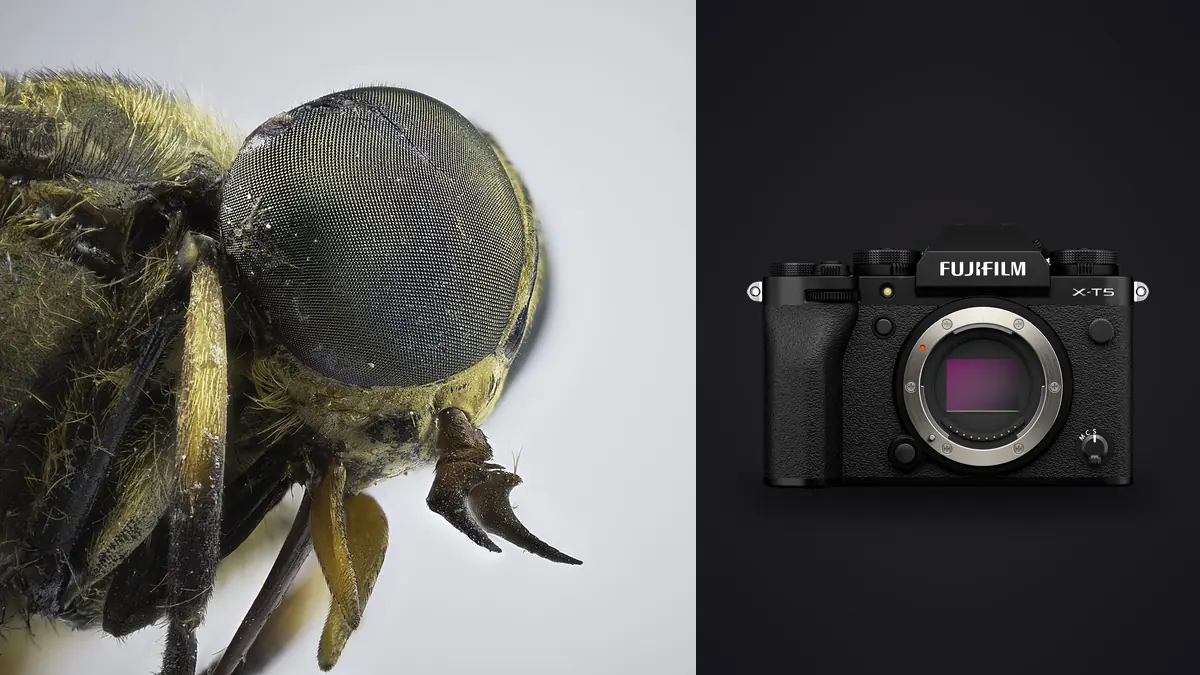
I spent most of last June crawling around a drainage ditch behind a friend's allotment trying to get a damselfly to sit still long enough for a focus-bracketed sequence. The X-T5 was not my first macro camera, but it's the one that finally made me stop dreading the "how many keepers did I actually get" moment back at the laptop. That's really what this piece is about: not whether the X-T5 is a good camera in the abstract, but what it's actually like to point 40 megapixels of APS-C sensor at something the size of a grain of rice, and what breaks, works, or surprises you along the way.
What the sensor and stabilizer actually buy you at this scale
The X-T5's 40.2MP X-Trans sensor is the headline spec, and for insect work it earns its keep in a specific way: cropping. A dragonfly that fills a quarter of the frame at 1:1 magnification still leaves you with roughly a 10-megapixel final image after you crop in, which is print-usable and more than enough for web use. That safety margin matters more in bug photography than almost any other genre, because your subject rarely cooperates with your framing. It flies off, it turns its head, it lands two inches further away than you planned. Having resolution to spare means you can fix framing in post rather than chase the shot again.
The in-body stabilization is rated up to 7 stops in ideal conditions, but be honest with yourself about macro work: at anything past about 1:1 magnification, IBIS becomes far less useful. Stabilization corrects for angular camera shake, and at extreme close focus your dominant motion is often linear, your whole body swaying a centimeter forward and back, which IBIS barely touches. I still leave it on because it helps at 0.5x to 1x reproduction ratios and for handheld focus-bracket sequences where a steady base frame matters, but I've stopped expecting it to bail me out at 2x magnification with the Laowa lens.
Base ISO and the diffraction wall
One thing that isn't obvious until you've shot a few hundred macro frames: at high magnification your effective aperture narrows well past what the lens barrel says. This is the bellows factor. An aperture ring set to f/11 at 1:1 magnification behaves closer to f/22 in terms of light loss and diffraction softening. On a 40MP sensor with tiny photosites, that softening shows up fast, softer edges, less crisp texture on compound eyes and wing veins. I generally shoot insects between f/5.6 and f/8 on the lens ring and lean on focus stacking to buy back depth of field, rather than stopping down further and eating the diffraction penalty. Base ISO of 125 gives a little headroom for this, but not enough to ignore the tradeoff entirely.
Lens choice matters more than the camera body here
Fujifilm's own macro lineup for X-mount is thinner than Sony's or Canon's, so the decision tree looks different depending on how serious you are about magnification beyond life-size. Here's how the realistic options stack up for someone actually chasing insects rather than product shots on a tabletop.
| Lens / setup | Max magnification | Autofocus | Working distance at max mag | Approx. street price | Best for |
|---|---|---|---|---|---|
| XF60mm F2.4 R Macro | 0.5x (half life-size) | Yes, slower motor | ~9cm | $450 | Larger, calmer subjects: dragonflies at rest, caterpillars |
| XF80mm F2.8 R LM OIS WR Macro | 1.0x (true life-size) | Yes, fast linear motor | ~11cm | $1,200 | Skittish insects, weather-sealed field use, handheld stacking |
| Laowa 65mm F2.8 2x Ultra Macro APO | 2.0x | No, fully manual | ~4-5cm | $500 | Small stationary subjects: jumping spiders on a leaf, ants at rest |
| Laowa 25mm F2.8 2.5-5x Ultra Macro | 5.0x | No, fully manual | ~2-4cm | $400 | Studio-style extreme macro, controlled subjects, not live insect chasing |
| XF80mm + MCEX-16 extension tube | ~1.3x | Yes, retained | ~8cm | +$150 over lens | Pushing the 80mm past 1:1 without buying a second lens |
My honest recommendation, if you're starting from nothing: the 80mm. The 65mm Laowa is genuinely excellent glass optically and half the price, but manual focus at 2x magnification on a live, moving insect is a skill that takes months to get comfortable with, and the working distance is short enough that you'll spook half your subjects before you're in position. The 80mm's autofocus isn't going to nail focus on a compound eye by itself at high magnification (nothing does reliably), but it gets you close enough that manual fine-tuning or focus bracketing does the rest, and the weather sealing means you can keep shooting when the morning dew that insects love is still on the grass.
Focus bracketing: the feature that actually changes what's possible
The X-T5's automated focus bracketing lives under the AF/MF menu, and it's the single feature I use more than anything else for insects. You set a frame count (up to 999, though I've never gone past about 40 for a bug), a step size that controls how far focus shifts between frames, and an interval delay. For a beetle at roughly 1:1, I typically run 25 to 35 frames at a step size around 3-4, which usually covers the depth from antennae to wing tips without leaving gaps.
What the camera does not do is stack those frames into a single image in-camera. Some other systems handle blending internally; the X-T5 hands you a folder of RAW files and expects you to run them through Helicon Focus, Zerene Stacker, or Photoshop's own stacking tool afterward. I'd rather have this than not, but it does mean every insect session multiplies your file count by 20-40x compared to a single-frame shot, and that has real consequences for how you review a card afterward (more on that below).
Where bracketing falls apart
Wind is the enemy. If you're stacking a hoverfly on a flower stem outdoors and a breeze moves the stem mid-sequence, the resulting stack either fails to align or introduces ghosting around wing edges that no stacking software fully hides. I've had better luck bracketing insects that are naturally still (resting butterflies, dew-slowed bees on cold mornings) than trying to force a stack on something actively moving. For subjects in motion, I just shoot a fast burst at a single focus distance and accept a shallower depth of field rather than chase a stack that's going to fail anyway.
Light, without cooking or spooking anything
Natural light works for maybe half the year here, mostly overcast mornings when contrast is soft and insects are sluggish from the cold. The rest of the time I'm using a small twin macro flash (a Godox setup that works over Fuji's TTL hot shoe) with diffusion domes taped on, because bare macro flash at close range is harsh enough to blow out a beetle's shell entirely. Flash also freezes motion far better than a fast shutter alone can at these magnifications, which matters when your subject's wings are doing something even at rest.
A cheap white foam reflector, the kind sold for portrait work, does double duty: bounce light into shadow under a leaf, or use it as a makeshift wind block on days when a breeze is ruining your bracket sequences.
Field habits that matter more than any setting
Approach insects from a low angle and move slowly enough that your shadow doesn't cross them first, most species react to a shadow faster than to movement itself. I shoot handheld for probably 90% of insect work; a focusing rail is precise but useless the moment your subject relocates two centimeters, which happens constantly. Instead I do the classic macro rock, holding focus roughly where I want it and swaying my whole body forward and back in small increments while firing a burst, which is a crude manual version of focus bracketing that works when the automated version is too slow to keep up with a moving subject.
The weather sealing on the X-T5 body (paired with a WR lens like the 80mm) has saved a session more than once when morning dew turned into actual drizzle halfway through. I wouldn't want to test its limits in a downpour, but for the damp, humid conditions insects actually prefer, it holds up fine.
What a stacking session does to your evening
Here's the part nobody mentions in gear reviews: a single productive morning of focus-bracketed insect shooting can leave you with 1,500 to 2,500 RAW files, most of which are 20-40 frame stacks of the same six or seven subjects from slightly different focus positions and slightly different body angles as you readjusted between bursts. Reviewing that manually, frame by frame, is genuinely the worst part of macro photography, worse than the crouching, worse than the mosquito bites.
This is the part of my workflow where imagic actually earns its place rather than being another app I opened once. Its burst clustering groups those near-identical bracket sequences together automatically instead of making me scroll past 30 nearly-identical thumbnails of the same beetle to find the one where its head wasn't tilted. The local sharpness and focus scoring is genuinely useful here too, because with a stack you don't want the "best single frame," you want to quickly identify which few frames in each cluster are actually sharp on the part of the subject you care about (the eyes, almost always) before you commit to running the full stack through Helicon Focus. Everything runs locally on the machine, so a folder of a few thousand RAW files from a morning in the field doesn't mean waiting on an upload before you can start culling. If you want more on how the culling logic actually decides what counts as sharp versus soft, there's a longer breakdown at how AI photo culling works.
Color grading is the other place this matters for insects specifically. Backgrounds tend to be similar across a season (greens, browns, leaf litter), and I built an apply_my_style preset in imagic off a batch of edits I was happy with, so new sessions land close to my usual look before I touch a slider, which for a genre where you're editing hundreds of frames a week saves real time. For a broader look at trimming down the review-and-edit cycle beyond just this camera, this workflow piece covers habits that apply whether you're shooting macro or anything else with high frame counts.
Frequently Asked Questions
Is the X-T5 actually good for insects, or is it just good in general?
It's a strong choice specifically because of the resolution-to-crop tradeoff and the focus bracketing implementation, not because it was designed with insects in mind. A camera built around action autofocus would arguably track a moving insect's eye better, but few APS-C bodies at this price point give you 40 megapixels to crop into and a bracketing menu this flexible in the same package.
Do I need the 80mm macro, or can I start with extension tubes on a regular lens?
Extension tubes on something like the 35mm f/2 will get you closer than the lens focuses natively, but you lose infinity focus entirely and the working distance shrinks uncomfortably close for anything that can fly away. They're a fine way to test whether you enjoy macro before spending on dedicated glass, but they're a stepping stone, not a long-term solution for live insects.
Why does my focus stack have ghosting around the wings even on a still subject?
Even a "still" insect breathes, and wings especially can drift slightly between frames in a 30-shot bracket sequence that takes several seconds to capture. Shortening your bracket count and step size to cut total capture time helps, as does shooting in cooler, calmer conditions when insects are naturally less active mid-sequence.
How many keeper shots should I expect from a morning of bracketed insect shooting?
From roughly 2,000 raw frames covering maybe 15-20 separate stacking attempts, I typically end up with 8-12 finished stacked images I'd actually publish or print, and that's on a good morning. The ratio sounds discouraging until you remember that each "keeper" is really the survivor of a 20-40 frame internal competition, not a single missed shot.