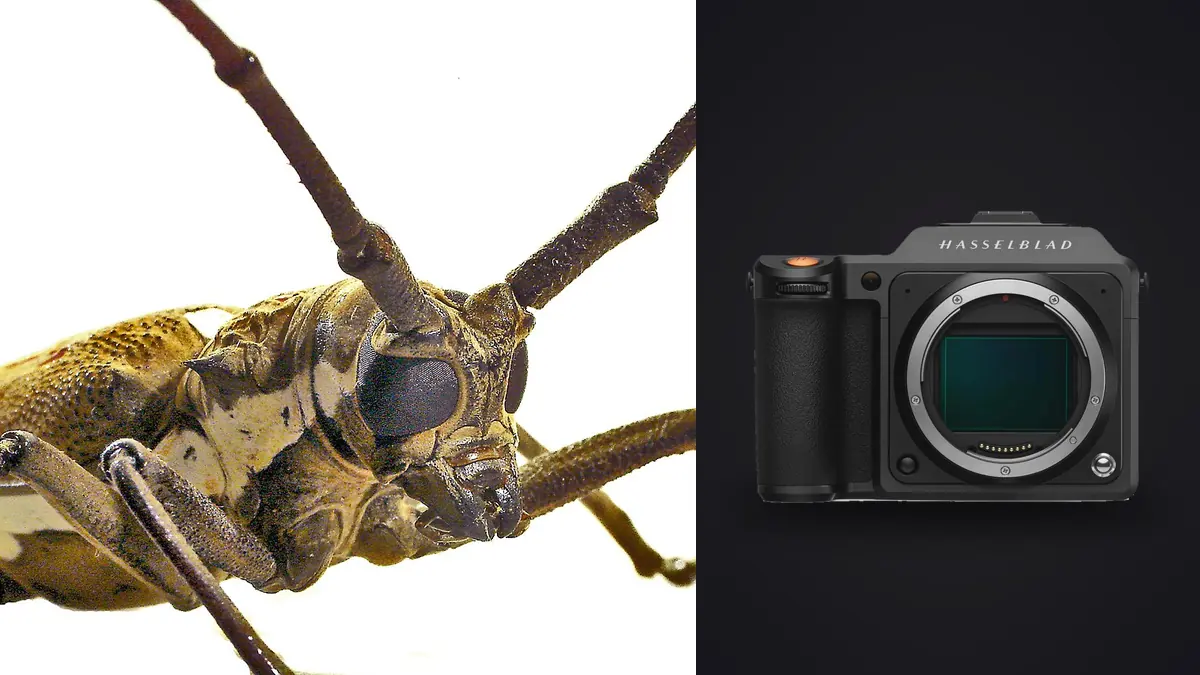
Bringing an $8,000 medium format body into a garden to photograph a jumping spider sounds like a joke until you actually do it and start seeing what the sensor resolves in a beetle's elytra. Then it stops being funny and starts being a genuine argument about whether resolution or magnification matters more for insect work. The Hasselblad X2D 100C was not designed with macro in mind. Hasselblad builds it for landscape, architecture, and studio work, and the marketing material barely mentions bugs. But a handful of photographers have started using it for exactly that, and after several seasons chasing dragonflies and weevils with one, I think the honest verdict is "it depends, and two specific things about this camera change the calculus more than the megapixel count does."
The sensor resolves more than it should be able to, until you stop it down
The X2D 100C's 43.8 x 32.9mm CMOS sensor packs 100 million photosites into a pixel pitch of roughly 3.76 microns, which is tighter than most full-frame 100+ MP sensors squeeze into a smaller area. That density is a gift for a static insect filling the frame in good light. Antennae segments, the pile on a bee's thorax, the faceted texture of a compound eye all hold up under heavy crops in a way a 24 or 45MP file simply can't match.
The catch is diffraction. At that pixel pitch, softening from diffraction becomes visible starting around f/8 to f/11, well before you'd notice it on a full-frame body with larger photosites. Insect macro at anything beyond about 1:2 magnification usually demands f/13 to f/18 just to get a full antenna or set of legs in focus, and that's before you're stacking frames to fight the depth of field problem entirely. So the same aperture that buys you the depth of field you need for a beetle also throws away a meaningful chunk of the resolution advantage you paid for. You end up in a strange spot: shoot wide enough to keep the sensor sharp and you don't have the depth of field to hold the subject; stop down enough for the subject and you've softened the file back toward what a smaller, cheaper sensor would have delivered anyway. The 15-stop dynamic range claim from Hasselblad does earn its keep on backlit wings and iridescent shells, where highlight roll-off on thin, glossy cuticle would clip instantly on a lesser sensor. That part is real and it shows up in the files.
The XCD 120mm Macro won't get you to true life-size
This is the detail that trips people up before they've even unboxed the lens. The XCD 120mm f/3.5 Macro tops out at 0.5x magnification, meaning 1:2, not 1:1. A 15mm damselfly abdomen segment that a Canon RF 100mm Macro or an OM System 60mm Macro would render at full sensor-filling size, the Hasselblad lens renders at half that. For anything smaller than roughly a large ant, you're cropping into the file to get the framing you actually want, which is precisely the situation where the 100MP sensor starts paying its way back. It behaves almost like a built-in digital teleconverter for the smallest subjects, at the cost of composing loosely in the viewfinder and trusting the crop later.
On the plus side, the minimum focus distance sits around 53cm from the sensor plane, which with the lens barrel and hood translates into a working distance that's genuinely comfortable for skittish subjects. Jumping spiders and hoverflies that bolt the instant a 1:1 macro lens gets within a few centimeters will often tolerate the X2D setup at a distance where they don't register it as a threat. That's a real, underrated advantage for anyone shooting live insects rather than pinned specimens.
No mechanical shutter, and why that matters more up close
The X2D 100C ships with no mechanical shutter at all. Every exposure is read electronically off the sensor. At normal focal lengths that's mostly a durability and noise story. At macro magnifications it's a sharpness story. Shutter shock from a physical curtain firing can blur a shot even at 1/125s once you're working at 2x or 3x effective magnification through cropping, because the vibration amplitude relative to the subject's real-world size is so much larger. Removing the shutter mechanism removes that failure mode entirely, and on a tripod or focusing rail I've been able to shoot handheld-adjacent macro sequences that would have shown micro-blur on almost any DSLR of the same era.
The trade-off is flash sync. Electronic-only readout on this sensor doesn't give you the fast global sync some dedicated macro rigs offer, so if you're trying to freeze a wing mid-beat using flash duration rather than shutter speed, you're leaning entirely on the strobe's own flash duration and not getting help from a high sync speed. For static or lightly-moving subjects it's a non-issue. For anything airborne, it matters.
In-body stabilization helps less than the spec sheet implies
Hasselblad rates the 5-axis IBIS at up to 7 stops, and at normal shooting distances that number is roughly believable. At macro distances, angular stabilization (the part IBIS is best at) becomes almost irrelevant, because the dominant camera movement at a few centimeters from the subject is linear, forward-and-back breathing that shifts the focal plane rather than rotating the frame. IBIS barely touches that kind of motion. In practice I still shoot the vast majority of insect work off a focusing rail or a small tripod with a ball head, and treat the stabilization as a nice-to-have for framing checks and scouting shots rather than something to rely on for the keeper frame.
How it stacks up against smaller, cheaper macro rigs
The numbers below are the ones that actually change a buying decision for insect macro work, not a generic spec dump. Weight and in-camera stacking support in particular are the two variables that decide whether a system is pleasant to carry into the field for a three-hour session.
| System | Max magnification | Effective focal length (FF equivalent) | Approx. body + lens weight | In-camera focus stacking |
|---|---|---|---|---|
| Hasselblad X2D 100C + XCD 120mm Macro | 0.5x (1:2) | ~95mm | ~2.0 kg | No, manual bracketing only |
| Sony a7R V + FE 90mm Macro G OSS | 1.0x (1:1) | 90mm | ~1.24 kg | Bracketing sequence, no in-camera blend |
| Fujifilm X-T5 + XF 80mm Macro | 1.0x (1:1) | ~122mm | ~1.31 kg | Bracketing sequence, no in-camera blend |
| OM System OM-1 + M.Zuiko 60mm Macro | 1.0x (2:1 with digital tele-converter) | 120mm | ~0.78 kg | Yes, captures and blends in-body |
Read that table honestly and the OM System combination wins on nearly every practical axis for someone whose main goal is getting a clean, stacked insect image out of the camera with minimal desk time. The Hasselblad wins on file quality once you're printing large or delivering to a client who will crop hard, and it wins on working distance for wary subjects. It loses on weight, on native magnification, and badly on stacking convenience, since Hasselblad doesn't offer any in-camera stacking or blending at all, only a plain manual bracket where you fire off a sequence yourself while adjusting focus by hand or via the rail.
What manual stacking actually does to your evening
Because there's no automated in-camera stack, every subject worth stacking means shooting 15 to 40 frames by hand, racking focus a fraction of a millimeter between each one. A session covering ten or twelve subjects easily produces 250 to 400 raw 3FR files, and at roughly 100 to 150MB each, that's 30 to 50GB before you've opened a single editing app. The lens and the sensor stopped being the bottleneck; sorting the files became the bottleneck instead.
This is the point where I stopped trying to manage stacks by eye in a flat folder view and started running everything through imagic before it ever touches a stacking application like Helicon Focus. The local sharpness and focus scoring is genuinely useful here in a way it isn't for a normal shoot, because within a single 30-frame stack of a weevil, the frames aren't duplicates of each other, they're each sharp in a different narrow slice of the subject, and you need to quickly confirm which ones actually landed in focus versus which ones got blurred by a gust moving the leaf mid-sequence. Instead of scrubbing through 30 nearly-identical thumbnails, the duplicate and burst clustering groups each stack together automatically, so a session of 400 files resolves down to twelve clusters you can scan in a couple of minutes rather than an hour. And because everything runs locally with no cloud upload, none of that raw insect data leaves the laptop, which has mattered on a couple of field trips where the nearest reliable connection was a two-hour drive away. If you haven't looked closely at how the culling side of this actually works, this piece on how AI photo culling works goes into more detail on the scoring approach than I'll repeat here.
Once a stack is blended into a single output file, getting consistent color and contrast across a dozen different insects shot in different light throughout an afternoon is its own small problem. Beetle shells shift wildly in how they reflect light depending on angle, and a treatment that looks right on a metallic green scarab can look flat on a matte brown weevil two subjects later. Running blended files through imagic's apply_my_style, trained on my own previous macro edits rather than a generic preset, has cut a lot of the repetitive slider work out of a typical stacking session. It doesn't replace judgment on the outliers, but it gets the baseline close enough that I'm making small adjustments instead of starting from zero on every image.
Lighting: bring your own solution, because Hasselblad doesn't have one
Stopping down to f/16 or f/18 for depth of field on a subject a few centimeters from the lens eats an enormous amount of light, and there is no native Hasselblad TTL macro flash system to fall back on the way Canon and Nikon shooters have with dedicated twin-flash or ring-flash brackets. Everything here is manual: a bracket-mounted speedlight or two, dialed in by test fires and a bit of chimping on the rear screen, adjusted per subject since insect surfaces vary so much in how they reflect a direct flash. It works, but it's slower than systems built around a proper TTL macro flash, and it's worth budgeting the extra gear and the extra setup time if you're coming from a system that had that automation built in.
Who this setup is actually right for
I'd point someone toward the X2D 100C for insect macro only if large-format printing or heavy post-crop delivery is the actual end use, meaning gallery prints, stock licensing at scale, or client work where a subject needs to survive being cropped to a fraction of the frame. If the goal is fast turnaround, in-field stacking convenience, or chasing insects that don't sit still, a Micro Four Thirds body with a native 1:1 macro lens and in-camera stacking will get you to a finished, usable image faster and with far less gear weight on your shoulder. The Hasselblad rewards patience and a tripod. It does not reward trying to catch a hoverfly hovering.
Frequently Asked Questions
Can the X2D 100C autofocus reliably on a moving insect?
Not in the way a modern mirrorless sports or wildlife AF system can. The hybrid contrast-based autofocus is accurate on a basking dragonfly or a resting beetle but isn't built for continuous tracking of erratic flight. Most people using this body for insects shoot manual focus with focus peaking and lean on a rail for the fine adjustment, treating autofocus as a rough starting point rather than the final word.
How much of the 1TB internal storage does a day of stacked insect shots actually use?
Using the rough average of 120MB per 3FR file, a session generating 300 to 400 stacked frames runs somewhere around 40 to 50GB. That leaves plenty of headroom on the internal SSD for a single outing, but a multi-day trip with several stacking sessions a day will chew through it faster than landscape or portrait shooting would, simply because of how many frames each subject requires.
Does shooting with no mechanical shutter cause any smear on fast-moving wings?
For stacked macro work it doesn't come up, since both the subject and the camera are effectively still for each individual frame in the stack. Rolling-shutter artifacts from the electronic readout would only become visible with genuinely fast subject motion under certain lighting, and macro sequences lit by strobe or steady continuous light avoid that scenario almost entirely.
Is the resolution advantage over a 45 or 61MP full-frame body worth it for insect prints?
Only if you're printing large or cropping hard. Because the XCD 120mm Macro caps at 1:2 rather than 1:1, small subjects already require cropping into the file to get a tight composition, and the extra resolution buys back some of that lost magnification. If you're delivering web-sized images or modest prints, a 1:1 full-frame or APS-C macro lens will get you there with less weight, less cost, and a simpler workflow.