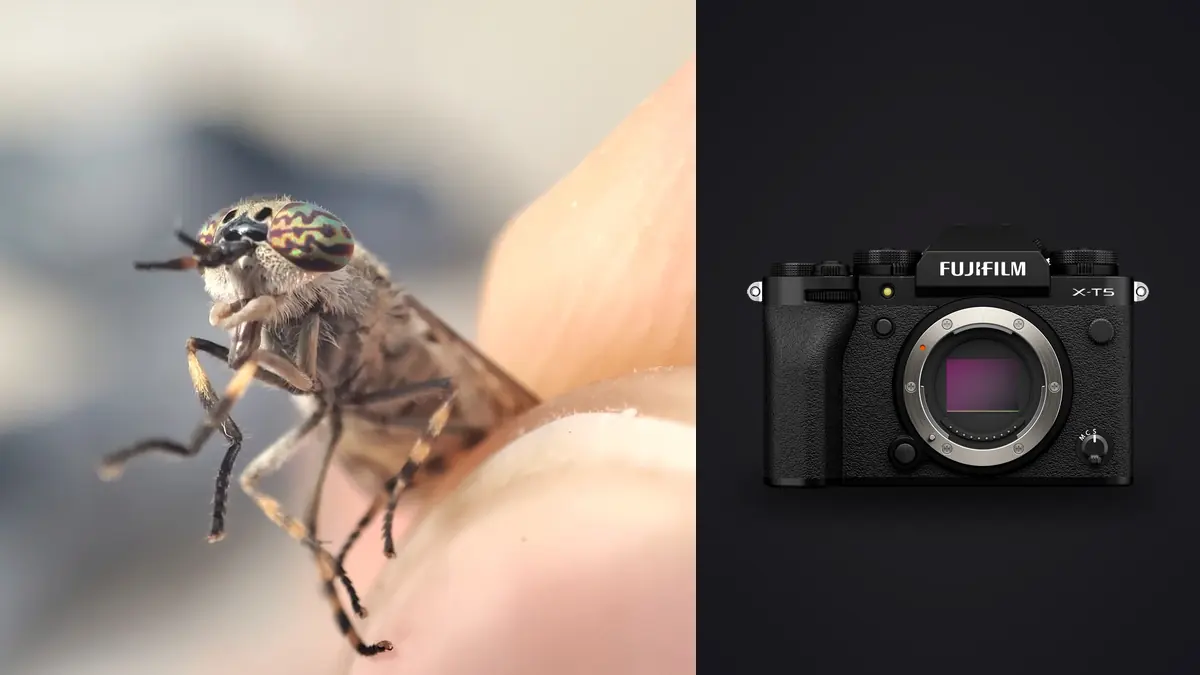
I spent most of last June crouched over a drainage ditch behind a friend's allotment, trying to get a damselfly to hold still long enough for a 1:1 frame. The Fujifilm X-T5 was the body doing the work, paired with a lens that cost more than the camera. What follows isn't a spec sheet rehash. It's what actually changes when you point this particular sensor and this particular autofocus system at something six millimetres long that doesn't want to be photographed.
Why the X-T5's sensor matters more than its resolution number
The headline spec on the X-T5 is 40.2 megapixels on an APS-C X-Trans sensor, and most reviews treat that number as a landscape or studio selling point. For insect work it does something different: it buys you cropping room. A mantis that won't let you inside 15cm, or a jumping spider that bolts the second your shadow crosses it, can still yield a usable frame if you back off and crop hard in post. I've pulled genuinely sharp 12-megapixel crops out of full-frame X-T5 files of subjects I never got physically close to, which isn't something I could say about the 24-megapixel bodies I used before this one.
The trade-off is diffraction. At true 1:1 macro magnification you need small apertures to hold enough of the subject in focus, but this sensor's pixel pitch starts showing softening from diffraction past roughly f/11, and it's visible if you pixel-peep at f/16. On a lower-resolution body you'd get another stop or two of headroom before diffraction became visible at normal viewing sizes. In practice this means the X-T5 pushes you toward focus stacking rather than stopping down, which is a technique shift worth planning for before you're in the field, not after you've shot a whole session at f/18 wondering why nothing looks quite crisp.
In-body stabilisation, and where it actually helps
The five-axis IBIS is rated to 7 stops depending on the lens, and at normal shooting distances it's genuinely excellent. At macro distances the physics change: any stabilisation system is compensating for angular camera shake, but at high magnification the dominant blur source becomes linear movement, tiny shifts in distance to the subject as your hands sway forward and back. IBIS barely touches that. What it does help with is framing and composition while you're holding the camera at awkward angles low over a leaf or a pond edge, where a shaky viewfinder image makes it hard to even confirm you've got the right insect in frame before the shutter fires. I still shoot handheld macro at 1/250s or faster whenever the subject and light allow it, IBIS or not.
Autofocus: honest about its limits here
The X-T5's 425-point phase-detection system with subject detection covers birds, animals, cars, and a handful of other categories, but there is no dedicated insect or bug detection mode, which some competing systems now offer. At macro magnifications beyond about 1:3 the phase-detection AF on Fuji's own macro lenses starts to hunt, especially in the low, dappled light typical of undergrowth at dawn. My workflow settled into single-point AF with the smallest point size, focus peaking turned on in a colour that isn't green or brown (I use red, since most of what I shoot is exactly those two colours), and a willingness to switch to manual focus-and-rock for anything closer than 1:2. This isn't a knock on the camera so much as a reminder that at true macro scale, autofocus systems built around eye-detection algorithms trained on birds and mammals don't have much to grab onto on a fly's compound eye.
Where the AF does earn its keep is on subjects at 1:4 magnification and looser, bees working a lavender head or hoverflies patrolling a flowerbed, where there's enough contrast and size for the system to lock reliably. That's a meaningful chunk of practical insect photography, so I don't want to overstate the limitation.
Lens choices, because the body alone won't get you to 1:1
The X-T5 has no built-in macro capability. Everything below comes from the lens, and Fujifilm's X-mount lineup has three realistic paths plus a budget option worth knowing about.
The Fujinon XF80mmF2.8 R LM OIS WR Macro is the one most people land on. It's a proper telephoto macro, true 1:1, weather-sealed, with its own optical stabilisation that works alongside the body's IBIS. The working distance at 1:1 is around 12cm from the front element, enough that you're not casting a shadow over a skittish subject the way you would with a shorter lens. It's also heavy, and the tripod collar, while useful on a monopod, adds bulk you'll notice after two hours of handheld shooting.
The Fujinon XF30mmF2.8 R LM WR Macro is newer and lighter, also 1:1, but the working distance shrinks to around 4cm at full magnification. That's fine for photographing a stationary flower or a dead leaf, considerably less fine for anything with a nervous system, since you're basically photographing from inside the insect's flight-response zone.
The Laowa 65mm f/2.8 2x Ultra Macro APO is manual focus only, no electronics at all, but it doubles the reproduction ratio to 2:1. For genuinely small subjects, springtails, tiny beetles, the compound eye detail on a housefly, this is the lens that gets you there. Manual focus on a moving insect at 2:1 is a skill in itself and the failure rate is high, but the keepers are worth it.
Extension tubes (Fujifilm's MCEX-11 and MCEX-16) turn any existing lens into a closer-focusing one for a fraction of the cost of a dedicated macro lens. I keep a set in the bag for the XF56mmF1.2 specifically because the extra magnification combined with that lens's rendering gives backgrounds a softness the dedicated macro optics can't quite match, though you lose infinity focus entirely while the tube is attached.
| Lens / setup | Max magnification | Working distance at max mag | Autofocus | Best for |
|---|---|---|---|---|
| XF80mmF2.8 Macro WR | 1:1 | ~12cm | Yes, with OIS | Dragonflies, bees, anything that spooks easily |
| XF30mmF2.8 Macro WR | 1:1 | ~4cm | Yes | Static subjects, flowers, slow-moving beetles |
| Laowa 65mm f/2.8 2x APO | 2:1 | ~4-5cm | Manual only | Very small insects, extreme detail shots |
| XF56mmF1.2 + MCEX-16 tube | ~0.6:1 | ~15cm | Yes, slower | Insect portraits with soft, separated backgrounds |
Focus bracketing on live subjects (it mostly doesn't work, and that's fine)
The X-T5 has an in-camera focus bracketing mode that lets you set a step size, shot count, and interval, then fires off a sequence racking focus through the scene for later stacking in software. It's a genuinely useful feature for dew-covered spiderwebs, pinned specimens, or anything that will hold still for the two or three seconds a full bracket takes. For live insects it's close to useless, because by the third or fourth frame the subject has moved its head, shifted a leg, or flown off entirely, and stacking software can't reconcile that with the earlier frames. What I actually use focus bracketing for is torpid insects: bees and wasps roosting overnight on stems, which barely move in the cool of early morning and give you a genuine window to rack focus across the whole body without motion artifacts. Outside that narrow window, single-shot manual focus with careful depth-of-field placement (favouring the eyes, letting the abdomen fall soft) does more for a live-insect image than any stacking technique will.
Field settings that actually held up
My baseline for insect work with this camera: aperture priority at f/8 to f/10 as the practical ceiling before diffraction starts costing more than depth of field gains, auto ISO capped around 6400 since the X-Trans files clean up well through that range, and a minimum shutter speed floor of 1/500s for anything with wings, faster for damselflies taking off. I shoot almost exclusively on the electronic shutter for macro work, partly for the higher minimum shutter speed ceiling but mostly because it's silent, and a mechanical shutter's clack at close range is enough to send a wary jumping spider straight off the leaf. The one caveat is rolling shutter distortion on fast wing movement, which shows up as a slight skew on dragonfly wings mid-beat if you catch the wrong instant, so I still switch back to mechanical for anything I expect to be genuinely fast.
Weather sealing turned out to matter more than I expected. Early morning is the best time to find insects torpid enough to photograph calmly, and early morning in most temperate climates means dew, sometimes heavy enough that I've had condensation running down the lens barrel. The X-T5 body plus the WR-rated macro lenses shrugged this off across a full season without issue; a non-sealed combination would have needed a lot more babying.
What the RAW files are like to work with
X-Trans files have a reputation, deserved or not, for occasional smearing on very fine repeating detail when demosaiced by software tuned primarily for Bayer sensors. On insect subjects the place this shows up is fine hair on a bee's thorax or the texture on a moth's wing scales, areas where you genuinely want every bit of resolution the 40 megapixels can offer. I haven't found it to be a dealbreaker, most modern raw processors handle X-Trans well enough now, but it's worth test-processing a few macro files in whatever software you actually use before you commit to a big shoot, rather than discovering a demosaicing quirk on the one frame where a rare species finally held still.
Where this camera generates a genuine workflow problem is volume. A single productive morning at a pond can produce 800 to 1,200 frames once you account for burst sequences on anything that moved and the inevitable near-duplicates of a subject that stayed put for ten seconds. Going through that by eye, one at a time, at 40 megapixels per file, is not a good use of an afternoon. This is the point where I stopped trying to cull manually and started running everything through imagic first: its local sharpness scoring flags which frame in a six-shot burst actually landed focus on the compound eyes rather than the antennae, and the duplicate and burst clustering groups near-identical frames of the same beetle so I'm reviewing one representative image per moment instead of forty. It runs entirely on the machine, nothing leaves the laptop, which matters to me for a fairly boring reason: I don't want to wait on an upload queue when I'm trying to turn a shoot around the same evening.
The other piece that's saved real time is imagic's apply_my_style feature. Insect and macro shots tend to share a color character across a season, greens, browns, and the particular way early-morning light renders skin and chitin, so once I've graded a representative batch by hand I train that preset on my own edits and let it carry the look across the rest of the take instead of re-grading every frame from scratch. It's not a substitute for judgment on the standout shots, but for the bulk of a large take it removes a lot of repetitive work. If you're trying to tighten up the gap between shooting and having a finished folder, our breakdown of how AI photo culling actually works covers the mechanics in more depth, and the tips on speeding up a photo workflow apply just as well to a macro take as to anything else.
What I'd tell someone deciding whether to buy in
The X-T5 is not marketed as a macro or wildlife specialist, and it shows in a couple of specific ways: no insect-specific autofocus tracking, and a resolution level that punishes sloppy aperture choices more than older, lower-megapixel Fuji bodies did. What it gets right is the combination of a genuinely excellent APS-C sensor, full weather sealing when paired with WR lenses, a shutter mode quiet enough not to spook the subject, and a body light enough to hold at odd angles for the twenty minutes it sometimes takes a dragonfly to settle. Paired with the XF80mm macro specifically, it's a setup I'd recommend without much hesitation to anyone serious about insects who doesn't want to jump to a full-frame system and a heavier lens just to get there.
Frequently Asked Questions
Does the X-T5's in-body stabilisation actually help with handheld macro shots of insects?
Partly. It steadies the viewfinder image and helps with framing at awkward low angles, but at true macro magnification the main blur source is your own forward-and-back sway relative to the subject, which IBIS doesn't correct. Fast shutter speeds still matter more than stabilisation once you're past roughly 1:3 magnification.
Which Fujifilm macro lens is better for live insects, the XF30mm or the XF80mm?
For anything with legs or wings, the XF80mm's longer working distance (around 12cm at 1:1, versus roughly 4cm on the XF30mm) makes a real difference in how close you can get before the subject bolts. The XF30mm is better suited to flowers, fungi, and other subjects that won't react to you closing in.
Can the in-camera focus bracketing mode be used on live insects?
Rarely with success. Live insects move enough between frames that stacking software struggles to align the sequence cleanly. It works well on torpid, overnight-roosting insects in cool early morning, or on stationary subjects like dew-covered webs, but for active insects a single well-placed manual focus point usually outperforms a failed stack.
Is the 40-megapixel sensor a liability for macro work because of diffraction?
It's a trade-off rather than a flaw. Diffraction softening becomes visible past roughly f/11 on this sensor, which is earlier than on lower-resolution APS-C bodies, so you get less room to stop down for depth of field before image quality starts to suffer. The upside is enough resolution to crop significantly on subjects you can't physically approach, which partially offsets the narrower usable aperture range.