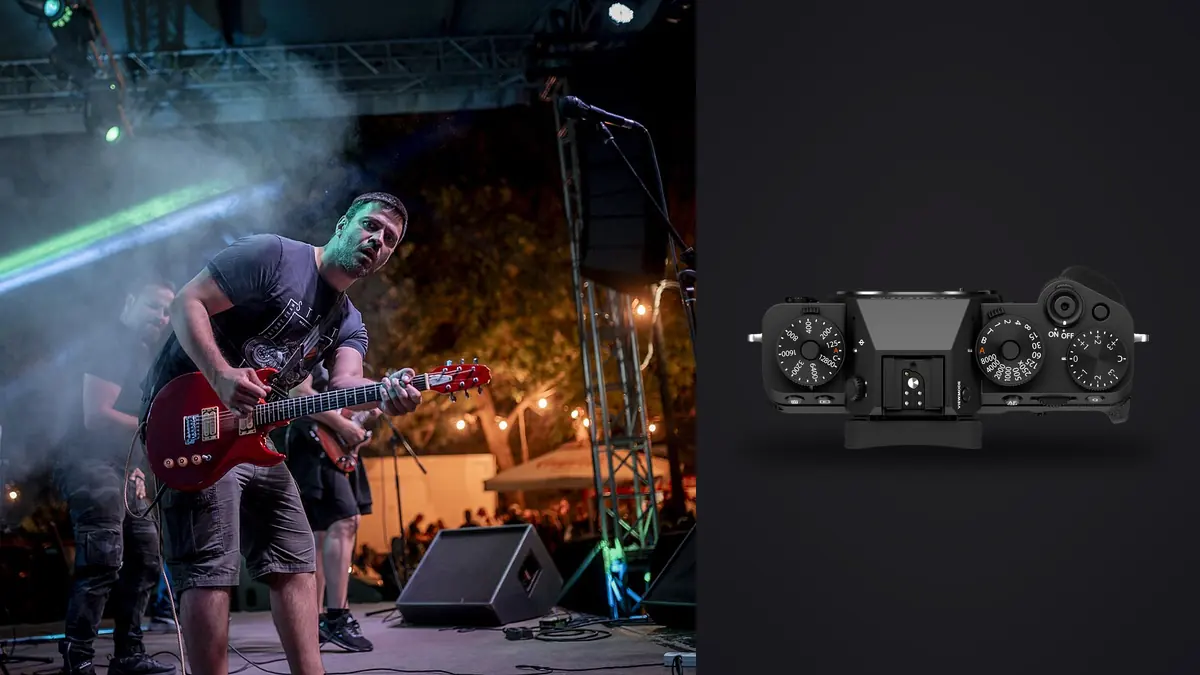
I've had a Fujifilm X-T5 in a photo pit more times than I can count over the last year, everything from a 200-capacity basement show with a single wash of red gel to a festival stage with proper moving lights. It is not the camera most working music photographers reach for first (that's still usually a full-frame body with a fast 70-200), but it has earned a permanent spot in my bag for a specific reason: it is small enough to run all night on a neck strap without wrecking your shoulder, and the files hold up better than the spec sheet suggests once you know how to expose for stage lighting.
This isn't a spec regurgitation. It's what actually changes about your keeper rate, your lens choices, and your post-show workflow when this particular body is the one hanging around your neck for three bands in a row.
The sensor question everyone asks first
The X-T5 uses the 40.2-megapixel X-Trans CMOS 5 HR sensor, which is a genuinely odd choice for low-light work on paper. More megapixels crammed into an APS-C sensor usually means smaller photosites and worse per-pixel noise at high ISO, and that tradeoff is real here. Compared to the 26-megapixel sensor in the older X-T4, the X-T5 is noisier at a pixel level once you get past ISO 6400.
But that's not the whole story for concert work. Because you're starting with 40 megapixels, you can downsample the final export and the noise averages out in a way a 26-megapixel file can't match. I regularly shoot at ISO 6400, sometimes 10000 for a dim support act, and after export at a sane web or print resolution the grain reads as texture rather than mush. Where the X-T5 genuinely struggles is ISO 12800 and up under mixed color stage lighting, where chroma noise in the blues and magentas gets ugly fast. I treat ISO 12800 as an emergency setting, not a working one.
What I actually dial in before doors open
My default for a small venue with unpredictable lighting is aperture priority, auto ISO capped at 6400, minimum shutter speed locked to 1/250s (faster if the singer moves a lot, and they always move a lot). For festival stages with proper lighting rigs I'll drop the ISO ceiling to 3200 because the light output is usually higher and more even.
Electronic shutter is a trap at most venues
On paper the X-T5's fully silent electronic shutter is perfect for gigs: no mechanical clack during a quiet acoustic set, no shutter sound bleeding into a live recording. In practice I only use it when I know the venue's lighting rig is running on a stable, flicker-free source, because most stage lighting isn't.
Cheap LED wash lights and moving heads run on PWM dimming, which means they're flickering at a frequency your eye can't see but a rolling shutter absolutely can. Shoot electronic shutter under that kind of light and you get horizontal banding across the frame, sometimes subtle, sometimes bad enough to bin the shot. I found this out the expensive way at a 300-cap venue where half a set's worth of frames came back with visible banding I hadn't noticed on the small EVF preview. Now my rule is simple: mechanical shutter unless I've specifically confirmed the lighting rig is flicker-safe, which in my experience is maybe one venue in five.
Lens choices change more than usual on this body
The X-T5's APS-C sensor applies a 1.5x crop, which matters more in a photo pit than it does for most other genres because pit access is usually capped at the first three songs and you don't get to walk closer. A 50mm lens behaves like a 75mm. That's mostly good news for tight vocalist shots but it pushes wide-stage shots further than you'd expect.
Here's how the lenses I actually rotate through for live shows stack up on this body:
| Lens | Full-frame equivalent | Max aperture | Where it earns its keep |
|---|---|---|---|
| XF 18mm f/1.4 R LM WR | 27mm | f/1.4 | Wide stage shots, full band in frame from a tight pit rail |
| XF 33mm f/1.4 R LM WR | 50mm | f/1.4 | General workhorse, singer-plus-guitarist framing |
| XF 56mm f/1.2 R WR | 84mm | f/1.2 | Headliner face shots from the barrier, best subject separation of the set |
| XF 50-140mm f/2.8 R LM OIS WR | 75-210mm | f/2.8 | Big rooms where the pit is roped off further from stage |
If I could only bring one lens to a general-admission club show, it's the 33mm f/1.4. It's fast enough for most lighting, wide enough that I'm not constantly backing into the barrier, and light enough that my wrist isn't dead after three sets. The 56mm f/1.2 is gorgeous but I only reach for it when I know I'll have real distance from the stage, otherwise it's cropping people's heads off constantly at that effective 84mm.
Autofocus does fine on faces, less well on fast-moving instruments
Fujifilm added subject detection to the X-T5's autofocus system, and for human faces under stage lighting it's genuinely solid, better than I expected coming from older X-series bodies. It tracks a singer moving across the stage reasonably well as long as there's enough light for the AF system to grab contrast in the first place.
Where it falls apart is fast, erratic movement combined with strobe or blackout hits, which happens constantly at rock and metal shows. A drummer's sticks, a guitarist headbanging into a spotlight that cuts out mid-swing, that kind of thing will hunt the AF system every time. I've stopped fighting it for those moments and switched to zone AF with a smaller area, manually placed, rather than trusting full-frame subject tracking to find the right person in a chaotic frame.
Buffer depth when a mosh pit actually erupts
Most of a set is manageable at a moderate burst rate, but hardcore and punk bills change the math entirely. When the pit opens up and a singer dives into the crowd, you want every frame you can get, and this is where the X-T5's buffer becomes a real limitation rather than a spec sheet footnote. Mechanical shutter tops out at 15fps, electronic at 20fps, and with the camera set to compressed RAW plus a fast UHS-II card I get roughly 30-something frames before the buffer chokes and the burst rate visibly drops. That sounds like a lot until you realize a genuinely chaotic two-second moment can eat through it.
My workaround is discipline rather than gear: short, deliberate bursts of four or five frames timed to the moment rather than holding the shutter down and hoping. It's a habit borrowed from shooting sports on smaller-buffer bodies years ago, and it transfers directly here. Using an uncompressed RAW format buys nothing in this scenario since it fills the buffer even faster, so lossless compressed RAW is what stays in my menu for anything with an active crowd.
Dynamic range against a lit backdrop
Backlighting is the default at most shows, not the exception, since the lighting designer's job is to make the stage look good from the audience's seats, not to flatter your exposure. A singer silhouetted against a bright wash with the crowd's phone lights scattered behind them is a common frame, and it's a genuine dynamic range test. The X-T5 handles it better than I expected coming from Fujifilm's older sensors: shadows on a performer's face pull up cleanly by a couple of stops in post without the muddy color shift that used to plague earlier X-Trans generations, as long as you're exposing for the highlights and not letting the stage lights themselves clip hard. Blow out a moving spotlight and there's no getting that back, so I'd rather underexpose a touch and recover shadow detail than chase a "correct" histogram that clips the light source.
Handling through a long night
The X-T5 doesn't have the built-in vertical grip that the X-H2 series offers, and after three sets with the 50-140mm attached, my hand knows it. It's not a dealbreaker, but if you're shooting a multi-band bill regularly, budget for the optional grip accessory or expect some forearm fatigue by the last act.
Battery life is the other real-world number worth mentioning. CIPA rates the NP-W235 battery at around 580 shots, but that number assumes a lot of idle time between frames. In actual gig use, with the EVF running continuously, bursts firing during choruses, and screen chimping between songs to check exposure, I get closer to 350-400 real frames before the battery taps out. For a three-band night I always carry a second battery. I've been caught out once without one and spent the headliner's set shooting conservatively to stretch the last 15%.
What happens after the show matters just as much
A decent three-band night with this camera leaves me with somewhere between 1,200 and 2,000 RAW files, most of them shot in short bursts trying to catch a specific expression or a light hit at the right moment. Culling that by eye at midnight after a show is how mediocre selects end up on a band's Instagram. This is the part of the workflow I've actually changed in the last year: I run the night's card through imagic before I do anything else, because its local sharpness scoring flags which frame in a five-shot burst actually landed critical focus on the eyes, and the burst clustering groups those near-identical frames together instead of making me click through each one individually. It's not doing anything magic, it's just doing the boring comparison work faster than my tired eyes can at 1am.
The other habit that's stuck is using imagic's apply_my_style preset feature, which is trained on how I've actually edited my own concert photos rather than a generic preset pack. Stage lighting swings wildly between venues, warm tungsten wash at one club, cold blue LED at the next, and having a preset that's learned my own color decisions across dozens of past shows gets me to a consistent look faster than starting from a flat profile every time. It's not a substitute for finishing touches in Lightroom, but it cuts the first pass down considerably.
One more thing that matters more in this genre than most others: a lot of pit photography happens under a photographer contract that restricts where the images can go before the band or their label has approved them. Everything running locally on my laptop instead of round-tripping through a cloud service is a genuinely practical benefit here, not just a privacy talking point, since I'm not uploading unreleased tour photos anywhere while I'm sorting through them. If you want more detail on how that kind of local sharpness scoring and burst grouping actually works under the hood, I wrote about it separately in how AI photo culling works, and there's a broader rundown of workflow habits worth stealing in 10 tips for a faster photo workflow.
Frequently Asked Questions
Is the X-T5's 40-megapixel sensor overkill for gig photography?
Not overkill exactly, but it's a tradeoff you should go in aware of. You get more cropping room, useful when pit access keeps you further back than you'd like, at the cost of slightly noisier files above ISO 6400 compared to lower-resolution APS-C bodies. Downsampling the export hides most of that noise, so it matters less if you're delivering web-sized images than if you're printing large.
Should I shoot the X-T5 in electronic or mechanical shutter at a show?
Default to mechanical unless you've confirmed the venue's lighting rig doesn't flicker. Electronic shutter under PWM-dimmed LED lighting, which describes most small-venue rigs, produces visible banding that's easy to miss on the rear screen and only obvious once you're editing at full size.
What's the one lens to bring if I can only carry one to a club show?
The XF 33mm f/1.4, which behaves like a 50mm on this body. It's fast enough for most stage lighting, wide enough to keep you out of trouble at close pit distances, and versatile enough to cover both wide band shots and tighter singer portraits without a lens change.
How many batteries should I carry for a multi-band night?
At least two. The official CIPA rating overstates real-world performance once you factor in continuous EVF use and frequent burst shooting; expect 350-400 usable frames per charge rather than the rated 580, and don't get caught relying on the last bar during the headliner's set.