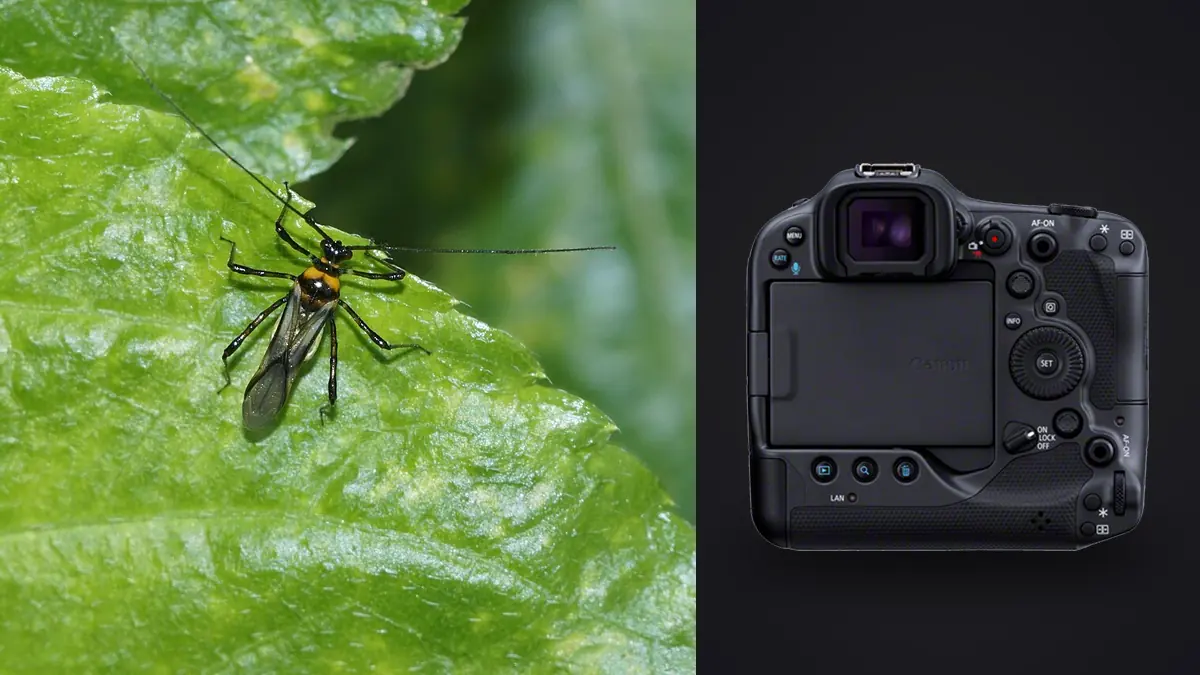
The Canon EOS R3 was built for people who need to freeze a puck leaving a stick or a sprinter's foot leaving the blocks. It was not built with a dew-covered robber fly in mind. And yet a fair number of macro shooters have ended up with an R3 in their bag anyway, usually because they already owned one for birds or motorsport and figured the same body should handle bugs too. I've spent a few seasons doing exactly that, dragging a camera meant for 1/8000s panning shots down into wet grass at 6am to photograph damselflies before they warm up enough to fly off. Some of what the R3 is famous for turns out to matter for insects. A lot of it doesn't, and a couple of its headline features actively work against you at high magnification.
This isn't a spec-sheet regurgitation. It's what actually changes when you point this specific body at something eight millimeters long.
The 24 megapixel question
Macro insect work is one of the few genres where resolution matters almost as much as glass. You're rarely filling the frame at true 1:1 with a subject the size of a housefly, which means you crop, and cropping eats megapixels fast. The R3's 24.1MP stacked sensor is excellent in almost every other respect, low noise, fast readout, genuinely usable to ISO 6400 in a pinch, but it gives you noticeably less room to crop than a 45MP R5 or even a 32MP APS-C body like the R7, which effectively multiplies your macro lens's reach by 1.6x on top of whatever true magnification the lens delivers.
In practice this means you need to get physically closer or rely more heavily on extension tubes and high-magnification lenses than you might expect from a flagship body. It's a genuine trade-off, not a deal breaker, but if your current workflow leans on "shoot slightly wide and crop hard in post," the R3 will frustrate you faster than its price tag suggests it should.
Autofocus: brilliant for eyes that aren't insect eyes
Dual Pixel CMOS AF II on the R3 is fast and sticky, and Eye Control AF (the feature that lets you select a focus point by looking at it through the viewfinder) gets a lot of attention because it's genuinely novel. For insect macro, though, I've found it close to useless. At high magnification your depth of field is measured in millimeters, sometimes fractions of a millimeter at 1:1 or beyond, and the difference between "in focus" and "just behind the compound eye" is not something eye-tracking or even standard subject-detection AF resolves reliably. Canon's animal eye detection will occasionally lock onto a dragonfly or a mantis because they're large enough and have eyes shaped enough like the algorithm expects, but for beetles, ants, moths, and anything under about 15mm, I turn subject detection off entirely and focus manually, usually using focus peaking with the magnified live view punched in.
Where the AF system does earn its keep is in focus bracketing. The R3 will fire a sequence of frames at incrementally shifted focus points and, unlike older Canon bodies, can composite the depth-stacked result in-camera rather than forcing you to export every frame to Photoshop or Helicon Focus first. For a stationary subject, a resting butterfly or a beetle that's gone still on a leaf, this is a real time-saver. For anything moving (which is most insects, most of the time) it's not fast enough between frames to freeze the sequence, and you end up with a stack full of parallax-shifted, half-flown-away frames that composite poorly.
30fps sounds great until you count the keepers
The R3's headline number is 30fps blackout-free electronic shutter, with a more modest 12fps if you want the mechanical shutter (useful for avoiding banding under LED ring lights, which the electronic shutter can pick up). For erratic subjects like hoverflies or jumping spiders that dart unpredictably, that speed is genuinely valuable. I've caught takeoff sequences on dragonflies that would have been pure luck at 10fps.
The catch is what 30fps does to your card and your evening. A ninety-second burst chasing a bee moving between flowers can generate 800 to 1,000 RAW frames, and when 90 percent of them are near-duplicates separated by a fraction of a wingbeat, sorting them by eye is miserable. This is the one place where I'll say plainly that a fast body creates a downstream problem a fast body alone can't solve. I run these sessions through imagic afterward specifically because its duplicate and burst clustering groups those near-identical frames together instead of making me click through all of them individually, and its local sharpness scoring flags which frame in each cluster actually nailed focus on the eye rather than the wing or the antenna. That combination is the only reason 30fps bursts are practical for me at all rather than something I quietly avoid using.
Stabilization and weather sealing, where it counts
The R3's 5-axis in-body stabilization, rated up to 8 stops combined with a compatible IS lens, is more useful for macro than I expected going in. Handheld macro at 1:1 or higher amplifies every tremor in your hands, and while IBIS can't fix subject motion (a shivering insect on a windy morning is going to blur regardless), it does let you shoot a stop or two slower without camera shake becoming the limiting factor, which matters when you're stopped down to f/11 or f/16 for depth of field and light is already scarce at dawn.
Weather sealing is the other underrated win. Early morning is when insects are slowest and most approachable, cold-blooded and not yet warmed up enough to fly, which also means shooting through dew, damp grass, and occasionally light drizzle. The R3 shares its sealing lineage with the 1D X series and shrugs off that kind of morning without complaint. I've had cheaper bodies fog internally or start acting up after a couple of hours in heavy dew; the R3 hasn't given me that problem yet.
Lenses that actually make sense on this body
RF 100mm f/2.8L Macro IS USM
This is the obvious pairing and, for most people, the right one. True 1:1 magnification, a spherical aberration control ring that lets you dial in softer or harder bokeh independent of aperture, and IS that cooperates with the R3's in-body system for genuinely steady handheld framing. It's not cheap, but it's the lens I reach for on 80 percent of insect outings.
MP-E 65mm f/2.8 1-5x Macro
An EF lens (you'll need the RF adapter), fully manual focus, and capable of magnifications well beyond life size, up to 5x. This is the lens for jumping spider portraits and ant faces, subjects too small for the 100mm to fill the frame with. It's brutal to use, no autofocus at all and a working distance measured in centimeters, but nothing else in Canon's native lineup gets you that close.
Third-party options
Laowa's 25mm f/2.8 2.5-5x and 100mm f/2.8 2x macro lenses are both available in RF mount now and worth a look if budget matters, though neither autofocuses and neither talks to the R3's IS coordination.
How the R3 stacks up against the other bodies people actually consider
Most photographers weighing an R3 for insect work are cross-shopping it against an R5 II (more resolution, less speed, no integrated grip) or an R7 (APS-C reach on a budget). Here's how they compare on the things that actually matter for this specific genre, not the general spec sheet.
| Factor | Canon EOS R3 | Canon EOS R5 Mark II | Canon EOS R7 (APS-C) |
|---|---|---|---|
| Resolution / crop room | 24.1MP, least room to crop | 45MP, best for cropping into tiny subjects | 32.5MP on a 1.6x crop, effectively extends any macro lens's reach |
| Max burst (e-shutter) | 30fps | 30fps | 15fps (30fps in RAW burst mode) |
| IBIS rating | Up to 8 stops | Up to 8.5 stops | Up to 7 stops |
| In-camera focus stacking | Yes, with depth compositing | Yes, with depth compositing | Yes, with depth compositing |
| Weather sealing | 1D X-class, best in this group | Strong, one step below R3 | Good but noticeably less robust |
| Body weight (body only) | 822g | 746g | 612g |
| Best fit for insect macro | Fast, erratic subjects; dawn/wet conditions | Maximum detail on stationary or slow subjects | Budget-conscious reach without a heavy telephoto-style macro setup |
If I were buying specifically for insect macro and had no other use case pulling me toward speed, I'd probably lean R5 II for the resolution. The R3 earns its keep when you're also shooting fast wildlife or sports with the same body and don't want to own two systems, which describes a lot of the working photographers who end up owning one.
Flash and working distance
Most serious insect macro leans on flash, usually a twin-flash bracket like Canon's MT-26EX-RT mounted around the lens hood, because natural light at f/11 to f/16 and a fast shutter speed to stop subject motion just isn't enough on its own. The R3's mechanical shutter flash syncs at 1/180s, and the electronic shutter can be used with flash in specific modes but with more restrictions around banding and rolling shutter artifacts under continuous light sources, which is one more reason I keep the mechanical shutter selected for anything flash-lit and save the 30fps electronic mode for available-light burst sequences chasing something in flight.
Where imagic fits into the actual workflow
None of the camera talk above matters much if the evening after a shoot turns into an hour of squinting at near-identical thumbnails. A two-hour macro session with any amount of burst shooting routinely produces two or three thousand frames, and insect work in particular generates huge numbers of visually similar shots because the subject barely moves between exposures. I cull these fully offline in imagic, no upload, no cloud round-trip, which matters when you're working with RAW files straight off a CFexpress card in a field with no signal anyway. The duplicate clustering groups the burst sequences automatically, the local sharpness scoring ranks each cluster by actual focus accuracy rather than just contrast at the frame center, and once I've settled on an edit style for a batch of dragonfly shots I run apply_my_style across the rest of that day's take so the color and contrast treatment stays consistent without me manually matching forty individual edits. It's not a replacement for good technique in the field, nothing is, but it's the difference between a two-hour shoot producing a one-hour cull or a fifteen-minute one. If your current process for sorting bursts is dragging, it's worth reading through how AI photo culling actually works before assuming you just need to shoot fewer frames.
For anyone building out a faster field-to-edit pipeline generally, not just for insects, this rundown of workflow habits covers a lot of the same ground from a broader angle.
Frequently Asked Questions
Is the Canon EOS R3 overkill for macro insect photography specifically?
For most people, yes. You're paying for a stacked sensor, a fully integrated vertical grip, and autofocus tracking sophistication that's aimed at sports and wildlife, none of which does much heavy lifting once you're at 1:1 magnification and focusing manually. It makes sense if you already own one for other work, less sense as a first purchase built around bugs alone.
Does Eye Control AF work on insects?
Not reliably. It's designed around human eye geometry and works best for portraits and general subject tracking. At macro distances and with subjects this small, I've had far better results turning it off and focusing manually with peaking enabled.
Will 24 megapixels limit me if I photograph very small insects like ants?
It limits your cropping headroom compared to higher-resolution bodies, yes. The workaround is getting your actual magnification closer to 1:1 or beyond in-camera (extension tubes, a high-magnification lens like the MP-E 65mm) rather than relying on cropping a wider shot afterward.
Should I use the mechanical or electronic shutter for flash-lit macro?
Mechanical, for anything flash-synced. It gives a clean 1/180s sync without the banding or artifact risk you can run into pairing the electronic shutter with certain flash setups and continuous ambient light sources in the same scene.