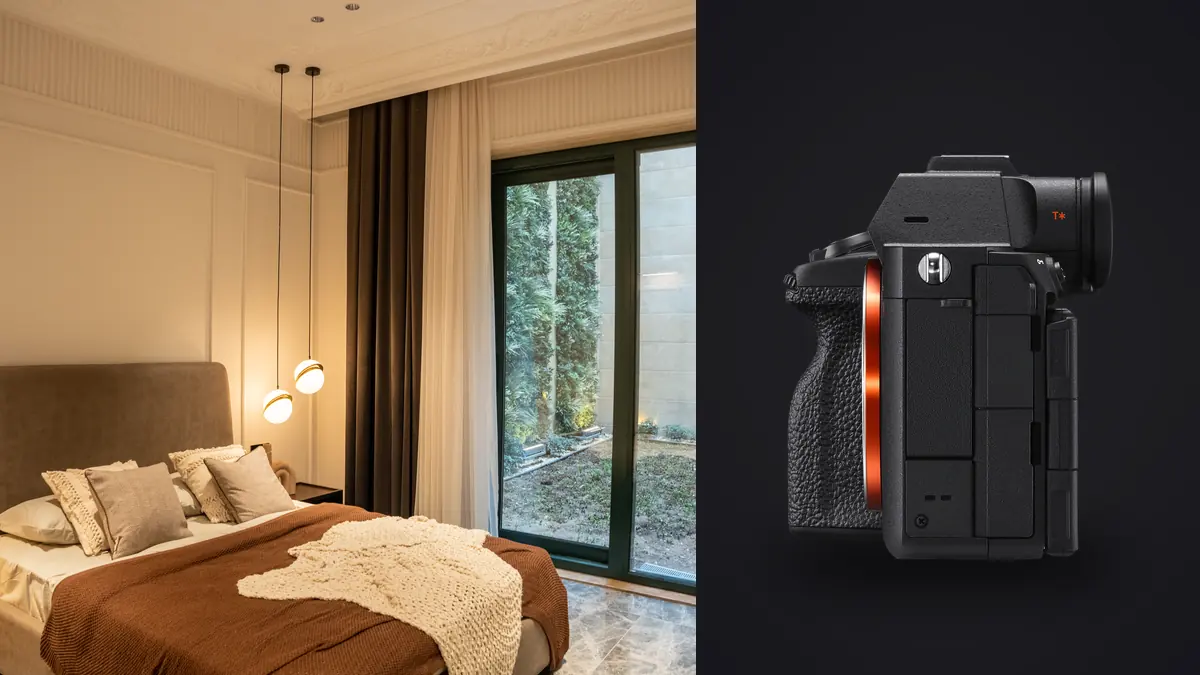
Every few months a client or a mentee asks whether they should move to the Sony A7R V for boudoir work, usually because a photographer friend swears by it or because the 61-megapixel number on the spec sheet is hard to ignore. I've shot somewhere north of forty boudoir and intimate sessions on this body since it replaced my A7R IV in the kit, in bedrooms, hotel suites, and one memorably stubborn Airbnb with orange overhead lighting the host couldn't tell me how to switch off. The short version: it's a genuinely good camera for this kind of work, but not always for the reasons people assume, and it introduces a couple of real headaches that never show up in a spec comparison.
The resolution helps less than you'd think, and hurts more than you'd expect
61 megapixels is genuinely useful for boudoir when the deliverable is a large canvas print or an album spread, and it's genuinely useful for cropping a single 85mm setup into something that reads like a tighter 135mm frame without renting a second lens. Those are real advantages I use on nearly every session.
What it doesn't do is make skin look better. If anything, a 61MP sensor is less forgiving of texture than the 24 or 33 megapixel bodies most boudoir photographers cut their teeth on. Pores, fine hair, stray goosebumps from a cold hotel room, all of it resolves with a clarity that means either more time in diffusion (a scrim or a sheer curtain between subject and window goes a long way) or more time on the retouching side afterward. People tend to ask why their skin looks "more textured" than in a friend's boudoir photos shot on an older camera, and the honest answer is resolution plus a sharp GM lens wide open.
The bigger practical cost is file size. A compressed RAW off this body runs 55 to 70MB depending on scene complexity; lossless compressed pushes past 90MB. A two-hour session with three or four outfit changes, where you're firing short low-speed bursts to catch the half-second where an expression actually works, easily produces 1,800 to 2,500 frames. That's 120 to 180GB from a single booking, routinely, before you've even opened Lightroom.
Autofocus and eye tracking when the room is dim on purpose
Boudoir lighting is rarely bright. Window light in late afternoon, a single continuous LED bounced off a wall, sometimes actual candles for a client who wants that look regardless of what it does to autofocus. This is where the A7R V's subject recognition earns its keep more than the resolution does.
The AI-driven subject detection tracks a human eye reliably even when the subject is reclining at an odd angle, turned mostly away from camera, or partially obscured by a sheet or hair falling across the face. That's a real step up from earlier A7R generations, which would occasionally snap focus to a shoulder or a bedframe when the face wasn't presented cleanly. In genuinely low, warm light I still see the system hunt when a subject is wrapped in sheer or lace fabric layered directly over skin, low contrast confuses it there, and I've learned to switch to a small spot AF area and place focus manually rather than trust wide-area tracking in that specific situation.
ISO performance is usable to about 3200 without much drama, and I'll push to 6400 if I need to keep a natural-light look and can't add a light without killing the mood. Past that, shadow detail in a dark bedroom starts falling apart in a way that's hard to fully recover even with modern noise reduction. Base ISO 100 is where the sensor is happiest, which pushes me toward wider apertures and slower shutter speeds more than I'd use on other genres.
Lens pairings that actually work in a bedroom-sized room
Working distance matters more in boudoir than in almost any other genre I shoot, because the room is small, the subject is often on a bed against a wall, and backing up ten feet to change your composition simply isn't an option. Here's how the lenses I actually reach for compare in that context, not the marketing framing.
| Lens | Typical working distance in a bedroom | Best use in a session | Where it struggles |
|---|---|---|---|
| Sony FE 35mm f/1.4 GM | 4-6 ft for waist-up | Environmental frames that show the room, wide shots of the whole bed | Distorts hands and feet if you get close for detail shots |
| Sony FE 50mm f/1.2 GM | 5-7 ft for waist-up | General coverage, most walk-and-talk posing sequences | Still needs some space; tight in small rooms for full-body |
| Sony FE 85mm f/1.4 GM II | 8-10 ft for waist-up | Compression, creamy backgrounds, most of my hero shots | Needs real distance; unusable in cramped hotel rooms |
| Sony FE 90mm f/2.8 Macro G OSS | 2-4 ft for close detail | Jewelry, lace texture, hands, detail inserts for albums | f/2.8 max aperture is limiting once light drops |
If I could only keep one, it's the 50mm f/1.2, not because it's the sharpest (the 85mm wins that comparison easily) but because it's the only one that reliably works in both a spacious primary bedroom and a cramped secondary one without forcing me to shoot from inside a closet doorway. The 85mm stays in the bag for setups where I know there's room, usually confirmed on a location scout or photos of the space beforehand.
The part nobody puts in the spec sheet: what happens to the files afterward
Boudoir clients ask, more often than in most genres, exactly where their images go after the card comes out of the camera. That's a fair question. These are the most personal photographs most people will ever have taken of themselves, and a lot of culling and editing software now routes files through a cloud service by default, which is a hard sell to a client who's already nervous about the shoot itself.
This is the specific reason I moved my culling workflow to imagic rather than one of the browser-based tools. It processes everything locally, no images ever leave the machine, which means you can honestly tell a client their photos never touched a server before editing even starts. For a genre built on trust, that's not a minor feature, it's close to a prerequisite.
Sorting 2,000 frames from one session without losing your afternoon
A boudoir session on this camera generates the exact problem imagic's culling tools were built for: long low-speed bursts where the difference between the keeper and the reject is a half-closed eye or a hand slightly out of position, repeated across a dozen poses. Running that sequence through the app's duplicate and burst clustering groups near-identical frames together automatically, so instead of scrolling through 40 nearly identical shots of the same pose one at a time, I'm comparing four or five genuinely different options within each cluster and picking fast.
The local sharpness scoring earns its place here too. At f/1.4 to f/2, with a subject who's breathing and shifting slightly between frames, front and back focus misses on the eye happen more often than I'd like to admit, and they're not always obvious at thumbnail size. Having the software flag focus quality across a full session before I start the visual pass has caught misses I would have otherwise overlooked, more than once. If you want the mechanics of how that scoring actually works, I wrote a longer breakdown in how AI photo culling works.
Editing consistency matters just as much as culling speed in this genre. Most boudoir photographers land on one signature look, warm and slightly desaturated, or moody and contrast-heavy, and clients book based on having seen that exact style in a portfolio. I trained imagic's apply_my_style feature on a batch of my own finished boudoir edits, and it now applies a first pass in that same direction to new imports before I make manual adjustments, which has cut the time between "cards downloaded" and "gallery ready" by roughly a third on a typical session.
Stabilization and shutter noise, two things that matter more in an intimate setting than they would on a landscape shoot
The in-body stabilization on the A7R V is rated up to 8 stops with certain lenses, and in practice it lets me hold 1/15s to 1/30s handheld in natural window light without a tripod cluttering an already-small room. That matters in boudoir specifically because a tripod changes the energy of a session, it puts a fixed point between photographer and subject that can make an already-vulnerable moment feel more clinical. Being able to move freely and shoot handheld at a slow shutter keeps the session feeling like a conversation rather than a photo booth.
Shutter sound is the other detail that doesn't show up in reviews aimed at landscape or wildlife shooters but matters constantly here. The A7R V's electronic silent shutter mode means I can fire continuous low-speed bursts through an intimate pose sequence without a mechanical clack punctuating every frame, which for a lot of clients is the difference between staying relaxed and getting self-conscious. I do watch for rolling shutter artifacts on faster movement, but boudoir is mostly slow, deliberate posing, so it's rarely an issue in practice.
Frequently Asked Questions
Is 61 megapixels actually necessary if clients mostly want Instagram-sized galleries?
No, and I'd tell any photographer buying specifically for boudoir not to chase the resolution number. What it buys you is cropping flexibility during a session and print quality for the album and wall-art upsells, which are real revenue in this genre. If your business is entirely digital delivery at web resolution, a 33MP body will save you money on both the camera and the storage you'll need afterward.
Does the shutter sound break the mood during an intimate session?
Not if you use the electronic silent shutter mode, which I run for the vast majority of a boudoir session. The mechanical shutter is fine for a handful of hero frames where you want the tactile confirmation, but for sustained posing sequences the silence keeps the room calmer.
Which lens should a boudoir photographer buy first if budget only allows one?
The 50mm f/1.2 GM, for working-distance flexibility across both spacious and cramped rooms. The 85mm f/1.4 GM II produces the more flattering compression and is my personal favorite result-wise, but it needs more physical space than a lot of bedrooms and hotel rooms actually offer.
How do photographers keep 61MP RAW files from overwhelming storage across a busy season?
Cull hard and cull fast, ideally the same day as the shoot while the poses are still fresh in memory, then archive only the selects at full resolution and offload rejects to cheaper cold storage or delete them outright after a grace period. Running the initial pass through imagic's local burst clustering before opening Lightroom cuts what I'm actually keeping around to a fraction of the raw card dump, which is the only reason a busy boudoir season doesn't quietly eat a new hard drive every few months.