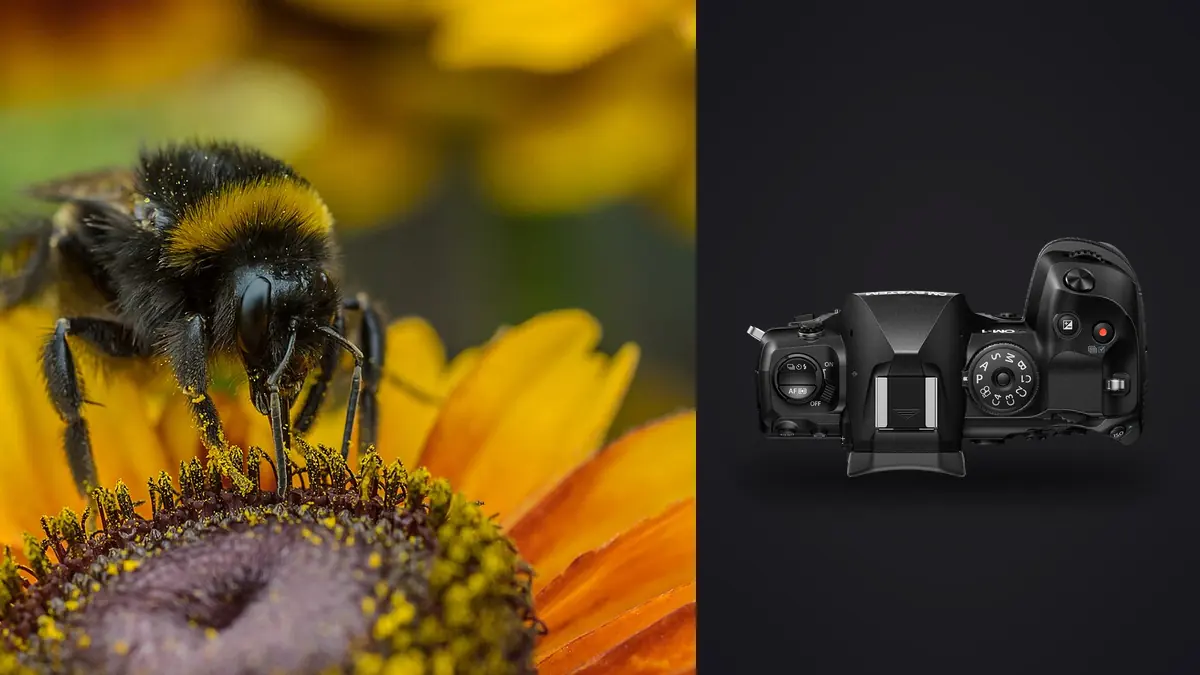
I spent most of a wet April kneeling in a drainage ditch trying to photograph a damselfly that would not sit still, and that morning did more to teach me what the OM-1 Mark II is actually good at than any spec sheet did. Macro insect work is a strange discipline. You're fighting depth of field measured in millimeters, subjects that can vanish in a wingbeat, and light that's usually terrible because the best bug activity happens at dawn when the dew is still on everything. This camera was built with a lot of that in mind, and after a season of dragging it through parks, greenhouses, and a fair amount of nettle, I have opinions about which parts of that design actually pay off in the field and which are more marketing than muscle.
The Sensor Size Argument I Actually Believe In
Every discussion of Four Thirds cameras for macro work eventually turns into a debate about sensor size, so I'll get it out of the way early. The OM-1 Mark II's 20.4-megapixel sensor is smaller than APS-C, let alone full frame, and on paper that sounds like a disadvantage. In practice, for insects specifically, it's the opposite. Depth of field at a given f-number scales with sensor size, so f/8 on this camera gives you roughly the depth of field you'd get at f/16 on a full-frame body, without paying the full diffraction penalty that a full-frame shooter pays for stopping down that far. When you're trying to keep a jumping spider's front eyes and pedipalps both in focus at true macro magnification, that extra sliver of depth of field is the difference between a usable frame and a soft one. I'm not going to pretend diffraction doesn't show up here too, because it does, and past about f/11 on this sensor you can see it if you pixel-peep. But the working range where the image still looks crisp is wider than people expect, and for insects it matters more than raw resolution does.
Which Macro Lens Actually Earns Its Keep
The camera is only half the story. Almost everyone doing serious insect work on this system ends up choosing between the M.Zuiko 90mm f/3.5 Macro IS PRO and the older 60mm f/2.8 Macro, and they're not really interchangeable tools despite both being labeled macro lenses. The 60mm gets you to 1x magnification (roughly 2x full-frame equivalent framing) and it's light enough to hand-hold all day, which makes it the better choice for bees and hoverflies working a flower bed where you're moving constantly and don't want a heavy lens fatiguing your arm by 10am. The 90mm goes to 2x magnification natively and 4x with the MC-20 teleconverter attached, which sounds excessive until you're trying to fill the frame with something the size of a rice grain, like a springtail or a first-instar mantis nymph. The tradeoff is working distance: at 2x magnification you're often only 8 to 10 centimeters from the subject, which is close enough that your own shadow becomes a real problem and skittish insects will simply leave. I use the 60mm for anything that flies off easily and the 90mm for slower, more tolerant subjects like caterpillars, beetles, and anything already dead or torpid from cold mornings.
In-Body Stabilization Changed How I Shoot Handheld
I was skeptical that stabilization mattered much for macro, since conventional wisdom says you want a tripod and a flash rig for serious insect work. That's still true for studio-style setups, but a lot of real insect photography happens in situations where a tripod is useless: uneven ground, subjects that move between frames, or spots where setting up a rig would spook everything nearby. The Mark II's IBIS, rated around 8.5 stops on its own and synced with the 90mm PRO's optical stabilization, actually lets you hand-hold at 1x-2x magnification and get sharp frames at shutter speeds that would have been unthinkable on older bodies. I've gotten clean shots of stationary dragonflies at 1/40s and 1.5x magnification, which is not something I'd have attempted with my old E-M1 II. It doesn't freeze subject motion, obviously, an insect's own movement will still blur regardless of how stable the camera is, but for the huge number of shots where the bug is still and you're the one shaking, it buys real keepers you'd otherwise throw away.
Pro Capture Saved More Shots Than Autofocus Did
The single feature that changed my hit rate the most wasn't autofocus tracking, it was Pro Capture. Insects that launch from a perch, a dragonfly taking off, a mantis striking, a jumping spider leaping toward a lens cap, do it faster than human reaction time can respond to. Pro Capture buffers frames continuously while you have the shutter half-pressed and only commits them to the card once you fully press, including a set number of frames from before you pressed it. Set to SH2 mode at reduced frame rate for reliable continuous autofocus, I've caught liftoff sequences that would have been pure luck otherwise. The catch nobody tells you about is buffer management: at full 50fps with continuous AF the buffer fills fast, and if you leave it running while waiting for something to happen you'll burn through card space and battery life quickly. I keep it dialed to a shorter pre-capture window, usually 10 frames, and only arm it once I can see a subject getting twitchy.
In-Camera Focus Stacking, and Where It Falls Apart
For anything stationary, cold-morning insects, subjects on a stem you can approach slowly, the in-camera focus stacking is genuinely useful and saves a laptop step in the field. You set a bracket, the camera fires a sequence stepping focus through the subject, and either lets you merge in-camera or hands you the raw stack to blend later. Where it falls apart is anything with a heartbeat that's actually beating. A stack of a resting butterfly works beautifully. A stack of a bee still working a flower does not, because between frame one and frame twelve the bee has rotated its head, moved a leg, or flown off entirely, and the merge shows ugly doubling wherever motion happened between exposures. My rule of thumb now is: if the subject hasn't moved in the last ten seconds, it's probably stack material. If it's actively feeding or grooming, I shoot single frames at a smaller aperture instead and accept the shallower depth of field.
| Subject | Aperture | Shutter | AF setting | Notes |
|---|---|---|---|---|
| Jumping spider portrait | f/8 to f/11 | 1/200s+ | Single-point S-AF, small AF target | 90mm PRO, focus on the front eyes, expect to reshoot many times |
| Perched dragonfly/damselfly | f/8 | 1/250s | S-AF with 5-frame focus bracket | Handheld stack works if there's zero wind |
| Dragonfly in flight | f/5.6 | 1/2000s | C-AF, Pro Capture SH2 | Widest usable aperture, prioritize shutter speed over DOF |
| Bee or hoverfly on flower | f/6.3 | 1/1000s | C-AF tracking, small target | 60mm lens, stay mobile, no stacking |
| Ants on the move | f/9 | 1/500s | S-AF, manual focus assist | Pre-focus on the trail and wait, don't chase |
| Torpid cold-morning subject | f/8 | 1/60s | S-AF, 20+ frame stack | Best light and best cooperation of the day, use it |
Weather Sealing, Dew, and Actually Working Outdoors Before 7am
Insect activity peaks around dawn and after rain, which means this camera spends a lot of its working life wet. The IP53 rating and the freeze-tolerant build (rated down to -10°C) aren't marketing fluff for this use case, they're the reason the body has survived mornings where the grass was soaked past my ankles and condensation was forming on every metal surface within minutes. I've had water bead and run straight off the top plate and control dials without any hesitation in operation. What the sealing doesn't solve is the lens fogging from the inside-out temperature differential when you bring a cold camera into a warm car, so I still let gear acclimate in the bag for ten or fifteen minutes before I start shooting, same as I would with any weather-sealed system. The dual card slots also matter more here than they would for landscape work, because a focus bracket sequence or a long Pro Capture burst can eat through a card's buffer write speed fast, and having a fast card as primary with a backup slot running has saved me from a full-card surprise mid-session more than once.
What Happens After the Shoot: Sorting Several Thousand Frames
Nobody warns you about the back end of this hobby. A single productive morning with a 20-frame focus bracket on six different subjects, plus a couple of Pro Capture bursts on anything that flew, easily produces two or three thousand frames. Most of those are near-duplicates: nine frames of the same bee from a burst where only one has the wings in a clean position, or a focus stack where half the frames are redundant because the depth of field already overlapped. I run everything through imagic before I open a single one in an editor, mainly because its sharpness and focus scoring is done locally on the actual pixel data rather than guessing from metadata, and with macro work where the plane of focus is razor thin, that distinction actually matters. It also clusters the burst and near-duplicate frames together so I'm comparing six similar dragonfly shots against each other instead of scrolling past two thousand thumbnails one at a time, which lines up with a lot of what we've written about in how AI photo culling actually works. Because it runs entirely offline, I can do this culling pass on a laptop in the car before I've even left the site, which has changed how I plan a shooting day, more in line with the workflow habits in our piece on speeding up the culling-to-edit pipeline. Once I've got the real keepers isolated, I lean on the apply_my_style preset trained on my own past macro edits to get a fast first pass on white balance and contrast across the set, since insect shots under overcast dawn light all tend to need the same handful of corrections.
Frequently Asked Questions
Is the Four Thirds sensor really a disadvantage for insect macro work compared to a full-frame body?
For this specific use case, not really. The depth of field advantage at equivalent apertures generally outweighs the resolution and high-ISO gap for anything shot near true macro magnification. Where full frame pulls ahead is low-light handheld work at wider apertures, which matters less once you're stopped down to f/8 or beyond for depth of field anyway.
Do I actually need the 90mm Macro IS PRO, or is the 60mm enough for most insects?
If your subjects are mostly larger and more approachable, bees, butterflies, larger beetles, the 60mm is lighter, cheaper, and easier to hand-hold all day. The 90mm earns its price when you're chasing 2x magnification on genuinely tiny subjects or need the extra working distance the longer focal length provides before you spook something.
How many usable frames come out of a typical focus-stacked insect session?
From a morning producing two to three thousand raw frames across brackets and bursts, I typically keep somewhere between 40 and 80 as finished, edited images. The ratio is brutal, which is exactly why sorting locally and quickly before editing matters so much for this genre.
Does Pro Capture drain the battery faster than normal shooting?
Yes, noticeably, especially with continuous autofocus engaged while the buffer is actively rolling. I carry at least two spare BLX-1 batteries for a full field day and try to only arm Pro Capture once a subject looks like it's about to move rather than leaving it running continuously.