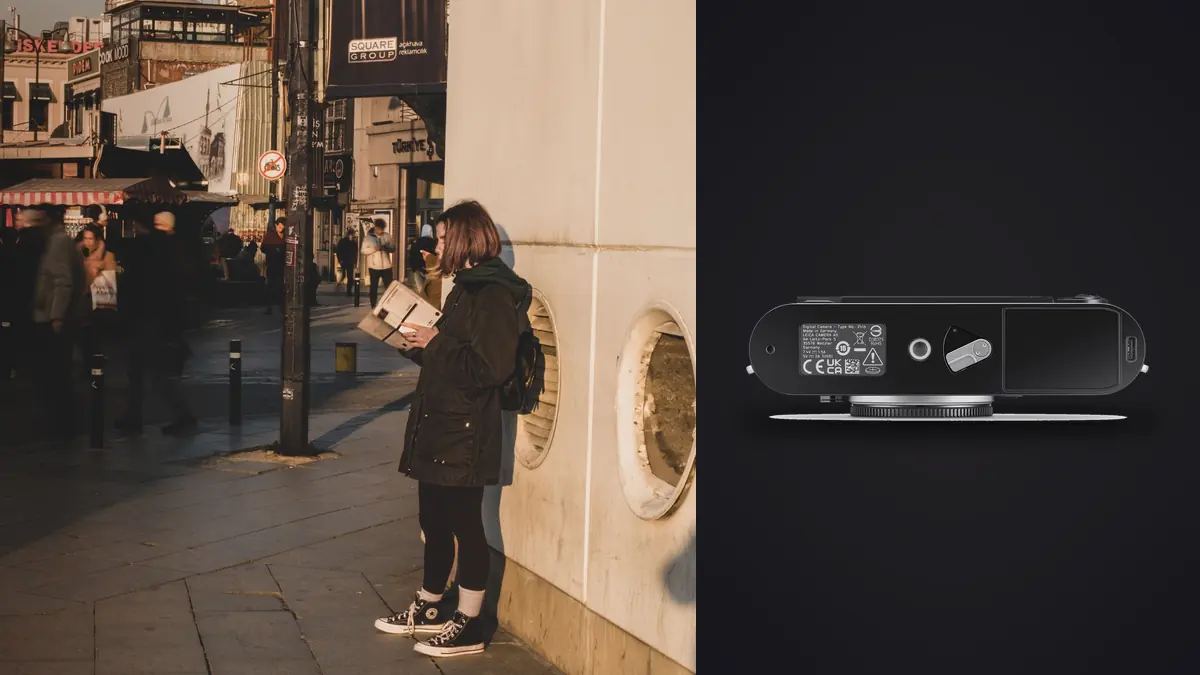
I spent about four months shooting a market vendor project with a Leica M11 before I trusted it enough to leave the backup DSLR at home. The camera is not faster than an autofocus mirrorless body. It is not more forgiving. What it is, once you put the work in, is quieter in every sense: quieter shutter, quieter presence on the street, and a quieter decision-making process because you're not fighting a focus system that's trying to guess what you want. For documentary work where a half-second of hesitation costs you the frame, that trade is worth understanding before you buy in.
Why a manual rangefinder still earns its place on the street
Autofocus has gotten absurdly good in the last five years, so the case for a manual rangefinder needs to be made honestly rather than romantically. Here's the honest version: the M11 doesn't hunt, doesn't rack focus visibly in the viewfinder, and doesn't need you to select a focus point before it commits. You pre-set a distance and aperture, and the camera does exactly nothing until you press the shutter. For a certain kind of documentary photography, walking into a scene where people are already wary of a camera, that predictability matters more than raw speed.
The rangefinder patch itself takes longer to learn than most reviews admit. Coincidence-image focusing under real street lighting, especially at dusk or in mixed shopfront light, is genuinely harder than focusing through an SLR viewfinder. I missed more frames in my first two weeks with the M11 than I had in years with an autofocus body. The payoff came once zone focusing became automatic (see below), at which point I was focusing before I even raised the camera, which is the entire point of the system.
Zone focusing is the actual skill, not the rangefinder patch
Most working street shooters on an M-series body aren't chimping the rangefinder patch for every frame. They're setting a distance and aperture combination that covers a working range, then framing and shooting without touching focus at all. The table below is what I actually dial in with a 35mm lens, which covers the vast majority of my documentary frames. Numbers are rounded and assume a circle of confusion appropriate for viewing at normal print sizes; treat them as a starting point, not gospel, since the M11's 60-megapixel files will show soft edges of a zone more readily than a lower-resolution sensor would.
| Aperture (35mm lens) | Focus set at | Usable sharp range | Typical street use |
|---|---|---|---|
| f/2.8 | 3 m | ~2.4 m to 4.1 m | Portraits and close interactions, shallow separation from background |
| f/4 | 3 m | ~2.2 m to 5.3 m | Default walking-around setting, covers arm's length to across a narrow street |
| f/5.6 | 4 m | ~2.6 m to 8.5 m | Wider scenes, market stalls, groups at slightly more distance |
| f/8 | 5 m | ~3 m to infinity (practical) | Bright daylight documentary, everything from mid-ground to background stays usable |
| f/11 | 6 m | ~3.3 m to infinity | High-contrast midday light, maximum hit rate with zero focusing |
What that table doesn't show is how often you'll deliberately break the zone to get separation on a single subject, using the rangefinder patch properly for a two or three second setup shot. That's fine. Zone focusing is the default state you return to between deliberate shots, not a rule you follow rigidly.
The resolution question: 60, 36, or 18 megapixels
The M11 lets you choose the output resolution of the DNG at capture time rather than forcing you to shoot at full resolution and downsample later. For documentary work this decision matters more than it sounds like it should, because 60-megapixel files accumulate fast over a multi-day assignment and because higher resolution makes every focus miss more visible on a client's monitor.
My rule of thumb after a couple of years with the camera: shoot 36MP for the majority of documentary days, drop to 18MP for anything involving a lot of walking-and-shooting where card space and file handling matter more than pixel-peeping, and only reach for the full 60MP when I know a specific frame might get printed large or cropped hard in post. The full-resolution files are genuinely excellent, but they are not free, and pretending otherwise just means a slower edit later.
Living with the shutter
Leica reworked the shutter mechanism for the M11 and it shows. The mechanical shutter tops out at 1/4000s and is noticeably quieter than the M10 generation, but the bigger change for street work is the electronic shutter option, which is silent and runs up to a much higher top speed. I use the electronic shutter selectively rather than as a default, because rolling shutter distortion is real on this sensor if your subject or your hand is moving quickly, and because the M11 can behave a little unpredictably with certain strobes and LED lighting when the electronic curtain is active. For candid documentary frames in daylight where nobody is sprinting past you, it's close to invisible, and that invisibility is the whole reason to own this camera over a DSLR for this kind of work.
One practical note that caught me off guard: the hybrid shutter mode, where the mechanical first curtain pairs with an electronic second curtain at high shutter speeds, occasionally introduces banding under flickering artificial light, the kind you get in a lot of indoor market or transit settings. If a frame looks wrong under fluorescent or LED lighting, that's usually the cause, and switching back to fully mechanical fixes it.
Battery, cards, and getting through a full day
The M11 dropped the removable baseplate that every M-series camera before it had, which means the battery slides in from the bottom and locks with a small latch instead of requiring you to unclip a plate first. It's a small thing until you're changing batteries one-handed on a moving subway platform, at which point it's a genuine improvement. Battery life is noticeably better than the M10 generation too, enough that a full day of documentary shooting, a few hundred frames with regular chimping to check exposure, usually gets through on one charge with a spare in reserve rather than two spares mandatory.
Storage is a hybrid setup: 64GB built into the camera body plus a UHS-II SD card slot. I treat the internal storage as an emergency buffer, not a primary, because pulling files off it later is slower than just swapping a card. One thing to flag for documentary shooters specifically: the M11's weather sealing is better than earlier M bodies but it is splash resistance, not a fully sealed body in the way a lot of professional DSLRs are. Light rain on a street shoot has never worried me. A sustained downpour would, and I've pulled the camera away rather than test it.
Lens choices that actually get used
Almost everything I shoot on this project comes down to two focal lengths. A 35mm Summicron or Summilux covers general documentary work, close enough to feel present in a scene without distorting faces the way a 28mm can at close range. A 28mm, whether the Elmarit or the faster Summilux, comes out when I need to work closer and still hold context, market stalls, doorways, small rooms where backing up isn't an option. I own a 50mm and barely use it for this kind of work; it's a portrait length more than a documentary one, and on the street it asks you to stand further back than most candid moments allow.
Worth mentioning: the M11's redesigned, thinner sensor stack was built specifically to improve rendering with wide-angle M-mount lenses, reducing the color shift and corner softness that older Leica sensors were known for at 21mm and 28mm. If you're bringing lenses over from an M9 or M240 body, the wide end genuinely looks different, and better, on the M11.
What the files actually cost you afterward
Nobody talks enough about what a 60-megapixel manual-focus camera does to your edit. Two problems compound each other: the files are large, and the focus misses are far less forgiving than they'd be at 24 megapixels, because a rangefinder error that would have looked "close enough" on a smaller sensor is obviously soft when you're looking at full resolution. On a multi-day shoot that's a lot of frames to check by eye, one at a time, at 100%.
This is the part of the workflow where I actually rely on imagic rather than working through Lightroom's loupe view frame by frame. It runs local sharpness and focus scoring on the DNGs as they come in, which catches the rangefinder misses fast, the ones where the zone was set half a stop off or the subject stepped past the focus plane between framing and firing. On a day with two or three hundred frames that's a real time save, and because it processes everything on the machine rather than uploading files anywhere, it's a workflow I'm comfortable using on documentary work where subjects haven't necessarily consented to their images sitting on a cloud server before I've even made an edit selection.
It also handles the duplicate and burst clustering problem that shows up more than you'd expect even on a manual camera. Documentary sequences, someone reaching for a door handle, a vendor mid-gesture, tend to produce three or four very similar frames shot a second or two apart as you refine your timing. Grouping those automatically instead of scrolling past near-duplicates fifty times a day matters more than it sounds like on paper. If you want the mechanics behind how that kind of scoring actually works, this breakdown of how AI photo culling works covers the underlying approach in more detail than I will here.
The other piece I've leaned on is the apply_my_style preset feature, which trains on your own past edits rather than shipping a generic film-emulation look. My documentary work has settled into a fairly specific black-and-white treatment over the last couple of years, and having that applied automatically as a starting point across a new batch of M11 files saves a genuinely large chunk of the editing session, without locking me into someone else's idea of what black and white street photography should look like. For more general habits that shrink that editing session further, 10 tips for a faster photo workflow is worth pairing with whatever culling tool you settle on.
A day-rate reality check
None of this replaces technique. A camera that removes autofocus doesn't make you a better observer of a scene, and I've had days where the M11 cost me frames a cheaper autofocus camera would have caught easily, usually fast-moving kids or a subject who turned unexpectedly close to me. What it's given me instead is a body that people forget is a professional camera within about ten minutes on a busy street, which for documentary access is worth more than a stop of autofocus speed most of the time. If your work depends on staying invisible in a room rather than freezing action, that trade skews heavily in the M11's favor. If you're shooting fast-breaking news or sports-adjacent documentary work, it's the wrong tool, and I wouldn't pretend otherwise.
Frequently Asked Questions
Can you realistically shoot fast-moving street scenes without autofocus?
Yes, but only once zone focusing is second nature. For anything moving unpredictably at close range, a rangefinder will lose frames an autofocus system would catch. For the walking-pace, medium-distance interactions that make up most documentary street work, pre-set zone focusing at f/5.6 or f/8 keeps up fine.
How many photos fit on a card when shooting at full 60-megapixel resolution?
It depends heavily on scene detail and whether you're shooting compressed or uncompressed DNG, but as a rough planning number, a 128GB UHS-II card holds somewhere around 1,500 to 1,800 compressed 60MP DNGs. I plan for closer to 1,200 in practice to leave margin, and I switch down to 36MP for anything where card changes mid-shoot would be disruptive.
Does the electronic shutter actually solve the discretion problem for candid shots?
Mostly. It's silent in the way that matters for street work, nobody hears the shot. The tradeoffs are rolling shutter distortion on fast motion and occasional banding under certain artificial lighting, so I treat it as the default for daylight candid work and switch back to mechanical indoors or with anything moving quickly through the frame.
Is 60 megapixels overkill for documentary and street photography?
For most individual frames, yes, in the sense that you won't print or crop hard enough to need it. Where it earns its keep is archival value and the option to crop a compelling frame you shot a little wide, which happens more often in documentary work than in planned studio shooting. I shoot most days at 36MP for that reason and reserve full resolution for frames I already suspect are keepers.
What's the biggest workflow surprise for photographers moving from a DSLR to the M11?
Underestimating how much time a genuinely sharp 60MP sensor spends exposing your focus mistakes rather than hiding them. Building a fast, reliable culling pass into your routine, whether that's local scoring software or a disciplined manual process, matters more with this camera than it did with lower-resolution autofocus bodies.