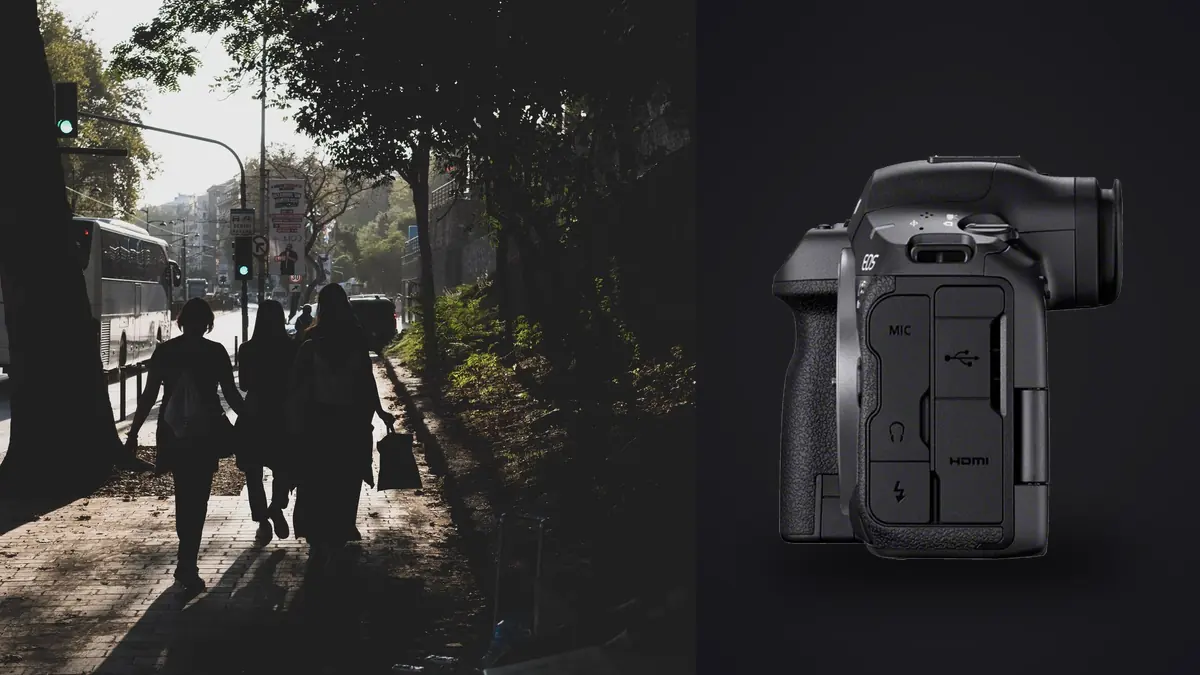
I spent six weeks last autumn on a documentary project in Naples with a Canon EOS R5 Mark II hanging off a Peak Design strap, and it took about three days before I stopped thinking about the camera and started thinking about the market stalls, the kids chasing a football through an alley, the old men playing cards outside a bar at 9am. That's the actual test for a street or documentary tool: not the spec sheet, but whether it disappears once you're deep in a scene. The R5 Mark II is not a small camera, and it will never be the answer for someone who wants a pocket-sized rangefinder body for pure discretion. But once you learn where its specific strengths sit (fast, quiet, almost stubbornly reliable autofocus, even shooting from the hip or the chest) it earns its keep in ways I didn't expect going in.
Size and Presence: The Honest Trade-Off
Let's deal with the obvious complaint first. At roughly 646 grams body-only and built on essentially the same chassis as the original R5, the Mark II is not a discreet camera in the way a Fujifilm X100VI or a Ricoh GR III is. People notice it. In tourist-heavy areas of Naples, that mattered less than I expected because half the crowd was already holding a phone up, but in tighter residential alleys where I was working on portraits of shopkeepers, the size did register with subjects before I'd even raised it to my eye.
What softens that trade-off is the grip and the control layout. For documentary work where you're often shooting one-handed while holding a notebook, a coffee, or a kid's hand out of the frame, the deep grip and well-placed AF-On button matter more than raw bulk. I paired mine with the RF 35mm f/1.8 STM IS most days, which keeps the whole rig light enough to carry for ten hours without shoulder complaints, something I can't say about the body paired with the RF 24-70mm f/2.8L, which turns the kit into a genuine workout by hour six.
Autofocus in a Moving Crowd
This is where the R5 Mark II actually changes how you shoot street work rather than just making it marginally easier. Canon carried over Eye Control AF from the R3, and after two frustrating days of calibration (it needs a proper, patient setup session, not a thirty-second attempt in a coffee shop) it became the single biggest workflow change in my kit. Looking at a face in a crowded frame and having the focus point jump there instantly, without a joystick nudge, means I catch expressions I would have missed a beat later with any previous R-series body.
The subject detection is also genuinely better at distinguishing a face partially obscured by a market umbrella or a bus window than the original R5 was. It's not flawless. In deep shade with strong backlight, like shooting into a doorway from a sunlit street, it will occasionally hunt for half a second before locking. But across roughly 40,000 frames from that Naples trip, my keeper rate on focus alone was noticeably higher than what I got from an R6 II on a similar assignment the year before.
Pre-continuous shooting is the other feature worth calling out specifically for documentary work. It buffers frames for up to half a second before you fully press the shutter, which sounds like a gimmick until you're photographing a street vendor tossing dough and you catch the actual peak of the throw instead of the half-second after you reacted to it. I used it maybe a dozen times over the trip, and every single one of those frames became a keeper.
Low Light, High ISO, and What Documentary Work Actually Demands
Most street and documentary shooting doesn't happen at golden hour. It happens in dim kitchens, under fluorescent market lighting, in bars at midnight where raising a flash would kill the entire mood of the scene. The R5 Mark II's stacked BSI sensor holds up cleanly through ISO 6400, and I pushed it to ISO 12800 on several interior shots without hesitation, knowing the noise pattern stays fine-grained rather than blotchy. Past ISO 25600 the files start losing enough shadow detail that I only reach for it when there's genuinely no other option, like a dimly lit backroom card game where flash was never on the table.
In-body stabilization rated up to 8.5 stops with compatible RF lenses is what actually let me shoot handheld at 1/15s in some of those interiors without a single blurred frame from camera shake. Subject motion is a separate problem the IBIS can't solve, but for static or slow-moving scenes in low light, it buys real flexibility that a lot of competing bodies simply don't offer.
Choosing Glass for Street Work
The lens you put on the R5 Mark II changes the whole character of a street kit more than almost any menu setting. I rotated through four primes over the course of the project and settled into a pattern that might be useful if you're deciding what to actually buy.
| Lens | Weight | Best Street Use | Where It Struggles |
|---|---|---|---|
| RF 28mm f/2.8 STM | 120g | All-day carry, environmental scenes, tight alleys | Soft wide open, no weather sealing |
| RF 35mm f/1.8 STM IS | 305g | General documentary work, portraits with context | Not fast enough for very dark interiors alone |
| RF 50mm f/1.8 STM | 160g | Candid close portraits, low light with IBIS help | Frames too tight for cramped market alleys |
| RF 24mm f/1.4L | 570g | Environmental storytelling, night scenes | Heavy for a full walking day, draws attention |
If I had to keep exactly one for a long documentary trip, it's the 35mm. It's fast enough for most interiors once you accept ISO 3200 as a normal working number, light enough to forget about, and the built-in IS pairs with the body's IBIS for a stabilization combo that genuinely lets you work slower shutter speeds than you'd expect.
Weather, Batteries, and Long Shooting Days
Naples in October threw a few short, hard rain squalls at me, and the R5 Mark II's sealing (equivalent to the original R5, not upgraded) held up fine through drizzle and a five-minute downpour under an awning. I wouldn't push it into a genuine storm without a rain cover, but for the kind of unpredictable weather documentary shooters actually encounter, it's dependable.
Battery life on the LP-E6P is solid for stills-only days, comfortably past 500 frames with the EVF in regular use, though I still carried two spares because a full day of chimping and reviewing takes a real bite out of the number. Dual card slots (CFexpress Type B and UHS-II SD) meant I could shoot RAW to the fast card and a JPEG backup to SD simultaneously, which saved me once when a corrupted card scare turned out to be a non-issue because the second copy was intact.
Getting From 3,000 Frames to a Finished Edit
The uncomfortable truth about a 45-megapixel body shooting at up to 30fps is that a single afternoon of street work can produce more files than most people shoot in a month. My Naples trip ended with just over 41,000 RAW frames across six weeks, and the old approach of scrolling through a Lightroom catalog one thumbnail at a time simply doesn't scale to that volume, especially when a huge percentage of those frames are duplicate bursts of the same three-second moment.
I moved my culling entirely into imagic for that project, running it locally on the laptop each evening before backing up to two separate drives. The sharpness scoring caught missed focus on frames that looked fine at thumbnail size but were actually a half-step behind on the eyes, which matters enormously when you're delivering a documentary edit that needs to hold up printed large. The burst clustering was the bigger time saver though: instead of manually comparing fifteen nearly identical frames of a vendor's hand mid-gesture, it grouped them and surfaced the sharpest one automatically, cutting my nightly review time roughly in half. Because everything runs on-device with no cloud upload, I wasn't worried about handing off unpublished documentary material to a third-party server either, which matters when some of what I was shooting involved people who hadn't yet agreed to publication.
For the final pass, I used imagic's apply_my_style feature, trained on a batch of edits I'd done manually on the first week's take, to apply a consistent baseline grade across the rest of the project before I went in for scene-specific adjustments. It's not a substitute for real editing judgment, but as a starting point across thousands of frames shot in wildly different lighting, it saved a genuine amount of repetitive work. If you're building out a faster review pipeline of your own, our piece on speeding up a photo editing workflow covers more of the habits that compound over a long project like this one.
Who Should Actually Buy This Camera for Street Work
If you're shooting purely for personal street photography on weekends, the R5 Mark II is arguably overkill, both in price and in the sheer file weight it produces per outing. A smaller APS-C body or a fixed-lens compact will get you closer to invisible and cost a fraction as much. But for working documentary photographers who need the autofocus reliability, the dynamic range for mixed indoor and outdoor light, and files that hold up to large print or heavy crop, it's a genuinely different tool than what most people are used to reaching for on the street.
One thing worth budgeting for alongside the camera itself is whatever you'll use to get through the file volume. I'd rather pay once for a local culling tool than add another monthly line item on top of a camera this expensive, which is part of why I stuck with imagic's one-time purchase instead of a subscription-based catalog app for this kind of high-output work.
Frequently Asked Questions
Is the Canon EOS R5 Mark II too loud or too obvious for candid street photography?
With the electronic shutter engaged and sound effects disabled, it's completely silent, which is the setting I used for almost all candid work. The mechanical shutter option exists for situations where you want the tactile feedback or need to avoid banding under certain artificial lights, but for street candids the electronic mode is the one to live in.
Does the eye control autofocus actually work for fast-moving street scenes?
Once calibrated properly, yes, though it works better for a single clear subject than for scanning a busy crowd looking for the next moment. I treat it as a fast way to lock onto someone I've already spotted rather than a tool for finding subjects in the first place.
How many RAW files can I realistically expect to shoot on a multi-week documentary trip?
It depends heavily on shooting style, but 500 to 1,000 frames per active shooting day is common once you factor in bursts for decisive moments. Over a six-week project that adds up fast, which is exactly why a local culling tool that can score sharpness and cluster near-duplicate bursts becomes necessary rather than optional. If you're curious how that kind of automated culling actually works under the hood, we cover the mechanics in how AI photo culling works.
Is the RF 35mm f/1.8 or the RF 50mm f/1.8 the better single lens for street and documentary work?
For most documentary contexts I'd pick the 35mm because it holds enough environment around a subject to tell a story, not just isolate a face. The 50mm is better if your work leans toward tighter candid portraits and you're comfortable working closer to your subjects, which not every street situation allows.