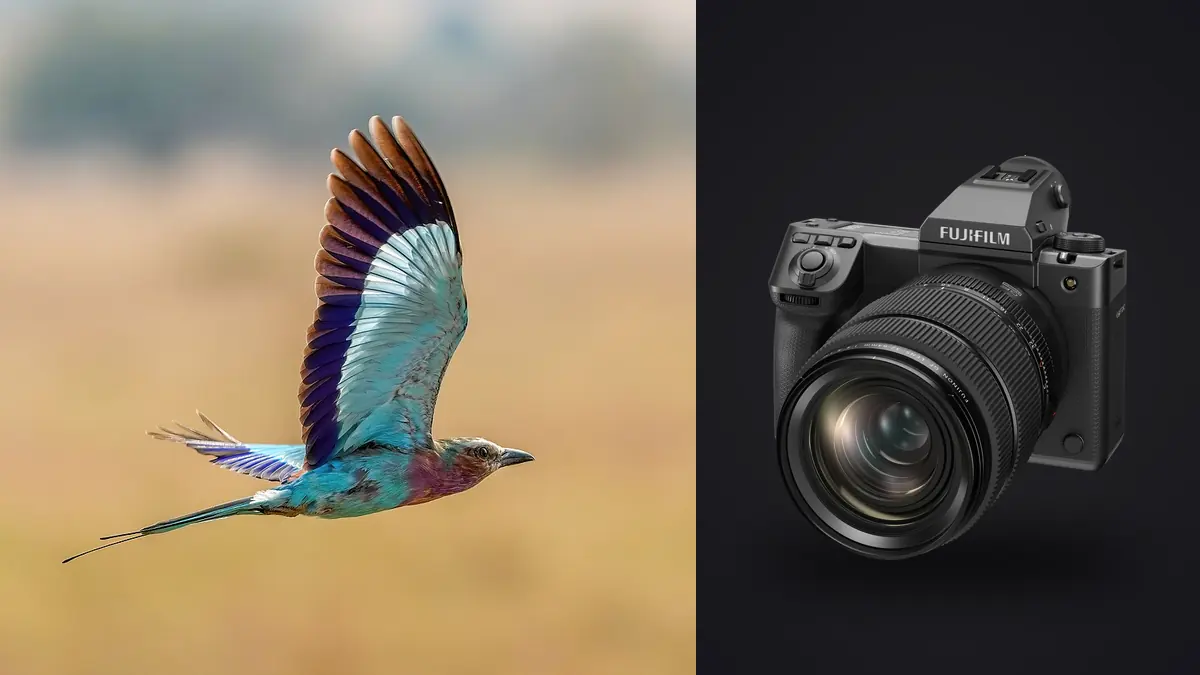
I get the same reaction every time I mention shooting birds in flight with a Fujifilm GFX 100 II: a pause, then "wait, the medium format one?" Yes, the medium format one. It is not the camera anyone would recommend from a spec sheet for erratic, fast-moving subjects, and I want to be upfront about that before getting into what it actually does well. This is not a puff piece for a camera that costs more than most people's cars. It is a report on where a 102-megapixel body with a comparatively modest autofocus system earns its keep against birds, and where it just does not.
The short version: for perched birds, slow raptors riding thermals, and anything with a predictable flight line, the GFX 100 II is genuinely rewarding, mostly because of what the sensor gives you afterward, not during the shot. For erratic small passerines darting through branches or anything requiring 20+ fps to nail the wingtip position, it is the wrong tool and no amount of technique fixes that.
The reach penalty nobody mentions upfront
Here is the thing that trips up photographers switching from full frame or APS-C: a longer physical focal length on a medium format sensor does not translate to more reach than you would expect. It translates to less. The GFX sensor (43.8 x 32.9mm) has a larger diagonal than full frame, so the crop factor works in reverse. A 500mm lens on the GFX 100 II gives you a field of view roughly equivalent to 395mm on a full-frame body. That surprised me the first time I put the GF 500mm f/5.6 R LM OIS WR on the camera and compared it side by side with a 400mm prime on a Nikon body I had brought along as a backup. They framed almost identically.
That is not a flaw in the lens, it is just sensor geometry, but it matters enormously for budgeting your kit. If you are coming from shooting a 600mm prime on full frame expecting the GF 500mm to out-reach it, it will not. Fuji's own GF telephoto lineup tops out at that 500mm f/5.6, and the 1.4x teleconverter (GF1.4X TC WR) gets you to 700mm actual, which lands around 553mm full-frame-equivalent at a real-world f/8. That is workable for perched birds at a respectful distance, but it is not what a serious BIF shooter chasing ospreys over open water is used to carrying.
Where the megapixels partially claw this back is in post. Cropping a 102MP frame down to something resembling an APS-C-equivalent center crop still leaves you somewhere around 40 to 45 effective megapixels, which is more resolution than a lot of dedicated wildlife bodies deliver natively. So the practical move becomes: frame a bit looser than instinct tells you, nail the focus, and crop hard afterward rather than trying to fill the frame in camera the way you would with a 600mm on a stacked-sensor body.
Lens reach at a glance
| Configuration | Actual focal length | Full-frame equivalent | Working aperture |
|---|---|---|---|
| GF 500mm f/5.6 alone | 500mm | ~395mm | f/5.6 |
| GF 500mm + GF1.4X TC WR | 700mm | ~553mm | f/8 |
| GF 500mm, cropped to APS-C-equivalent frame area in post | 500mm (optical) | ~630mm effective framing at ~45MP output | f/5.6 |
Autofocus: honest, not damning
Fuji's subject detection has come a long way, and bird detection does recognize an eye and lock onto it reliably once a bird is reasonably large in the frame and not tangled in branches. On a perched heron at 15 meters, it finds the eye almost every time and holds it through small head movements. That part works.
Tracking a bird accelerating off a branch, or a swift cutting sideways against a bright sky, is a different story. The GFX 100 II's autofocus system covers the frame with phase-detection points and the subject recognition model genuinely tries, but there is no dedicated AI processing chip paired with a stacked sensor the way there is in something like a Sony A9 III or a Nikon Z9. The hit rate on a fast, erratic subject drops noticeably compared to those bodies, and I noticed it drops further in low-contrast conditions like an overcast sky where the bird's silhouette blends with the background. My rough field impression across several outings, not a lab test, put keeper rates on genuinely fast BIF sequences somewhere around a third to a half of what I get out of a modern stacked-sensor sports body with the same subject and light.
Where this stops being a dealbreaker is with slower, larger birds. Herons, storks, most raptors soaring rather than stooping, geese in formation flight: these move predictably enough that the system keeps up, and the resulting files reward the extra resolution with detail in the feathers that a smaller sensor genuinely cannot match at the same output size.
Buffer depth is the real ceiling
Frame rate gets the headline attention but buffer depth is what actually decides whether you get the shot. The GFX 100 II tops out around 8 fps mechanical shutter, and only with the optional VG-GFX II vertical battery grip attached for the extra power draw; off a single battery in the body alone you are closer to 5 fps. Either way, that is already slower than most dedicated wildlife bodies.
The bigger issue is what happens after a couple of seconds of continuous shooting. Shooting lossless compressed RAW on a fast CFexpress card, I consistently ran the buffer dry somewhere around 50 to 60 frames before the camera stalled and started dropping to a crawl. At 8 fps that is roughly six to seven seconds of continuous shooting before you are waiting on the buffer to clear, which for a bird taking off, banking, and landing again is often not enough runway. Compare that to a body that can sustain 20 to 30 fps for hundreds of frames without flinching, and you start to understand why nobody builds a dedicated BIF kit around a medium format body.
Buffer and burst comparison
| Body | Max continuous (mechanical) | Approx. RAW buffer depth | Typical RAW file size |
|---|---|---|---|
| Fujifilm GFX 100 II | 8 fps (with grip) | ~50-60 frames | 100-130MB |
| Nikon Z9 | 20 fps | 1000+ frames | 50-60MB |
| Sony A9 III | 120 fps (global shutter) | 1000+ frames | 25-50MB |
| Canon EOS R5 Mark II | 30 fps (electronic) | ~190 frames | 50-65MB |
The file size column matters as much as the buffer column. A single afternoon of chasing birds with the GFX 100 II, even at a modest hit rate, can put you at 150GB or more of raw data before dinner. That has real consequences for how you cull afterward, which I will get to.
Shutter choice and the rolling shutter problem
The GFX 100 II does not have a stacked or global shutter sensor, so the electronic shutter reads the frame line by line at a speed slow enough to visibly warp fast-moving subjects. On a bird's wingtip moving quickly across the frame during a pan, this shows up as a subtle diagonal skew, sometimes enough to bend a wing shape in a way that is obviously wrong once you zoom in. I learned this the annoying way, reviewing a sequence of a kestrel hovering and noticing the wing edges looked slightly sheared on every third or fourth frame shot in full electronic silent mode.
The fix is simple but limits your options: stick to the mechanical shutter for anything with fast wing motion, even though that caps you at the lower frame rate and adds shutter noise you would rather not have near skittish birds. Electronic shutter is fine for slower subjects, perched birds, or anything where the motion across the frame is gentle.
What a day of shooting actually looks like
In practice, my kit for a birding session with this camera is the GFX 100 II, the GF 500mm f/5.6, occasionally the teleconverter if I am working a heronry from a fixed hide rather than following erratic flight. I shoot mechanical shutter, single or wide-area AF with bird detection active, and I keep expectations calibrated to slower subjects. I am not trying to compete with a Z9 shooter on swallows over a lake. I am trying to get a soaring red kite or a heron's takeoff with enough resolution to print large and crop hard.
The unglamorous part is what happens after the shoot. A session that produces two or three thousand frames at 100+ MB each is not something you want to scroll through one by one in a standard RAW browser, and this is where I lean on imagic. It runs the sharpness and focus scoring locally, so those huge GFX files never leave the machine, which matters given how large the folders get. It also clusters the burst sequences and near-duplicates automatically, which on a wing-beat sequence shot at even 8 fps can mean forty near-identical frames of the same takeoff collapsing down to the two or three that are actually sharp on the eye. Given the buffer limitations already forcing shorter bursts, not wasting review time on redundant frames matters more here than it would with a camera that can spray thousands of frames per outing.
The other piece that saves real time is the apply_my_style preset. I trained mine on a batch of heron and raptor edits I was happy with, tonal curve, a specific white balance lean, the sharpening approach that suits the GFX files without over-sharpening feather detail, and now a big batch of a day's keepers gets that look applied automatically instead of me re-deriving the same edit by hand across sixty images. It is not doing anything I could not do manually, it is just not making me do it sixty times.
Is it actually worth it for wildlife work
Depends entirely on what you shoot and why. If bird-in-flight action is the bulk of your work, buy the camera built for that job. A stacked-sensor sports body with a fast telephoto zoom will out-hit-rate the GFX 100 II on erratic subjects every single time, and it is not close.
If your interest leans toward habitat inclusion, large prints, and subjects that move with some predictability, the medium format sensor earns its cost in a way that is hard to describe until you see a heron portrait printed at 40 inches with feather detail intact at full crop. I have kept this camera in the bag specifically for slower, more deliberate bird photography, not as my primary BIF tool, and that split use is honestly the only way I would recommend it for this genre.
Frequently Asked Questions
Can the GFX 100 II keep up with fast bird-in-flight sequences at all?
It can track slower, larger birds like herons, storks, and soaring raptors reasonably well. Small, fast, erratic fliers like swifts or swallows will produce a noticeably lower keeper rate than a stacked-sensor sports body, and the buffer will run dry well before a comparable sports camera would.
Does the GF 500mm f/5.6 give enough reach for wildlife work?
It gives roughly 395mm of full-frame-equivalent field of view due to the larger medium format sensor, which is less reach than the focal length number suggests. Adding the 1.4x teleconverter brings that to roughly 553mm equivalent at f/8. The extra resolution partially compensates by allowing a heavier crop in post without losing as much detail.
Should I shoot electronic or mechanical shutter for birds in flight?
Mechanical, if wing motion is fast. The sensor is not stacked, so electronic shutter can visibly warp fast-moving wingtips through rolling shutter skew. Save electronic silent shooting for slower or stationary subjects.
How do I manage the huge file sizes from a day of shooting?
Plan for it before you shoot, not after. A single session can easily produce well over 100GB given files in the 100-130MB range. Culling software that scores sharpness locally and groups burst sequences, which is what I use imagic for, cuts review time dramatically compared to sorting that volume by eye in a standard browser. See our breakdown of how AI photo culling actually works if you want the mechanics behind that scoring.
If you are rethinking your whole capture-to-edit pipeline around a camera that produces files this large, it is worth reading through our workflow speed tips as well. Most of them apply even more directly once your average RAW file crosses the 100MB mark.