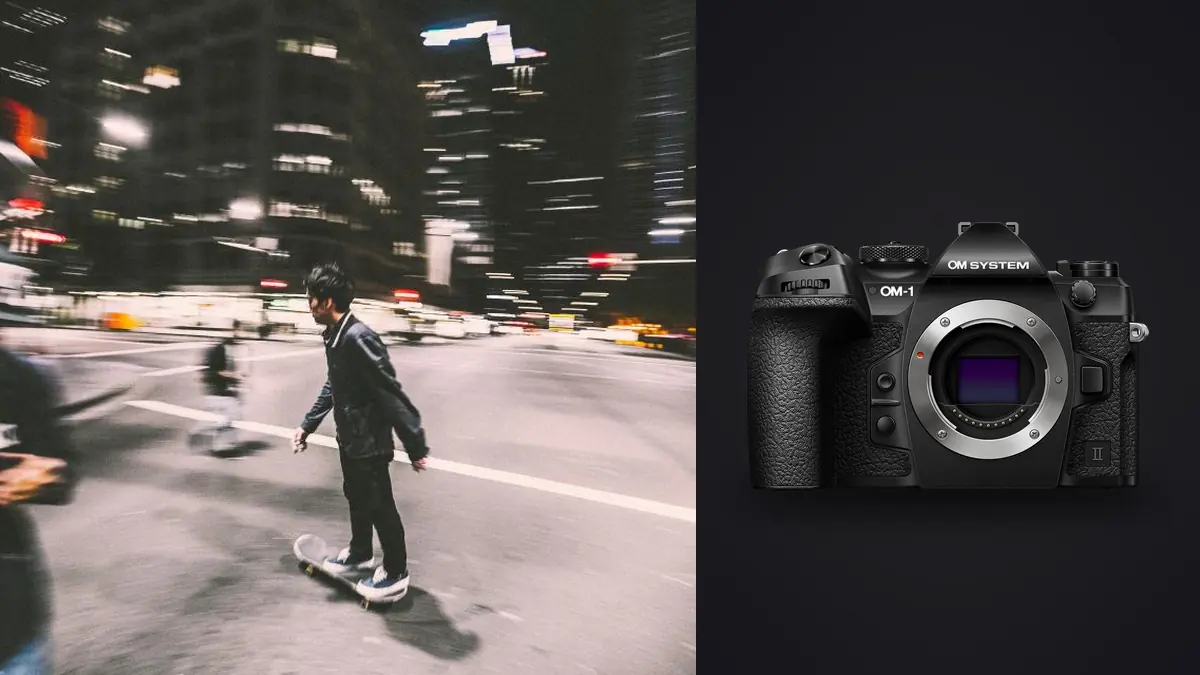
Street and documentary work punishes gear that gets in the way. You need something small enough that people stop noticing it within a few minutes, fast enough to nail a fleeting expression, and tough enough to survive a rainy market stall or a twelve-hour shift following a march. I've spent the better part of four months carrying the OM System OM-1 Mark II through exactly that kind of shooting, with an original OM-1 riding along as backup, and it's worth going through where this camera actually earns its keep versus where the spec sheet oversells it.
Why a Micro Four Thirds Sensor Still Makes Sense Here
The 20.4-megapixel stacked BSI sensor in the Mark II is the same resolution as its predecessor, and on paper that reads as a non-update. In practice, the 2x crop factor is the thing that actually matters for this genre. A 25mm lens gives you a 50mm field of view without carrying a 50mm-sized lens. A 300mm telephoto for compressing a crowded intersection weighs less than a kilogram instead of the two-plus kilograms a full-frame equivalent demands. For documentary assignments where you're walking for hours and need to change framing on the fly, that weight difference stops being a footnote and starts being the reason your shoulder doesn't give out by hour six.
The tradeoff is noise performance past ISO 3200, and I won't pretend otherwise. Full-frame bodies from Sony or Nikon pull ahead by a stop, maybe a stop and a half, once you're inside a dim bar or shooting a night market lit by a single string of bulbs. For daylight street work and most indoor documentary settings with any ambient light to speak of, the gap closes to the point where it doesn't change what you can deliver.
Handling, Grip, and the Silent Shutter
At 599g body-only, the Mark II sits in a sweet spot: substantial enough to feel balanced with a mid-size prime, small enough to disappear into a jacket pocket with the 17mm f1.8 attached. The grip is shallow compared to a Canon R6 II or a Nikon Z6III, and if you're shooting bare-handed in winter with gloves on, it gets cramped fast. I ended up adding a small aftermarket grip extension for cold-weather shifts.
The electronic shutter is genuinely silent, not "quiet" in the way some manufacturers stretch that word. No mechanical clack, no simulated shutter sound unless you turn one on deliberately. For candid work where you don't want a click announcing that you just took someone's photo, this matters more than almost any other spec on this camera. The catch is rolling shutter: pan quickly across a moving bus or a cyclist cutting through frame and you'll get visible skew. It's not as bad as older Four Thirds sensors, but it's there, and I've thrown away a handful of otherwise-good frames because of it.
Live ND is a feature I underrated before using it regularly. Simulating up to 5 stops of neutral density in-camera means you can drag the shutter for a motion-blurred crowd or traffic streak without carrying physical filters, which is one less thing to fumble with when a moment is closing fast. It does introduce some banding under certain LED street lighting at the higher ND settings, so I keep it to ND16 or below after dark.
Autofocus When You Don't Get a Second Take
The 1053-point cross-type phase-detect system with subject detection (human, plus the inherited bird, animal, and vehicle modes) is the biggest practical upgrade over the original OM-1 for this kind of shooting. Face and eye detection locks fast in daylight and holds through partial occlusion, useful when your subject is weaving between other pedestrians. The one real annoyance: in a dense crowd, it will sometimes latch onto a face in the background rather than the person you actually want in focus, and unless you've mapped a button to reposition the AF point quickly, you lose the frame while fighting the camera instead of the scene.
Pro Capture is where the Mark II separates itself from a lot of street-oriented competition. Half-press the shutter and the camera buffers frames continuously; a full press retrieves up to roughly 0.5 seconds of frames captured before you actually pressed the button, at up to 120fps in Pro Capture H (50fps with continuous AF/AE tracking in raw). For documentary work, that means the exact instant a hand reaches into frame, a pigeon takes off, or someone's expression breaks into a laugh is recoverable even if your reaction time was a beat too slow. It's changed how I shoot fast-moving street scenes; I trust my reflexes less and the buffer more.
Weather Sealing and the Realities of a Long Shift
IP53 dust and splash resistance sounds like marketing language until you're three hours into shooting a farmers market in steady drizzle with no cover. I've had the Mark II out in genuinely unpleasant rain, dust from a windy demolition site, and one memorable afternoon of sea spray on a fishing dock, and it kept working without a hiccup. Dual UHS-II card slots also matter more than people give them credit for on documentary assignments: setting one slot to backup mode means a card failure mid-shoot doesn't cost you the day's work, which is not a theoretical risk when you're documenting something that won't happen again.
Battery life is rated around 500 shots CIPA with the BLX-1 pack, but that number assumes light EVF use and minimal burst shooting. Running Pro Capture and the electronic viewfinder heavily, I get closer to 350 shots per charge on a long shooting day. I now carry three batteries as standard practice for anything longer than a half day, which adds weight back that the small body otherwise saves you.
How It Stacks Up Against Other Street-Oriented Cameras
None of these comparisons are apples to apples, since sensor size, lens mount, and price point all pull in different directions. But if you're actually choosing between systems for this specific genre, here's how the numbers line up.
| Camera | Body weight | Crop factor | Max silent burst | Weather sealing | Subject AF detection | Approx. launch price (body) |
|---|---|---|---|---|---|---|
| OM System OM-1 Mark II | 599g | 2.0x | 120fps (50fps w/ AF-C raw) | IP53 | Human, bird, animal, vehicle | $2,399 |
| OM System OM-1 (original) | 599g | 2.0x | 120fps (50fps w/ AF-C raw) | IP53 | Bird, animal, vehicle (human added later via firmware) | $2,199 |
| Fujifilm X-T5 | 557g | 1.5x | 20fps | Weather resistant, no formal IP rating | Human, animal, vehicle | $1,699 |
| Ricoh GR IIIx | 262g | 1.5x (fixed 40mm equiv.) | 4fps | None (base model) | Basic face detection only | $1,049 |
The Ricoh sits in its own category entirely; it's a different tool for a different pace of shooting, but it's worth including because a lot of street photographers cross-shop it. If your documentary work involves fast-breaking action and unpredictable subjects, the Mark II's buffer depth and tracking pull it well ahead of both the Fuji and the Ricoh. If your street work is slower, more observational, and you value pocketability above everything, the GR IIIx is still hard to argue with on size alone.
Lens Pairings That Actually Fit the Assignment
The 17mm f1.8 (34mm equivalent) has become my default walk-around for street work; it's close enough to a natural field of view that framing feels intuitive, and at 120g it disappears on the body. For portrait-driven documentary sequences, the 25mm f1.8 (50mm equivalent) gives that classic reportage framing without drawing attention, and its focus-by-wire ring is fast enough for quick manual overrides when autofocus hunts in low contrast scenes. When an assignment calls for versatility over discretion, the 12-40mm f2.8 II covers 24-80mm equivalent in a single lens that's still lighter than most full-frame 24-70mm zooms, though it's the one combination on this list where people do start to clock you as "a photographer" rather than just someone with a camera.
What Happens After the Card Comes Out
This is the part that doesn't get discussed enough in gear reviews. Shoot a single Pro Capture burst at 120fps for two seconds and you've generated 240 nearly identical frames of one moment. Do that a dozen times over a documentary shoot, on top of normal single-frame shooting, and you can easily walk home with four or five thousand images from one day. Manually scrubbing through that in a folder view to find the one frame where the expression actually lands is not a realistic workflow, and it's the reason a lot of good documentary photographers under-deliver relative to how much they actually shot.
This is where I moved my culling process into imagic rather than doing it by eye in Lightroom. It runs entirely on the machine, no cloud upload involved, which matters to me for documentary work specifically: a lot of what I'm shooting includes identifiable people in public, sometimes at protests or in situations where I'd rather not have those files touch a server I don't control. The local sharpness and focus scoring flags which frames in a Pro Capture burst are actually sharp on the subject's eyes rather than the background, and the duplicate and burst clustering groups those 240 near-identical frames into one representative thumbnail so I'm reviewing a dozen real moments instead of scrolling through hundreds of frames that differ by a fraction of a second. If you're shooting this kind of volume regularly, a piece on how AI photo culling actually works is worth reading before you build a habit around raw folder scrubbing.
The apply_my_style feature has also cut down the second half of the workflow, the part where you're trying to get a consistent look across a week's worth of assignment photos edited on different nights in different moods. I trained it on a batch of my own graded street work (a slightly desaturated, contrast-heavy look I use for most documentary sequences) and it now gets new imports most of the way there automatically, leaving me to fine-tune rather than start from a blank slate on every single frame. For anyone shooting high-volume bursts regularly, it's worth reading through some general workflow habits too; this rundown on faster photo workflows covers ground beyond what any one camera or app can fix on its own.
Where It Falls Short
I want to be straight about the weak points rather than closing on a sales pitch. The menu system, even after several firmware updates, is still more layered than it needs to be; finding a setting you use rarely means digging through submenus that don't follow obvious logic. At $2,399 for the body, it's a genuine premium over the Fujifilm X-T5, and the image quality difference between the two doesn't fully justify that gap unless you specifically need the burst depth, the weather sealing rating, or the telephoto reach advantage of the smaller sensor. And while Live ND is a clever feature, it's not a full substitute for physical filters if you're doing serious long-exposure work as part of a documentary series; the effective minimum shutter speed with Live ND engaged tops out around 1/125s depending on the strength selected, which limits how dramatic a motion blur effect you can pull off without stacking a real filter on top.
Frequently Asked Questions
Is the OM-1 Mark II too small to feel like a "real" camera to documentary subjects?
It cuts both ways. The compact body reads as less intimidating to most subjects, which has helped me get closer and get people to relax faster in sensitive documentary situations. Occasionally, on assignments where an institutional gatekeeper expects to see a big camera before granting access, the smaller body has worked against me. I've started carrying a printed press credential for exactly those situations rather than relying on the camera to signal professionalism.
Does the smaller sensor actually hurt image quality for typical street lighting conditions?
At base ISO and in daylight, no, the difference is negligible in any practical output. Past ISO 3200, in dim interiors or after sunset without added light, a full-frame body will out-resolve fine detail and hold cleaner shadows by roughly a stop to a stop and a half. For most daytime street and outdoor documentary work, this simply isn't a deciding factor.
How does Pro Capture change the way you actually shoot on the street?
It removes the pressure of anticipating the exact instant something happens. Half-pressing the shutter starts the buffer, and a full press pulls frames from roughly half a second before you pressed, so a lot of the reaction-time gap between seeing a moment and capturing it disappears. I use it constantly for anything involving sudden movement: a bird taking off, a hand gesture, a head turn.
What's a realistic battery and card plan for a full documentary shooting day?
Three BLX-1 batteries and two 128GB UHS-II cards set to backup mode has covered every full-day assignment I've shot with this camera, including heavy EVF use and regular Pro Capture bursts. I swap the primary card at the midpoint of a long day regardless of how full it is, purely as a hedge against losing an entire day's work to one card failure.