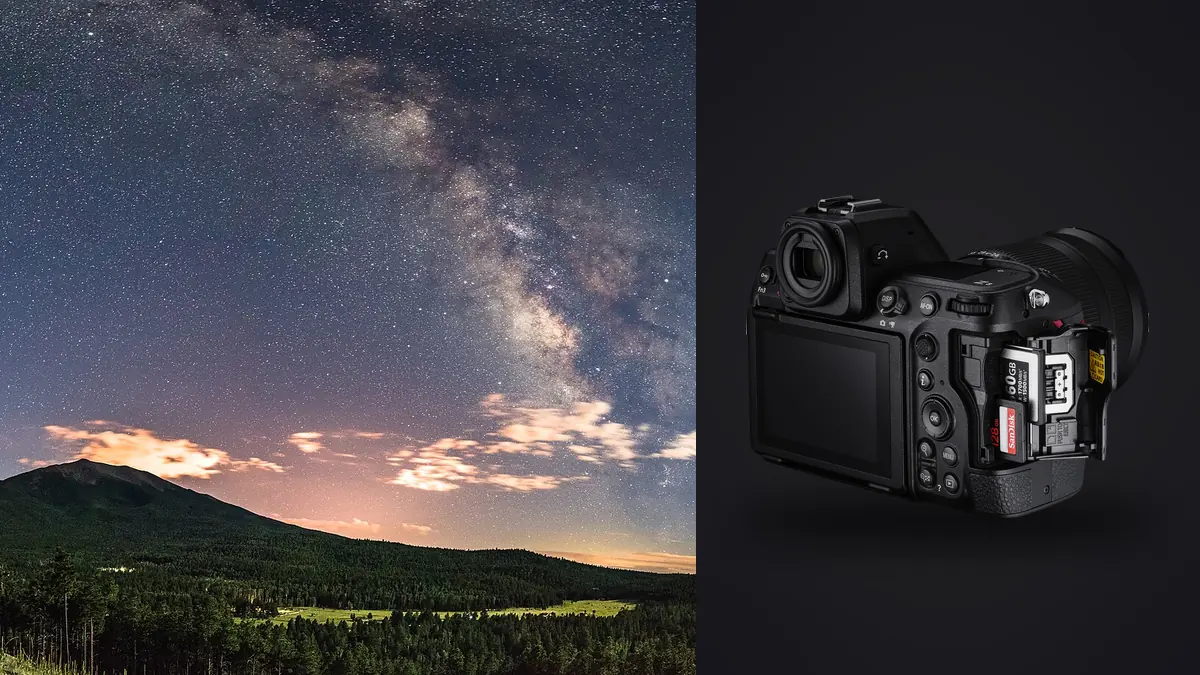
The first time I took a Z8 out under a genuinely dark sky, I shot it like my old D750 and paid for it the next morning. Forty five megapixels does not forgive the sloppy exposure math that a 24MP body will quietly let slide. Star stacking (shooting a burst of shorter frames instead of one long one, then blending them afterward in software) is how you fight noise and star trailing on a high resolution body without buying a tracking head. This is the workflow I have actually settled into after a dozen or so nights with the Z8, most of them in the UK (Rutland Water, the Elan Valley, one miserable but clear week in the Cairngorms), not a spec sheet dressed up with adjectives.
Why 45.7 megapixels changes your exposure math
The pixel pitch on the Z8's sensor is around 4.35 microns, noticeably tighter than the 5.9 micron pitch on an older 24MP FX body. That matters because star trailing is a pixel level phenomenon before it is a visible one. A star that stays a clean point on a lower resolution sensor at, say, 10 seconds will show as a soft oval on the Z8 at the same focal length and shutter speed, simply because there are more pixels available to record the rotation of the earth across that same patch of sky.
The old "500 rule" (500 divided by focal length, or 300 if you want to be honest with yourself) was written for lower resolution sensors and it falls apart here. I stopped trusting it entirely after pixel peeping a batch of 24mm frames that looked fine on the rear screen and showed visible elongation at 100% on a laptop. What I use now are working numbers I've actually checked at full resolution, not a formula I trust blindly:
| Focal length | Old "500 rule" result | Working max on the Z8 (checked at 100%) | Note |
|---|---|---|---|
| 14mm | ~35s | 10-11s | Corner stars still soften past 12s on most nights |
| 20mm | ~25s | 7-8s | My most-used focal length for wide Milky Way frames |
| 24mm | ~20s | 6s | Where I first noticed the old rule failing badly |
| 35mm | ~14s | 4s | Fine for stacking, awkward for a single hero frame |
| 50mm | ~10s | 2-3s | Only really usable with a tracker or heavy stacking |
None of this means shorter exposures are worse. It's the opposite: shorter, cleaner subs stacked in quantity beat one long, slightly trailed exposure almost every time, and it's the entire reason star stacking exists as a technique rather than a workaround.
Framing and focusing when you genuinely can't see anything
The Z8's stacked sensor gives you a blackout free viewfinder even mid-burst, which sounds like a spec sheet line until you're trying to recompose between frames at 2am and realize the EVF never actually cuts out on you. I still boost EVF brightness manually in the menu before I start, because the default gain under a genuinely dark sky (no moon, no light pollution) is too conservative to show faint stars for framing.
Autofocus in low light is rated down to -9 EV with a fast enough lens attached, and it does work on bright planets or the moon. For actual star fields I don't trust it and switch to manual focus every time: zoom the live view to maximum magnification on the brightest star in frame, rack focus until the point is as tight and small as it will go, then tape the focus ring so a stray glove doesn't nudge it three frames into a two hour sequence. I've lost entire sessions to a focus ring that drifted half a millimeter around frame 40.
Setting the interval timer for an actual stacking sequence
For stacking rather than a single frame you want the interval timer shooting menu, not just a remote release. A few settings that matter more than the manual suggests:
- Long exposure NR: off. Leaving it on doubles the time the camera spends per frame (it shoots a matching dark frame after every exposure), which roughly halves how many subs you get in a given window. Stacking software handles noise reduction across the frame set anyway, so an in-camera dark frame is redundant work.
- Interval slightly longer than shutter plus buffer clearing. At 45.7MP even lossless compressed raw files run 55-65MB each, and if your interval is too tight the camera skips a frame rather than queuing it. I set intervals about 1-2 seconds longer than the exposure itself as a safety margin.
- Shutter type. I default to electronic front curtain for these sequences to spare the mechanical shutter a few hundred extra actuations over a long night, and switch to full electronic only if I'm chaining multiple sessions back to back.
Buffer, cards, and batteries in the cold
A 300 frame stacking sequence at 45.7MP lossless compressed raw is somewhere around 17-19GB. Write speed matters here specifically because the camera is running unattended for an hour or two; I keep CFexpress Type B in slot one as primary and treat the UHS-II SD in slot two as backup only, since it's noticeably slower to clear the buffer during back to back short exposures.
Battery life is the other thing that catches people out. The EN-EL15c is rated for roughly 340 shots CIPA, but that number assumes room temperature. On a genuinely cold night (below freezing, which is exactly when the sky tends to be clearest) I get closer to half that in practice. I carry two spares in an inner jacket pocket, not the camera bag, and swap the moment the indicator drops rather than waiting for it to die mid-sequence and losing the last hour's worth of subs.
One thing the Z8's weather sealing doesn't solve: dew. There's no heated front element, and on a still, humid night I've had a lens fog over from the inside out around the two hour mark. A cheap dew heater strap powered off a USB battery pack around the lens barrel has saved more sessions than any camera setting has. See the Nikon Z8 camera page for full specs on the sensor and buffer depth referenced above.
Culling the sequence before you even open stacking software
This is the part nobody warns you about before your first real session: you come home with 250 to 400 nearly identical frames of the same patch of sky, and a handful of them are ruined by a plane crossing, a gust that nudged the tripod, or condensation creeping into one corner. Stacking software will happily include a soft or trailed frame in the blend and quietly drag down the whole result, so you do need to look before you stack.
Scrolling through 300 near-duplicate star fields by eye is genuinely the worst part of this hobby. I run the sequence through imagic before touching stacking software, mainly for two things: its local sharpness scoring flags the handful of subs where focus actually drifted or the tripod moved, without me having to zoom to 100% on every single frame, and its duplicate and burst clustering groups the sequence into visual clusters instead of one long flat reel, which makes it much faster to spot the outlier in a run of forty otherwise-identical frames. Since it processes everything on the machine rather than uploading a few hundred raw files somewhere, it's usable in a cottage or the car with no signal at 3am, which is exactly when I'm actually doing this.
For the handful of keeper subs I want to preview a look on before stacking (mostly to decide if a session is even worth the processing time), I'll run imagic's apply_my_style preset, trained on my own past night edits, over a couple of frames rather than manually resetting white balance and contrast on each one. It's not a substitute for the actual stack, but it saves guessing whether a night's take is worth the two hours DeepSkyStacker will spend on it. If you're new to culling workflows generally, how AI photo culling works covers the sharpness and clustering side in more depth than I'm going into here.
Matching the stacking method to what you actually shot
Not every night calls for the same approach, and picking the wrong one wastes the sequence you just spent two hours capturing.
| Method | Typical Z8 settings | Frame count | Software I use | Good for |
|---|---|---|---|---|
| Wide Milky Way noise stack | 14-24mm, f/2.8, 6-11s per NPF table above, ISO 3200-6400 | 15-25 subs | Sequator (free, Windows) | Reducing noise on a static wide field, no tracker needed |
| Star trail composite | 20-35mm, f/4-5.6, 20-30s per frame, ISO 800-1600 | 150-400 subs | StarStaX (comet or lighten blend) | Circular or linear trails without one blown-out single exposure |
| Tracked deep sky | 85-300mm on a star tracker, f/4-5.6, 60-120s per frame, ISO 800 | 20-60 subs plus darks/flats | DeepSkyStacker | Nebulae and galaxies where you need real integration time |
The wide Milky Way stack is what I reach for most, mostly because it doesn't need a tracker and travels light. Star trails are the forgiving option when clouds are drifting through and you'd rather bank two hundred short frames than gamble on one long clean exposure. Tracked deep sky work is its own much deeper rabbit hole and honestly the Z8 is arguably more camera than that use case strictly needs.
Mistakes I'd skip if I were starting again
Vibration reduction stays on by default even with the camera on a tripod, and on a couple of early sessions I left it on out of habit. It doesn't cause obvious trailing, but I've seen a faint softness in pixel level comparisons that went away once I switched it off for tripod work, which matches what most tripod shooting guidance says regardless of brand. Older Nikon Z bodies (the original Z6 and Z7 specifically) had a documented issue where in-camera noise reduction would strip out faint stars during long exposures even with long exposure NR switched off, sometimes called the "star eater" problem. I haven't seen the same aggressive removal in Z8 frames at ISO 3200-6400 in my own 100% crops, but I'd still recommend checking your own results rather than taking any camera's word for it, mine included.
The other one: don't skip formatting cards between sessions. A partially full CFexpress card with old frames on it clears its buffer more slowly than an empty one, and on a 400 frame interval sequence that difference adds up to real skipped frames by the end of the night.
Frequently Asked Questions
Do I still need a star tracker if I'm already stacking exposures on the Z8?
For wide Milky Way frames and star trails, no. Stacking short exposures gets you most of the noise reduction benefit a tracker would give you, without the setup time or the extra gear. A tracker earns its keep once you're shooting longer focal lengths for actual deep sky targets like nebulae, where you need integration times a static tripod simply can't give you before trailing shows up.
Does the Z8's in-body stabilization help for night photography?
Barely, and only for handheld shots you're not going to stack anyway. For anything on a tripod, which is nearly all star stacking, I turn it off. It's designed to counteract camera shake that isn't present when the body is locked down, and in my own comparisons it occasionally introduced very slight softness rather than helping.
What ISO should I actually shoot at for a stacking sequence versus a single frame?
I run noticeably higher ISO for stacked sequences than I would for a single hero shot, usually ISO 3200-6400 for wide Milky Way work, because the stack itself does the noise cleanup and a brighter individual sub means faster shutter speeds and less star movement per frame. For a single frame I'd pull that back closer to ISO 1600-3200 and lean on a longer shutter instead.
Can imagic actually do the star stacking, or is it just for sorting frames?
Just sorting, and I'd be misleading you to suggest otherwise. imagic doesn't align or blend star fields, that's still a job for dedicated stacking software like Sequator or DeepSkyStacker. Where it earns its place is beforehand, culling a few hundred near-identical subs down to the keepers so you're not feeding a stacking program frames that were ruined by a plane, a gust of wind, or a focus drift halfway through the sequence.