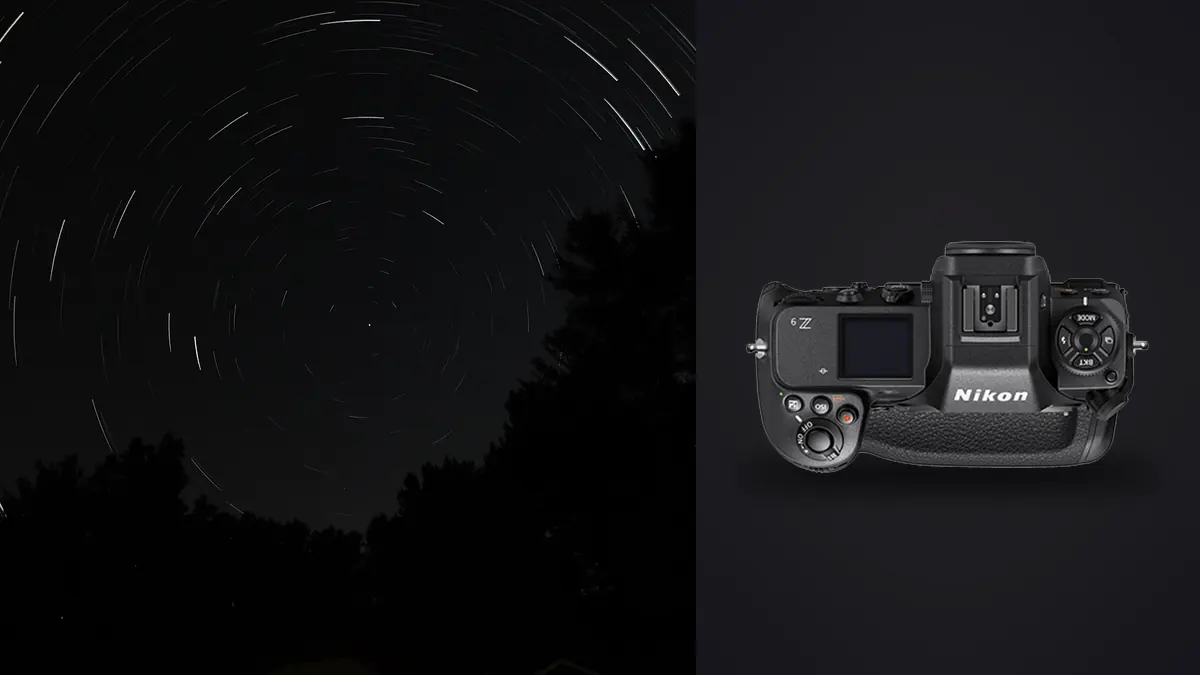
Three years ago I would have argued the Z9 was the wrong camera for a night sky kit. It's built as a sports and wildlife body, tuned around a stacked sensor and 20fps bursts that nobody chasing the Milky Way actually needs. After a few dozen clear nights with one strapped to a tripod, and more often riding on a small star tracker, I've mostly reversed that opinion. It isn't the resolution or the frame rate that changed my mind. It's what the stacked sensor and the fully electronic shutter do for a stacking workflow specifically, which is a different question from whether the camera is "good for astro" in the abstract.
What the Stacked Sensor Changes at Night
The obvious talking point is the fully electronic shutter, no mechanical curtain at all, which means zero shutter shock on a body that's otherwise heavy enough to matter on a lightweight tripod head. For a single long exposure that's a marginal benefit. For stacking, where you're firing dozens or hundreds of consecutive frames, it matters more: there's no mechanical wear accumulating over a session, and no shutter clatter waking up the rest of the campsite at 2am.
Base ISO on the Z9 is 64, and the native range runs to 25,600 with expansion to 102,400. In practice I rarely go past ISO 3200 to 6400 for stacked wide-field work, because stacking is doing the noise-reduction job that a single brutal high-ISO exposure would otherwise have to handle alone. That's the whole point of stacking many shorter subs instead of one long one: you keep ISO moderate, keep individual exposures short enough to avoid trailing, and let the averaging in software pull the noise floor down instead of asking the sensor to do it in one shot.
Dynamic range at base ISO is genuinely strong, enough that pulling shadow detail out of a foreground silhouette against a starfield doesn't immediately introduce banding, which older Nikon bodies I've used were not shy about producing.
Setting Up an In-Camera Stacking Sequence
Interval timer over a remote release
I use the built-in interval timer (in the photo shooting menu, not the separate time-lapse mode, which discards the individual frames you actually need for stacking) rather than a remote intervalometer clipped to the strap. The Z9 will run a sequence of up to 9999 shots, and the interval only needs a second or two of padding beyond your exposure time. For 20-second subs I set a 22-second interval, then walk away and let it run for however many frames the session calls for. Fewer cables in the dark, less to snag on a tripod leg when you're moving around blind.
Long exposure noise reduction: turn it off
This is the one setting I've seen visiting photographers get wrong most often. Long exposure NR doubles your exposure time (a 20-second sub becomes a 20-second dark frame capture immediately after, with the shutter effectively busy for 40 seconds per sub), which on a stacking sequence means you're throwing away roughly half your session time for a noise reduction pass that stacking software does better anyway, using its own dark frame library or a simple averaging pass across all your light frames. Leave it off, keep the interval timer running continuously, and let Sequator or DeepSkyStacker handle noise on the back end.
Raw compression and card math
At 45.7 megapixels, a 14-bit uncompressed raw file is close to 90MB. High Efficiency compressed brings that down to roughly 45 to 55MB depending on scene detail, and that difference matters a lot once you're shooting 300 or 400 subs in a single session. Do the arithmetic before you head out: 350 frames at 50MB average is 17.5GB, and that's for one target in one night. I carry two 325GB CFexpress Type B cards and still keep an eye on remaining capacity if I'm planning to shoot more than one composition before the sky rotates too far.
The Star-Eater Question
Older Nikon bodies had a well documented problem where in-camera processing, not just the noise reduction toggle but something baked further into how raw files get built during long exposures, would smear or outright delete the dimmest point-source stars, especially toward the image corners. It got nicknamed "star eater" in the astro community years back and it was real, not internet folklore.
I tested for it on my Z9 the way I test any new astro body: same composition, same ISO, a run of subs at 5, 10, 20, and 30 seconds, then a 100% crop on the faintest visible stars in a corner rather than the center where it's easy to miss. What I found was better than I expected coming off a D850, but not perfect. At 20 seconds and beyond, specifically on High Efficiency compressed raw, I could see a very slight softening of the dimmest stars compared to the same frame shot as lossless compressed raw. It's subtle enough that it won't show in a finished stack unless you're pixel-peeping the way I was for this test, but if you're chasing faint nebulosity rather than a bright Milky Way band, shoot lossless compressed and budget the card space for it.
Untracked, Tracked, or a Bit of Both
Which approach makes sense depends more on your lens and your patience than on the camera body, but the Z9's deep buffer and quiet electronic shutter make all three genuinely comfortable to run for a long session, which wasn't always true of older bodies that would start hesitating on card writes deep into a sequence.
| Approach | Typical sub length | ISO on the Z9 | Subs per session | Where it falls apart |
|---|---|---|---|---|
| Untracked wide-field (14-24mm) | 10-15 seconds | 3200-6400 | 60-150 | Diminishing returns past f/2.8; foreground usually needs a separate blended exposure |
| Untracked with a longer lens (35-50mm) | 4-6 seconds | 4000-8000 | 150-300 | Short subs carry thin signal each, so it takes a big stack to look clean |
| Tracked single exposure | 2-5 minutes | 800-1600 | 1 (plus darks/flats) | No margin for tracker error; one gust or snagged cable ruins the whole frame |
| Tracked multi-sub stack | 60-120 seconds | 1600-3200 | 15-40 | Needs a mount rated well above the Z9 body's weight plus lens |
That last row is worth flagging on its own. The Z9 body alone is around 1340 grams, and a 14-24mm f/2.8 adds another 650 grams or so on top of that. A tracker rated for 3 to 5kg payload can technically hold that combination, but I've found tracking accuracy degrades noticeably as you approach the rated limit, so I treat the published payload figure as a ceiling to stay well under rather than a target to reach.
Focusing When You Can Barely See the Frame
Autofocus on the Z9 is rated down to around -9 EV with certain fast primes attached, which sounds like it should handle a starfield, and it genuinely can lock onto a bright star or planet in a clear sky. But for the fainter parts of a Milky Way composition I still go manual, every single time. The routine that works for me: switch to manual focus, punch in live view magnification on the brightest star in frame, adjust the ring until it collapses to the smallest point you can get, then back off the magnification and reframe without touching the focus ring again. The articulating screen helps more than I expected here, since a lot of wide astro compositions point close to the zenith, and a fixed screen means shooting flat on your back in the dirt.
Lens Choices That Actually Matter for Stacking
Coma control at the corners matters more for stacked wide-field work than it does for a single frame, because any smearing present in the individual subs gets reinforced rather than averaged away once you stack them. The Z 14-24mm f/2.8 S is clean enough wide open that I rarely stop down for coma alone. The Z 20mm f/1.8 S and Z 24mm f/1.8 S are both usable at f/1.8 for a Milky Way core shot, but I generally shoot them closer to f/2 to f/2.2, a third to half a stop down, purely to tighten up the corner stars. It's a small adjustment on paper but it shows up clearly once you're averaging thirty or more frames and any softness compounds instead of cancelling out.
Turning a Card Full of Subs Into One Finished Frame
The unglamorous part of any stacking session is what happens after you get home with 300 raw files and a laptop. Before any of them touch stacking software, I run the folder through imagic to sort out which subs are actually usable. Its local sharpness scoring catches the frames where the tracker hiccupped mid-exposure or the tripod caught a gust, the kind of soft-star frame that's easy to miss scrolling through thumbnails at 1am but that will visibly drag down an averaged stack if it sneaks in. I would rather cut ten marginal subs before stacking than find out after a two-hour render that the result looks slightly mushy and have no idea which frame caused it.
The other imagic feature I actually rely on for these sessions is the duplicate and burst clustering, since an interval-timer sequence is functionally one very long burst of near-identical frames. Grouping them automatically instead of scrolling through hundreds of visually similar thumbnails one at a time saves real hours, and it's the same underlying idea covered in more general terms in how AI photo culling actually works if you want the mechanics behind it.
It also matters that imagic runs entirely on the laptop with no upload step involved, because a lot of the dark sky sites worth the drive don't have any signal at all. A 15 to 20GB session folder isn't going anywhere near a cloud service out there even if you wanted it to, so local processing isn't a nice-to-have for this kind of shooting, it's the only option that actually works in the field. Once the culled selects are sitting in a stacking program (I split my time between Sequator for quick wide-field results and DeepSkyStacker when I want more control over dark and flat frame calibration), the actual pixel-level stacking is a separate step from the culling, but doing the culling first is what keeps that step from eating the whole night. There's a broader case for front-loading culling before any heavy processing stage in this rundown on speeding up a photo workflow, and it applies just as much to three hundred astro subs as it does to a wedding take.
Battery and Weight, the Unsexy Parts
The EN-EL18d is CIPA-rated for roughly 700 shots, but that figure assumes a mix of shooting, not a static interval sequence running for two straight hours in near-freezing air. Cold cuts real capacity noticeably, so I carry a second battery in an inner jacket pocket rather than a camera bag, and I've swapped batteries mid-session more than once on a long winter shoot. The body itself, at 1340 grams without a lens attached, is not a small thing to carry to a dark sky site that's a mile walk from the car, and it adds up over a season of driving out to remote locations for a few hours of usable darkness. None of that is a reason to leave it home. It's just worth planning around rather than discovering at 11pm with one battery bar left and ninety more subs still to go.
Frequently Asked Questions
Does the Z9's electronic-only shutter cause any real problems for star stacking?
Not in my experience. The usual concerns around electronic shutters, rolling shutter distortion and banding under certain artificial lights, mostly don't apply to a static tripod pointed at a night sky with no moving subjects in frame. The benefit, zero shutter shock across a long sequence, outweighs the theoretical downsides for this specific use case.
Should Long Exposure Noise Reduction stay on for a stacking sequence?
No, turn it off. It doubles the time each sub takes to capture, which roughly halves how many usable frames you get in a given session, and stacking software already handles noise reduction through the averaging process itself, or through separate dark frames you shoot once and reuse across the whole set.
Is the stock Z9 sensor good enough for astro, or does it need to be modified?
For Milky Way and wide-field star work, the stock sensor is genuinely good enough on its own. Where an astro modification (removing the stock IR-cut filter) actually starts to matter is deep red hydrogen-alpha nebulosity, which the stock filter attenuates heavily. If that's not your target, I wouldn't bother modifying the body.
How many subs do I actually need for a clean stack?
It depends more on sub length and target brightness than on any fixed number, but as a rough field rule I don't bother stacking fewer than 40 frames for a Milky Way composition, and I've gone well past 150 when the sky was unusually dark and I wanted a genuinely clean result. More subs helps, but past a certain point you're fighting diminishing returns against a growing chance that satellite trails or a passing plane ruin a few frames you then have to cull out anyway.