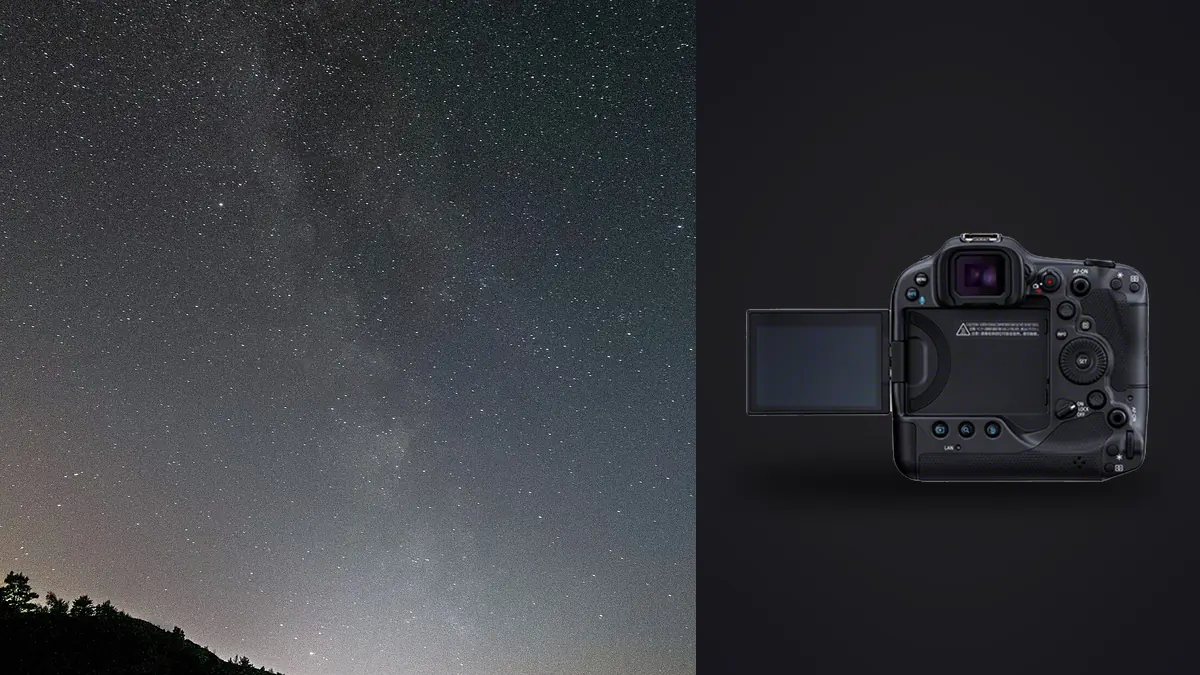
The first time I took a Canon EOS R3 out for a stacking session, I almost didn't bother. It's built and marketed as a sports and wildlife body, DIGIC X, 30fps electronic shutter, eye-controlled AF, the whole pitch is speed. None of that sounds like a camera you'd point at a fixed patch of sky for three hours. But the stacked sensor and the sensible ISO behavior underneath all that speed happen to make it a genuinely good tool for star stacking, once you stop trying to use the features it's famous for and start using the ones nobody talks about.
This is a walkthrough of how I actually run a stacking session with this body, from focus to the interval timer to what I do with the folder of raw files afterward. It's specific to the R3's menus and sensor characteristics, not a generic "how to stack stars" primer you could apply to any camera.
Why the Sensor Cooperates Here
The R3 uses a 24.1 megapixel stacked, back-illuminated full-frame sensor. Stacked sensors get marketed for readout speed (that's how you get 30fps with a fully electronic shutter and no viewfinder blackout), but the side effect that matters for astro is pixel pitch. At 24 megapixels on a full-frame sensor, the individual photosites are noticeably larger than what you'd get on a 45 or 61 megapixel body. Bigger photosites collect more light per pixel at a given exposure, which shows up directly as cleaner shadows at ISO 3200 to 6400, which is exactly the range most of my star stacking exposures live in.
Native ISO runs 100 to 102400, expandable to 50 and up to 204800 at the top end. I don't go anywhere near the expanded range for stacking work (the noise floor gets ugly fast), but having clean, usable files up through ISO 6400 without heavy banding means I can keep shutter speeds honest instead of pushing exposures long enough to trail stars in a single frame. For a deeper look at how noise reduction tooling has evolved for files like these, see this rundown of modern noise reduction in photo editing.
One thing worth flagging for anyone coming from a Sony body: Canon's long exposure noise reduction is a menu toggle you control, and it doesn't touch your raw star data the way some older in-camera algorithms did on other systems. Turn LENR off before a stacking session. Not because it damages anything, but because it doubles your exposure time (the camera takes a dark frame after every light frame) and during a star trail sequence that gap between frames is exactly what shows up as broken, dashed trails instead of continuous ones.
Getting Focus Right Before It Actually Gets Dark
Autofocus on this body is rated down to -7.5 EV with an f/1.2 lens attached, which is genuinely dark. In practice I've had it lock onto the moon, onto Jupiter when it's bright and high, and occasionally onto a distant streetlight I'm using as a focus reference. What it will not reliably do is find focus across a scattered field of dim, low-contrast points, which is what most of the sky actually looks like to a contrast-detection system. Star fields don't give autofocus enough to grab onto. So the routine stays manual, same as it would on any camera:
- Point at the brightest star or planet available, or the moon if it's up.
- Switch to manual focus, punch into 10x live view zoom on that point.
- Rack focus until the point is as small and tight as it'll go. Stars don't have a hard "in focus" click the way a face does, so you're hunting for the smallest possible dot, not a snap.
- Tape the focus ring. Cold air and gravity both nudge focus rings over a three-hour session, and I've lost entire sequences to a lens that crept half a millimeter by frame 200.
If there's genuinely nothing bright enough in frame to focus on, I focus on a torch held at roughly the same distance as infinity would resolve (about 50 meters out works), or I pre-focus during blue hour before it's fully dark and tape it then.
Exposure and the Interval Timer
The built-in interval timer (Shooting menu, Interval timer) is what makes this body practical for stacking without an external intervalometer. You set frame count, interval, and it runs unattended. For star trail work I set it to shoot continuously with the shortest gap the camera allows between exposures, usually around a second once LENR is off, because every gap between frames is a gap in the trail. For exposure length on untracked wide shots, the old "500 rule" divided by focal length is a rough starting point, but with a 24 megapixel sensor you get a bit more headroom before pixel-level trailing becomes visible than you would on a higher-resolution body, since each star has to move across more physical distance to smear across an equivalent number of pixels. I still stay conservative and keep single exposures at 10 seconds or under on a 15-24mm lens rather than chasing the theoretical maximum.
| Technique | Lens & Aperture | Shutter Speed | ISO | Frames per Stack | Gap Between Frames | Stacking Tool |
|---|---|---|---|---|---|---|
| Untracked Milky Way, foreground included | RF 15-35mm f/2.8 @ 16mm | 10s | 4000 | 18-22 | ~1s | Starry Landscape Stacker / DeepSkyStacker |
| Tracked wide-field (star tracker mounted) | RF 15-35mm f/2.8 @ 24mm | 60s | 1600 | 20-25 | 2-3s (tracker settle) | DeepSkyStacker |
| Star trails, 2-3 hour sequence | Samyang RF 14mm f/2.8 | 30s | 800 | 250-320 | ~1s, LENR off | StarStaX (comet mode) or in-camera Multiple Exposure |
| Lucky-imaging moon/planetary burst | RF 100-500mm @ 500mm f/7.1 | 1/500s | 800 | 200-400 | continuous, electronic shutter | AutoStakkert! / RegiStax |
That last row is a bit of a curveball for a star stacking article, but it's worth including because the R3's electronic shutter genuinely earns its keep there. Lucky imaging for the moon or planets works by shooting hundreds of frames at high frame rate and keeping only the sharpest percentage, and a fully electronic shutter with no mechanical component means no shutter shock at all across that whole burst, plus the shutter mechanism doesn't wear down from the extra actuations. On a mechanical or hybrid shutter body I'd be nervous about running 400-shot bursts every clear night for a season. On the R3 it's a non-issue.
In-Body Stabilization: Turn It Off
This trips people up because IBIS is one of the R3's headline features and the instinct is to leave everything "smart" turned on. Don't. On a tripod, stabilization systems have nothing real to correct for and can actually introduce a very faint wobble as the system hunts for movement that isn't there, particularly on longer exposures. It's a minor effect and some people never notice it, but there's no upside to leaving it on for a locked-off tripod shot, so I switch it off at the start of every stacking session and don't think about it again.
What Actually Goes Wrong on Site
The camera side of this is the easy part. What ends a session early is almost always one of three things.
Dew
Front element fogging is the most common failure on a humid night, and it creeps up slowly enough that you can lose the back half of a three-hour sequence without noticing until you're home. A simple dew heater strap powered by a USB battery pack solves this completely. I run one on every session longer than 45 minutes regardless of the forecast.
Battery drain in the cold
The R3's integrated grip design means the LP-E19 is a larger cell than you'd get on a body with a removable bottom grip, and CIPA rates it around 860 shots, but that number means little for a three-hour interval sequence in near-freezing air. Cold cuts effective capacity noticeably. I keep a spare battery in an inside jacket pocket, not the camera bag, because body heat matters more than you'd think.
Card fill and redundancy
Dual slots (CFexpress Type B plus SD UHS-II) mean I can write RAW to the CFexpress card for speed and mirror to the SD card as a backup, which matters more for astro than for most other genres simply because a bad session can't be reshot. The sky you photographed at 1am on a specific clear night with a specific moon phase doesn't come back tomorrow.
From a Full Card to a Finished Stack
A three-hour star trail sequence at roughly one frame every 31 seconds works out to somewhere around 350 raw files. A wide Milky Way session where I'm bracketing focus, testing framing, and shooting several stacks across the night can easily land at 800 to 1,000 frames by the time I pack up. Going through that manually, frame by frame, at 2am with cold hands is how good data gets buried under bad decisions. What I actually do now is dump the card straight into imagic and let it run its local sharpness scoring across the whole session before I touch anything. Focus drift from a bumped tripod or a ring that crept despite the tape shows up immediately as a cluster of lower-scored frames, and I can pull those out before they ever reach DeepSkyStacker and quietly soften the final composite. For the trail sequences specifically, the burst and duplicate clustering groups the near-identical consecutive frames together, so instead of scrolling through 300 nearly indistinguishable shots of the same static sky I'm spot-checking maybe every twentieth frame in a cluster to catch a plane track or a satellite streak that snuck through. Everything runs on the laptop with no upload step, which matters more than it sounds like it should when you're doing this from a dark-sky site an hour from the nearest signal and the raw folder from one night is already pushing 30GB. Once the lights are culled down to the clean set, they go into DeepSkyStacker or Sequator for the tracked and untracked stars, or StarStaX for trails using comet mode so a moving foreground element (a person, a car's headlights passing on a distant road) doesn't leave a duplicated ghost across the final frame. The R3's Multiple Exposure mode with the "brighten" (additive comparison) blend mode can also do a rough in-camera trail stack on site if I want to check composition and gap length before committing to a full unattended run, though I still redo the real stack from individual raws afterward for the extra control.
Lenses and Trackers Worth Pairing With This Body
For untracked wide astro the RF 15-35mm f/2.8L is the one that lives on the camera most nights, wide enough at 15mm to hold a lot of foreground and fast enough at f/2.8 to keep ISO in check. The RF 14-35mm f/4L trades a stop of light for a bit more reach on the wide end, which I only reach for when I specifically want the extra field of view and I'm shooting tracked anyway so the f/4 doesn't cost me as much. On the manual focus, budget end, the Samyang (Rokinon) RF 14mm f/2.8 has been reliable for trail work where autofocus isn't relevant anyway. For tracked sessions I've used a Star Adventurer GTi and an iOptron SkyGuider Pro, both of which handle the R3's weight fine with a wide-angle lens attached, though the body's integrated grip adds enough bulk that I check balance carefully before walking away from an unattended run. A camera falling off a tracker mid-sequence is not a mistake you get to make twice with expensive glass on the front.
Frequently Asked Questions
Does the R3's autofocus actually help with astrophotography, or is it just a spec sheet number?
It helps at the margins. Locking onto the moon or a bright planet at -7.5 EV to set a focus reference point is genuinely useful and saves time compared to hunting manually. But for the actual star field you're photographing, autofocus doesn't have enough contrast to work with, so manual focus through 10x live view zoom remains the reliable method for the shot itself.
How many frames do I really need before the noise reduction from stacking pays off?
With this sensor's noise characteristics, I see diminishing returns setting in somewhere around 20 to 25 frames for a wide untracked stack, the improvement from frame 20 to frame 30 is real but small. Tracked deep sky targets benefit from more, since you're often pushing fainter signal, and I'll run 30 to 40 frames when I have the sky time for it.
Is it safe to run the electronic shutter continuously for a multi-hour trail sequence?
Yes, and it's arguably the better choice specifically because of that duration. There's no mechanical shutter cycling on this body's fully electronic mode, so there's nothing to wear down across a 300-plus frame overnight run, and rolling shutter distortion (the usual electronic shutter concern) isn't a factor when your subject is a static night sky rather than something moving fast across the frame.
Should I leave in-body image stabilization on for tripod-mounted star exposures?
No. Turn it off. On a locked-down tripod there's no real camera shake for the system to correct, and IBIS can introduce a faint self-induced wobble while it hunts for motion that isn't there. It costs nothing to switch off at the start of a session.