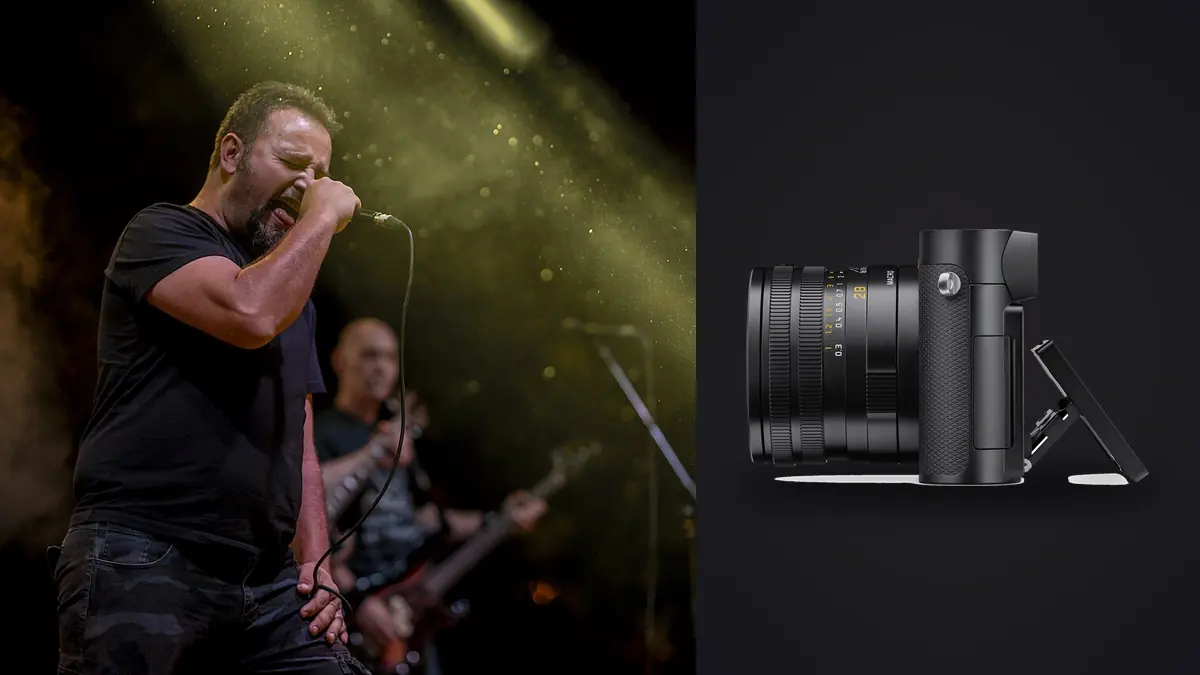
This Lens and Location Guide for Leica Q3 concert work begins with an immovable fact: the lens is a fixed 28mm f/1.7. That makes the camera compact and consistent, but it also means your access determines your pictures. From the back of a large venue, a 28mm frame will describe the crowd and architecture rather than isolate a singer. At stage edge, the same lens can place a performer inside the lights, monitors, instruments, and audience.
This is not a generic low-light setup guide. It is a lens and location plan for deciding where the Q3 can make distinctive work, where its crop options remain useful, and where a second camera is the honest answer. The 60.3 megapixel DNG files provide room to refine framing, but resolution cannot recreate a viewpoint you were never allowed to occupy.
Start with the venue map, not a camera menu
Ask the promoter or venue contact where photographers may stand, how long the shooting window lasts, whether flash is prohibited, and whether movement between positions is permitted. A standard "first three songs" rule still leaves important questions. You may be confined to a pit, placed at front of house, limited to an aisle, or asked to remain at one side. The Q3 is viable in each position only for different kinds of frame.
Request a stage plot when it is available. Note the lead vocal position, drum riser, keyboard station, microphone stands, wedges, video screens, and likely lighting direction. Find safe routes before doors open. Do not plan to cross cables, block emergency paths, lean into the audience's view, or step onto a stage without explicit permission. A useful photograph is not worth disrupting the show.
| Position | Natural picture | Main risk |
|---|---|---|
| Center pit | Performer plus stage geometry | Upward distortion and microphone blockage |
| Side pit | Profiles, hands, and layered band members | Monitors and stands cutting through faces |
| Balcony or rear | Lighting design, crowd, and venue scale | Subject too small for a clean crop |
| Backstage wing | Transitions and off-axis moments | Restricted access and dark sight lines |
| Small club floor | Audience intimacy and full-body action | Little room to retreat from sudden movement |
Choose assignments that suit a fixed wide lens
The Q3 is at its best when the brief values atmosphere, proximity, and context. Small clubs, rehearsals, sound checks, backstage portraits, record-store performances, and venue features all give a 28mm lens room to speak. It is less convincing as the only camera for a stadium show when the required deliverables are tight headshots from a distant press position.
Translate the shot list into distances. A full-length performer near stage edge may fit comfortably from the pit. A waist-up frame requires either closer access or cropping. A clean face filling the frame from front of house is generally a telephoto task, regardless of how many pixels are available. If the commissioning editor expects all three, carry a second body with an appropriate lens or agree on a deliberately wide visual treatment in advance.
The camera's digital crop framelines can help you visualize 35mm, 50mm, 75mm, or 90mm-equivalent compositions, depending on current firmware and settings. They do not change perspective and they use progressively less of the sensor. Treat them as framing aids, not interchangeable lenses. Whenever the final use is a large print, a double-page spread, or a severe further crop, preserve the full DNG and make the crop non-destructively later.
Plan three positions for one song window
If movement is allowed, design a short route with distinct visual jobs. Position one might be low and central for a strong opening frame that establishes the singer and lighting rig. Position two can be off-axis for layered band members, instrument details, and profiles. Position three can turn toward the audience or move higher for a closing environmental frame. The route should be possible without running or crossing another photographer's sight line.
Watch the rehearsal or opening act for lighting cues. Identify when front light reaches faces, when a backlight makes clean silhouettes, and when strobes overwhelm the scene. Notice where the vocalist steps away from the microphone and where the guitarist or drummer becomes visible. A fixed lens rewards anticipation because recomposing with your feet takes time and may not be possible once the pit fills.
- Arrival frame: establish the venue, crowd density, and stage scale before the room becomes inaccessible.
- Primary frame: reserve your cleanest position for the performer and the strongest repeatable light cue.
- Relationship frame: wait for eye contact or physical alignment between band members rather than merely fitting two people in the view.
- Exit frame: photograph the audience response or a backstage transition if permission covers it.
Match exposure choices to the picture, not the darkness
The f/1.7 maximum aperture is valuable, but it does not need to remain wide open. Close slightly when two performers at different distances both matter, or when edge detail in stage architecture supports the frame. Keep shutter speed high enough for the motion you intend to freeze. Stabilization helps reduce camera shake in a static scene; it does not stop a drummer's hand or a singer turning quickly.
Colored LEDs make the rear preview unreliable as a sole exposure judge. Watch the histogram and individual color channels where the camera display allows it. A red or blue channel can clip while overall brightness appears moderate. Preserve important illuminated skin and accept that unlit areas may become genuinely dark. Raising every shadow later often weakens the lighting design and reveals color noise.
Electronic shutters can interact with pulsed light and produce bands or broken LED patterns. Make a test frame under the actual rig. If artifacts appear, use a shutter mode and speed that behaves more predictably. The Q3's leaf shutter is useful in many circumstances, but lighting frequency and electronic readout choices still deserve a real venue test rather than an assumption.
Control perspective at stage distance
A 28mm lens exaggerates distance when you work close. Hands, shoes, or the guitar nearest the lens can become much larger than the performer's head. That can be energetic when intentional and awkward when accidental. Keep faces away from extreme corners, avoid tilting steeply upward unless converging lines serve the picture, and take half a step back when a reaching hand begins to dominate.
Microphone stands are a practical composition problem. Move laterally before raising the camera, and look for a clean gap between the microphone, mouth, and eyes. From a low pit, a small shift can replace a stand through the face with a useful diagonal. Check the background at the same time. Bright exit signs, amplifier logos, and isolated LEDs attract attention more strongly than their size suggests.
For crowd frames, hold the camera above or beside your normal eye line only when it remains secure and does not obstruct anyone. The tilting screen can help with a lower or higher viewpoint. Keep the strap controlled, know where the lens hood is, and avoid making contact with performers or audience members in a compressed room.
Prepare files and coverage before doors open
Format a known-good card in camera after verifying that prior work is backed up. Set file naming and clock accurately if images will be combined with another photographer's coverage. Record DNG when the assignment may need substantial white-balance or highlight work. A small JPEG can support rapid reference, but do not let duplicate formats complicate delivery unless they have a defined purpose.
Build a short pre-show checklist: charged battery plus spare, clean lens, enough storage, silent and display behavior understood, exposure controls reachable, and a fallback position agreed. Confirm whether the venue objects to autofocus-assist lights or bright rear-screen review. Turn off anything distracting before the room goes dark.
After the show, copy and verify the files before formatting the card. A local application such as imagic for desktop can scan the shoot, then analyze quality and group near duplicates or bursts without uploading the photographs. Culling sets statuses rather than deleting files, and edits remain non-destructive until export applies them. For more equipment-centered planning, visit the Camera Hardware guides.
Use sound check, when permission allows, as a geometry rehearsal rather than a promise about the final light. Stand in each approved position and note how much of the performer fits at full 28mm, where the microphone blocks the face, and which fixtures sit directly behind a head. Save one reference frame from every position. Even if the show lighting changes, those frames reveal whether a requested crop is realistic and whether you need the second body.
Also plan how you will leave each position. A packed pit can make a theoretically excellent angle unusable if reaching it requires pushing past colleagues during a song. Pick routes with clear floors, communicate quietly, and remain aware of security instructions. The best Q3 location is one you can occupy safely without turning the performance into a negotiation.
Finally, assign each required deliverable to a position before the lights go down. If no approved position can produce a requested tight portrait, tell the editor early and propose an environmental alternative. That conversation is more professional than silently substituting a severe crop after the show.
Make the Q3 decision before accepting the brief
The Q3 is a purposeful concert camera when you can work close and the story includes place. It is a poor sole choice when access is distant and the required list centers on isolated faces. That distinction is not a judgment on image quality. It is geometry. Review the credential, position map, expected output size, and shot list together, then decide whether the fixed 28mm is the assignment's main voice, a second viewpoint, or the wrong tool.
A strong plan leaves room for the performance. Once you know where each type of frame can happen, you can stop searching randomly and respond to gesture, light, and interaction. The camera then becomes simple: one angle of view, several considered positions, and a clear reason for every move.
Frequently Asked Questions
Can the Leica Q3 replace a telephoto camera at a concert?
Only when the brief does not require distant, tight coverage. Its high-resolution crop options are useful for moderate reframing, but they cannot match the perspective or subject size of a genuinely longer lens from the same position.
Is 28mm too wide for live music photography?
No, if access lets you work close and the venue is part of the story. It becomes limiting when photographers are held far from the stage or the editor wants mostly isolated portraits.
Should I shoot every concert frame at f/1.7?
No. Use the aperture that gives the required depth of field and edge behavior, then set shutter speed for subject motion and raise ISO as needed. Maximum aperture is an option, not a default.