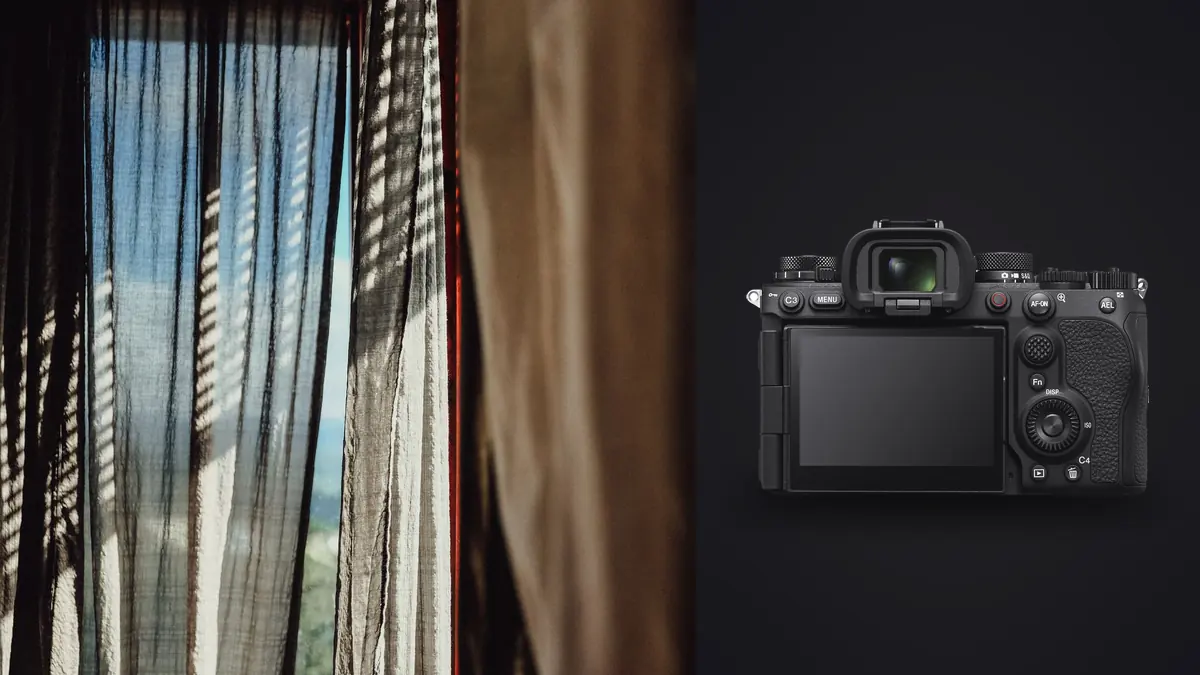
Most articles about the Sony A9 III talk about it as a sports camera, and fairly so, that's who Sony built it for. But I picked one up for boudoir and intimate portraits, not a sideline soccer field, and after eight months of shooting with it I have a clearer picture of where it actually earns its keep in this genre and where it's genuinely the wrong tool. Neither story gets told much, so here's the honest version.
Why the Global Shutter Changes the Lighting Equation
The headline spec is the sensor itself: a 24.6MP stacked CMOS chip that reads out every pixel simultaneously instead of scanning line by line. That's what "global shutter" means in practice, and the sports crowd cares about it because it kills rolling shutter skew on fast-moving subjects. For boudoir work, the more useful side effect is something quieter: because there's no mechanical curtain and no rolling readout, the camera can sync flash at literally any shutter speed, all the way to 1/80000s, at full flash power, no high-speed sync mode, no power penalty.
That matters more in this genre than people expect. A lot of boudoir work happens in hotel rooms and Airbnb suites with big windows, and the ambient light in those rooms is often bright enough that you're fighting it, not missing it. If you want a wide-open aperture for that soft falloff behind the subject and you're also using an off-camera strobe to shape the face and body, a conventional camera boxes you in. Push past your native sync speed (1/250s on most current bodies) and you either lose one to three stops of flash power to HSS, or you stop down and lose the background blur you were shooting for in the first place.
Here's roughly what that trade-off looks like in a bright, window-lit room at ISO 250:
| Shutter speed | Aperture for correct ambient exposure | Conventional camera (1/250s native sync) | A9 III (global shutter) |
|---|---|---|---|
| 1/250s | f/8 | Full flash power, normal sync | Full flash power, normal sync |
| 1/500s | f/5.6 | HSS engaged, roughly 1 stop of power lost | Full flash power, normal sync |
| 1/1000s | f/4 | HSS engaged, roughly 1.5-2 stops lost | Full flash power, normal sync |
| 1/2000s | f/2.8 | HSS engaged, roughly 2-3 stops lost, softbox often has to move in close | Full flash power, normal sync |
| 1/4000s | f/2 | Often impractical with a modifier at working distance | Full flash power, normal sync |
| 1/8000s | f/1.4 | Usually not workable without stripping down to a bare speedlight | Full flash power, normal sync |
What that table means on set is simple: on a bright afternoon shoot, I can hold f/1.4 on an 85mm, keep the strobe modified with a medium softbox at a normal working distance, and not think about it. On my old A7 III I'd have been juggling ND filters, moving the light uncomfortably close to the subject, or waiting for the sun to move. That's not a small convenience, it's the difference between shooting the light you have and shooting around it.
The Resolution and Dynamic Range Trade-Off
Now the part that doesn't get mentioned enough in the marketing: 24.6MP is a step down from what a lot of boudoir and fine-art photographers have gotten used to, and the dynamic range at base ISO is narrower than a typical modern stacked sensor. Global shutter readout costs something, and Sony paid for the speed with headroom. Base native ISO is 250, not 100, which means you're already starting a stop "up" compared to most full-frame bodies, and independent testing after launch consistently found the A9 III trailing the A7R V and even the standard A7 IV in shadow recovery.
For boudoir specifically, that shows up in one place: skin. Skin tones in the shadow side of a body, especially on darker or more richly toned skin, are where you lean on dynamic range the hardest during retouching. If you're the kind of shooter who exposes conservatively and pulls detail back in post, you'll notice the ceiling sooner on this sensor than you would on a body built around dynamic range instead of readout speed.
| Sony A9 III | Sony A7R V | Sony A7 IV | |
|---|---|---|---|
| Sensor | 24.6MP stacked, global shutter | 61MP stacked, rolling shutter | 33MP, rolling shutter |
| Native base ISO | 250 | 100 | 100 |
| Shadow recovery at base ISO | Noticeably tighter, plan exposure carefully | Class-leading, forgiving of underexposure | Solid, comfortable margin |
| Max flash sync | Any shutter speed, no HSS needed | 1/250s native, HSS above that | 1/250s native, HSS above that |
| Continuous shooting | Up to 120fps, blackout-free | Up to 10fps | Up to 10fps |
| Approx. body price at launch | $5,999 | $3,899 | $2,499 |
| Strongest fit | Flash-heavy, movement-heavy, bright-room sessions | Large prints, fine-art album work, heavy retouching | Everyday boudoir, budget-conscious start |
If the bulk of your boudoir work is delivered as web galleries and modest print sizes, 24.6MP is plenty, files crop cleanly and edit fast. If you're regularly producing 30-inch album spreads or wall art, you'll feel the gap against the A7R V, and no amount of sharpening closes a resolution deficit that's baked into the sensor.
Silent, Skew-Free Motion: What It Actually Buys You
Boudoir and intimate portraiture involve a lot of small, continuous movement that studio and event photography mostly doesn't: fabric settling, hair falling as a client tips her head, a sheet being pulled across skin, hands moving through a pose. On a rolling-shutter sensor shot electronically (silent mode), fast movement close to the lens can smear or skew, especially wide open where depth of field is already razor-thin and you're relying on the eyes staying put while everything else moves. The A9 III's electronic shutter reads the whole frame at once, so that skew simply isn't there. I shoot silent mode as the default now, not a special case, because there's no image-quality reason not to.
The silence itself matters too, more than I expected going in. A lot of boudoir clients are shooting for the first time and are already self-conscious. A camera that doesn't clack on every frame, especially during a burst where you're firing six or eight shots through a moving pose, keeps the room quieter and the mood less clinical. It's a small thing that compounds over a two-hour session.
Autofocus for Intimate Portraiture
The A9 III runs the same AI-driven subject recognition as Sony's other current bodies, with human pose detection and eye AF that tracks through partial obstruction, a hand across the face, hair falling over an eye, a shoulder turned three-quarter to camera. In practice it holds eye focus through the kind of movement that used to require manual focus discipline or a lot of missed frames. Where it struggles is the same place every contrast-detect-assisted system struggles: very soft, diffused window light with low subject contrast, or a shot where the eyes are closed and there's no clear AF target, which happens constantly in this genre. In those cases I still fall back to a single focus point on the collarbone or shoulder and stop down slightly rather than trust the algorithm to guess.
One underrated feature for this kind of shoot is pre-capture buffering, up to a second of frames captured before you fully press the shutter, triggered once you're at half-press. For genuine, unposed reactions, a laugh, a breath, a moment of eye contact that lasts half a second, it's saved me shots I would have missed by a beat on any camera without it.
Handling the Data Afterward
The practical cost of a camera that shoots up to 120fps with pre-capture buffering is the number of frames you come home with. A single 90-minute boudoir session with a handful of bursts can easily leave 1,800 to 2,500 RAW files on the card, most of them near-duplicates of the same pose a few hundredths of a second apart. Sorting that by eye is where a session used to lose an evening.
This is the part of the workflow I moved into imagic. It scores sharpness and focus locally on the RAW files as they come in, groups near-identical burst frames and duplicates together, and surfaces the sharpest, best-timed frame from each cluster instead of making me click through every near-twin one at a time. For a boudoir photographer specifically, the offline part matters as much as the speed: these are files a client is trusting you with, and running culling entirely on the machine, with nothing uploaded anywhere, means that trust doesn't depend on someone else's server. If you haven't looked at how automated culling handles burst-heavy work like this, how AI photo culling works covers the mechanics in more depth than I can here.
The other piece that's specific to this genre is consistency across a delivered gallery. Clients expect a cohesive look across forty or fifty final images, not forty different edits. imagic's apply_my_style feature trains a preset off a set of your own previously edited photos rather than a generic filter, so once I've established the tone I want on the first handful of images from a session, I can apply that same learned look across the rest of the culled set instead of rebuilding it frame by frame. It's saved real hours on delivery week specifically.
Lens Pairings Worth Knowing
Body choice matters less than glass here, and a few pairings have earned a permanent spot in my bag for this work:
- Sony 85mm f/1.4 GM II: the default portrait length, close enough for detail shots without distorting proportions, and it resolves well even wide open where the A9 III's lower megapixel count would otherwise show soft edges on a lesser lens.
- Sony 50mm f/1.2 GM: better for environmental frames in smaller rooms, hotel suites especially, where an 85mm forces you against the far wall.
- Sony 35mm f/1.4 GM: useful for wider, more storytelling frames, a hand on a doorway, the room itself, but needs care with proportions up close.
None of these are unique to the A9 III, they're the same lenses that work on any Sony E-mount body, but the sync-anywhere flash makes all three usable wide open in bright rooms in a way that's harder to pull off on a camera capped at 1/250s native sync.
Is It Worth It for This Genre?
If your boudoir or intimate portrait work leans heavily on off-camera flash in bright, uncontrolled spaces, hotel rooms, sunlit bedrooms, Airbnb suites with big windows, and you want wide apertures without fighting your own light, the A9 III solves a real problem that no amount of technique fully solves on a conventional shutter. That's a genuine, specific advantage, not a marketing line.
If your work is mostly shot with continuous or window light, delivered as large prints, or leans on aggressive shadow recovery in the edit, the price premium buys you speed and sync you're not using, while costing you resolution and dynamic range you are. The A7R V or even the A7 IV will serve that kind of session better for less money. I still reach for the A9 III on any shoot with a strobe and a bright room, and I reach for a higher-resolution body when I want large prints. Owning both isn't necessary for everyone, but knowing which one your actual shooting style needs before you spend $5,999 is worth more than any spec sheet.
For context beyond the mastering sony a9 iii for boudoir intimate portraiture guide focus in entry 116, continue with photo automation guide. These resources connect the subject to a practical local review process.
Frequently Asked Questions
Do I actually need global shutter flash sync for boudoir work, or is it overkill?
It depends entirely on where you shoot. If most of your sessions happen in controlled studio light where you're not fighting bright ambient, you'll rarely hit the limits of a conventional 1/250s sync speed. If you regularly shoot with flash in sunlit rooms and want backgrounds soft at f/1.4 to f/2, the ability to sync at any shutter speed removes a real, recurring constraint rather than a theoretical one.
Is 24.6MP enough resolution for boudoir prints and heavy retouching?
For web galleries, social delivery, and prints up to roughly 16x20 inches, yes, the files hold up well and crop comfortably. For large album spreads or wall art beyond that size, or for retouching workflows that involve significant cropping after the fact, a higher-resolution body like the A7R V leaves more room to work with.
Does the A9 III handle low, moody bedroom lighting without flash?
It's usable but not its strength. The higher base ISO of 250 and the narrower dynamic range compared to Sony's other current bodies mean low-light, available-light sessions ask more of the sensor than they would on an A7 IV or A7R V. It's not a dealbreaker for occasional ambient-light frames, but it's not the reason to buy this camera.
What lenses pair best with the A9 III for intimate portrait sessions?
The 85mm f/1.4 GM II is the most-used length for this genre and resolves cleanly wide open, which matters given the sensor's lower pixel count. A 50mm f/1.2 GM covers tighter rooms and environmental frames well, and a 35mm f/1.4 GM is useful for wider storytelling shots where proportion distortion isn't a concern.