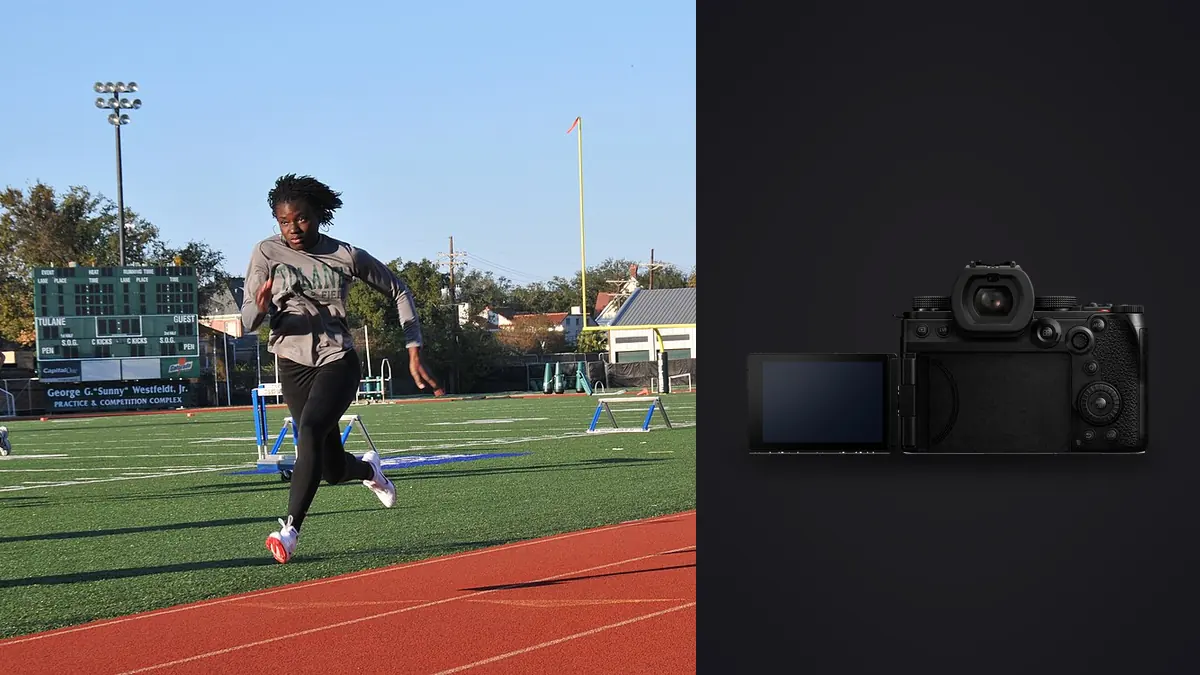
I picked up the S5IIx expecting a video camera that happened to take stills, since that is basically how Panasonic marketed it: ProRes internal, ProRes RAW over HDMI, a cooling fan, network streaming. What I did not expect was to end up using it for two full outdoor track seasons and a handful of indoor fieldhouse meets, because the stills side of that body is quietly capable in ways the marketing barely mentions. This is not a camera built for World Athletics championship coverage. It is a camera a lot of school, club, and college-adjacent shooters can actually afford, and it holds up better on a track than its reputation suggests.
What follows is what I actually learned shooting sprints, relays, distance heats, and field events with this body over roughly eighteen months, plus where it genuinely struggles compared to a dedicated sports camera.
The autofocus is the real story, not the burst rate
The S5IIx shares its sensor and autofocus system with the S5II, which was Panasonic's first full-frame body with phase-detect autofocus instead of the old contrast-and-DFD system. That matters more for track than any spec sheet number does. Panasonic's earlier full-frame bodies would visibly hunt and pulse when a runner crossed in front of a busy background, like bleachers full of parents in bright shirts. The phase-detect system does not do that. It locks onto a moving human shape and stays there through a 100m sprint far more consistently than the S5 or S1 generation ever did. Where I still run into trouble is subject switching in a crowded lane. During a relay handoff, human detection will occasionally jump from the incoming runner to the outgoing runner a half second before the baton actually changes hands, because both bodies are moving toward the camera and both register as valid subjects. I have mostly solved this by narrowing the AF area to a fixed zone around where the exchange happens rather than trusting full-frame tracking to sort it out. It is a small workflow adjustment, but it is the difference between a sharp exchange frame and a frame where the camera locked focus on the wrong kid.
Detection settings that actually help
I leave Human detection on and Animal/Bird off entirely, since track meets have zero use for the latter and it occasionally steals a frame of attention when a mascot or a dog on a leash wanders near the infield. I also turn off face priority within human detection for anything shot from further than about 40 meters away, because at that distance the system sometimes fixates on a bib number or a bright patch of fabric instead of the torso, and torso tracking through a stride cycle is more reliable than face tracking on a face that is only visible for a fraction of a second at a time.
Burst modes: what the spec sheet doesn't tell you
The S5IIx offers 9fps with the mechanical shutter and up to 30fps in electronic shutter burst mode with a short pre-capture buffer. On paper the 30fps number looks like it solves every timing problem you'd ever have at a track meet. In practice I use the mechanical 9fps mode for probably 80 percent of my track shooting, and here is why.
| Setting | Mechanical 9fps | Electronic 30fps (SH burst) |
|---|---|---|
| Rolling shutter risk on lateral pans | None | Noticeable skew on fast side-on pans, e.g. 100m at full stride |
| Buffer before slowdown (compressed RAW) | Roughly 40-45 frames | Drops to a few seconds before the card write queue backs up |
| Flicker sensitivity indoors | Lower, shutter is a physical curtain | Higher, banding shows up under gym fluorescents/LEDs |
| Best use case at a meet | Sprints, hurdles, relay exchanges, any lateral pan | Long jump takeoff, pole vault bar clearance, throw release, short bursts you can't blink through |
| Sound/vibration at close range | Audible shutter clack, fine outdoors | Silent, useful if you're shooting from close to a start line |
The rolling shutter issue is the one nobody warns you about. Shoot a sprinter side-on with the electronic shutter at 30fps and their leading leg or an outstretched arm can skew visibly, because the sensor reads out line by line rather than all at once. It is subtle enough that you might not notice on the back of the camera at a track meet, then very noticeable once you pull the file up at full size that night. For anything where the athlete is moving laterally across your frame at speed, mechanical wins. For field events where the motion is mostly vertical or the athlete is coming toward you, like a long jump takeoff or a discus release, electronic shutter's 30fps is genuinely useful and the rolling shutter artifact barely shows.
Buffer depth and the card slot reality
This is my biggest practical complaint. The S5IIx uses dual UHS-II SD card slots, not CFexpress. At 9fps with compressed RAW, the in-camera buffer is decent, somewhere in the low 40s of frames before the rate drops, but clearing that buffer back to full speed takes noticeably longer than it would on a body with CFexpress Type A or B slots. On a meet with back-to-back heats, that means if I burn through the buffer chasing a photo finish and then immediately want to fire off a burst on the next heat thirty seconds later, I sometimes catch the camera still writing. I have started shooting JPEG+RAW at a slightly reduced RAW compression setting specifically for meet days, which is not something I'd bother doing for a portrait session, but it buys back enough buffer headroom to matter across a five-hour meet.
Buy the fastest V90 SD cards you can find for this body. It is one of the few situations where the card genuinely gates the camera's usable performance rather than being a minor upgrade.
Lens pairing for shooting from the stands or trackside
Because this is a full-frame sensor, there is no crop-factor reach bonus the way there is on an APS-C or Micro Four Thirds body. If you are coming from a Micro Four Thirds system, which a lot of Panasonic shooters are, be ready for the fact that a 100-400mm here behaves like an actual 100-400mm, not the 200-800mm equivalent field of view you might be used to. That caught me off guard the first meet I shot with it.
My go-to combination for outdoor meets from the stands is the 100-400mm f/4.5-6.3, handheld, because a monopod in a crowded grandstand is more trouble than it's worth and the lens is light enough to track a runner through an entire 200m without my arm giving out. For infield access, where I can get closer to the action, I switch to a 70-200mm f/2.8, which also handles indoor fieldhouse light far better thanks to the wider aperture. A 1.4x teleconverter on the 70-200 keeps working reasonably well with this AF system in daylight, but indoors under dimmer gym lighting I noticed a real drop in hit rate with the converter attached, enough that I stopped using it for indoor meets specifically.
Recommended starting settings by event
| Event type | Shutter speed | Drive mode | Notes |
|---|---|---|---|
| 100m/200m sprints (side-on) | 1/2000 or faster | Mechanical 9fps | Avoids rolling shutter skew during full-stride panning |
| Hurdles | 1/2500 | Mechanical 9fps | Freeze the trail leg over the barrier |
| Distance/relay | 1/1000-1/1600 | Mechanical 9fps, zone AF | Slightly more motion blur is acceptable and looks natural |
| Long jump/triple jump | 1/2000 | Electronic 30fps SH burst | Motion is mostly toward camera, rolling shutter is a non-issue here |
| Pole vault | 1/2000 | Electronic 30fps SH burst | Bar clearance happens in a fraction of a second, use the pre-burst buffer |
| Shot put/discus/javelin | 1/2000 | Electronic 30fps SH burst | Release moment is easy to miss without it |
| Indoor sprints under gym lighting | 1/1000, ISO 3200-6400 | Mechanical 9fps | Mechanical shutter avoids banding under fluorescent/LED gym fixtures |
Indoor fieldhouses are the real stress test
Outdoor daylight meets are where this camera feels comfortable. Indoor fieldhouses are where I found its limits. Dual native ISO helps keep noise reasonably controlled up through ISO 6400, and I have pushed to 12800 on a heavily underlit banked 200m track and gotten usable, if grainy, files after a pass through noise reduction. But the light in most fieldhouses is inconsistent, mixing old fluorescent fixtures with newer LED banks, and that mix is exactly the scenario where flicker banding shows up in electronic shutter mode. Sticking to the mechanical shutter indoors avoids the issue almost entirely, at the cost of the higher burst rate you might want for a fast indoor 60m dash.
Weather sealing and handling on a real meet day
The magnesium alloy body has held up fine through a drizzly regional meet and a genuinely unpleasant afternoon of blowing dust off a dry infield. I would not call it bombproof the way a flagship sports body is, but I have not babied it and it has not let me down. Battery life is the one place the video-oriented design works against you a little: a body built around an active cooling fan and continuous recording is not necessarily optimized around all-day stills battery life, and I carry two spares for anything longer than a half-day meet, which is not unusual for mirrorless bodies generally but worth planning for.
Getting through the files afterward
A five-hour meet with heats, finals, and field events running simultaneously easily produces four to six thousand frames by the end of the day, and a meaningful chunk of those are near-duplicate bursts from the same stride cycle or the same vault attempt. This is where I stopped trying to cull manually in Lightroom and moved that first pass into imagic. Its local sharpness and focus scoring catches the frames where the camera locked onto a bib number or the background fence rather than the runner's face, which happens more often than I'd like even with a solid phase-detect system, and its burst clustering groups those 9fps and 30fps sequences together so I am picking one keeper out of a dozen instead of scrolling through all of them individually. Because a lot of meets happen at rural school tracks with unreliable wifi, having that first cull run entirely on my laptop without uploading a single RAW file matters practically, not just as a privacy preference. Once the culling pass is done, I run the surviving frames through imagic's apply_my_style preset, which is trained on my own past edits rather than a generic sports LUT, so a meet shot on the S5IIx ends up looking consistent with meets I've shot on other bodies rather than sticking out as a different look. If you're building out a faster post-meet workflow generally, our tips for a faster photo workflow cover more of this ground, and if you want the mechanics behind the culling step itself, how AI photo culling actually works goes into more detail than I have room for here.
Frequently Asked Questions
Is the Lumix S5IIx fast enough for sprint events like the 100m?
Yes, with a caveat. The 9fps mechanical burst combined with reliable phase-detect human tracking is enough to catch stride position, foot strike, and lean at the line consistently. Where it falls short of a dedicated sports flagship is buffer clearing between bursts on a UHS-II SD card, so if you're shooting back-to-back heats with no gap, plan your card choice and RAW compression settings accordingly rather than expecting flagship-level sustained performance.
Should I shoot mechanical or electronic shutter for track and field?
Use mechanical shutter for anything with fast lateral motion across your frame, like sprints and hurdles viewed from the side, because the electronic shutter's rolling readout can visibly skew a moving limb at 30fps. Save the electronic 30fps burst for events where motion is mostly toward or away from the camera, like long jump takeoffs, pole vault clearances, and throw releases, where the extra frame rate helps you catch a split-second moment without the skew becoming visible.
What lens is best for shooting a track meet from the stands with this camera?
A 100-400mm f/4.5-6.3 handheld is my default for stadium shooting, since it's light enough to track a full lap without fatigue and gives real reach on a full-frame sensor. If you can get trackside access, a 70-200mm f/2.8 handles low light and indoor meets noticeably better, though you'll need to physically move closer since there's no APS-C crop factor giving you extra reach for free.
How does the S5IIx handle indoor fieldhouse lighting?
Reasonably well up to about ISO 6400 thanks to dual native ISO, with usable files even pushed higher if you're comfortable applying noise reduction afterward. The bigger issue indoors is flicker banding under mixed fluorescent and LED gym lighting when using the electronic shutter, which mechanical shutter mode avoids almost entirely, so I default to mechanical for any indoor meet regardless of the frame rate I'm giving up.