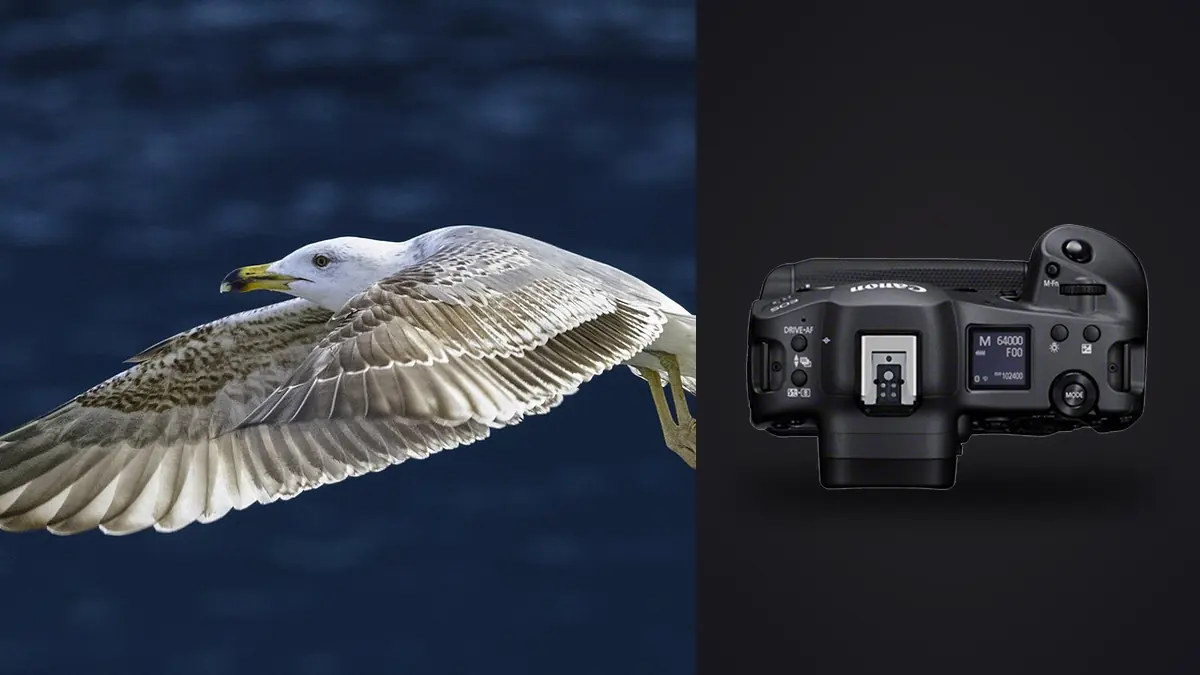
I picked up the Canon EOS R3 mostly out of curiosity about the stacked sensor and Eye Control AF, and kept it because it turned out to be one of the few bodies that doesn't flinch when a peregrine drops through a frame at 60 mph. This isn't a spec sheet regurgitation. It's what changed in my actual keeper rate once I stopped fighting the camera's defaults and started shooting it the way it wants to be shot for wildlife and birds in flight.
The sensor readout is the whole story
Most of what makes the R3 good for flight photography traces back to one thing: the 24.1MP stacked, back-illuminated CMOS sensor reads out fast enough that rolling shutter distortion, the classic skewed-propeller look you get from electronic shutters on slower sensors, basically disappears. I've shot herons banking hard against a blue sky at 30fps electronic and gotten clean wingtips, not the warped, jello-edged mess you'd see from a non-stacked sensor at the same shutter mode.
That readout speed is what lets Canon offer fully silent 30fps shooting without a mechanical shutter tax. For a lot of bird work that silence matters less for stealth (birds mostly don't care about shutter clatter at 20+ meters) and more for not spooking a nest or blind situation where every click carries. The 12fps mechanical option is still there and I'll use it for perched portraits where I want the shutter's tactile confirmation, but flight work lives at 30fps electronic almost exclusively for me now.
Autofocus: animal detection is good, Eye Control AF is situational
Canon's deep-learning subject detection on the R3 recognizes birds specifically, distinguishing eye, head, and body, and it holds onto a bird against a busy background (reeds, branches, other birds in a flock) noticeably better than the R5's first-generation detection did. Against open sky it's close to unmissable. Against a cluttered mangrove edge with a heron half-obscured by branches, it still occasionally jumps to a twig, but recovers fast once the bird clears the obstruction.
Eye Control AF, the feature that lets the camera place the AF point where your eye is looking through the viewfinder, gets more attention than it deserves in most reviews. It's genuinely useful for one specific case: a flock of shorebirds moving as a group where you want to snap focus to a different individual bird faster than the joystick allows. It requires a calibration step every session (lighting and how you're wearing glasses both throw it off), and if you skip recalibrating after switching light conditions, it drifts and starts putting the AF point somewhere unhelpful. I use it maybe one shoot in four. For pure birds-in-flight tracking against sky, Animal Priority tracking with the center zone active does the job without any calibration fuss.
AF Case settings that hold up in the field
Canon carried over the AI Servo Case 1-6 presets from the 1D X line, and for erratic flight (swallows, terns working a shoreline, anything changing direction unpredictably) Case 4 with tracking sensitivity pushed toward +1 and acceleration/deceleration tracking at 0 has been my starting point. For raptors on a straight glide or stoop, Case 2 with slightly reduced tracking sensitivity avoids the AF jumping to a closer branch or another bird crossing the frame. None of these are "set and forget." I adjust Case settings between a heron rookery (slow, predictable) and a falconry demo (violent direction changes) within the same afternoon.
Buffer and card reality, not the marketing number
The advertised buffer depth assumes a fast CFexpress Type B card and specific file settings, and the number you actually get shooting C-RAW at 30fps for six or seven seconds straight (which is a normal length for a passing raptor) is meaningfully lower than the headline figure once you factor in a card that's 60% full partway through a shoot. I standardized on a 325GB CFexpress card and shoot C-RAW rather than full RAW for anything above 12fps, which buys noticeably more consecutive frames before the buffer clears and the frame rate throttles. The SD UHS-II second slot is fine for backup but far too slow to be a primary card for extended bursts; I only use it for redundancy on files I can't afford to lose.
| Shooting mode | Frame rate | Realistic burst length before slowdown (fast CFexpress, C-RAW) | Best use case |
|---|---|---|---|
| Mechanical shutter | 12fps | Effectively unlimited on a fast card | Perched birds, static wildlife portraits |
| Electronic, full RAW | 30fps | Roughly 4-5 seconds of continuous shooting | Short, decisive action (strike, launch) |
| Electronic, C-RAW | 30fps | Roughly 7-9 seconds of continuous shooting | Extended flight sequences, unpredictable flocks |
| Pre-continuous shooting | Up to 30fps | Captures up to 0.5s before full shutter press | Takeoff moments, unpredictable launch timing |
Pre-continuous shooting deserves a specific mention because it changes how you time a takeoff shot. Half-press to activate tracking, and the camera buffers frames from up to half a second before you fully press the shutter, then writes them if you complete the press. For an osprey that launches off a piling with zero warning, that half second is often the difference between having the wing-extension frame and missing it entirely.
Lens pairing for the R3's autofocus ceiling
The R3's AF system is fast enough that lens choice becomes the limiting factor more than the body. The RF 100-500mm f/4.5-7.1L is the lens I reach for most, light enough for handheld flight tracking over a full morning and sharp through 500mm even wide open. The RF 200-800mm f/6.3-9 gives real reach for distant raptors or skittish species, but the variable aperture drops to f/9 at the long end, which pushes ISO harder in anything but full sun. With the RF 1.4x extender on the 100-500mm, autofocus stays reliable in good light but starts to hunt in overcast conditions or heavy tree cover, which is worth knowing before you commit to that combination on a cloudy dawn shoot.
For the budget-conscious end, the RF 600mm f/11 and RF 800mm f/11 primes autofocus fine with the R3's AF system in bright conditions but become noticeably less confident as light drops, since you're already working at f/11 native. I keep one in the bag as a lightweight second option for hikes where carrying the 100-500mm plus a body feels like enough weight already.
Image stabilization and handholding long lenses
In-body stabilization on the R3 combines with IS-equipped RF glass for up to 8 stops in ideal conditions, though in practice, panning a bird in flight defeats a chunk of that benefit since the system is compensating for camera shake, not subject motion. Where it actually pays off is stabilizing the viewfinder image itself during tracking, which makes it easier to keep a small, fast-moving subject centered in the frame at 500mm+ handheld. For static long-lens work, like a heron standing motionless at dusk, I've gotten clean handheld frames at shutter speeds I wouldn't have trusted on older bodies.
Practical shutter speed floor for flight work
Stabilization doesn't help freeze wing motion, so I don't lean on it to drop shutter speed for anything airborne. For small, fast wingbeats (songbirds, swallows) I stay at 1/3200s or faster. For larger, slower-flapping birds like herons and raptors, 1/1600s to 1/2000s usually freezes the wing convincingly while leaving room to keep ISO reasonable. The R3's native ISO range tops out at 102400 with an extended ceiling beyond that, and usable detail holds up well through about ISO 6400 for web and print sizes under 16x20, with noise becoming a bigger factor in shadow recovery above that.
What a real flight-photography session leaves you with
A single decent morning shooting egrets working a tide line at 30fps electronic can leave you with 3,000 to 6,000 frames, and the overwhelming majority of them are near-duplicates: the same wingbeat cycle repeated across a dozen frames with one or two actually sharp on the eye. This is where the volume the R3 generates becomes a workflow problem rather than a camera problem. I run those cards through imagic after a shoot specifically because its burst clustering groups the repeated wingbeat sequences together instead of making me scroll through them one at a time, and the local sharpness scoring flags which frame in each burst actually nailed focus on the eye rather than the wingtip or the chest feathers, which is the difference that matters most in flight shots.
Because imagic processes everything on the machine rather than uploading to a cloud service, I don't think twice about running a full card from privately accessed land or a sensitive nest location through it. That offline processing was a bigger deal to me than I expected going in, since a lot of the culling tools I'd tried before assumed a persistent upload connection I didn't have at some of the remote blinds I shoot from.
The other piece that's saved actual editing time is the apply_my_style preset feature, which trains on edits I've already made rather than shipping a generic wildlife preset. After running it against a batch of flight shots from a shoot I'd already graded, the exposure and white balance starting point it applied to a fresh batch from the same lighting conditions needed only minor tweaks rather than a full re-grade from scratch. It won't replace deliberate per-image work on a hero shot, but for triaging a few thousand near-identical frames down to a workable baseline, it's a real time saver, not a gimmick.
Weather sealing and battery life for full-day sessions
The integrated vertical grip that gives the R3 its body shape isn't just for portrait-orientation comfort, it houses a larger battery (the LP-E19) that has genuinely outlasted a full day of intermittent 30fps bursts for me, something I couldn't say about smaller mirrorless bodies that needed a battery swap by early afternoon. Weather sealing has held up through drizzle and salt spray at coastal shoots without issue, though I still keep a rain cover on hand for anything beyond light mist, mostly out of habit from years on bodies that weren't as forgiving.
Frequently Asked Questions
Is the Canon EOS R3 overkill for someone just starting in bird photography?
For a beginner, probably. The AF customization options (Case settings, tracking sensitivity, subject priority) take real time to learn, and a lot of that complexity is wasted if you're still working out composition and light. An R7 or R6 Mark II with a long RF zoom will teach you more about the craft per dollar spent. The R3 earns its keep once you already know what you're chasing and need the buffer depth and readout speed to keep up with it.
Does the electronic shutter cause any banding under artificial light for wildlife photography?
It can, but it's rarely relevant for outdoor bird and wildlife work since you're shooting under natural light. Where I have seen it is photographing captive raptors at an indoor falconry demonstration under fluorescent or LED panels, where banding showed up in electronic shutter mode and forced me back to mechanical shutter for that specific setup.
How does the R3's animal detection AF compare across different bird species?
It's most reliable on birds with clear head-to-body contrast against the background, herons, egrets, raptors, larger waterfowl. Small, fast songbirds against dense foliage are still the hardest case for any camera's subject detection, and the R3 will occasionally lose the eye and fall back to general subject tracking in that scenario. Species with unusual head shapes or heavy plumage around the face, like owls, get detected but the eye-lock is a touch less precise than on a hawk or heron.
What card speed do I actually need to avoid buffer slowdowns during flight sequences?
You want a CFexpress Type B card rated for sustained write speeds well above the R3's peak data rate at 30fps, not just the marketing "up to" read speed. Budget CFexpress cards that hit their advertised number briefly and then throttle under sustained writes are the most common cause of buffer complaints I see from other shooters, more so than the camera itself.
If you're weighing the R3 against other bodies for this kind of work, it's worth reading up on how AI photo culling actually evaluates sharpness before you commit to a camera purely on burst rate, since the volume of frames a fast body produces only pays off if your culling workflow can keep pace with it. And if the RAW backlog from a body like this is what's been slowing you down rather than the camera itself, our notes on building a faster photo workflow cover the culling and triage side in more depth.