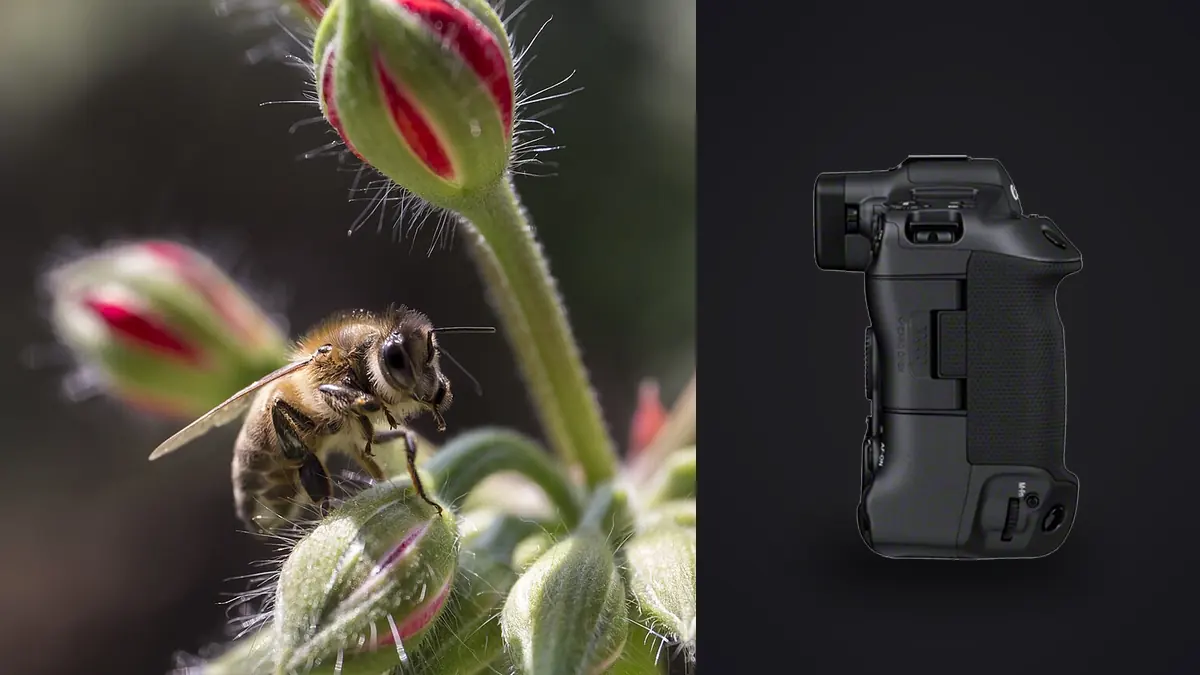
Most of the buzz around the Canon EOS R3 when it launched had nothing to do with dragonflies or jumping spiders. It was built and marketed as a sports and photojournalism camera, all stacked sensor, 30fps bursts, and that odd, divisive Eye Control AF party trick. Macro shooters weren't really in the room when Canon designed this thing.
And yet here I am, well over a year into using an R3 almost exclusively for insect work, telling people it's a better macro body than its spec sheet suggests, with one asterisk nobody selling you the camera will mention upfront: 24.1 megapixels isn't a lot of resolution when your subject is 8mm long and you need to crop hard just to fill the frame. This isn't a "buy this camera" piece. It's what actually happens when you point an action camera at a praying mantis for a season.
The Resolution Question Nobody Asks Before Buying
Macro photography is one of the few genres where megapixels genuinely matter beyond bragging rights, because you are routinely cropping in post even after getting to 1:1 or higher magnification in camera. A jumping spider's face fills maybe a third of the frame at true 1:1 with a 100mm macro lens. Crop that down to just the eyes and palps, and a 24.1MP file (6000x4000 native) can drop to something in the 2000x1300 range. That's still fine for web use and a 6x4 print, but it's tight if a client wants a 16x20 wall print of a single dewy-eyed spider.
Compare that to a 45MP body like the R5, where the same crop leaves you around 3800x2500, comfortably printable much larger. I noticed this the first spring I shot odonata (dragonflies and damselflies) with the R3 after two years on an R5. My keeper rate on sharp frames went up because of the autofocus and burst advantages I'll get into below, but the individual file quality per crop went down. It's a genuine tradeoff, not a marketing footnote.
In practice, I've made peace with it by shooting a bit wider than I used to and doing the tight crop deliberately rather than by accident, and by accepting that anything destined for large print goes on a tripod with the R5 instead. The R3 has become my "things that move fast and won't sit still" camera. The R5 is my "things that hold still long enough for me to think" camera. Neither replaces the other for insect work, which surprised me going in.
Autofocus That Actually Keeps Up With a Moving Bug
Eye Control AF: great for people, unreliable for insects
Eye Control AF, the system that tracks where your eye is looking through the viewfinder and moves the focus point there, gets a lot of attention because it's genuinely useful for portraits and events. For insects it's close to useless. The calibration is tuned for human eyes at typical shooting distances, and when you're six inches from a hoverfly with your eye jammed against the viewfinder trying to hold still yourself, the calibration drifts constantly. I turned it off entirely for macro work within the first few outings. If you're buying an R3 specifically for bugs, don't let Eye Control AF factor into the decision.
What does matter is the underlying Dual Pixel CMOS AF II system and how well it holds a single point on a small, low-contrast subject. Insects with fine hairs, translucent wings, or compound eyes that don't have obvious contrast edges can make any autofocus system hunt, and the R3 is no exception, but it recovers from a missed focus attempt faster than older Canon bodies I've used. I run single-point AF almost exclusively for insects rather than the subject-detection modes, because animal and bird detection on this camera is tuned for eyes and faces on larger fauna, not on an ant's head. Whole Area AF with detection on will happily lock onto a leaf vein instead of the actual bug.
Servo tracking on erratic subjects
Where the R3 pulls ahead is tracking something that's actually moving, like a bee working a flower head or a dragonfly in a hover. Servo AF combined with the high burst rate means I can trust the camera to keep adjusting through a three or four second sequence instead of nailing one frame and drifting on the rest. I still miss plenty of frames to focus wobble at high magnification, because depth of field at 1:1 or greater is measured in millimeters and no AF system alive can compensate for a spider adjusting its own position mid-pounce. But the hit rate on a moving subject is noticeably better than what I got out of older DSLR-era AF.
Lens Pairings That Make Sense on the R3
The RF 100mm F2.8L Macro IS USM is the obvious partner and the one I use for probably 80% of my insect shots. Its 1.4x maximum magnification (beyond true 1:1) is genuinely handy for small subjects, and the Hybrid IS does real work handheld, though at high magnification no image stabilization fully substitutes for a beanbag or tripod on a still subject.
For anything smaller than a jumping spider, I reach for the MP-E 65mm 1-5x macro, which is manual focus only regardless of camera body. This is where the R3's burst rate quietly earns its keep: since there's no autofocus to help you, you're rocking the whole camera forward and back by fractions of a millimeter to find focus, firing continuously, and picking the sharpest frame afterward. At 5x magnification depth of field is measured in fractions of a millimeter, so a 12fps or 30fps burst through that focus travel gives you meaningfully more chances at a usable frame than a slower body would.
Extension tubes on the RF 100mm push magnification further with some light loss, and I've used a 1.4x teleconverter behind the 100mm for extra working distance on skittish subjects like adult dragonflies, at the cost of a stop of light and somewhat slower AF acquisition.
Frame Rate, Buffer, and What 30fps Actually Buys You
The R3's headline 30fps electronic shutter sounds excessive for photographing something that isn't going anywhere, and for a lot of insect subjects it is excessive. But wingbeats change that calculus. A hoverfly's wings move fast enough that even 12fps mechanical only catches a handful of distinct positions per second of flight, while 30fps gives you a real shot at freezing a clean wing position instead of motion blur across the board.
The buffer matters more than the top frame rate in real use. The R3 has a single CFexpress Type B slot and a separate SD slot, and if you're recording to the SD card (or worse, both cards simultaneously) your effective buffer depth collapses well before you'd expect from the spec sheet. I learned this the annoying way, mid-burst on a rare (for my area) robber fly, when the buffer choked because I'd left RAW+JPEG backup running to both cards out of habit from a different body. CFexpress only, RAW alone, is the setting I now leave permanently on for anything with wings.
| Camera | Sensor | Max burst (e-shutter) | Typical RAW buffer | Best suited to |
|---|---|---|---|---|
| Canon EOS R3 | 24.1MP full-frame stacked | ~30fps | ~150 frames (CFexpress) | Flying insects, erratic subjects, action-first shooting |
| Canon EOS R5 | 45MP full-frame | ~20fps | ~87 frames (CFexpress) | Static or slow subjects where crop resolution matters, tripod stacking |
| Canon EOS R7 | 32.5MP APS-C (1.6x crop) | ~30fps | ~42 frames (UHS-II SD) | Budget-conscious reach for small subjects, extra "free" magnification from the crop |
The R7's crop factor is worth pausing on, because a 1.6x sensor effectively adds working distance and reach without extra glass, which is genuinely valuable for skittish insects. It's the buffer and single card slot that hold it back for the kind of extended burst shooting insect flight demands. None of these three is objectively "best" for macro; they trade resolution, speed, and reach against each other in different ways.
Field Technique: Working Distance, Diffused Light, and Focus Bracketing
Working distance is the practical constraint that no spec sheet captures well. The RF 100mm gives roughly 15cm of working distance at 1:1, which sounds close on paper and is close in practice, close enough that many insects notice you and leave before you've composed. I use a diffused twin macro flash almost year-round now, both to freeze motion at the fast shutter speeds handheld macro demands and to soften the harsh shadows a bare flash throws on a shiny beetle carapace.
The R3's in-camera focus bracketing (multiple shots at incrementing focus distances, useful for later stacking into extended depth of field) works well on genuinely still subjects: a cold morning damselfly still torpid from overnight temperatures, or dew-covered spiderwebs before the sun burns it off. It's less useful on anything actively moving, obviously, since the increments assume the subject stays put between frames.
Handling the Weight on a Macro Rig
The R3's integrated vertical grip means it's a genuinely heavy body, over a kilogram before you add a lens. For handheld macro that extra mass is a mixed blessing. It adds stability at high magnification, where the tiniest hand tremor gets amplified into visible camera shake, similar to how a heavier tripod head dampens vibration better than a flimsy one. But after ninety minutes crouched in long grass tracking beetles, that weight adds up in your shoulders and forearms in a way a lighter body like the R7 simply doesn't. I've settled into using a chest harness rather than a neck strap specifically because of this camera, which wasn't necessary with lighter setups.
After the Shoot: Sorting Thousands of Nearly Identical Frames
Here's the part nobody warns you about before you buy a 30fps body for insects: a single decent dragonfly encounter can leave you with four or five hundred frames, most of them near-duplicates of the same perch with tiny differences in wing angle or focus plane. Scrolling through that at 100% zoom hunting for the one genuinely sharp frame on the compound eyes is not a good use of an evening.
This is where I lean on imagic rather than doing it by eye. Its local sharpness scoring looks at actual focus data across a burst instead of me guessing from a thumbnail, which matters a lot with insect eyes since a frame can look sharp at a glance and still have the focus plane sitting on an antenna instead of the eye. The duplicate and burst clustering groups those four hundred near-identical frames into a handful of clusters automatically, so I'm reviewing maybe fifteen groups instead of scrolling one photo at a time. Everything runs locally on my laptop, which matters more than I expected the first time I tried culling a day's shoot from a nature reserve with no signal at all. For a deeper look at how that scoring actually works, we wrote up how AI photo culling works separately.
Once I've got the keepers picked, I use the apply_my_style preset trained on my own past macro edits (the desaturated greens and lifted shadow tone I tend to settle on for foliage backgrounds) to get a consistent starting point across a batch shot under different light, rather than eyeballing white balance and color grade fresh on every single frame. If your burst counts are climbing the way mine did after switching to the R3, it's worth reading through our tips for a faster photo workflow as well, since a lot of it applies directly to high-volume macro shooting.
Frequently Asked Questions
Does the R3's Eye Control AF actually work on insect eyes?
No, not reliably. It's calibrated for human eyes at portrait and event distances, and the calibration drifts fast when you're inches from a subject and holding an awkward macro pose yourself. Turn it off for insect work and use single-point AF instead.
Is the R3 worth buying specifically for macro insect photography, or should I get an R5 or R7 instead?
If insects are your only subject and budget is tight, the R7's crop factor and price make more sense. If you shoot a mix of fast-moving subjects (insects in flight, birds, sports) and want one body that handles all of it well, the R3 earns its keep. If large-print detail on still subjects matters more to you than speed, the R5's resolution will serve you better than the R3's frame rate.
What's the best lens combination for handheld insect macro on the R3?
The RF 100mm F2.8L Macro IS USM covers the vast majority of subjects from moths down to small spiders, with usable autofocus and real stabilization. For anything smaller, the manual-focus MP-E 65mm 1-5x paired with the R3's fast burst rate lets you "focus by firing" through the plane of sharp focus rather than relying on AF that isn't there.
Does the mechanical shutter matter for macro, or should I just stay on electronic?
For genuinely still subjects, electronic shutter is fine and quieter, which matters for not spooking skittish insects. For fast wingbeats or anything with rapid motion, the higher electronic frame rate outweighs the marginal rolling shutter risk, since most macro subjects aren't moving laterally fast enough for rolling shutter distortion to show up in a meaningful way.