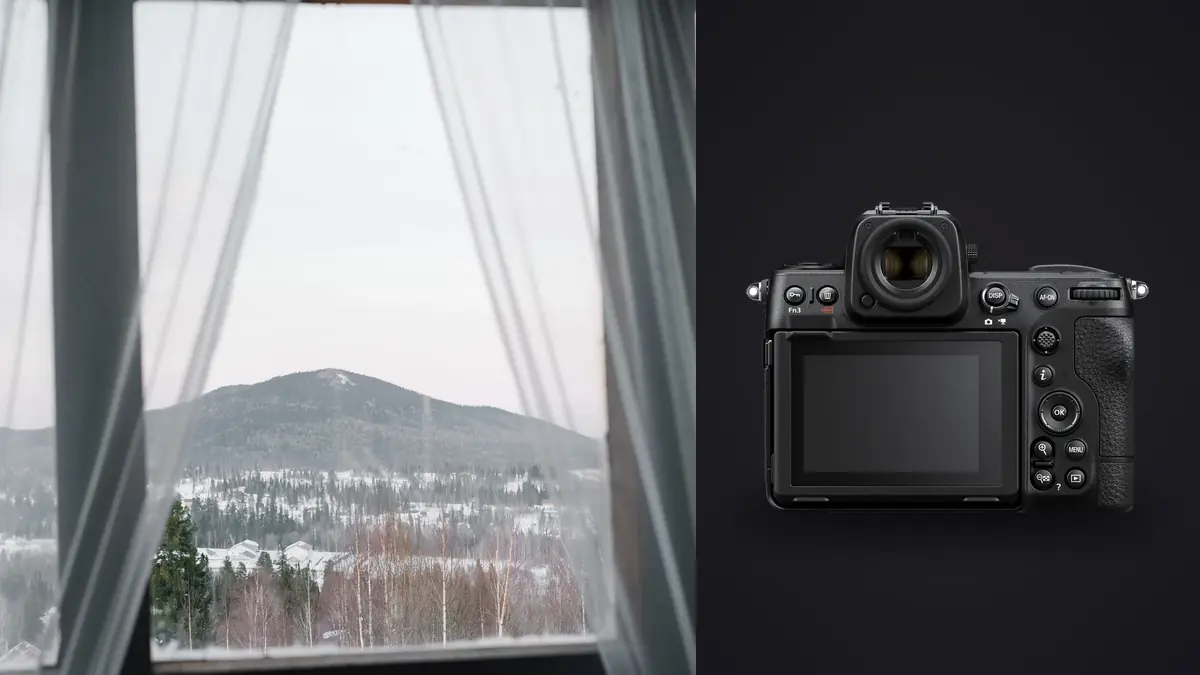
I picked up a Z8 about a year and a half ago as an all-round body, and it took me a few boudoir sessions before I realized it was actually a better fit for that work than for anything else I shoot. Boudoir has a strange set of technical demands that don't line up with most camera marketing. You need a body that's quiet enough not to feel invasive, fast enough to track a subject through slow, deliberate movement rather than sports-style action, and forgiving enough in low, warm, often single-source light that you're not fighting noise at every edit. The Z8 happens to check all three boxes better than the bodies I used before it, and after enough sessions to trust the pattern, I want to walk through exactly why, and where it still falls short.
The sensor and shutter matter more here than in most genres
Boudoir sessions live or die on comfort. If your client can hear the shutter clatter every time you fire, they tense up, and tension shows in the shoulders and the jaw before it shows anywhere else. The Z8's stacked 45.7MP sensor lets you run fully electronic shutter with essentially no rolling shutter penalty for anything short of very fast subject motion, which almost never happens in this genre. I shoot the whole session in electronic shutter, silent mode on, and subjects often ask partway through if I'm "actually taking pictures." That question is a good sign. It means they've stopped performing for the camera and started just existing in the room, which is when you get the shots that don't look like a stock boudoir shoot.
The other side of that same sensor is dynamic range at the ISO values this work actually happens at. Most of my boudoir sets are lit with one modified strobe or a single continuous LED panel plus whatever window light is doing that day, and I'm routinely between ISO 800 and 3200 depending on how moody the set should be. The Z8 holds detail in shadow-heavy skin without the blotchy noise pattern I remember from earlier bodies. I can recover a stop and a half in post on a dark boudoir frame and the skin still looks like skin, not like it's been run through a plastic filter.
Silent shutter has a real limitation you should know about
The one place this bites you: some LED panels and older strobe packs will produce visible banding in full silent electronic mode if your shutter speed creeps up past what the light source can cycle cleanly. I found this out shooting under a cheap continuous panel at 1/500 and getting faint horizontal bands across a third of the frame. Dropping to 1/250 and adding a touch more ISO fixed it instantly. If you're renting or using a continuous source you haven't tested, shoot a few frames at your working shutter speed before the client arrives and zoom in at 100%.
Autofocus behavior for slow, intimate movement
Boudoir AF is a different problem than most portrait AF. You're not tracking someone walking toward you, you're holding focus on a subject who might roll from their side onto their back over three seconds, with hair falling across the eye halfway through. The Z8's subject-detection AF (set to Auto, not locked to Person, since it will occasionally want to jump to a hand or a piece of jewelry if you force Person mode in tight compositions) handles this well as long as you keep the AF area reasonably tight. I run 3D-tracking with the initial point placed manually on the near eye, then let the camera hold it through the motion. What actually improved my keeper rate wasn't a setting, it was accepting that I needed to shoot in shorter bursts rather than one continuous roll. A boudoir pose evolves slowly enough that a 5-8 frame burst captures the full range of a movement, and reviewing bursts that size is manageable. Letting the shutter run at 20fps for four straight seconds gives you 80 nearly identical frames of the same tilt of the head, and at the end of a full session that turns into thousands of frames that all look the same at a glance. I run everything through imagic afterward specifically because it clusters those burst sequences and flags the sharpest, best-focused frame in each group automatically, based on local sharpness and focus scoring rather than file size or a rough histogram check. That one step probably saves me ninety minutes per full session compared to scrubbing bursts by eye in a folder view.
Eye AF in low, warm light
The eye-detect algorithm on the Z8 is noticeably more reliable in dim, warm light than what I had on my previous Nikon body. I still lose it occasionally when a subject is looking down and away from a soft-focus light source, at which point I switch to single-point AF and place it manually. It's rare enough that I don't build a workaround into my workflow, I just watch the AF box in the EVF and react.
Lens choices, compared honestly
I get asked constantly which Z-mount lens is "the" boudoir lens. There isn't one. Each of these four does something different, and I rotate through all of them depending on the room size and the mood the set calls for.
| Lens | Best for | Working distance in a small bedroom | Trade-off |
|---|---|---|---|
| Nikkor Z 85mm f/1.2 S | Compression, dreamy separation, classic boudoir look | Tight. Needs 8+ feet of room to work a full-length pose | Heavy (2.4 lb), slow to focus-hunt in very dim light |
| Nikkor Z 50mm f/1.2 S | Environmental boudoir, showing the room, wider two-shot poses | Comfortable in almost any bedroom | Less flattering compression on close facial crops |
| Nikkor Z 35mm f/1.8 S | Getting-ready candids, wide detail shots, tiny apartments | Excellent, works in cramped bathrooms and closets | Needs care with perspective distortion on close bodies |
| Nikkor Z MC 105mm f/2.8 S Macro | Jewelry, lace texture, hands, detail inserts for albums | N/A, used for details only | Not a portrait lens, don't try to use it for full-body work |
If I had to keep exactly one, it's the 50mm f/1.2. It's the only lens on that list that works in every room I've ever shot in, and wide open it still separates the subject from the background enough to feel intentional rather than accidental. The 85mm is my "hero shot" lens, brought out for maybe six frames per session when I want that compressed, soft look for a final gallery cover image, not something I shoot the whole set on.
Exposure strategy for skin, not for the meter
Nikon's matrix metering wants to expose for the overall scene, and in boudoir that usually means underexposing skin because the frame is dominated by dark sheets, dark furniture, or a dark backdrop. I meter manually off the subject's skin with the histogram, aiming to sit skin tones just right of center rather than trusting the in-camera meter, and I keep highlight-weighted metering off entirely for this genre. If you let the camera protect a bright window in the background, you'll consistently underexpose the person you're actually there to photograph. My baseline settings for a single-strobe boudoir set: f/2.0 to f/2.8 depending on lens, 1/160 to 1/250 shutter, ISO 400 to 800 with the strobe, climbing to ISO 1600-3200 if I switch to window light only later in the session. I shoot 14-bit raw, always, uncompressed if card space allows since I want maximum shadow recovery latitude for the darker frames.
What actually happens after the shoot
This is the part nobody talks about enough with this genre, and it's the part that changed my workflow the most. Boudoir clients are trusting you with images they would not want anywhere near a public cloud sync, an auto-upload folder, or a shared drive that syncs to a phone in someone else's pocket. I moved my whole culling and first-pass edit process to imagic specifically because it processes everything on the machine, nothing gets uploaded anywhere during culling or preset application, and a finished, sorted gallery can be shared without a single frame having touched a server I don't control. That's not a small feature for this kind of work, it's close to a requirement, and it's the first thing worth mentioning when a nervous first-time boudoir subject asks how their photos are going to be handled. Once the culling pass is done, I built an apply_my_style preset in imagic off about forty of my previous best boudoir edits so the first pass on skin tone, contrast curve, and warmth lands close to my finished look before I ever open a dedicated editor. It's not magic, it still needs a human pass on skin retouching and dodge/burn, but it cuts the flat, unedited raw look out of the process early, and it means I'm not manually resetting a base preset from scratch every session. If you're comparing culling tools for this kind of workflow, it's worth reading through how the current culling software options stack up before committing to one, since the privacy and clustering behavior varies more between tools than people expect. For the color grading pass itself, warm skin tones with a slightly lifted black point tend to read as intimate rather than clinical, and I've written more on the mechanics of that in a separate piece on color grading for portrait work if you want the longer version.
Card handling and file security on location
I run dual CFexpress Type B cards in the Z8, both slots writing raw simultaneously rather than raw-to-one and JPEG-to-the-other. For most of my work a JPEG backup would be fine, but for boudoir I want two full raw copies leaving the location with me, because these are not sessions I can easily reshoot if a card fails. I don't touch anyone's laptop, don't email preview files, and don't post a "sneak peek" without written permission, which for this genre is closer to a legal necessity than a courtesy.
Studio setup that actually works in small spaces
Boudoir sessions often happen in hotel rooms or a private bedroom, not a dedicated studio, so gear that folds down small matters as much as image quality. My kit for an on-location boudoir session is one speedlight or a small strobe with a 24-inch softbox, a five-in-one reflector for bounce fill, and the Z8 body with two lenses in a small sling bag. I stopped bringing a second light body a while ago; the Z8's in-body stabilization is good enough that I can shoot handheld at 1/60 with the 50mm and get sharp frames even in near-window-light-only conditions, which means I'm not hauling a second strobe and stand into a hotel room that barely fits the bed.
Frequently Asked Questions
Is the Nikon Z8 overkill for boudoir photography compared to a cheaper body?
Not for the reasons people usually assume. You don't need 45.7 megapixels or 20fps for this genre specifically, but you do benefit from the low-light autofocus reliability, the electronic shutter's near-total silence, and the dynamic range that lets you recover shadow detail in warm, moody lighting without the file falling apart. A cheaper APS-C body can absolutely produce beautiful boudoir work, but you'll fight noise and AF hunting more in the exact lighting conditions this genre lives in.
What's the biggest mistake photographers make shooting boudoir with a high-resolution body like the Z8?
Shooting too wide open, too consistently. A 45-megapixel sensor will show every soft edge at f/1.2 if focus drifts even slightly off the near eye, and skin at extremely shallow depth of field can look strange rather than flattering once you're cropping in during retouching. I close down to f/2.0-2.8 for most of a session and reserve f/1.2 for a handful of deliberately soft, dreamy frames.
How do you handle client privacy with digital files after a boudoir shoot?
Treat it like any sensitive-document workflow, not like a normal portrait session. I avoid cloud auto-upload at every stage, from the memory card through culling to final delivery, and I only hand off finished galleries through a private, password-protected link. Choosing culling and editing tools that process locally rather than uploading to a server matters more here than in almost any other type of photography.
Which Z-mount lens should a beginner start with for intimate portrait work?
The 50mm f/1.2 S, if budget allows it. It's the most versatile of the four lenses I use regularly for this genre, works in tight rooms, and doesn't force you into the compressed "beauty shot" look of an 85mm before you've developed your own style. If the price is out of reach, the Z 50mm f/1.8 S at roughly a third of the cost gets you 80% of the way there optically for a lot less money.