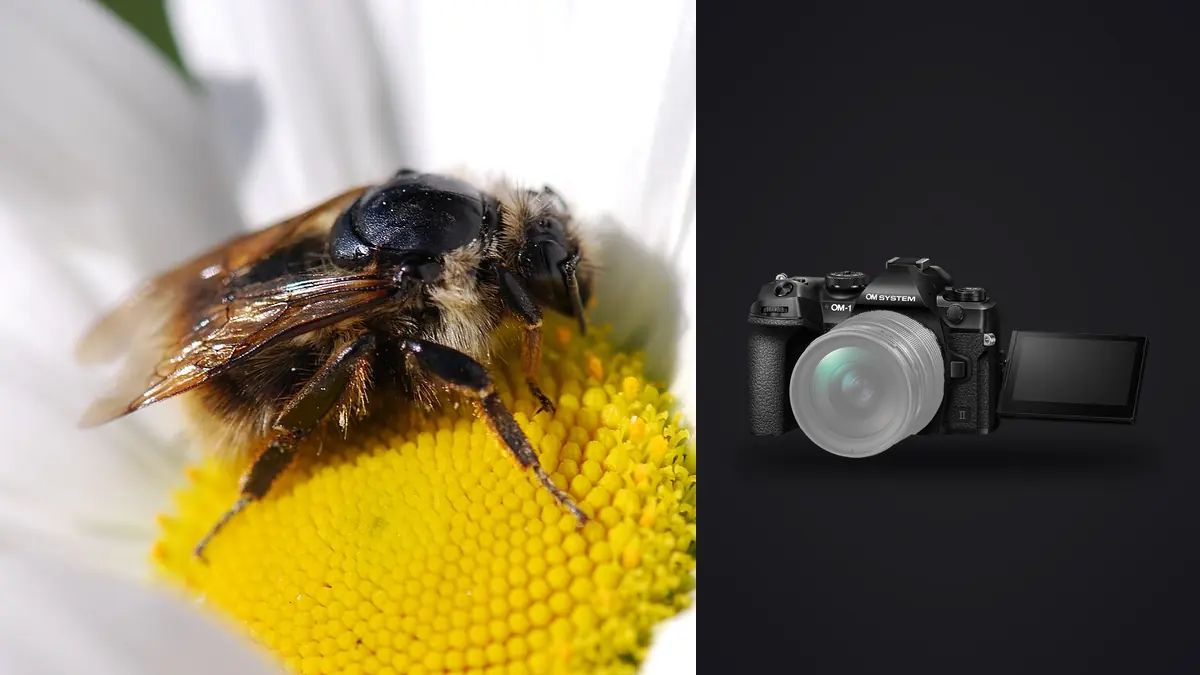
Most of the cameras that get recommended for macro insect work are recommended by people who shoot flowers. Flowers hold still. A robber fly does not. If you spend your mornings on your knees in wet grass trying to get a sharp eye on a jumping spider before it decides you're a threat, the calculus for choosing gear is different, and it's the reason the OM System OM-1 Mark II has quietly become the camera a lot of insect photographers reach for even though it never gets discussed in the same breath as the big full-frame bodies.
I've been shooting insects with the Mark II for the better part of a season now, mostly around damp meadow edges and a compost pile that, embarrassingly, produces more interesting subjects than most of the "nature reserves" nearby. This isn't a spec-sheet rundown. It's what actually matters when the subject is six millimeters long and about to fly.
The small sensor is the whole point, not a compromise
Every review of a Micro Four Thirds body eventually apologizes for the sensor size. For insect work, stop apologizing. The 2x crop factor means the OM System 90mm f/3.5 Macro IS PRO, a lens that hits 2x native magnification on its own, delivers a field of view equivalent to roughly 180mm at 4x magnification once you account for the crop. You get that reach without a bellows, without a teleconverter stack, and without giving up autofocus. For a photographer trying to fill the frame with a lacewing without breathing on it, that difference is not academic. It's the gap between getting the shot and watching the subject drop off the leaf the second your shadow crosses it.
The tradeoff people warn you about is diffraction. On a sensor this size, you start losing meaningful resolution past roughly f/8, sometimes f/11 depending on how critically you pixel-peep. On a full-frame body you might comfortably stop down to f/16 for depth of field and barely notice softening. Here you can't lean on a small aperture the way macro shooters traditionally have. That pushes you toward focus stacking as a default technique rather than an occasional trick, and the OM-1 Mark II happens to be built around exactly that assumption.
Autofocus that's good at everything except the one thing you need
The Mark II's AI subject detection recognizes birds, planes, trains, and a handful of other categories reasonably well. Insects are not one of the trained subject classes, and no amount of firmware hope is going to change the physics of the camera trying to lock onto a leg-thin antenna against a busy leaf background. In practice this means you're back to good old single-point AF, usually in the smallest point size the camera offers, placed manually on the compound eye every single time. The camera does help in a less flashy way: focus point size and precision have gotten noticeably tighter than the original OM-1, and the joystick response for repositioning that point quickly, without dropping into a menu, is fast enough that you can track a beetle's slow crawl across a stem without losing the AF point entirely. That's a small thing until you've fought a camera that makes you re-center focus from scratch every time the subject moves two centimeters.
Manual focus still wins for the tiny stuff
For anything under about 5mm, I mostly turn autofocus off entirely and focus by rocking my body back and forth with the lens set to a fixed magnification. It sounds primitive because it is, but it's also how most serious macro shooters have worked for decades regardless of brand. The Mark II's focus peaking and the magnified live view help here, but they don't replace the technique. No camera has solved this yet, and any article that claims otherwise about any body is overselling it.
In-body stabilization changes what's actually shootable handheld
Rated stabilization numbers on this camera run into the eight-stop range with certain lenses, and while I don't fully trust marketing stops as a real-world unit, the practical effect is obvious: I can handhold the 60mm macro at 1:1 magnification at shutter speeds that would have been a tripod-only proposition a few years ago. That matters enormously for insects because a tripod telegraphs your presence and slows down your ability to reposition, and most interesting subjects don't wait around for you to level a ballhead. Handheld high-resolution shot mode is a neat party trick on static subjects (50 megapixels handheld, more on a tripod) but it's close to useless for anything alive, since it merges multiple exposures and any subject movement between frames shows up as ghosting. I've tried it on a resting dragonfly exactly once and gotten a smeared wing for my trouble. It's a mode for lichen and static macro subjects, not bugs.
Focus bracketing in camera, and why I still don't always trust it
The in-camera focus stacking feature will shoot a bracketed sequence and composite it into a single JPEG without ever touching a computer. It works. For a still subject like a resting moth on a tree trunk at dawn, I've gotten usable stacked files straight out of the camera that needed almost no cleanup. But the in-camera composite algorithm struggles the moment anything in the frame moves between exposures, which for live insects is often, since even a resting fly's wings and antennae twitch between shots taken a fraction of a second apart. The stacked JPEG then shows ghosting artifacts around exactly the part of the animal you care about most. My actual workflow ended up being: shoot the bracket sequence (I usually run 8 to 15 frames depending on the lens and aperture), keep the raw files, and decide later whether to stack them in software or just pick the single sharpest frame from the sequence. That decision happens back at the desk, not in the field, and it's created a real logistics problem I didn't expect: a two-hour macro session can leave you with 800 to 1,200 raw files, most of which are near-duplicates of each other by design.
Lens comparison for insect work on this body
| Lens | Native magnification | Equivalent magnification (2x crop) | Working distance at max mag. | Best suited for |
|---|---|---|---|---|
| M.Zuiko 30mm f/3.5 Macro | 1.25x | 2.5x | ~4cm | Static subjects only, very tight working distance spooks anything alert |
| M.Zuiko 60mm f/2.8 Macro | 1x | 2x | ~19cm | General-purpose insect and flower work, best value in the lineup |
| OM System 90mm f/3.5 Macro IS PRO | 2x | 4x | ~13.7cm at 2x, more backed off | Skittish subjects like dragonflies and jumping spiders, in-lens focus bracketing |
The 90mm PRO is the lens most reviewers point to and for good reason, but I'd push back slightly on the idea that it should be everyone's first macro lens. It's heavier, the working distance advantage only really pays off once you've gotten comfortable with the technique of finding and holding focus at high magnification, and beginners often do better learning on the 60mm first, where the field of view is a bit more forgiving. I bought the 60mm before the 90mm and have no regrets about the order.
Pro Capture saved more shots than any other single feature
Pro Capture buffers frames continuously while you have the shutter half-pressed and, on a full press, saves the buffered frames from before the shutter was fully depressed along with what comes after. For anything that takes off the instant it senses you, which is most flying insects, this is the single feature that most changed my keeper rate. A dragonfly launching from a reed gives you maybe one useful frame of "still perched, wings about to unfurl" and that frame usually happens faster than human reaction time. Pro Capture doesn't need you to react at all. I'd rate this above the sensor's resolution, above the lens lineup, above almost anything else on the spec sheet as the reason this body earns its keep for insects specifically.
Weather sealing matters more here than it does for most genres
Good insect activity often means dew-heavy dawns, humid stream edges, or the kind of light drizzle that keeps mosquitoes down and photographers indoors. The body's sealing has held up through some genuinely unpleasant mornings for me without issue, including one session where I was crouched in wet grass for forty minutes with condensation actively forming on the lens barrel. I wouldn't go looking for a downpour to test it, but for the kind of damp conditions that insect photography regularly puts you in, it's held up better than any of the previous Olympus-badged bodies I've used.
What nobody mentions: the sort-through afterward
This is the part that doesn't make it into gear reviews but ends up eating more time than the actual shoot. A single productive morning with bracketed sequences, Pro Capture bursts, and the usual number of "close but the antenna moved" attempts routinely produces well over a thousand raw files. Sitting down and manually flipping through them one by one to find the frame in each bracket sequence where the eyes are actually sharp is the least enjoyable part of macro work, full stop. I run these sessions through imagic afterward specifically because it clusters near-duplicate bursts and bracket sequences together instead of making me scroll through them as one long undifferentiated strip, and its local sharpness scoring flags which frame in each cluster actually nailed focus on the eye rather than the leg or the wing tip in front of it, which matters a lot when eight frames in a stack look nearly identical at thumbnail size. Because it scores and sorts everything on my own machine rather than uploading a macro library full of RAW files somewhere, I'm not waiting on a slow connection out in the field or worrying about a folder of files leaving my laptop. Once I've got a keeper set, I lean on the apply_my_style preset to carry over the same editing look I've settled on for insect shots across a whole batch instead of re-deciding contrast and color balance frame by frame. None of that replaces the shooting decisions covered above, but it's the difference between actually going through a shoot the same week versus letting it sit untouched in a folder for a month, which I think happens to more macro photographers than anyone admits. If sorting bracket sequences and bursts is new territory, how AI photo culling actually works is a reasonable place to see the mechanics behind that kind of scoring, and these workflow tips cover more of the desk-side habits that keep a big shoot from turning into backlog.
Frequently Asked Questions
Is the OM-1 Mark II fast enough to autofocus on flying insects mid-flight?
Honestly, rarely, and I don't think any current camera reliably nails continuous AF on something like a hoverfly in flight given how erratically they move and how little contrast a thin body offers the AF system. Where the camera earns its keep is Pro Capture on a perched subject about to launch, not tracking something already airborne. Set expectations there and you'll be a lot happier with your keeper rate.
Do I need the 90mm PRO lens or is the 60mm macro enough to start?
For most people starting out, the 60mm f/2.8 is the better first lens. It's lighter, cheaper, and the working distance, while tighter than the 90mm, is still workable for a lot of subjects that aren't especially flighty. Move to the 90mm once you've hit its limits with genuinely skittish subjects like dragonflies or jumping spiders where the extra distance actually changes your success rate.
How many shots should I bracket for focus stacking an insect?
It depends heavily on magnification and aperture, but I typically run 8 to 15 frames at moderate magnification (around 1x to 1.5x) with the aperture around f/4 to f/5.6, stepping the focus in small increments. Going much higher than that on a live subject usually just increases the odds that something moves partway through the sequence and ruins the stack anyway.
Does the small sensor actually hurt image quality for macro work?
In good light, not in any way that shows up in a printed image or a normal-sized web export. Where it shows up is in low light and high ISO, where you'll see noise appear earlier than on a full-frame body doing the same job. Since most productive insect photography happens in daylight anyway, this ends up mattering less in practice than it does on paper.