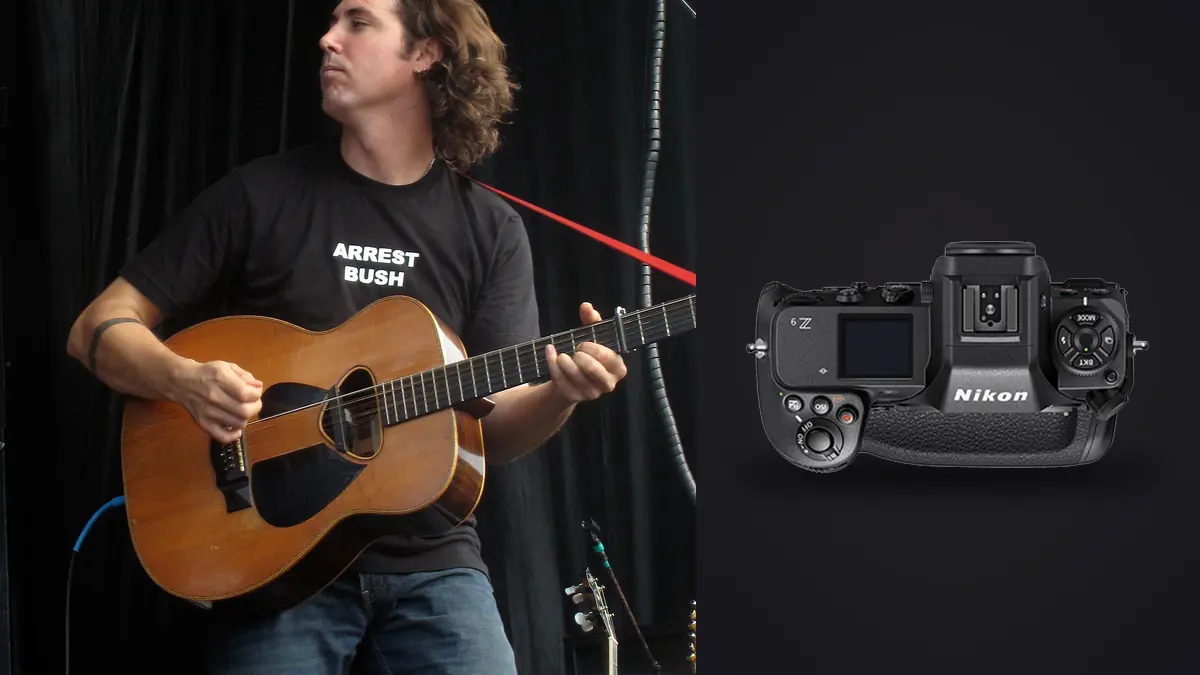
Three songs, no flash, elbow to elbow with three other shooters at the barrier, and the singer decides tonight is the night she runs the full width of the stage during the bridge. That's the environment the Nikon Z9 actually gets tested in, not a studio bench or a spec sheet comparison. I've carried this body into everything from 150-capacity bar shows to arena tours over the past couple of years, and the parts that matter for concert work aren't always the parts Nikon leads with in its marketing copy. Here's what actually changes about your night in the pit.
The Shutter Is the Real Story, Not the Megapixel Count
The Z9 doesn't have a mechanical shutter. There's no curtain to close, which means there's no viewfinder blackout between frames, ever. When you're tracking a drummer's stick through a fill or trying to catch a singer mid-jump, that continuous, unbroken view through the EVF matters more than almost any other spec on the sheet. You're not guessing where the subject went during a blackout interval and hoping your prediction was right. You watch the motion happen in real time while the camera is recording it.
That electronic-only shutter also tops out at 1/32000, which is far more than you'll need for anything short of freezing a cymbal at close range. The setting I actually use night to night is silent shooting for the quiet acoustic segment almost every touring act throws into a set. Seated theater shows and stripped-down encores are the moments where a mechanical shutter clack would carry to the third row, and being able to shoot a solo piano ballad without a single sound out of the camera has saved me from dirty looks from front-of-house more than once.
Autofocus When the Only Light Source Is a Moving Wash
Stage lighting is the thing that breaks autofocus systems that were tuned on daylight test charts. A red or magenta gel wash across a singer's face drops contrast in exactly the wavelength range a lot of older AF systems rely on, and strobing effects during a chorus can make a camera hunt right when you need it locked. The Z9's phase-detect points cover almost the entire frame and stay active even when the scene is dim and colored, which is the difference between tracking a moving vocalist through a wash change and losing focus lock every time the lighting cue shifts.
In practice I run back-button AF-C with 3D-tracking, drop the point onto an eye once at the top of a song, and let the camera carry it through jumps, spins, and mic-stand swings. It reacquires fast enough after an occlusion (a bandmate crossing in front, a mic stand blocking the face for a beat) that I'm not constantly re-placing the focus point mid-song. That's the single biggest workflow change coming from an older DSLR into pit work: less time managing focus, more time watching for the moment.
How Far You Can Actually Push ISO Before a Show Stops Being Usable
Native sensitivity runs 64 to 25600, expandable further, but "expandable" and "usable for a delivered image" are two different claims. In a well-lit arena show with a real lighting rig, I'm comfortable at ISO 3200 to 6400 without thinking twice, and the files hold up fine for web galleries, social delivery, and even a full-page print. Drop into a dim 200-capacity club with three par cans and a fog machine, and I'm regularly at ISO 10000 to 12800 to hold a shutter speed fast enough to freeze a strum or a headbang. Files at that range still clean up well with modest noise reduction because the detail underneath the grain is genuinely there, not smeared by aggressive in-camera processing.
Where I stop is the expanded range above native ISO. I've pushed into it exactly twice, both times in venues so dark that the alternative was a blurred, unusable frame, and both times the resulting files were only good enough for a small web crop, not a print or a hero image for an artist's press kit. My rule now: expanded ISO is an insurance policy for the one frame you can't afford to lose, not a setting you dial in for a whole set.
Frame Rate, Buffer, and the Card Question
The frame rate options matter less in isolation than how deep the buffer runs before the camera slows down, because a three-song pit set with a fast band can mean thousands of frames if you're not deliberate about when you hold the shutter down.
| Shooting Mode | Frame Rate | File Format | Real-World Buffer (fast CFexpress Type B) | Best Use in the Pit |
|---|---|---|---|---|
| Continuous High | 10 fps | 14-bit lossless compressed RAW | Effectively unlimited across a 3-song set | Default setting for most of the show, safe battery and buffer usage |
| Continuous High+ | 20 fps | 14-bit lossless compressed RAW | 1,000+ frames before any slowdown | Guitar solos, drum fills, jumps, anything with fast limb movement |
| High-Speed Frame Capture+ (C30) | 30 fps | Full-res JPEG or reduced-bit RAW | Several hundred frames | Crowd-surf moments, mic-stand throws, single decisive-moment grabs |
| Pre-Release Capture | up to 120 fps buffered | JPEG only | Rolling ~1-second pre-buffer | Catching a drumstick break or confetti burst you'd otherwise miss by a frame |
Two Type B card slots means I run one card as the working card and mirror to the second, which has saved a set at least once when a card started throwing write errors mid-show. Cheap out on the card and you'll feel it at 20fps: a slower CFexpress card turns that "1,000+ frames" number into a camera that stutters after 60 or 70 frames and makes you wait. It's the one piece of gear in this whole setup where spending less directly costs you shots.
Matching Glass to the Room
The body doesn't do much for you if the lens on the front doesn't match the room you're shooting in. Venue distance from the barrier to the stage changes everything about what focal length actually gets used.
| Venue / Pit Distance | Lens | What It Gets You | Trade-off |
|---|---|---|---|
| Small club, front rail, 3-8 ft | Z 24-70mm f/2.8 S | Full-body wides at 24mm, tight face shots at 70mm without moving | Loses reach fast if security pushes shooters back mid-set |
| Mid-size theater, pit 10-20 ft | Z 70-200mm f/2.8 S | Face-fills-the-frame shots across most of the pit | Heaviest combo to hold one-handed overhead for a full song |
| Arena, pit 20-40 ft from stage | Z 70-200mm f/2.8 S + 1.4x teleconverter | Reaches the drummer riser and side-stage platforms | Costs roughly a stop of light right when the venue has the least of it |
| Tight, low-light bar gig, no barrier | Z 50mm f/1.2 S or Z 35mm f/1.4 | Best light-gathering glass in the bag, forces close, honest angles | No zoom means physically repositioning to reframe, easy to miss a beat |
My actual bag for a typical arena night is the 24-70mm on the body and the 70-200mm on a second Z body slung over the opposite shoulder, swapping between the two rather than swapping lenses mid-song. For a support-act club show where I know I'll be right at the rail all night, the 24-70mm alone usually covers it.
Battery and Weight Over a Full Set
The Z9's grip is built into the body rather than an add-on, which means there's no separate battery pack to forget at home, but it also means the body alone is close to 1,340 grams before a lens goes on. Add the 70-200mm f/2.8 and you're holding roughly 2.3 kilograms above your head for the closing chorus of a song, repeatedly, for three songs. That's a real consideration if you're shooting four or five acts in a night at a festival, not a one-off complaint.
On battery life, one EN-EL18d has comfortably carried me through a full headline set of aggressive 20fps bursts without dying, though I still carry a second for festival days that stretch across six or more acts with no real charging window between sets. No flash in the pit means no external battery drain from a speedlight either, which is one less thing to manage while you're also managing autofocus, framing, and not getting shoved into the barrier.
Getting Through the RAW Files Before the Next Show
A three-song pit set shot at 20fps during the loud moments routinely leaves me with 900 to 1,500 RAW frames by the time security waves us out. Multiply that across a four-band bill or a multi-night festival run and the bottleneck stops being the camera and starts being everything that happens after you leave the venue. This is the part of Z9 ownership nobody mentions in a hardware review, and it's where I've changed my workflow the most.
I run the night's card through imagic before I do anything else. The local sharpness and focus scoring is built for exactly this problem: out of a 40-frame burst of a guitarist mid-solo, it flags which two or three frames actually landed critically sharp on the eye or the strings, instead of me squinting at a laptop screen at 1am trying to eyeball the difference between frame 12 and frame 13. Because it's scoring focus locally on the machine rather than waiting on anything remote, it works the same whether I'm doing this in the green room, the tour bus, or a hotel room with venue wifi that can't hold a connection for more than ninety seconds. If you haven't compared how different tools actually make that sharpness call, this breakdown of how AI photo culling works covers the mechanics in more depth than I can here.
The burst clustering matters just as much. A 20fps sequence of a jump shot produces a dozen frames that look nearly identical at a glance, and manually deduplicating that across an entire set is where an hour disappears. Having those bursts grouped automatically means I'm making one keep-or-reject decision per moment, not per frame. Then, because different venues throw wildly different color casts at you (heavy magenta in one room, cool blue-white LED walls in the next), I lean on the apply_my_style preset, trained on my own past edits rather than a generic template, to get every gig's selects to a consistent starting look before I touch anything by hand. It's not a substitute for grading a hero shot properly, but it gets the bulk of a 60-image gallery to something deliverable fast, which matters when a band's team wants same-night content for socials. Everything runs on the laptop itself with no upload step, which is the part that actually lets you hand a gallery to a tour manager before the bus pulls out, rather than waiting on a cloud service in a venue with no signal.
For context beyond the mastering nikon z9 for concert live music guide focus in entry 45, continue with photography guide library. These resources connect the subject to a practical local review process.
Frequently Asked Questions
Do I need a second grip or external battery pack for a full show?
No. The Z9's grip is integrated into the body, and one EN-EL18d has been enough for a full headline set of heavy 20fps shooting in my experience. For a long festival day covering multiple acts back to back with limited charging windows, I bring a spare battery rather than a spare grip, since there's nothing to attach.
Does the electronic-only shutter cause banding under LED stage walls?
It can, depending on the venue's lighting rig and its refresh rate. I've hit visible banding at a handful of shows with cheaper LED wash lights, usually solved by nudging the shutter speed slightly or switching on the camera's flicker reduction setting. It's worth testing during soundcheck or the opening act rather than discovering it while reviewing files after the headliner's set.
What ISO can I actually push in a dark club before the images stop being usable?
For a delivered gallery, I stay in the 3200 to 6400 range in well-lit rooms and accept 10000 to 12800 in dim clubs, since detail underneath the grain still holds up to modest cleanup at those levels. Anything in the expanded range above native ISO I treat as a last resort for one unrepeatable frame, not a setting for the whole set.
How do you get through thousands of burst frames the same night as the show?
By not doing it manually frame by frame. Running the card through imagic right after the set groups burst sequences together and scores focus locally so the genuinely sharp frames surface first, and applying a personal preset trained on past edits gets the selects to a consistent look before any manual grading starts. That combination is what makes same-night delivery realistic instead of an all-nighter.