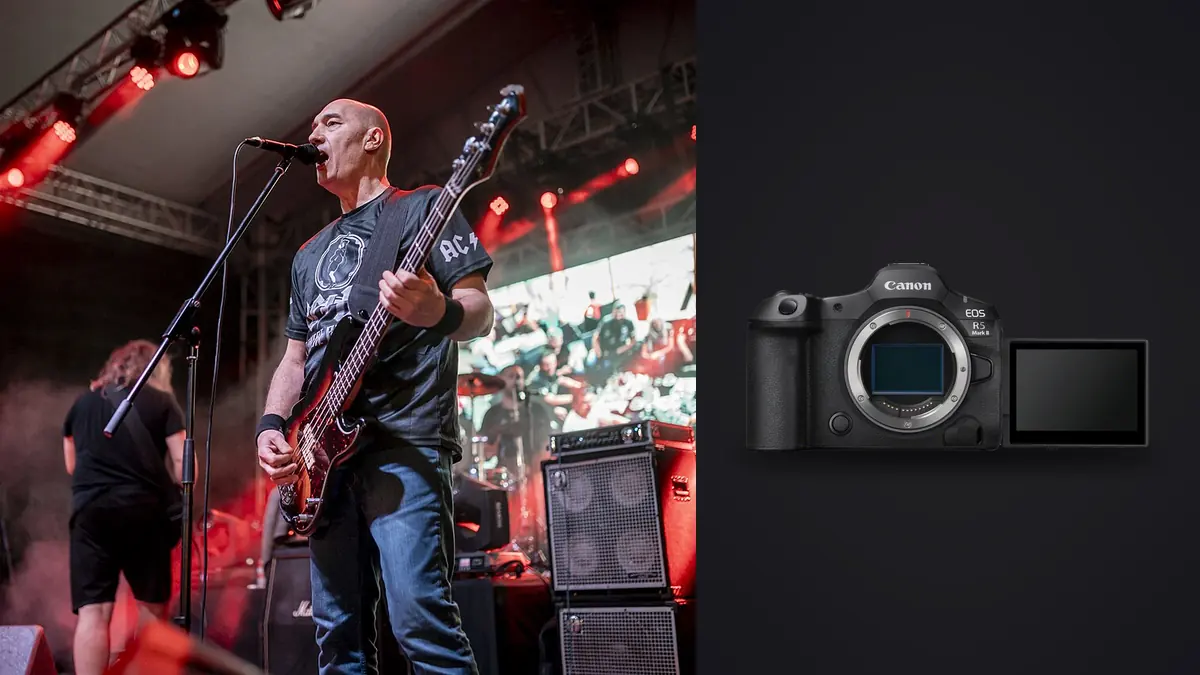
Concert photography is the one genre where camera specs stop being marketing copy and start deciding whether you walk out of the pit with a usable frame or a blown highlight where a guitarist's forehead should be. I've shot club gigs and a couple of theater bills with the Canon EOS R5 Mark II, and I have opinions about where it genuinely earns its keep over the original R5 and where old habits still apply. This isn't a spec sheet lifted from Canon's press release. It's what changes when you're three songs into a photo pit with zero chance of a reshoot, and what happens to the RAW folder once you're home at 1am with a deadline.
The Stacked Sensor Is the Real Story for Stage Work
Everything else in this article traces back to one change: the R5 Mark II moved to a 45-megapixel stacked, back-illuminated CMOS sensor instead of the non-stacked sensor in the original R5. On paper that reads as a spec bump. On stage it means the sensor reads out fast enough that electronic (fully silent) shutter stops being a compromise you tolerate for quiet acoustic breaks and starts being something you can shoot an entire set on.
With the original R5, running full electronic shutter under a moving light rig or an LED video wall was asking for trouble: rolling shutter skew on fast pans, visible banding as the sensor scanned across a flickering source line by line. The Mark II's faster readout doesn't eliminate that risk, but it narrows the window enough that I now default to electronic shutter for most of a set and only drop to mechanical when a specific fixture is clearly strobing at a frequency the sensor doesn't like. That's a real workflow change, not a marketing bullet point.
Shutter Mode and Anti-Flicker: What Actually Works Under Stage Lighting
Stage lighting rigs run on dimmers that pulse LEDs faster than your eye notices but slower than a camera shutter cares about. Different modes on the R5 Mark II handle that differently, and the right choice changes song to song depending on what the lighting designer is doing. Here's how I actually use the three options over a typical set:
| Shutter Mode | Top Burst Speed | Sound | Banding Risk Under LED/Moving Head Rigs | When I Reach for It |
|---|---|---|---|---|
| Mechanical | 12 fps | Audible click | Low (per-frame exposure is more consistent, though brightness can still drift frame to frame under a slow strobe) | Loud sections, opening songs, whenever I want the tactile confirmation of a shutter fire in a noisy pit |
| Electronic (silent) | Up to 30 fps | Silent | Moderate, lower than the original R5 thanks to the stacked readout, but not zero on hard strobes or cheap PWM-dimmed fixtures | Quiet verses, acoustic breaks, any moment where a mechanical click would be obvious to the crowd or the artist |
| Electronic + Anti-Flicker | Up to 30 fps | Silent | Lowest, camera times capture to the light source's peak brightness | Fixed-position spotlights and follow spots where the flicker source is steady and predictable |
Anti-flicker mode is worth turning on by default for theater shows where a single follow spot dominates the frame. It's less reliable across a wall of RGB LED battens all pulsing at different rates, which is exactly the situation most club and festival stages throw at you. In that case I've had better luck shooting a short test burst during soundcheck, chimping the results at 100 percent, and picking whichever mode showed the least banding on that specific rig before the doors open.
Glass for the Pit, the Riser, and the Wings
Lens choice matters more than body choice for how a concert set actually looks, and the R5 Mark II doesn't change the physics, it just gives you more room to work with the results. For club and mid-size venue pits, where the barrier puts you two to three meters from the stage lip, the RF 24-70mm f/2.8 covers the wide establishing shot and the tighter vocalist close-up without a lens change, which matters when you've got three songs and no time to swap glass.
For theater and arena work, where the pit sits further back or you're shooting from a riser, the RF 70-200mm f/2.8 earns its weight. It also compresses busy stage design (LED walls, truss lighting, pyro) into something that reads cleanly instead of cluttering the frame. When I know a show will be dark and intimate, a small club with house lighting only, I'll bring a 50mm f/1.2 or 85mm f/1.2 instead. Wide apertures matter more than sensor resolution once you're working under a single 200-watt wash light. The in-body stabilization rated to 8.5 stops helps with handheld shots of the room and static elements, but it does nothing for a headbanging drummer. You still need shutter speed, not stabilization, to freeze human motion.
Autofocus in the Dark: Eye Control AF and Subject Tracking at Gigs
Eye Control AF sounds perfect for concert work in theory: look at the singer's face and the camera focuses there. In practice, results depend heavily on calibration, and calibration drifts if you're wearing glasses that fog up under stage heat or if you're constantly repositioning your eye relative to the viewfinder while jostling for space in a crowded pit. I calibrate it before doors and re-check it at intermission if the venue runs hot. For the openers, when I haven't had time to recalibrate, I fall back to a single AF point with back-button focus and Face/Eye Detect tracking, which is more predictable even if it's less magical.
The harder problem isn't the AF system, it's the light itself. Hard backlight from a follow spot or a rear-facing wash will blow highlights and confuse contrast-based focus confirmation even with a subject-detection system this capable. When a performer walks into a silhouette against a bright background, I pre-focus on where I expect them to stop (a mic stand, a monitor wedge) and switch briefly to a single point rather than trusting continuous tracking to hold onto a subject the camera can barely see.
Exposure Strategy from Club Floor to Arena Bowl
Venue size changes your ISO baseline more than any camera spec does. In a small club running a handful of LED pars, I'm routinely at ISO 3200 to 12800 just to hold a shutter speed fast enough to freeze a strummed guitar hand. In a theater with a proper follow spot on the lead vocalist, that drops to ISO 800 to 3200 because the spot itself is doing the work a wide rig can't. Arena shows are deceptive: the lighting budget is enormous, but the dynamic range swing between a spotlight-lit face and a dark upstage riser is wider than either of the smaller venues, so I lean on manual exposure with auto ISO and dial in exposure compensation around minus one third to minus two thirds of a stop to protect highlights on skin under a hard spot. RAW gives you the latitude to lift shadows back afterward; it doesn't give you back a blown-out forehead.
A shutter speed floor matters more than people expect going in. 1/320s is my minimum for a vocalist doing normal stage movement, and I'll push to 1/800s or faster for anyone throwing drumsticks, jumping, or headbanging. That floor doesn't move regardless of how good the sensor's high-ISO performance is, because motion blur isn't a noise problem, it's a shutter speed problem.
Card Strategy and Buffer Reality at 30fps
A 45-megapixel sensor shooting bursts at up to 30fps generates data fast, and a three-song pit set with a few extended bursts per song adds up quicker than the number sounds. I've come home from a three-band bill, shooting all three sets, with somewhere between 3,000 and 5,000 RAW frames on the primary card. CFexpress Type B in the fast slot is not optional if you're leaning on the top burst rate; a slower card means the buffer fills mid-burst and you miss the exact beat you were chasing. I run CFexpress as primary and the UHS-II SD slot as an overflow or backup, and I make a point of giving the buffer a chance to clear during a quieter song rather than holding the shutter down through an entire set.
The practical upshot is that a night with three opening acts and a headliner can leave you looking at two full high-capacity cards of RAW files by the time you're driving home. That volume is manageable during the show. It becomes the actual bottleneck once you're sitting at a laptop at 1am with an editor expecting a gallery by morning.
After the Show: Turning Thousands of RAW Frames Into a Gallery Before Sunrise
This is where the gear stops mattering and the workflow after the show starts to matter more. A four-thousand-frame night isn't four thousand distinct moments, it's a few hundred moments each captured as a six-to-fourteen-frame burst, most of them a blink or a soft-focus miss apart from the one frame you actually want. Scrolling through that manually at 1am, zoomed in to check eye focus under a moving spotlight, is how a quick edit turns into a three-hour slog.
I run the night's cards through imagic before I open anything in an editor. Its local sharpness and focus scoring catches the frames where autofocus hunted for a fraction of a second under a strobe hit, which is a common and easy-to-miss failure mode when you're shooting continuous AF at 30fps in low light. The burst and duplicate clustering groups that fourteen-frame drum-hit sequence into a single pick decision instead of fourteen separate ones, which is the single biggest time saver across a multi-band night. Because it runs entirely on the laptop with no cloud upload, unreleased press photos and embargoed tour shots never leave the machine before they're supposed to, which matters more in this genre than in almost any other kind of photography I shoot.
Once the culled selects are set, I lean on imagic's apply_my_style feature, trained on my own previously graded gig photos, to get a first-pass edit that already accounts for how I usually handle mixed color temperature under stage washes: warm key light, cool rim light, the occasional green or magenta gel throwing everything off. It's not a substitute for a final grade on the hero images, but it means the eighty or so gallery frames that get shared online don't sit at default RAW color while I hand-edit the six images that actually need individual attention. If you're new to the idea of local culling before you touch an editor at all, how AI photo culling works covers the mechanics in more depth than I have room for here, and these workflow tips are worth a look if a three-band night regularly turns into a two-day edit backlog for you too.
Frequently Asked Questions
Does the R5 Mark II's electronic shutter still band under concert LED lighting?
Less than the original R5, but not never. The stacked sensor's faster readout narrows the window where a scanning shutter catches a light source mid-pulse, so banding shows up less often and less severely than it did on the non-stacked sensor. Cheap PWM-dimmed LED fixtures, which are common on smaller club rigs, are still the most likely culprit. Anti-flicker mode helps against a single steady source like a follow spot, but it's not a guarantee against an entire wall of mismatched battens. Test at soundcheck rather than assuming.
What's the best lens for shooting from a photo pit with the R5 Mark II?
For most club and mid-size venue pits, an RF 24-70mm f/2.8 covers wide stage shots and tight vocalist close-ups without a lens change, which matters when you only get three songs. For theater or arena work where the pit or riser sits further back, an RF 70-200mm f/2.8 does more of the work and compresses busy lighting rigs into a cleaner frame. A fast prime like an 85mm f/1.2 is worth carrying for small, dim clubs where a single wash light is doing all the work.
How many RAW files should I expect from a typical three-band bill?
Shooting all three sets with a mix of mechanical and electronic bursts, I typically land somewhere between 3,000 and 5,000 RAW frames across the night. That number climbs fast if you lean on the 30fps electronic top speed for extended bursts rather than shorter, more deliberate bursts timed to the beat. Card capacity and buffer clearing time both become real constraints at that volume, and so does the culling time afterward.
Is 45 megapixels overkill for editorial concert delivery?
For a typical web gallery or social post, yes, you're downsampling regardless. Where the resolution earns its keep is cropping: a wide stage shot that includes the full band can be cropped down to a tight single-performer frame in post without falling apart, which gives you more usable angles from fewer physical repositionings in a crowded pit. It also means file sizes and card space become a bigger practical concern than they were on the 20-megapixel original R5, so plan storage accordingly.