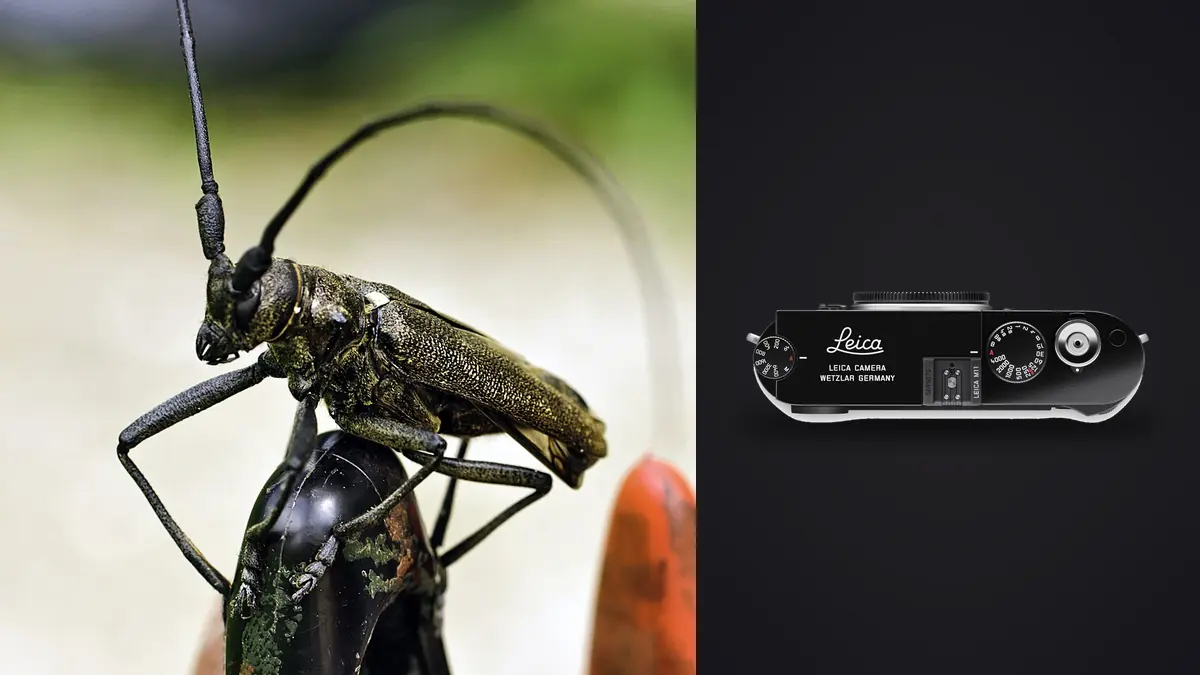
A Leica M11 is a strange tool to reach for when a hoverfly lands two centimeters from your lens hood. It is a rangefinder. No autofocus, no in-camera focus stacking, no continuous tracking, and a viewfinder built around a coupled optical patch rather than a live feed of what the sensor actually sees. And yet plenty of M11 owners end up pointing it at jumping spiders, dew-covered beetles, and resting moths anyway, usually because they already own the body for street or travel work and do not want to build a second system just for bugs. This is what actually happens when you try it: which lenses get you close enough, how focusing works once the rangefinder stops helping, and what kind of hit rate you should expect before you plan a whole outing around it.
Why the Rangefinder Stops Being Useful First
The M11's coupled rangefinder patch is calibrated for a working range that bottoms out around 0.7 meters on most current M lenses (older screw-mount glass and some 1950s designs stop even further out, around one meter). At that distance, even a fast 90mm lens is only filling the frame with something the size of a fist. A ladybird at 0.7 meters is a speck. True macro, the kind where a 6mm weevil fills a third of the frame, needs a reproduction ratio approaching 1:2 or 1:1, and the rangefinder mechanism simply was not built to couple that close. Try to focus a live insect through the optical viewfinder at those distances and the patch just stops moving; you have run out of mechanical travel before you have run out of subject distance.
What this means in practice is that every serious macro frame on an M11 gets composed and focused through live view, either the rear screen or, more usefully outdoors, the clip-on Visoflex electronic viewfinder. The rangefinder becomes irrelevant the moment you are working this close. That is not a limitation unique to the M11 (any rangefinder has the same mechanical ceiling), but it is the first thing to understand before buying glass for this, because it changes which lenses are even worth considering.
Lens and Adapter Combinations That Actually Get You There
Once you accept that focusing will happen through the EVF rather than the patch, the lens choice opens up considerably, because rangefinder coupling accuracy stops mattering. Here is what I have actually used or tested for insect work, with real magnification ceilings rather than marketing round numbers.
| Lens / Setup | Max magnification | Focusing method | Approx. cost | Best suited to |
|---|---|---|---|---|
| Leica Macro-Elmar-M 90mm f/4 + Macro-Adapter-M | 1:3 | Rangefinder-coupled via goggle adapter, or EVF | ~$5,300 + $425 for the adapter | Larger insects (dragonflies, big moths) where you still want native rangefinder coupling for general use |
| Leica APO-Macro-Elmarit-R 100mm f/2.8 (R-to-M adapter) + 12mm extension tube | 1:2 native, close to 1:1 with the tube | Visoflex live view only, no coupling | ~$2,500-3,000 used + ~$150 adapter | Anyone who wants the sharpest option; this glass has a reputation among macro shooters that predates digital |
| 7artisans 60mm f/2.8 macro (native M-mount) | 1:1 | Visoflex live view, fully manual | ~$300-400 | Budget entry point; usable but noticeably softer wide open than the Leica options |
| Vintage OM/Nikon macro lens + generic adapter + extension tubes | 1:1 or beyond | Visoflex only, fully manual, no electronic contacts | Often under $500 total | Maximum flexibility for true 1:1 work, but the clunkiest handling of the group and arguably defeats the point of buying an M body |
The Macro-Elmar-M is the only option in that table that keeps any rangefinder coupling at all, and even then only through a goggled adapter that projects a corrected image into the patch, an old-school solution that dates back to the film-era Elmar 90mm. For anything closer than 1:3, you are on the EVF regardless of what lens is mounted.
Focusing on a Moving Subject Without Autofocus
This is where the M11 either earns its keep or reveals itself as the wrong tool for the job, depending on what is sitting on the leaf in front of you. The Visoflex EVF has a focus peaking overlay and a 5x/10x magnified assist that, on a static subject, is genuinely precise, arguably more so than autofocus hunting on a lens stopped down for depth of field. Peaking will outline the exact plane in focus in a bright color, and at 10x magnification on a 60-megapixel sensor you can place focus on a compound eye with real confidence. The catch is timing. A butterfly warming its wings on a cool morning, a garden spider anchored in its web, or a moth that has settled on a wall overnight will sit still long enough for you to zoom in, peak, and shoot. A bee working a lavender spike, a hoverfly hanging in the air, or anything actively foraging will not. I have gone out specifically chasing bees at a lavender bed with the M11 and come back with two usable frames out of roughly 300 exposures; the rest were front-focused, back-focused, or the subject had simply moved between the moment I locked focus and the moment the shutter fired. That is not a criticism dressed up as a review caveat, it is just the arithmetic of manual focus against an insect that does not know it is being photographed.
Subjects That Actually Cooperate
The realistic playbook for insect macro on this body leans toward subjects that are temporarily or permanently slow: early morning shoots before insects have warmed up and become active, spiders in webs (which barely move once anchored), moths drawn to a porch light at night, and anything already resting rather than foraging. Treat active daytime insects as a low-probability bonus rather than the plan.
Depth of Field, Diffraction, and Light at High Magnification
Depth of field at anything approaching 1:1 is measured in fractions of a millimeter, which pushes most macro shooters toward f/11 to f/16 just to get an insect's head in focus from antenna to eye. On a 60-megapixel full-frame sensor with a pixel pitch around 3.76 microns, diffraction softening becomes visible earlier than it would on a lower-resolution body, generally somewhere past f/11. The M11's triple-resolution DNG mode (60, 36, or 18 megapixels, selectable in-camera) is genuinely useful here: dropping to 36MP for a heavily stopped-down macro session reduces the visible diffraction penalty through pixel binning while still leaving more resolution than most cameras offer natively. There is no in-body stabilization on the M11, so handheld work at high magnification, where even a slight hand tremor becomes a visible shift at these ratios, needs either a fast shutter speed and correspondingly more light, or a diffused flash. A small twin-flash or ring light bounced through a diffuser is close to mandatory if you are shooting handheld at f/13 and want anything faster than a tripod-and-cable-release approach.
Sorting the Files Afterward
Manual focus racking without an in-camera stacking mode means you end up bracketing focus by hand, nudging the focus ring a fraction between shots and firing a burst along the optical axis. On a good subject that is a dozen or more nearly identical 60-megapixel frames, most of them off by a hair in one direction or the other, one or two actually nailing the plane you wanted. Going through that by eye, at full resolution, frame by frame, is exactly the kind of grinding review work that eats an evening. This is the part of the workflow where I actually lean on imagic: its local sharpness scoring flags which frame in a rack landed focus on the compound eye without me opening each file individually, and the burst clustering groups the racked sequence together automatically instead of leaving forty near-duplicate thumbnails scattered through the folder. Everything runs on the laptop with no upload step, which matters more than it sounds when a shoot happens at a reserve or a garden with no signal and RAWs you would rather not send anywhere. For anyone comparing how automated culling actually decides what counts as sharp versus a duplicate, that mechanism is worth reading up on separately (see how AI photo culling works). Once the keepers are sorted, the M11's file rendering (especially through the APO-Macro-Elmarit-R) has enough of a consistent character that I run the whole set through imagic's apply_my_style preset, trained on my own previous edits, so a moth shot at 11pm under LED and a spider shot at 7am in overcast daylight land on the same tonal footing without me manually matching white balance and contrast across two very different lighting setups.
Is It Actually the Right Camera for This
Being honest about it: no, not as a first choice. Most people doing serious insect macro work reach for a mirrorless body with autofocus, in-camera focus bracketing, and a burst rate well past the M11's 4.5fps ceiling, because those features solve problems the M11 does not even attempt to. A modern focus-stacking-capable body paired with a native 100mm macro will out-produce the M11 on hit rate for anything that moves, at a fraction of the cost once you add up an M11 body plus an adapted APO-Macro-Elmarit-R and a Visoflex. Where the M11 earns a place in this niche is narrower: if you already own the glass, or you want the discipline of a slower, more deliberate process on subjects that hold still (torpid insects on cold mornings, moths at night, staged specimen work), the per-shot quality from that sensor and the APO-Macro-Elmarit-R in particular is excellent. It is a camera that rewards patience and punishes impatience in roughly equal measure, which is either exactly what you want from a hobby or a good reason to buy something else. If cost is part of the decision, it is worth comparing what a dedicated culling and editing workflow actually costs against the camera gear itself; imagic is a one-time purchase rather than a subscription, which at least keeps the software side of a macro habit from adding to the bill every month (details on the pricing page).
Frequently Asked Questions
Can you get true 1:1 macro with a Leica M11?
Not through the native rangefinder-coupled lens lineup. The closest true M-mount option, the Macro-Elmar-M 90mm with its dedicated adapter, tops out around 1:3. Reaching 1:1 means adapting a lens like the APO-Macro-Elmarit-R with extension tubes, or using a native M-mount macro lens like the 7artisans 60mm, and focusing entirely through live view since the rangefinder patch has no role at that distance.
Do I need the Visoflex to shoot insect macro on the M11?
Practically, yes. The rear screen works in a pinch, but outdoors in daylight it is hard to judge peaking accuracy on a screen you are squinting at, and holding the camera away from your eye adds shake at magnifications where shake is already the enemy. The Visoflex's peaking and 5x/10x magnified assist are what make manual macro focus reliable at all.
Is the 60-megapixel sensor actually useful for this, or just a spec number?
It is genuinely useful, mainly as insurance. Because the M11's practical magnification ceiling is lower than a dedicated macro system's, the extra resolution gives you room to crop in post when you could not physically get as close as you wanted. The triple-resolution DNG mode also lets you drop to 36MP for heavily stopped-down shots, which softens the diffraction penalty a little at f/13 and beyond.
What kind of keeper rate should I actually expect on live insects?
Low, and it depends entirely on how cooperative the subject is. On a slow or anchored subject (a spider in its web, a torpid moth) you can land focus reliably on most attempts. On anything actively foraging or in flight, expect single digits out of a few hundred frames. Budget the session around patience rather than volume, and treat this as one more reason to lean on a faster review workflow once you are back at the computer sorting through what you actually got.