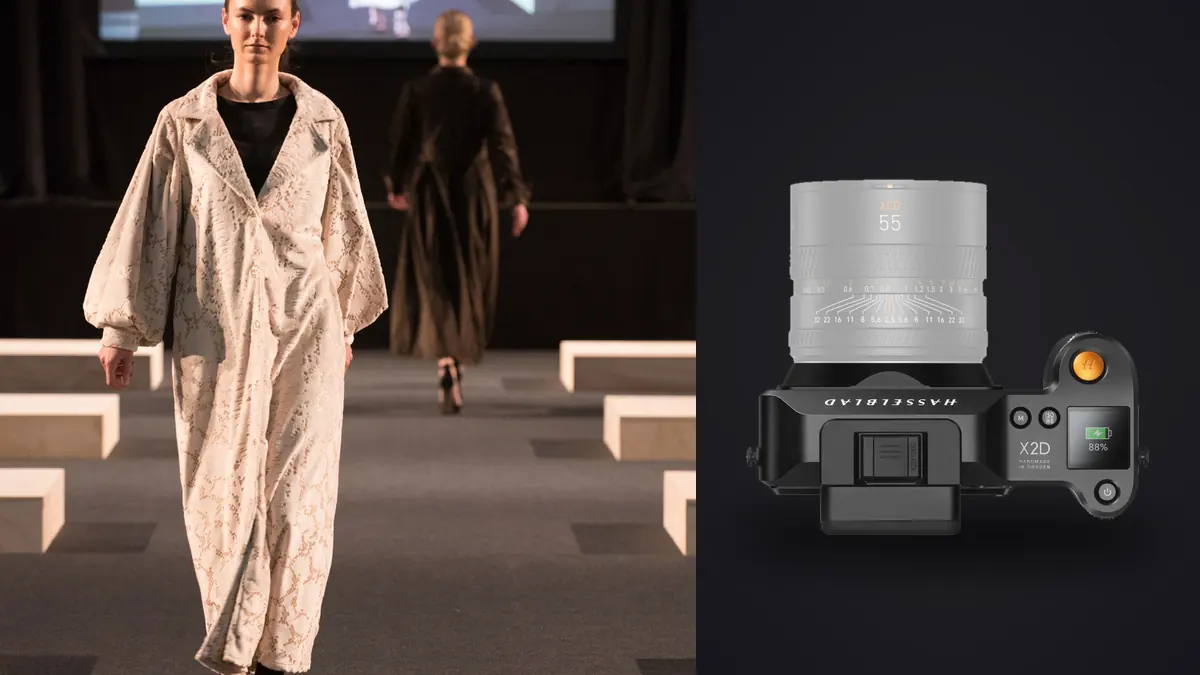
A lookbook shoot isn't a hunt for one decisive frame. It's eighteen to thirty looks, two or three angles per look, a steamer running in the corner, and a creative director standing behind the tether screen asking to see the last capture again. When a small ready-to-wear label handed me a Hasselblad X2D 100C for a pre-fall lookbook last season because their creative director wanted "that medium format texture," I found out fast that the questions that matter on this kind of set are not the ones camera reviews usually answer. Nobody cares about dynamic range charts at 4pm when you're on look fourteen of eighteen and the model needs a break.
What follows is what I actually learned running the X2D 100C through a full commercial lookbook week, not a spec sheet rewritten with adjectives.
The resolution question is not hypothetical on this kind of set
Lookbook deliverables get cropped more than almost any other genre of commercial photography. The same frame becomes a full-bleed website hero, a square Instagram grid post, a tight three-quarter crop for a wholesale catalog, and sometimes a detail crop of just the collar or the hem for a press kit. On a 24 or 45 megapixel body, that pipeline eats into your margin fast: crop a 24MP file down to a square Instagram post and you're often below 1500px on the short side by the time it's through a couple of rounds of client-requested reframing.
The X2D's 100 megapixel sensor gives you room to make those decisions after the fact instead of guessing them on set. I shot most looks a touch wider than I normally would specifically so the retoucher could choose the crop later, something I wouldn't trust myself to do on a smaller sensor without visibly softening the file. The other place it earned its keep was fabric. A wool bouclé jacket and a plain cotton poplin shirt read almost identically as "texture" on a 24MP file at web size. At 100MP, viewed at 100%, you can see the actual weave structure, which matters when a brand's whole pitch to wholesale buyers is fabric quality. That's not a nice-to-have for a fashion client, that's the product.
What actually changes with no mechanical shutter
The X2D 100C has no mechanical shutter at all. Exposure timing on the XCD lenses runs through in-lens leaf shutters, and the sensor itself can also do a fully electronic exposure. In practice this means the camera is close to silent on set, which sounds like a small thing until you've spent a day shooting fifteen feet from a model who's trying to hold a relaxed expression through take after take. A quiet camera changes the mood of the room more than people expect. Clients notice it too. More than one creative director has commented that the shoot "feels calmer" without a mirror slapping every two seconds. The tradeoff is rolling shutter behaviour on fast movement. If a look calls for a hair flip, a fabric flare, or a spin (which happens more often in lookbook work than people assume, brands like showing garment movement even in a still image), you can get skew on hard motion because sensor readout isn't instantaneous. For static or lightly posed looks it's a non-issue. For anything with real motion, I'd rather have a camera built around fast burst and tracking autofocus. This camera is not that, and I don't think Hasselblad ever pretended it was.
Five-axis in-body stabilization helps more than expected on a handheld lookbook day. Between strobe pops you can shoot available light test frames at slower shutter speeds to check composition and expression before the flash exposure, and the stabilization makes that possible without a tripod eating up floor space in a small studio.
Picking XCD glass for a lookbook day
You don't need the whole XCD lineup for lookbook work. Most days two lenses are enough, with a third only for accessory or detail shots. Here's roughly how the common XCD primes map to what actually happens on a lookbook set, based on the 0.79x crop factor of the sensor relative to full frame.
| XCD lens | Approx. 35mm-equivalent field of view | Where it earned its spot on set |
|---|---|---|
| XCD 38V f/2.5 | ~30mm | Full-length looks in a tight studio where you can't back up far enough for a normal lens |
| XCD 55V f/2.5 | ~43mm | The workhorse. Full body and three-quarter looks without the distortion of the 38V |
| XCD 90V f/2.5 | ~71mm | Portrait-leaning crops, campaign-style hero shots pulled from the same set |
| XCD 135mm f/2.8 | ~107mm | Detail shots of embroidery, hardware, or accessories when the pixel-shift mode wasn't practical |
The 55V lived on the body for probably 70 percent of the week. It's fast enough for a dim studio corner, sharp wide open in a way that flatters fabric without making skin look clinical, and the working distance is close to what a client expects a "normal" fashion frame to look like. The 90V came out for anything getting pulled as a hero image or social crop, since the compression flatters both the garment and whoever's wearing it.
Colour that survives contact with a brand's swatch book
Every fashion client has a colour they will notice if you get it wrong, usually the one garment in the collection dyed in a shade the brand spent real money developing. Hasselblad's colour processing (branded Natural Colour Solution) handled skin tone and fabric colour with less hand-holding than I expected going in. Reds in particular, which are notoriously hard for digital sensors to render without going orange or oversaturated, held up close to what I was seeing on the rack. That said, "close" is not "correct," and no camera's out-of-camera colour is going to match a Pantone swatch a designer is holding next to the monitor. I still shoot a colour chart at the start of each lighting setup and build a base grade from it. Where the X2D actually saved time was consistency: garment colour stayed stable across a full afternoon of shooting under the same strobes, which meant less per-look colour correction than I've had to do with some other bodies where white balance would drift slightly look to look. Photographers who shoot catalog-style product photography even more often than lookbook work run into the same consistency problem, just magnified across a much bigger set.
Tethering, and the part where the client is watching over your shoulder
Lookbook shoots are approval-driven in a way most other commercial photography isn't. The creative director wants to see the frame, ask for a chin adjustment, check that the label logo isn't creased, and approve before you move to the next look. I tethered the whole week through Phocus on a laptop stationed next to a folding table, and the workflow held up. USB-C tethering was stable across a nine-hour day with zero dropped connections, which is more than I can say for every camera I've tethered in a studio with a dozen other electronics running. The internal 1TB SSD is worth mentioning even if you tether, because it's a second copy of every frame written in-camera without you thinking about it. On a shoot where a single missed look means calling the model's agency to rebook, that redundancy is not a luxury.
What happens after wrap is the part nobody warns you about
Here's the number that actually changes your evening: eighteen looks, three angles each, five to eight frames per angle to get past blinking and awkward hand positions, comes out to somewhere around 500 to 700 RAW files in a single day. At roughly 100 to 150MB per 100MP RAW, that's 60 to 100GB before you've even started retouching, and every one of those files needs to be looked at, because a lookbook client is paying for consistency across the whole set, not just a handful of standout frames. This is the part of medium format work that camera marketing never mentions, and it's where I stopped trying to cull manually at 1am. For another set of field notes on handling that RAW volume end to end, see our Hasselblad X2D 100C fashion lookbook RAW workflow piece. I run the day's take through imagic before I touch anything in a full editor. Its local sharpness and focus scoring flags the frames where the model's eyes or the garment's key detail actually landed crisp, which matters more than usual on a 100MP file where "looks sharp" at thumbnail size can still be soft at 100%. It also clusters each burst of near-identical poses together instead of making me scroll past the same standing pose eight times, which is most of what a lookbook take actually consists of. It runs entirely on the laptop, nothing leaves the machine, which matters more for a job like this than you might expect. Unreleased pre-fall collections are usually under an NDA until the brand's own launch date, and a brand asking whether its files are going anywhere near a cloud service before that date is a completely reasonable question, which local processing sidesteps. Once the culling pass is done, I lean on the apply_my_style preset, trained on my own past edits, to get a consistent base grade across all eighteen looks before I go back in for the per-look colour fixes a fashion set always needs. It's a much faster starting point than grading each look from a flat default.
Where I wouldn't reach for this camera
I'd think twice about the X2D for a lookbook built around movement, catwalk-style walking shots, or anything shot on a fast-moving location where autofocus needs to track a subject closing distance. 3.2fps burst and a contrast-leaning autofocus system are fine for a model holding a pose while you fire off a handful of frames to catch the best expression. They are not built for a model walking toward camera at pace. If a brief calls for kinetic energy over static polish, I'd bring a mirrorless body with real subject tracking and treat the X2D as the camera you bring back for the still, considered frames afterward. Price is the other honest limitation. A body plus even two XCD primes puts you well past what most emerging labels can justify for a lookbook, and clients who are counting every euro of production budget won't always see the difference between this and a well-shot 45MP file once it's compressed for a website. Medium format earns its cost on print catalogs, large format retail displays, or brands actively marketing "made well" as part of their story. For a straightforward e-commerce lookbook going straight to a product page, it's genuinely overkill.
Frequently Asked Questions
Is the X2D 100C fast enough to shoot a lookbook with movement, or is it strictly for static poses?
It handles posed, held looks well, including small adjustments between frames, but 3.2fps and its autofocus system aren't built for a model walking or spinning toward camera. For anything with real motion in the brief, a faster mirrorless body with dedicated subject tracking will get you a better hit rate.
How many looks can you realistically shoot in a day with 100-megapixel RAW files?
On my week it was around eighteen looks with three angles each, roughly 500 to 700 RAW files and 60 to 100GB by wrap. The camera itself doesn't slow that down much (buffer clears quickly enough for lookbook-paced shooting), the bottleneck shows up afterward, in review and culling.
Do I need Phocus specifically, or can I cull and grade a lookbook set in something else?
Phocus is worth having on set for tethering and first-pass colour, since it's built around Hasselblad's own colour processing. For culling several hundred frames afterward, I don't use Phocus at all, I run the take through imagic first to flag the sharp frames and group the near-duplicate poses, then bring the survivors into whatever editor I'm grading in.
Is medium format overkill for a lookbook that's mostly going on a website and Instagram?
Often, yes. If the final use is web display and social crops, a well-shot 40 to 45 megapixel file will look nearly identical to a client once it's compressed. Medium format pays off when the brand is printing catalogs, doing large retail displays, or leaning on fabric texture as part of the pitch.