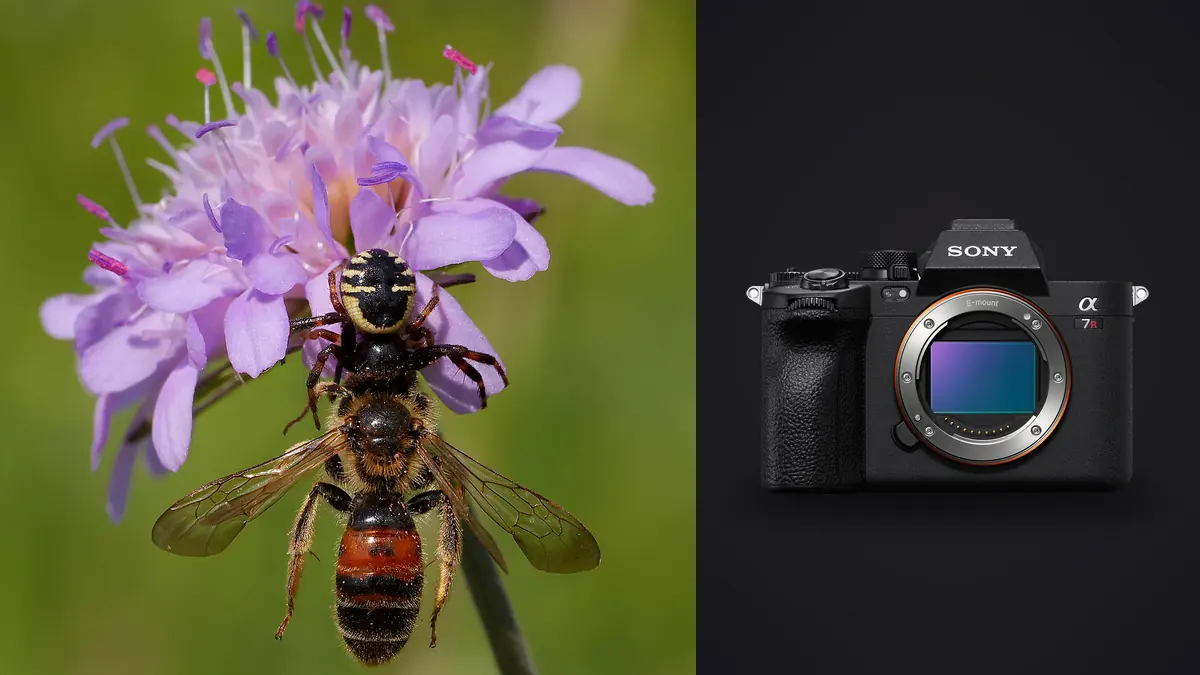
I picked up the Sony a7R V mostly for landscape work, and it took two accidental afternoons photographing damselflies at a local pond before I realized the sensor was doing something genuinely useful for bug photography that had nothing to do with the marketing copy. This isn't a spec sheet rundown. It's what I've found actually matters after a season of chasing dragonflies, jumping spiders, and the occasional uncooperative hawkmoth with this body, and where the camera's reputation gets ahead of what it delivers in the field.
Why 61 Megapixels Is Not Just a Number Here
Every review of the a7R V mentions the 61-megapixel sensor and moves on to autofocus, because for portrait or landscape shooters, resolution mostly means bigger prints. For insect work it means something more practical: cropping room you can spend on distance you don't have.
Most macro insects don't let you get physically close enough for a true 1:1 fill-frame shot, at least not without spooking them. Damselflies will tolerate a slow approach to maybe 20-30cm with a 90mm macro before they lift off. A robber fly perched on a fence post gives you even less patience. With a 24-megapixel body, cropping in on a shot where the subject only fills a third of the frame leaves you with a soft, noisy 8-megapixel result that falls apart at anything beyond a phone screen. With the a7R V's file, that same crop still leaves you 15-20 usable megapixels, enough for a decent print or a full-bleed web hero image without anyone noticing you weren't actually as close as the photo implies.
The Crop-in Habit I've Built Around It
In practice I now shoot slightly wider than I want the final frame to be on purpose. Instead of creeping forward for the tightest possible composition and risking the flush, I hold position, fire off a few frames, and decide the crop later at the desk. It changes how you approach the animal: less stalking, more patience, and a noticeably higher keeper rate because you're not lunging the last few centimeters that usually ends the session.
The tradeoff is obvious and worth saying plainly: files this large add up fast. A morning at the pond produces raw files in the 90-120MB range each, and a decent session easily clears 30GB before lunch. If you're working from a laptop in the field with no signal, that volume becomes its own problem, which I'll come back to.
Insect Eye AF: Does the AI Recognition Actually Work?
Sony added insect subject recognition to the a7R V's AI-processing autofocus system through a firmware update, and it's the single feature people ask me about most. The honest answer is that it works well on the subjects you'd expect and struggles exactly where you'd guess it would.
On a stationary jumping spider, staring straight at the lens the way they do, the recognition locks onto the eye cluster reliably and holds it through small repositioning, almost the way human eye AF behaves on a portrait. That's genuinely useful, because jumping spider eyes are the entire photo; miss them by even a millimeter of focus and the shot is worthless no matter how good everything else looks.
Where it falls apart is fast, erratic motion at high magnification. A dragonfly in flight, wings a blur, body angled and turning, gives the AF system very little stable pattern to grab onto, and at true macro magnifications the depth of field is thin enough that even a correct lock can drift out of focus between the AF confirming and the shutter firing. I still get my highest hit rate on flying insects using continuous AF with a fairly tight focus area rather than full-frame subject tracking, treating the insect recognition as a bonus rather than something to rely on outright. For anything under 20cm working distance with extension tubes added, I mostly switch to manual focus and rock the camera slightly to find sharpness myself, since the focus motor visibly hunts once magnification gets high enough that "in focus" and "out of focus" are separated by a few millimeters of camera position.
Settings I Actually Dial In, By Subject
Insect photography isn't one workflow. A perched damselfly at 1:1 and a moth coming to a light trap at night need almost opposite settings, and I've stopped trying to find a single "macro mode" that covers both. Here's roughly what I run depending on what's in front of the lens.
| Subject | Aperture | Shutter | Drive / AF | Notes |
|---|---|---|---|---|
| Perched dragonfly or damselfly, natural light | f/8-f/11 | 1/500s or faster | Single AF, small flexible spot | Wind moves the perch more than the insect moves; shutter speed covers plant sway |
| Jumping spider portrait | f/11-f/16 | 1/200s (flash-synced) | Single AF with insect eye recognition on | Diffused flash lets you stop down for depth without a noise penalty |
| Bee or hoverfly on a flower | f/9 | 1/1000s+ | Continuous AF, tracking on | They return to the same flower repeatedly; pre-focus and wait rather than chase |
| Moth at a light sheet, night | f/13-f/16 | 1/160s (flash-synced) | Single AF, manual fallback | Full flash power for real depth on wing detail; ambient light is irrelevant |
| Static "specimen" macro (dew, motionless subject) | f/8, focus bracketing on | Whatever ambient allows | In-camera focus bracket, 10-40 frames | Only viable option when the subject genuinely won't move for several seconds |
Stabilization and Focus Bracketing Get More Use Than Pixel Shift
The a7R V's in-body stabilization is rated up to roughly 8 stops with the right lens attached, and while that number is mostly irrelevant for landscape work where you'd use a tripod anyway, it matters a lot for macro, because a tripod is often not an option. Insects move to new perches, light changes, and setting up a tripod and legs for every individual shot means missing most of the session. Handholding at 1:1 with IBIS doing real work lets me react in the two or three seconds a subject actually holds still.
The built-in focus bracketing function, which fires a sequence of frames at incrementally shifted focus points for later stacking in software like Helicon Focus or Zerene, is something I use constantly for genuinely static subjects: a dead beetle found on a trail, a dew-covered web at first light before any breeze starts, a preserved specimen on a plain background. It is completely useless for anything alive and moving, which is most of what you'll actually be shooting, so I'd push back on anyone who buys this camera expecting to stack live insects routinely. You can, occasionally, on the rare still morning with a cooperative subject. Most of the time you're working with a single frame and getting the depth of field you get.
Pixel shift multi shooting, the mode that captures multiple sensor-shifted frames and composites them into an extremely high-resolution image via Sony's desktop software, sits in the same category. It requires an utterly static scene and a tripod, which rules out essentially every living insect. I've used it exactly twice on actual bug photography, both times on dead specimens laid out deliberately for the shot. It's a real capability, just not one built for what most people buy this camera to photograph.
Lens Pairing: What Sits in the Bag
The Sony FE 90mm f/2.8 Macro G OSS is still what I reach for most, mostly because the working distance at 1:1 (roughly 8 inches from the front element) is the best compromise between magnification and not scaring off anything with legs. The FE 50mm f/2.8 Macro is lighter and cheaper but the working distance at full magnification is short enough that you'll be casting a shadow over your subject before you're even at the distance you need, which is a real problem with anything light-sensitive like a moth. For subjects smaller than a grain of rice, jumping spider eyes especially, I've had good results stacking the 90mm with a set of extension tubes, accepting the autofocus becomes essentially decorative at that point and doing the fine work manually.
Third-party options are worth considering too. The Sigma 105mm f/2.8 DG DN Macro gives more working distance than the Sony 90mm at a lower price, though I find the OSS on the Sony noticeably better for handheld work at high magnification. For anyone chasing true super-macro beyond 1:1, something like the Laowa 90mm 2X or the 25mm Ultra Macro trades all autofocus convenience for raw magnification, manual focus only, and a working distance so short you'll only ever use it on subjects that genuinely can't run away.
The Part Nobody Mentions: Sorting What You Actually Shot
A single morning of dragonfly photography with focus bracketing turned on and a decent hit rate on flight shots can leave you with 800-1,500 frames, most of them near-duplicates of the same three seconds. At 61 megapixels each, that's not a folder you want to scroll through one by one in a field tent with no signal and a laptop battery you're rationing.
This is honestly where I've come to rely on imagic for the culling pass, since it runs its sharpness and focus scoring entirely on the machine, no upload, no waiting on a connection that doesn't exist at most of the places I shoot. It clusters the near-identical frames from a focus bracket or a burst of the same perched dragonfly and surfaces the sharpest one from each group, which turns an evening of scrolling into maybe twenty minutes of confirming its picks. If you haven't looked at how that scoring actually works under the hood, this breakdown of AI photo culling covers the mechanics better than I can here.
Once a season's worth of macro shots develop a consistent look (I lean warm and slightly desaturated on greens, since raw insect photography tends toward an overwhelming amount of foliage green otherwise) I've started using imagic's apply_my_style feature to push that same edit across a new batch automatically, since it trains on your own past edits rather than a generic preset pack. It saves the worst part of macro editing, which is applying the same six adjustments to four hundred nearly identical frames by hand. For anyone drowning in insect macro files generally, these workflow tips line up closely with what's actually saved me time in the field.
What Actually Frustrates Me About This Camera for Macro
None of this is a pure endorsement. Battery life takes a real hit running the EVF at high resolution through long macro sessions; I carry three batteries for anything longer than half a day and still occasionally run one dry. The four-axis tilting screen is a genuine improvement over a fixed rear LCD for low-angle shots of ground-dwelling insects, but it's not a full articulating screen, and there are angles, shooting straight down into leaf litter, where I still end up lying flat on the ground to see the display at all. And if you don't actually need 61 megapixels, and plenty of insect photographers genuinely don't, the price premium over something like the a7 IV is hard to justify on resolution alone. The AI autofocus and stabilization are the real reasons to pay more, not the pixel count, even though the pixel count is what gets talked about.
Frequently Asked Questions
Do you actually need 61 megapixels for insect macro photography?
Not strictly, but it buys you real cropping latitude on subjects that won't let you get close enough for a true fill-frame shot, which in my experience is most of them. If your subjects are cooperative and you're already getting tight 1:1 compositions in camera, a lower-resolution body will serve you fine and cost less.
Does the a7R V's insect eye AF actually hold up on live subjects, or is it a demo feature?
It's genuinely useful on stationary or slow-moving insects, jumping spiders especially, where it locks onto the eyes reliably. On fast erratic fliers like dragonflies it loses the plot quickly, and I still rely more on a small manual AF area than on subject recognition for anything moving fast.
What's the best single macro lens to pair with the a7R V for insects?
The Sony FE 90mm f/2.8 Macro G OSS is the one I'd recommend first, mostly for the working distance, which matters more than raw sharpness once you're trying not to scare off a living subject. The Sigma 105mm is a solid budget alternative if the Sony's price is the sticking point.
Is focus stacking with the built-in bracketing feature worth using for insects?
Only for subjects that are completely motionless, dead specimens, dew-covered webs before any wind starts, that kind of thing. For live insects it's rarely practical since almost nothing holds still through a multi-frame bracket sequence, so most of your live-subject shots will be single frames working with whatever depth of field your aperture gives you.