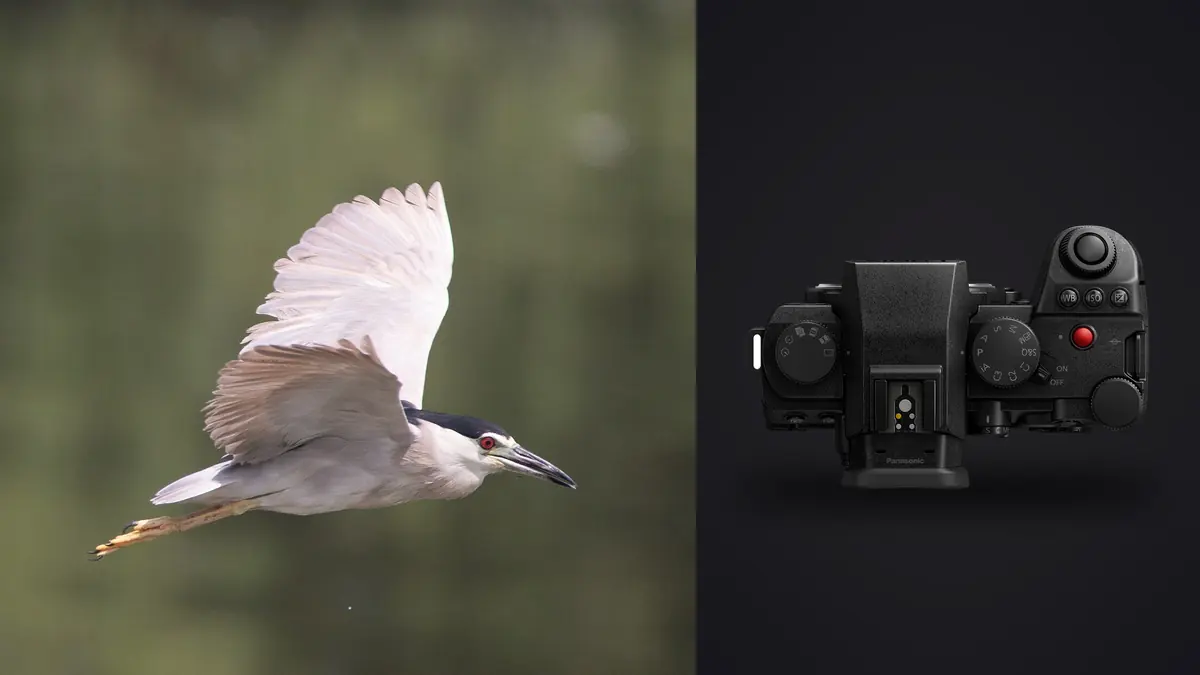
Why I even bothered testing a video camera on birds
The Lumix S5IIx has a reputation problem for anyone shopping specifically for wildlife work. It ships from Panasonic dressed up in cooling fans, ProRes RAW output over HDMI, and all-black styling clearly aimed at hybrid shooters and run-and-gun filmmakers. None of that sounds like a bird camera. I picked one up mostly for shooting video and only started pointing it at ospreys because I already owned an L-mount 100-400mm and was curious whether Panasonic's first real phase-detection autofocus system could do anything with a bird against open sky.
It surprised me, and then it also frustrated me, sometimes in the same afternoon. This is a write-up of what actually happened across a few months of shooting herons, gulls, and one memorably uncooperative pair of kestrels, not a rehash of the spec sheet.
Phase Hybrid AF changed what this body could do, but it's still not an OM-1
Every Lumix full-frame body before the S5II generation used Panasonic's contrast-detection DFD system, which was excellent for static subjects and genuinely unreliable for anything crossing the frame at speed. The S5IIx inherited the S5II's Phase Hybrid AF, Panasonic's first phase-detection implementation in a full-frame Lumix, and it is the single biggest reason this camera is even worth discussing for birding.
Subject recognition includes a bird-specific mode buried in the animal detection settings, and when a bird is reasonably large in the frame against a clean background, it locks on with a confidence I never got from the old S5. Where it gets shakier is exactly where wildlife shooters spend most of their time: a small bird lost against branches, a gull banking hard against a cluttered shoreline, a raptor diving through backlight. The system hunts more than I'd like in those conditions, and it occasionally locks onto a twig with total conviction. I don't think that's a knock unique to Panasonic. Most hybrid AF systems outside the flagship sports bodies do this. But if you're coming from a Nikon Z8 or an OM-1 expecting the same tenacity, recalibrate your expectations before your first outing.
Setting the body up so it stops fighting you
Out of the box, the S5IIx's AF-C custom settings are tuned conservatively, presumably because Panasonic still expects most buyers to be shooting people and video, not flighty subjects. The defaults will cost you frames on anything moving fast. Three changes made the biggest difference for me:
- Push AF sensitivity toward the "quick" end of the custom AF settings so the camera commits to a new subject faster instead of smoothing between the old and new focus distance. This costs you some stability on slow subjects but pays off the moment a bird lifts off unexpectedly.
- Switch from the default multi-area AF to a smaller tracking zone you place manually, then let bird detection take over once it's locked. Full-frame wide-area tracking spends too much time deciding what the subject even is when there's foliage in the shot.
- Turn on the electronic level and back-button focus separately from the shutter. Obvious advice for any wildlife body, but the S5IIx ships with focus-on-shutter-half-press active, which fights you the moment you want to recompose mid-burst.
None of this turns the S5IIx into a dedicated sports camera. It turns it into a competent one for a genre it wasn't primarily designed around.
Shutter choice matters more here than on a stacked-sensor body
This is the part most casual reviews skip, and it's the part that actually changes how you shoot birds in flight on this camera. The S5IIx does not have a stacked sensor. Its electronic shutter reads the sensor line by line at a speed that's fine for portraits and landscapes and noticeably slow for a bird flapping its wings at eight or ten beats per second. Shoot a gull banking hard in electronic shutter mode and you'll get visibly skewed wingtips, a mild jello effect that's obvious the moment you zoom into 100%.
I ended up treating shutter selection as a deliberate exposure-triangle-style decision rather than a "just leave it on electronic for speed" default. Here's how I actually split it across a normal outing:
| Mode | Realistic frame rate | AF behavior | Rolling shutter risk on wingbeats | When I actually use it |
|---|---|---|---|---|
| Mechanical shutter, AF-C | Around 9 fps | Full continuous tracking between frames | None | Perched birds about to launch, slow soaring raptors, anything where I need clean wingtips |
| Electronic shutter, AF-C (continuous H) | Roughly 7 fps | Tracking maintained, slightly less consistent than mechanical | Noticeable on fast horizontal wingbeats, subtle on gliding subjects | Silent shooting near nesting sites, or when the mechanical shutter's vibration is a concern on a long lens |
| Electronic shutter, 30fps burst (AF-S only) | Up to 30 fps | Focus locks on the first frame only, no tracking through the burst | High, visible skew on fast fliers like swallows or hummingbirds | Never for true flight sequences; occasionally for a static bird about to do something predictable, like a launch from a fixed perch |
| 6K photo mode (pulled from video) | Roughly 30 fps equivalent, 18MP frames | Continuous AF as in video mode | Same rolling shutter as 4K/6K video, most visible of the four | Backup only, when I've already missed the real shot and want any documentation of a rare bird |
The takeaway I keep repeating to people who ask me about this camera for birding: don't chase the headline 30fps number. For anything with fast wingbeats, mechanical shutter at roughly 9fps with solid AF-C tracking outperforms the flashy electronic burst mode in usable-frame percentage, even though the raw frame count is lower.
Reach, crop modes, and the lens question
The 24.2-megapixel sensor gives you room to crop without the image falling apart, which matters because L-mount telephoto glass is still catching up to what Sony and Nikon shooters have access to. I ran the Panasonic Lumix S 100-400mm most of the season, occasionally borrowing a Sigma 100-400mm DG DN from a friend to compare. Both are usable hand-held with the S5IIx's in-body stabilization doing real work, though neither is a substitute for a 500mm or 600mm prime when a bird refuses to come closer.
Panasonic's APS-C crop mode for stills gets you roughly 1.5x additional reach at reduced resolution, which on a 400mm lens puts you around 600mm equivalent framing. I used this constantly for smaller songbirds where full-frame 400mm still left too much empty sky in the composition. The tradeoff is real: you're down to something in the 10-11 megapixel range in that crop, which is fine for web use and modest prints but not for anything you plan to crop further in post.
If you're weighing lens purchases specifically for this body, the Sigma 150-600mm DG DN Sports arrived for L-mount and is worth testing before committing to the shorter 100-400mm options, especially for anyone shooting small perched birds rather than large raptors in flight where 400mm is usually enough.
The part nobody mentions: what a day of shooting actually leaves you with
A single decent flight sequence on this camera, shot at 9fps mechanical over three or four seconds of a bird crossing the frame, is 30 to 35 frames. Multiply that by every attempt across an afternoon, including the failed launches, the birds that turned away, and the out-of-focus safety frames, and I was routinely coming home with 1,800 to 2,500 raw files from a single outing. That's before I even start separating the two or three actually sharp wing-position frames from the blur.
This is where I stopped trying to cull manually. Scrubbing through 2,000 nearly identical frames of a heron's wingbeat, squinting at each one to judge whether the eye is sharp, is not a good use of an evening. I run everything through imagic before I open a single frame in an editor. It scores sharpness locally on the machine, so it's actually looking at focus accuracy rather than just file size or exposure, and it clusters the burst sequences together so I'm comparing the six frames of one wing-down moment against each other instead of scrolling past all 2,000 files in chronological order. Because it processes everything on the laptop without uploading a single RAW file anywhere, I can do this culling pass on location during a lunch break, which matters when you're three hours from decent internet at a coastal reserve.
Once the culling pass narrows things down to the frames actually worth editing, I lean on the apply_my_style preset feature, which builds its look from edits I've already made rather than a generic wildlife preset pack. Bird photography edits tend to be repetitive in a good way (similar white balance corrections for overcast coastal light, similar shadow recovery on backlit wings), so having a preset trained on my own prior edits saves real time across a batch instead of starting from a flat profile every time. If you're trying to build a faster edit-to-post pipeline generally rather than just for birding trips, our workflow speed guide covers the broader version of this problem.
Where the S5IIx genuinely falls short for this genre
I want to be direct about the limitations rather than talk myself into loving a camera I only partly love. Buffer depth is the recurring frustration. On a fast SD UHS-II card the buffer holds up reasonably well for a four or five second burst, but push into a longer sequence, like a heron's full takeoff-to-cruise flight, and the frame rate visibly stutters as the buffer fills and the card struggles to keep pace. Bodies with CFexpress support don't have this problem to nearly the same degree, and it's the clearest argument for spending more on a dedicated action camera if birds in flight are your primary subject rather than a secondary interest alongside video work.
Weather sealing is adequate but not exceptional, and I got noticeably more nervous shooting in coastal mist with this body than I do with cameras built around a magnesium chassis designed from the ground up for field abuse. It survived every outing I put it through, but I babied it more than I wanted to.
Battery life during a long AF-C tracking session with the rear screen active also runs shorter than the official rating suggests, which is typical of mirrorless bodies generally but worth planning around if you're doing full-day outings. I carry three batteries now and have used all three on the longer days.
Would I recommend it for wildlife specifically
If birds in flight are the only thing you shoot, no, I'd point you toward a camera with a stacked sensor and a deeper buffer built specifically for the job. But that's a narrow audience. If you're a hybrid shooter who does video work, portraits, and the occasional wildlife outing, and you don't want to own two separate systems, the S5IIx handles birding competently enough that I stopped feeling like I needed a second body for it. The Phase Hybrid AF genuinely closed the gap that made older Lumix bodies a non-starter for this kind of work. It just hasn't closed all of it, and the shutter mechanics in particular require you to shoot more deliberately than you would on a purpose-built action camera.
For anyone trying to figure out whether an AI-assisted culling pass is even worth adding to a wildlife workflow at all, our explainer on how the culling actually works walks through the sharpness scoring and clustering logic in more detail than I've gone into here.
Frequently Asked Questions
Does the Panasonic S5IIx's electronic shutter cause visible distortion on fast-flying birds?
Yes, on subjects with rapid wing motion. Because the sensor isn't stacked, the rolling shutter readout is slow enough that fast horizontal wing movement produces a mild skew, most visible on birds like swallows or terns that beat their wings quickly. Mechanical shutter avoids this entirely and is my default for anything with fast wingbeats.
Is the S5IIx's autofocus good enough for birds in flight compared to Sony or OM System bodies?
It's a meaningful step up from previous Lumix full-frame bodies thanks to Phase Hybrid AF, but it's not competing with dedicated sports and wildlife flagships on tracking tenacity in cluttered backgrounds. It performs best against clean sky or open water and gets noticeably less confident once branches or waves enter the frame.
What frame rate should I actually shoot at for birds in flight on this camera?
Mechanical shutter at roughly 9fps with AF-C tracking gives you the best ratio of usable, correctly-focused frames to total files shot. The 30fps electronic mode looks impressive on paper but locks focus on the first frame and introduces rolling shutter artifacts, so it's a poor fit for actual flight tracking.
Do I need a specific lens to get useful reach for birding with the S5IIx?
A 400mm lens like the Panasonic Lumix S 100-400mm is a reasonable starting point, and the camera's APS-C crop mode adds roughly 1.5x extra reach for smaller birds at reduced resolution. Shooters focused mainly on small perched songbirds may want to look at longer L-mount options like the Sigma 150-600mm before settling on a 400mm lens.