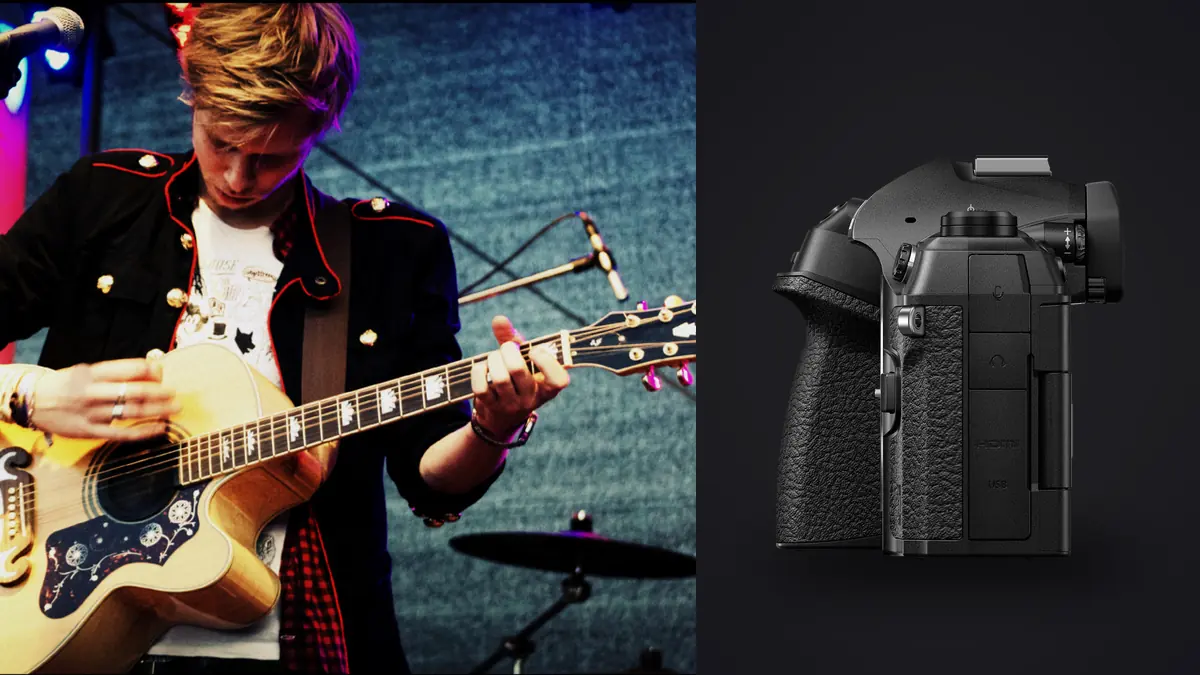
I picked up the OM System OM-1 Mark II for a six-week club tour mostly because my shoulder was tired of carrying two full-frame bodies and a bag of fast primes into venues with no freight elevator and a load-in that involves three flights of stairs. What I didn't expect was how much of the camera's autofocus behavior, buffer handling, and stabilization would end up mattering more in a photo pit than on a bird hide, which is where most of the marketing photography for this camera gets taken.
This is a rundown of what actually held up once this became my main concert body: not a spec sheet copied from the press release, but what changed about how I shoot when the light is bad, the band won't stand still, and I've got three songs from the barricade before security walks me out.
Why a Micro Four Thirds body even gets a look in the pit
The obvious objection is sensor size, and I'll get to that. But the case for the OM-1 Mark II in a live setting starts with the 2x crop factor working in your favor for once. A 40-150mm f/2.8 gives you an 80-300mm equivalent field of view in a lens that weighs about 760g. The full-frame equivalent glass to match that reach at that aperture is closer to 1.4kg, and on a night where you're shooting four support acts plus a headliner from a barricade with your arms above your head half the time, that difference is not cosmetic. By the third band your forearms know exactly how much lens they're holding.
It also changes what you can carry into a venue that has a strict one-bag policy at the door. A body, the 12-40mm f/2.8, and the 40-150mm f/2.8 covers a 24-300mm equivalent range in a bag small enough that most venue security stops asking questions about it.
The sensor and the ISO ceiling, honestly
The 20.4MP stacked BSI sensor is genuinely good for its class, and OM System's low-light autofocus claim (down to -8.5 EV with an f/1.2 lens) is not marketing fluff, it locks focus on a single spotlit face in a nearly black room better than I expected. But the sensor is still Four Thirds, and noise is the honest tradeoff.
In practice I treat ISO 3200 as the comfortable working ceiling for anything I want to keep at full quality. ISO 6400 is usable for web and social delivery with a bit of noise reduction in post. Past that, in the kind of DIY venue lighting where the only illumination is a single par can and whatever's bouncing off the ceiling, I'll push to ISO 12800 because a noisy usable frame beats a clean black one, but I know I'm losing shadow detail and color fidelity doing it. A comparable full-frame body buys you roughly a stop and a half to two stops before you hit that same noise floor. That gap is real and I'm not going to pretend otherwise. It just doesn't decide the outcome of most nights, because most nights the stage has more light than a basement show.
In-body stabilization is doing more than the spec sheet suggests
OM System rates the IBIS at up to 8.5 stops with certain lenses, and while I don't shoot handheld at absurdly slow shutter speeds for a moving subject, the stabilization changes what's possible for the quieter parts of a set. For a seated keys player or a vocalist holding a note without much movement, I can drop to 1/60 or even 1/30 and still get a sharp frame, which lets me keep ISO down a stop or two exactly where the ISO ceiling above starts to bite.
What it doesn't do is freeze a drummer's stick or a guitarist headbanging through a breakdown. IBIS corrects camera shake, not subject motion, and I still run 1/250 to 1/320 minimum for anyone actively moving on stage, faster for anyone jumping. It's a tool for extending your low-light margin on the calm moments, not a substitute for shutter speed on the loud ones.
Autofocus in strobing light and stage smoke
The subject detection AF (human, bird, animal, vehicle) is tuned more for general portrait and wildlife use than for a guitarist whose face is half-hidden behind a headstock while a strobe cuts every two seconds. In that specific chaos, face and eye detection hunts more than I'd like, chasing a hand or a cymbal instead of locking onto the singer.
What actually works for me is dropping subject detection and running a single small AF point moved with the joystick, placed on wherever the performer's face is likely to be a half-second before I press the shutter. It's more manual than I wanted a 2024-generation autofocus system to require, but the cross-type coverage across the frame means that once you've placed the point, it grabs focus fast even in near-darkness on a single-lit performer. Smoke machines and hazers slow it down regardless of camera brand, that's a physics problem, not a firmware one.
Burst modes, Pro Capture, and the buffer you'll actually hit
The headline numbers are 120fps electronic with focus and exposure locked on the first frame, or up to 50fps with continuous AF tracking, plus a 10fps mechanical shutter option for venues that don't allow silent electronic shutters (a few classical and jazz rooms still ask for the mechanical click, oddly enough, as proof you're not running video). Pro Capture is the feature I use more than any of those numbers suggest: half-press the shutter and the camera buffers frames before you fully press, so a drum hit or a jump gets caught even though your reaction time is always a beat behind the actual moment.
The buffer reality: at 50fps with continuous AF on a fast UHS-II card, I get a genuinely useful run, several seconds of full-speed shooting before it slows. At 120fps the buffer empties in under two seconds, so I only trigger that mode for the specific move I'm trying to catch, not for riding the shutter through a whole chorus. Do that across a four-band bill and you'll end up with a memory card holding a thousand or more frames of three or four songs, a lot of which are three-frame duplicates of the same beat.
Settings baseline by venue type
| Venue type | Typical light | Shutter speed | ISO I'll push to | Notes |
|---|---|---|---|---|
| Arena / large festival stage | Bright, moving LED washes | 1/500 | 3200 | Plenty of light most of the set; save ISO headroom for blackout moments |
| Mid-size club (300-800 cap) | Mixed color gels, uneven | 1/320 | 6400 | Where the OM-1 II's AF earns its keep, single-point tracking |
| Small club / DIY basement | One or two par cans | 1/250 | 12800 | Noise floor is real here; shoot RAW and expect a heavier cull |
| Outdoor festival, daylight set | Full sun, harsh shadows | 1/1000 | 400 | Weather sealing matters more than ISO; watch for lens flare on wide glass |
Lens picks that make sense on this system
Three lenses cover almost every pit assignment I take. The 12-40mm f/2.8 II Pro (24-80mm equivalent) is the walk-around for wide stage shots and full-band frames on small stages where you can't back up. The 40-150mm f/2.8 Pro (80-300mm equivalent) is the workhorse, it stays on the second body all night for tight shots of a singer's face or a guitarist's hands from twenty feet back. The 8-25mm f/4 Pro earns its place on tiny stages, house shows, and anywhere you're shooting from the side of the stage instead of the barricade and need the extra width.
For the darkest rooms I'll swap to a 17mm f/1.2 or 25mm f/1.2 prime and trade reach for light-gathering. On this system, aperture speed buys you more in low light than it does on full frame relative to the ISO penalty, so a fast prime is worth carrying as a dedicated low-light option rather than defaulting to the zoom wide open.
Weather sealing and the outdoor festival slot
The IP53 rating held up through a genuinely miserable outdoor set in steady rain where I watched another photographer's non-sealed body get pulled and bagged mid-set. I didn't baby the camera, no rain cover, just kept the lens hood on and wiped it down between songs. Dust at a desert festival was the same story, no issues after a three-day run. Dual card slots also matter more here than people give them credit for: if you're the only photographer with access for an artist who cares about their image rights, shooting to two cards simultaneously means a corrupted card doesn't cost you the set.
Getting through the take after the last song
A three-song, twelve-minute pit set shot at 50fps for the key moments plus steady coverage in between routinely leaves me 800 to 1,200 RAW frames for a single band. Multiply that by a four-band bill and you're looking at a genuinely unpleasant sorting job if you're doing it by eye, flagging closed eyes, motion blur on the hands, and the four nearly identical frames from every burst.
This is the part of the job that's actually improved my workflow more than any camera spec. I run the night's cards through imagic before I touch anything in an editor, since its local sharpness and focus scoring flags the genuinely soft frames out of a burst automatically, and the duplicate and burst clustering groups those near-identical strobe-lit sequences so I'm picking the best of six instead of scrubbing through all six by hand. Because it processes everything on the laptop rather than uploading anywhere, I can do this cull in the greenroom or the tour van on venue wifi that barely loads email, which matters more than it sounds like it should when you've got a 6am load-out and a label wanting a same-night selects gallery. If you want the mechanics of how that scoring actually works, this breakdown of AI photo culling covers it in more depth than I will here.
The other piece that's saved real time on tour is imagic's apply_my_style feature. I trained a preset from a set of my own graded concert photos, the specific way I pull down blown highlights from stage lighting and balance the color casts from mixed LED washes, and now a fresh night's take gets a first-pass edit that already looks like my work instead of a flat RAW file. It's not a substitute for finishing the actual selects by hand, but it cuts the time between "cards in the laptop" and "gallery ready to send" by a lot, which lines up with most of the general advice in this faster workflow guide about killing the slow steps between shooting and delivery rather than trying to shoot faster.
Where it loses to full frame, and where that stops mattering
I want to be straight about the limits. Shadow recovery on a black stage background is narrower than what I got out of a full-frame body I used to shoot with, push the shadows too far on a Four Thirds file and you'll see banding before a full-frame sensor would. Background separation at a given aperture is roughly two stops shallower in equivalent terms, so getting that creamy isolated bokeh on a wide arena stage takes faster glass than it would on full frame. And the used market for OM System glass is thinner than Sony or Canon, so resale isn't as forgiving if you change systems later.
None of that has cost me a usable frame at an actual show. The job is getting a sharp, well-exposed photo of someone moving fast under bad light with a rig you can carry through a fourth night in a row without your back giving out, and on that specific job this camera has been consistently more reliable than the marginal image quality gap would suggest.
Frequently Asked Questions
Is the OM-1 Mark II's autofocus fast enough for mosh pits and stage diving?
For predictable, well-lit action it tracks well, but crowd surfers and pit chaos under strobing light are hard for any camera's subject detection. I get more consistent results manually placing a single AF point with the joystick and pre-focusing on the barricade line than trusting automatic subject tracking in that specific scenario.
What ISO can I realistically use in a dark club with this camera?
ISO 3200 to 6400 is comfortable for client-ready work. I'll go to ISO 12800 in genuinely underlit DIY venues when there's no other option, knowing I'm trading shadow detail and color accuracy for a usable exposure at all.
Do I actually need Pro Capture mode for live music?
Not for every song, but for a specific jump, drum hit, or guitar swing it's the difference between catching the peak moment and missing it by a frame. I treat it as a targeted tool for two or three key moments per set rather than a mode to leave running constantly, since the buffer empties fast at the higher frame rates.
Is the 2x crop factor a real disadvantage for wide stage shots?
For full-band wides on a big stage it does mean carrying a genuinely wide lens like the 8-25mm f/4 rather than relying on a standard zoom's wide end. For everything from mid-stage to tight portraits, the same crop factor works in your favor by turning a moderate zoom into serious reach without the weight of full-frame telephoto glass.