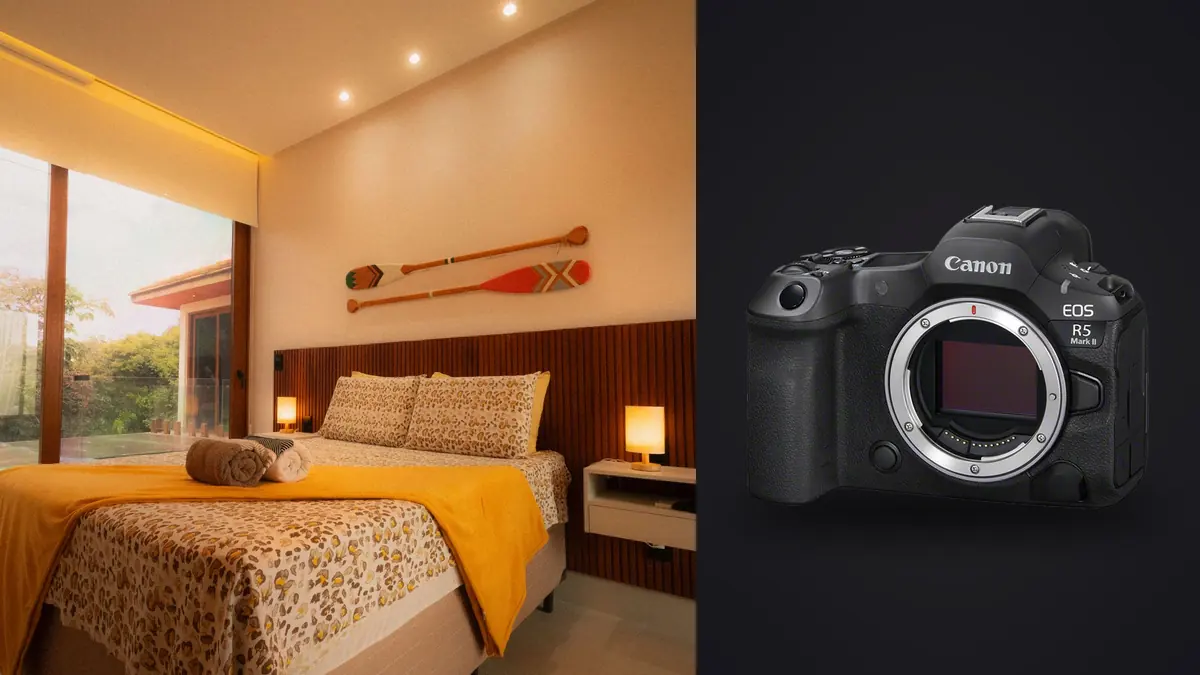
Boudoir and intimate portrait work asks different things of a camera body than a wedding day or a studio headshot session does. You are usually shooting in one room, often with whatever ambient light the space gives you, moving fast between poses so the client does not have time to get self-conscious, and you need every frame usable because there is no do-over shoot two weeks later. The Canon EOS R5 Mark II turns out to be a genuinely good match for that brief, not because Canon built it with boudoir in mind, but because the specific problems this genre creates line up with what the camera is actually good at.
What the R5 Mark II actually brings to a boudoir set
The 45 megapixel stacked sensor is the headline spec, and for close, cropped intimate work it earns its keep. You can frame a full body pose, then crop hard into a waist-up shot or a detail image in post without the file falling apart, which matters a lot when a client asks for a tighter version of something you shot wider. Rolling shutter is also far better controlled than on the original R5, so if you lean on the electronic shutter for quiet operation, a real consideration when you are working a few feet from someone in an otherwise silent room, you do not get the skewed verticals that plagued early stacked-sensor bodies during quick movement.
Buffer depth matters more here than people expect too. A 20 or 30 fps burst through a pose change, robe coming off a shoulder, hair falling a certain way, fills the buffer fast, and the R5 Mark II clears it quickly enough with a fast CFexpress card that you are not staring at a locked-up rear screen while a client waits mid-pose wondering what is wrong.
Autofocus that keeps up even when the subject barely moves
Boudoir subjects do not run, jump, or spin between frames, so it is tempting to think autofocus sophistication does not matter much here. In practice it matters more than most people expect, just for different reasons than sports or wildlife work. You are shooting close, often at f1.2 to f2, with a plane of focus shallow enough that a few centimeters of forward lean between poses can throw focus off a set eyebrow onto a shoulder. The R5 Mark II's eye detection is reliable enough that I stop manually recomposing around it and just trust the box, even through hair, through a sheer robe, or at odd three-quarter angles where older systems used to hunt.
Eye Control AF, the system that tracks where you are looking through the viewfinder and moves the AF point there, is more useful in this genre than in almost any other I shoot. Poses shift quickly and the composition changes with them, and being able to glance at a hand resting on a collarbone and have the camera pick that up as the point of focus, rather than defaulting to the nearest eye, saves real time across a two hour session. It takes a session or two of calibration to trust fully, and it degrades if you wear glasses that shift on your face, but once it is dialed in it changes the rhythm of how you shoot this kind of work.
Working with the light the room actually has
Most boudoir sessions happen in bedrooms, hotel rooms, or small studio sets dressed to look like a bedroom, and none of those spaces were built with photography in mind. Window light is often your best and only real light source, and it moves and dims through a two hour session. This is where in-body stabilization stops being a nice-to-have and starts changing what is actually possible. Paired with a stabilized RF lens the R5 Mark II is rated for up to 8.5 stops of correction, and while I never plan a shoot around hitting that number, it means you can drop shutter speed to 1/30 or slower for a static, reclined pose and still get a clean file at ISO 800 instead of pushing to 3200 and fighting noise in skin tones later.
High ISO performance on this sensor holds up better than the resolution jump would suggest. Grain shows up gently rather than in blotchy color noise, which matters specifically for skin, since color noise reads as blemishes and texture noise just reads as texture. I still light most sessions with at least one continuous LED panel bounced off a wall or through a diffusion scrim, both because comfort improves with a bit more visible light in the room and because I would rather not lean on ISO 6400 as a crutch. But on days when the space only has window light, this body makes that a real option instead of a compromise you apologize for afterward.
| Light source | ISO range | Shutter speed | Aperture | Notes |
|---|---|---|---|---|
| North-facing window, overcast | 400-1600 | 1/60-1/125 | f1.8-f2.8 | Meter for the shadow side of the face; window light falls off fast past four feet |
| Single LED panel, bounced | 200-800 | 1/125 | f2-f4 | Bounce off a wall or ceiling rather than shooting direct; direct reads harsh on skin |
| Two-light strobe set (softbox plus rim) | 100-200 | 1/160-1/200 sync | f2.8-f5.6 | Standard studio approach; gives the most repeatable results across a full series |
| Practical or lamp light only, evening | 1600-6400 | 1/30-1/60, IBIS assisted, static pose | f1.2-f1.8 | Only reliable for still, reclined poses; expect to lean on noise reduction in post |
Lens choices that do not fight the format
The RF 50mm f1.2L is the lens I reach for most on this body for boudoir. At f1.2 the falloff is dramatic enough to isolate a subject from a busy bedroom background without needing to art-direct the whole room, and the focal length stays close enough to natural perspective that it does not distort the body at typical shooting distances. The RF 85mm f1.2L is the better pick in a larger room where you can back up; it flattens features slightly and reads as genuinely flattering on close crops, but in a small hotel room you will find yourself backed into a closet trying to get the shot.
For detail work, a hand on fabric, a strap sliding off a shoulder, jewelry against skin, the RF 35mm f1.8 Macro IS STM earns a spot in the bag even though it is a modest lens sitting next to two L-series primes. It focuses close enough for true macro detail shots, which round out a gallery and give clients something beyond straight body poses. I would avoid zooms for most of a boudoir session; the constant lens changes to hunt for the right focal length break the mood you are trying to hold with the client far more than physically swapping primes ever does.
Skin tone rendering out of the camera
Canon's color science has always handled skin reasonably well, and the R5 Mark II does not reinvent that formula so much as give it a cleaner sensor to work from. Straight out of camera JPEGs, useful for quick previews you show a client mid-session, render warm without tipping orange, and the RAW files hold enough latitude in the highlights that a bright window-lit frame does not clip on a shoulder or collarbone the way older sensors sometimes did. Where this matters most in practice is mixed lighting: a session with window light on one side and a warm lamp on the other used to force a choice between two skin tones in the same frame. The dynamic range here gives you enough room to bring both into a believable match in post, rather than picking one light source to expose correctly and letting the other go muddy.
Culling a boudoir shoot without losing the afternoon to it
A two hour boudoir session shot at 20 to 30 fps, even used sparingly for a handful of sequences, produces a genuinely large take. Multiply that by a full day of back-to-back clients and sorting through thousands of near-duplicate frames by eye becomes the actual bottleneck, not the shooting itself. This is where I have started running everything through imagic before it ever touches Lightroom. It scores sharpness and focus locally on the machine and groups burst sequences and duplicate frames automatically, so instead of clicking through forty near-identical frames of the same pose looking for the one with open eyes and a relaxed hand, I get a short list already narrowed down to the sharpest, best-expression options. The processing stays on the machine, nothing gets uploaded anywhere just to sort or score a shoot, which is a genuine answer when a client asks how their images are being handled before they have even seen a proof.
That privacy question comes up more in this genre than in almost any other I shoot. Boudoir clients are trusting you with images they would never want sitting on a stranger's server, and a lot of culling and editing tools now route files through cloud processing by default, sometimes without making that obvious anywhere in the app.
For editing consistency across a session, I built an apply_my_style preset in imagic trained on my own past edits: warm shadows, a specific highlight rolloff on skin, restrained clarity rather than heavy sharpening. Running a fresh batch through it gets every image in a session to a consistent starting point before I go in and do the individual retouching a finished gallery actually needs. It is a smaller time save than the culling step, but it means the first pass through a gallery already looks coherent rather than like forty separate edits stitched together. If you are comparing culling tools for a genre where discretion is part of the job, how AI photo culling actually works is worth reading before you commit to one.
A settings starting point, not a formula
None of the numbers above are rules; every room and every client is different. But if I had to hand a new-to-genre shooter a starting point on this body it would be this: back-button focus with eye detection locked to Person priority, electronic shutter for quiet operation, mechanical shutter as a fallback if you see banding under LED panels, and a habit of checking the histogram rather than trusting rear-screen brightness, since screen brightness lies more in dim rooms than in almost any other setting I shoot. Shoot RAW even for the quick previews you show a client mid-session; you can pull a fast JPEG off a RAW file in seconds, but you cannot recover detail from a JPEG you shot small to save card space.
Budget more time for the walkthrough conversation before the camera comes out than for the shooting itself. The gear solves the technical half of this genre reasonably well now; it was never the hard half. Photographers weighing whether the R5 Mark II is worth the jump from a lower-cost body for this kind of work should also look at how the editing side of the workflow is priced, since a strong camera body paired with a slow, expensive edit pipeline still eats the margin on a boudoir session.
Frequently Asked Questions
Is the 45 megapixel sensor overkill for boudoir work, or does the resolution actually help?
It is not overkill for this specific genre. Boudoir galleries lean heavily on close crops and detail shots pulled from wider frames, and having 45 megapixels to crop into means you are not choosing between the framing you want in the moment and the framing a client asks for afterward. If you mostly deliver full-frame, uncropped images, a lower-resolution body would serve you just as well.
Do I need flash for boudoir, or is available light enough with this camera?
Available light is a genuine option with the R5 Mark II's stabilization and high-ISO handling, especially for reclined, static poses near a window. Most working shooters still bring at least one continuous LED for consistency across a session and for client comfort, since a slightly brighter room reads as more professional than shooting in near-darkness even when the camera can technically handle it.
What lens gives the most flattering results for close, intimate framing?
The RF 85mm f1.2L flatters features at typical portrait distances and is a strong choice when the room is large enough to back up in. In tighter bedrooms and hotel rooms, the RF 50mm f1.2L is more practical and still renders skin and features naturally at the distances you will actually be shooting from.
How should I handle client image files given how sensitive this kind of work is?
Keep the culling and initial sort local rather than routing files through a cloud service, and be upfront with clients about how their images move from card to delivery. Local tools that score and group images entirely on the machine, imagic among them, avoid the extra step of images sitting on someone else's server before a client has even seen a proof.