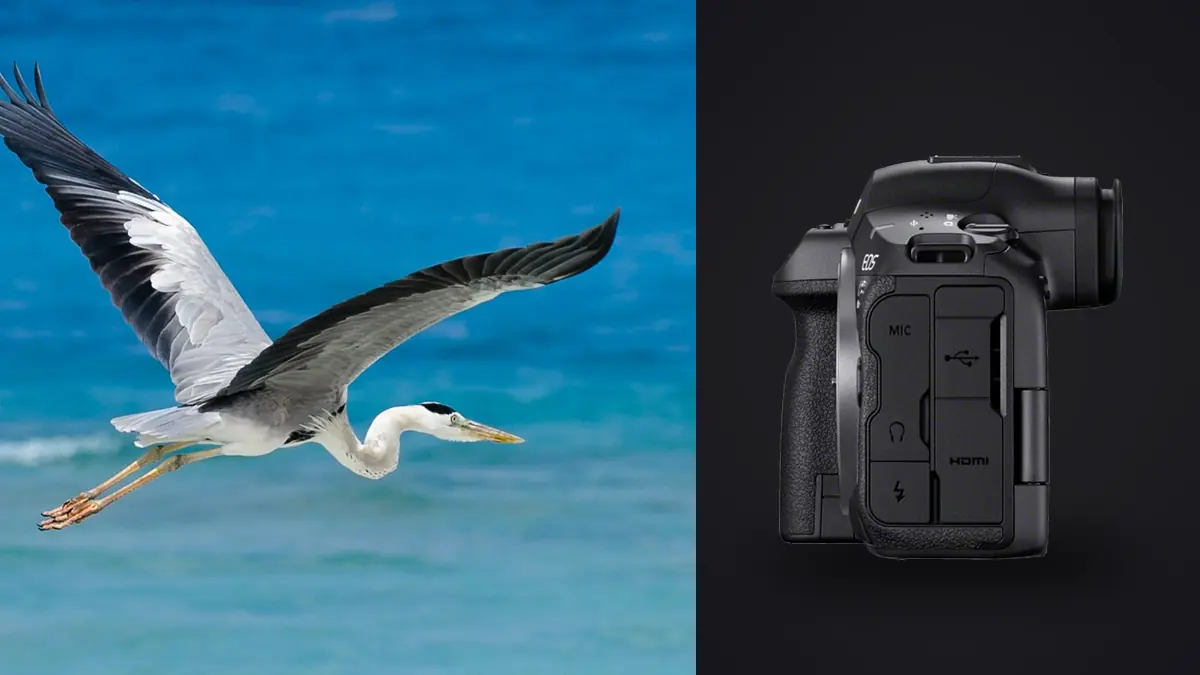
I spent three mornings on a tidal estuary this spring trying to get clean flight shots of oystercatchers coming off a mudbank at low tide, and it's the trip that finally told me what the Canon EOS R5 Mark II actually changes for bird photography. Not the megapixel bump. Not the marketing line about the stacked sensor. It's the combination of a much faster readout and a genuinely different autofocus brain that changes how you shoot, and it also changes how much work you're signing up for afterward when you sit down to go through the files.
The Stacked Sensor Is the Real Story, Not the 45 Megapixels
The original R5 had a 45-megapixel sensor too, so on paper the resolution story looks unchanged. What's different is that the Mark II's sensor is stacked and back-illuminated, which means the readout speed is dramatically faster. In practice that kills most of the rolling shutter skew you'd get on a fast wingbeat with the electronic shutter. On the first R5, shooting a kestrel hovering into wind with e-shutter at 20fps, you'd sometimes get a faint slant to the wingtips on the trailing edge of the frame. On the Mark II at 30fps I stopped seeing it on anything short of a peregrine stoop, and even then it's marginal.
That matters for birding specifically because birds in flight are one of the few subjects where rolling shutter distortion is actually visible in the final image, not just a theoretical spec-sheet concern. Wingtips move fast enough, and are high-contrast enough against sky, that skew shows up as a soft diagonal smear on one side of the bird. The Mark II's readout speed is what makes shooting the full 30fps electronic mode viable for BIF work in a way it wasn't quite on the original R5.
The Buffer Math Nobody Mentions Before You Buy One
Here's the part that doesn't show up in the launch marketing: 30fps is a firehose, and the buffer is what decides whether that firehose is actually useful to you on a given morning. A single uncompressed RAW frame off the 45MP sensor lands around 55-65MB depending on scene detail. At 30 frames per second that's close to 2GB of data per second of shutter hold. Even with a fast CFexpress Type B card, you will hit the buffer wall on a long flyby sequence, and when you do, the frame rate drops hard until the card catches up.
| Drive Mode | Max Rate | Rough RAW Buffer (fast CFexpress B card) | Where I actually use it |
|---|---|---|---|
| Mechanical shutter | 12 fps | Buffer rarely becomes the limiting factor | Perched raptors, gulls on the water, anything where I want zero rolling-shutter risk and don't need top speed |
| Electronic shutter (full RAW) | 30 fps | Roughly 3-4 seconds of sustained shooting before the rate visibly sags | A heron lifting off, a tern folding into a dive, short unpredictable action |
| Electronic shutter (C-RAW) | 30 fps | Noticeably deeper, often 6-8 seconds sustained | Long flyover sequences of geese or waders where I want the full run, not just the launch |
| Pre-Continuous shooting | 30 fps | Same ceiling as above, but you're spending buffer before you even press the shutter | A perched bird I know is about to bolt but can't predict the exact half-second |
Pre-Continuous shooting deserves its own mention because it's the single feature that's changed my hit rate on launch shots the most. Half-press the shutter and the camera is already buffering up to half a second of frames before your full press registers, so the exact instant a bird's legs leave the branch is no longer a reaction-time problem. The tradeoff is that you're burning through buffer and card space even during the moments you're just watching and waiting, so I only leave it switched on when I'm actively staked out on a nest or a known perch rather than walking a trail.
Autofocus on Erratic Flight Paths: Where It Earns Its Reputation and Where It Doesn't
Canon carried the deep-learning subject detection from the R3 and R1 down into the Mark II, and for birds specifically it recognizes eye, head, and body even at awkward angles, not just a clean side profile. On gulls circling a boat or gannets working a bait ball, where the bird is constantly rolling and banking, it holds the eye box far more consistently than the original R5 did. I'd put the improvement at genuinely noticeable, not marginal, particularly on birds under about 15 percent of the frame where the older system used to hunt.
Eye Control AF is the feature that gets the most attention and deserves a more honest take than most reviews give it. It works by tracking where your eye is looking in the viewfinder and steering the AF point there, which sounds perfect for birding because you can look at a bird crossing through branches and let your eye do the pointing instead of a joystick. In practice it needs a careful calibration session (Canon recommends doing it in the actual lighting condition you'll shoot in, and again if you put on or take off glasses) and it still drifts a little over a long session in bright glare, which is exactly the condition you're often in at a coastal site at midday. I use it for maybe half my birding sessions, mostly on slower-moving subjects like herons and raptors where a small pointing error doesn't cost me the shot. For fast passerines darting through dense cover I go back to a single AF point and back-button focus, because a half-second of AF hunting from a miscalibrated eye point costs more than it saves.
Where the system still struggles is small birds against cluttered backgrounds with similar tonal values, think a warbler against autumn foliage rather than open sky. The detection engine will lock onto the wrong contrast edge occasionally, and no amount of AF case tuning fully solves that. It's a real limitation, not just user error, and I'd rather say that plainly than pretend the R5 Mark II reads every scene correctly.
Lens Pairings That Actually Make Sense
The RF 100-500mm f/4.5-7.1L is still my default for anything within about 40 meters, mostly because at 1.4kg it's light enough to handhold for a full morning of walking a shoreline. Paired with the 1.4x teleconverter it becomes a 140-700mm at a maximum aperture around f/10, and the Mark II's autofocus still tracks reliably at that aperture in decent light, which wasn't always true on the original R5 body.
For anything more serious about distant raptors or shorebirds that won't let you get close, the RF 200-800mm f/6.3-9 IS is the lens I reach for now. It's heavier at 2.05kg and the variable aperture bites at the long end, but on the Mark II's higher native ISO ceiling I can push to ISO 6400 on an overcast morning and still get usable RAW files after noise reduction. The RF 600mm f/11 is the budget option worth mentioning too. It's fixed aperture, no zoom, and genuinely limiting in low light, but at under 950g it's the only supertele I'll pack when weight is the actual constraint, like a multi-day hiking trip where every camera body ounce competes with food and water.
The Settings I Actually Dial In Before First Light
Back-button AF stays on for everything, no exceptions, because separating focus from the shutter button is what makes it possible to release the AF point on a bird that suddenly ducks behind a reed and reacquire cleanly. AF Case 2 (accelerate/decelerate tracking, subject shifts easily to another subject) is my starting point for open-water birds like terns and gulls where subjects cross paths constantly. For a single raptor working a thermal with nothing else in the frame, I'll switch to Case 4, which resists subject switching and holds tracking through partial occlusion by a branch or wire.
I shoot electronic shutter at 20fps rather than the full 30fps for most general BIF work, not 12 and not 30. Twenty is the sweet spot where the buffer lasts long enough for a real sequence and I'm not drowning in near-duplicate frames of a wing at nearly the same position. I only push to full 30fps for genuinely fast subjects, a diving kingfisher or a stooping falcon, where the extra frames actually buy meaningfully different wing positions rather than three copies of the same one. Mechanical shutter stays selected as my safety net through the camera's electronic first-curtain-off setting when a lens change is imminent, since the Mark II closes the shutter curtain automatically to protect the stacked sensor from dust during swaps, a small but genuinely useful change from the original body.
Cold Mornings, Long Lenses, Real Battery Numbers
The LP-E6P battery rated for the Mark II gets you noticeably more shots per charge than the older LP-E6NH on paper, but that number assumes room-temperature testing. On a 2C dawn estuary session with the EVF running at high refresh and Eye Control active, I've watched a full battery drop to around 40 percent by mid-morning on a session that would have used maybe 60 percent of an LP-E6NH under the same conditions on the original R5. I carry three batteries for any full-day trip and keep the spares in an inside jacket pocket rather than the camera bag, since cold-soaked batteries lose capacity fast.
Weight is the other honest conversation nobody has until they've carried an R5 Mark II plus RF 200-800mm on a gimbal for six hours. The combination is over 3kg before you add a tripod head, and while the body's grip and balance are genuinely comfortable, a full day of walking with that setup on a strap is a different proposition than a mirrorless kit with a compact prime. If you're planning multi-day birding trips on foot rather than from a hide or vehicle, weigh the whole kit before you commit to the longest lens option.
What a Morning of BIF Shooting Does to Your RAW Folder
Here's the number that surprised me the first time I actually did the math: three hours of intermittent 20fps bursts at a wader roost, shooting maybe 15 percent of the time and reviewing the rest, left me with just over 3,100 RAW files and roughly 165GB on the card. Most of those are near-duplicate frames from the same three-second launch, wingbeats a fraction of a second apart, and only a handful from each burst are actually sharp on the eye with the wing in a flattering position.
That's the part of the R5 Mark II ownership experience that the spec sheets never mention, and it's exactly the bottleneck I built imagic to solve for myself. It runs a local sharpness and focus score across the whole folder without uploading anything anywhere, which matters when you're offline at a coastal site with no signal and want to do a first pass over lunch rather than waiting until you're back at a desk. It also clusters near-duplicate frames from the same burst, so instead of scrolling through 40 nearly identical wingbeat frames one at a time, you're comparing four or five visually distinct clusters and picking the sharpest one from each. If you haven't compared how different culling tools handle burst-heavy wildlife work, this breakdown of how AI photo culling actually scores sharpness covers the mechanics in more depth than I can here.
The other piece that's specific to bird photography is consistency across a season. I shoot the same estuary through spring and autumn migration, and I want oystercatchers in March to look tonally like oystercatchers in September without re-inventing my edit from scratch each time. imagic's apply_my_style feature trains on a folder of my own previously edited RAWs rather than a generic preset pack, so the starting point for a new batch already leans toward how I actually grade shorebird light, not a stock look built for someone else's subject matter. Between the sharpness scoring and the style matching, a folder that used to take most of an evening to get through now takes closer to 40 minutes, which is more time actually back out shooting the next tide. For anyone running a similarly high-volume RAW workflow, these workflow adjustments pair well with tightening up the culling stage specifically.
Frequently Asked Questions
Does the 45-megapixel sensor hurt low-light performance during early-morning bird activity?
Less than the megapixel count suggests, because the sensor is new for the Mark II rather than a carried-over part. Noise at ISO 6400 and 12800 is comparably controlled to the original R5 despite the pixel count being unchanged on paper, and Canon's processing pipeline (DIGIC X plus the added DIGIC Accelerator) helps more with autofocus computation in low light than with raw noise floor. For pre-dawn shoots I still favor slower shutter speeds down around 1/1000s for larger birds rather than pushing ISO further, since motion blur on a slow wingbeat is more forgiving to the eye than heavy noise reduction artifacts on feather detail.
Is Eye Control AF reliable enough to trust for a serious birding trip, or is it a gimmick?
It's genuinely useful, not a gimmick, but it's conditional. On slower subjects with predictable movement, herons, egrets, perched raptors, it lets you point focus with a glance faster than a joystick can move, and after a careful calibration it's accurate to within roughly the eye of a mid-sized bird at typical shooting distances. On fast, erratic small birds, or in harsh side lighting that affects eye tracking accuracy, I've had it drift enough to cost a shot, so I keep back-button single-point AF as my fallback rather than relying on it exclusively for an entire trip.
Should I get the RF 100-500mm or the RF 200-800mm for birds in flight?
It comes down to where you actually shoot. If your local sites let you get within 30-40 meters of active birds, roost edges, harbor walls, garden feeders, the 100-500mm's lighter weight and faster minimum aperture at the wide end make it the more comfortable lens for a full day of handholding. If you're regularly shooting distant raptors over open country or shorebirds that won't tolerate approach, the 200-800mm's extra reach earns its weight penalty, and the Mark II's autofocus holds up well enough at f/9 that the variable aperture isn't the limitation it would have been on an older body.
How much storage should I plan for a full day of bird-in-flight shooting?
Budget more than you think. A single busy morning session at 20fps with moderate discipline about not holding the shutter down constantly produced around 165GB for me in three hours; a full day covering both a dawn and dusk flight can easily run 300-400GB in RAW. I carry two 325GB CFexpress Type B cards as primary storage and back up to a portable SSD each evening on multi-day trips, since a single card failure mid-trip with no backup is not a risk worth taking with irreplaceable migration footage.