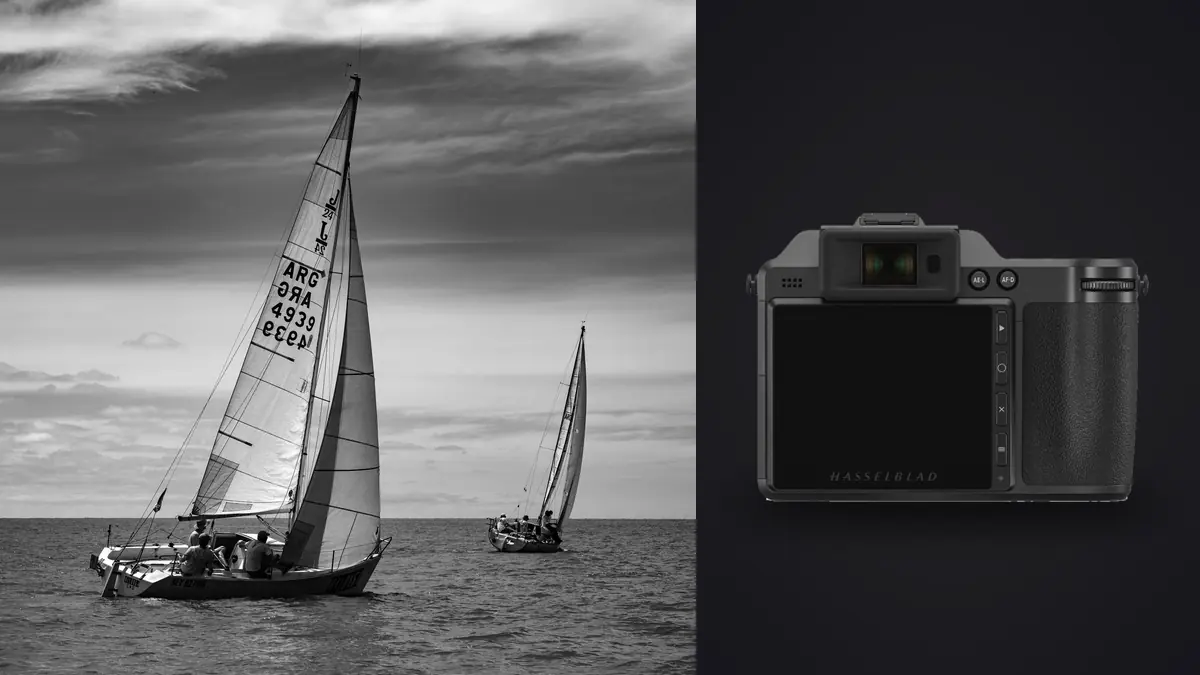
I brought a Hasselblad X2D 100C to a regional track and field meet last spring, mostly on a dare from another photographer who thought I was joking. I wasn't. I'd been shooting portraits and product work on the X2D for about a year and wanted to know, honestly, whether a 100-megapixel medium format body with a contrast-detect autofocus system could survive four hours of sprints, jumps, and throws without embarrassing me. The short answer is that it can, but only if you stop trying to make it behave like a camera it isn't. This is not a camera built for sports. Hasselblad has never marketed it that way. What it is, though, is a very capable tool for a narrower slice of action photography than most people assume, and understanding exactly where that slice starts and ends is the entire game.
Why bother with a medium format body at a track meet
The obvious question is why anyone would choose a body with a rated continuous shooting speed of roughly 3.3 frames per second, no mechanical shutter, and an autofocus system tuned for stillness over movement, when a used Sony a9 or a Nikon Z9 would out-perform it in every metric that matters for chasing a sprinter down a straight. The answer isn't performance. It's the file.
A clean frame off the X2D 100C, at the moment a pole vaulter clears the bar or a discus thrower reaches full extension, holds detail that a 24 or 45-megapixel sensor simply doesn't capture. You can crop a distant long jump landing to a tight composition and still print it two feet wide without the image falling apart. The dynamic range on the 43.8x32.9mm sensor also means late afternoon meets, the kind where half the infield is in hard shadow and the other half is blown out under stadium lights, become workable in a way they aren't on a smaller sensor pushed to match. I'm not claiming this outweighs the tracking deficit for every shooter. For meets where I'm delivering maybe fifteen or twenty final images to a program or a sponsor, rather than a full gallery of every heat, it does.
What actually breaks when you point 4D Focus at a sprinter
Hasselblad's 4D Focus system is contrast-detection based, and it is genuinely good at what it was designed for: locking onto a static or slow-moving subject with precision, in low light, without hunting. Point it at a runner accelerating out of the blocks and ask it to hold focus through eighty meters of closing distance, and it starts to lag. Not catastrophically. It's not that the system fails outright, it's that it confirms focus a beat later than a phase-detection system would, and on a subject moving at sprinting speed a beat is the difference between a sharp frame and a soft one.
The other issue is the shutter. The X2D 100C has no mechanical shutter at all, it reads the sensor electronically for every exposure. That's fine for portraits and landscapes, but it means rolling shutter distortion shows up the moment you're panning with a fast subject, especially anything crossing the frame laterally, like a 200m runner coming out of the curve. Verticals lean. Wheels on a relay baton exchange (if you're tight enough to see one) can smear. I didn't fully appreciate how much this would matter until I saw it on a monitor at 100%, where a sprinter's torso had a visible skew that wasn't there in the finish-line-facing shots taken seconds later.
None of this means the camera can't produce usable sports images. It means the definition of "usable" narrows considerably, and you have to plan your positioning and event selection around that narrowed definition rather than fighting it.
Which events actually work
After three meets with the X2D 100C as my only body, I started keeping rough notes on which events were worth the risk and which ones I'd default back to a crop-sensor mirrorless body for. Here's roughly where that landed.
| Event | Peak-moment predictability | What actually works | Realistic keeper rate |
|---|---|---|---|
| 100m / 200m sprint | Low (fast, continuous motion, no natural pause) | Pre-focus on the finish line, don't try to track | Poor, maybe 1 in 15 frames sharp at the line |
| High jump / pole vault | High (clear apex over the bar) | Focus and hold on the bar, wait for the body to arrive | Strong, often 7 or 8 in 10 clean at the apex |
| Long jump / triple jump | Medium (landing is semi-predictable, takeoff is fast) | Pre-focus the sand pit edge, shoot the landing not the flight | Good for landing, weak for mid-air extension |
| Shot put / discus / javelin | High (release point is a fixed spot in the circle) | Focus on the release zone, single-shot not burst | Strong, this is the format's best event by far |
| 4x100 relay handoff | Low (fast, two moving subjects, narrow exchange zone) | Wide enough framing to allow a focus margin for error | Weak, plan to lose most exchange attempts |
| Distance events (1500m+) | Medium (subjects slower, more predictable stride) | Continuous shooting in short bursts as runners pass a mark | Decent, the slower pace suits the AF system |
The pattern is obvious once you see it laid out: anything with a fixed release point or a genuine pause in motion (the apex of a jump, the moment before a throw, the top of a vault) plays to the camera's strength. Anything that's continuous lateral motion at speed is fighting the sensor readout and the focus system at the same time, and you will lose more of those frames than you keep.
Technique adjustments that actually helped
A few habits made a real difference once I stopped trying to shoot the X2D 100C like a dedicated sports body.
Manual pre-focus, not continuous AF-C. For sprints and jumps, I stopped trusting the camera to track and started manually focusing on a fixed point on the track or runway, then waiting for the subject to arrive at that point before firing. This flips the whole workflow around, you're timing the subject to the focus plane instead of asking the focus plane to chase the subject, and it works far better with a contrast-detect system.
Faster shutter speeds than you'd think necessary. Because there's no mechanical shutter to fall back on, I found 1/2000s to be closer to a real minimum than 1/1000s for anything moving across the frame, purely to keep rolling shutter skew under control. That costs you a stop or two of light, which on an overcast afternoon meant pushing ISO further than I'd like on a body whose native strength is clean low-ISO files.
Longer glass than you'd expect for a stadium. The XCD lineup isn't built around long telephotos the way a sports-focused mirrorless system mount is. I ran the XCD 90V for most of the day and it's a very good lens, but it's not reaching the far side of a 400m oval the way a 400mm f/2.8 would for a full-frame shooter. Plan to work closer to the action than you're used to, or accept you'll be cropping hard on some of the biggest files a consumer camera can produce, which at least the resolution allows for.
Shoot single-shot deliberately rather than leaning on the burst. At roughly 3.3fps, holding the shutter down doesn't get you much more than three or four frames before you've missed the moment anyway. I got better hit rates timing single decisive presses around the predictable events than I did spraying short bursts and hoping one landed.
The part nobody warns you about: what happens after the meet
Here's the thing about shooting a slow-AF body at a fast event: you don't come home with fewer problem files, you come home with a higher proportion of them. A modern sports body might miss focus on one frame in twenty. On the X2D 100C, at a sprint or a relay exchange, I was seeing something closer to one in six or seven land sharp, and every one of those files was 100 to 200 megabytes. Going through a full card of 100-megapixel RAWs by eye, at 100% zoom, looking for the handful that are actually sharp among dozens that look fine on a thumbnail but fall apart the moment you check focus, is a genuinely bad use of an evening.
This is where I lean on imagic to do the first pass. It scores focus and sharpness locally on the actual pixel data rather than the thumbnail, which matters a lot here because a soft-but-plausible-looking frame from a contrast-detect miss is exactly the kind of thing that fools your eye at low zoom and wastes twenty minutes at full resolution. Everything processes on my own machine too, which matters when you're carrying 400GB of RAW files off a CFexpress card and don't want to wait on an upload before you can even start sorting. For events like the pole vault or discus circle, where I fired several near-identical single shots at the same predictable moment across different attempts, the burst and duplicate grouping also cuts down a set of eight visually similar frames to the two or three actually worth opening in an editor. The underlying reason a burst-heavy sports day eats an evening is the same regardless of camera system, and it's worth reading the broader breakdown in this guide to sports photography burst culling if a slow-AF body isn't the only thing filling your card with near-duplicates.
Color and tone: the other reason I kept coming back to it
Medium format color out of the X2D 100C has a specific character, skin tones in particular hold up under processing in a way that's noticeably different from smaller sensors, even before any grading happens. I built a personal edit style over a year of portrait work on this camera, and when I got to my culling shortlist from the meet, running that same look through imagic's apply_my_style feature (it's trained on my own previous edits, not a generic filter) got the track shots most of the way to a consistent finished look before I touched anything by hand. That mattered more than usual here, because a track meet gallery moves between full sun, deep shadow under the stands, and stadium floodlight within the same twenty minutes, and keeping a coherent color story across all three lighting conditions by hand, frame by frame, is slow work. If you're weighing camera choices around match-day or meet-day turnaround more broadly, it's worth reading up on faster photo workflow habits generally, since a lot of what saved me time here wasn't camera-specific at all.
Who this setup actually makes sense for
If you're a working sports photographer whose living depends on covering ten events a weekend and delivering same-day galleries, the X2D 100C is the wrong tool and no amount of technique adjustment changes that math. But if you're a program photographer shooting a handful of meets a season for a school, a club, or a sponsor, and what you're actually being asked for is a small set of striking, print-worthy images rather than exhaustive event coverage, the tradeoffs start to make more sense. I've also had luck using it purely for the field events at a meet, shot put, discus, high jump, pole vault, and switching to a second, faster body for the track events, which sidesteps the camera's weak spot entirely rather than trying to force it through.
I wouldn't recommend it as a first sports camera, or as anyone's only camera if sports coverage pays the bills. But as a second body carried specifically for the moments where image quality matters more than hit rate, at a stadium where you already know which events reward a slower, more deliberate approach, it earned its place in my bag more often than I expected going in.
Frequently Asked Questions
Can the X2D 100C actually keep up with a 100m sprinter?
Not reliably with continuous autofocus. The contrast-detect 4D Focus system confirms focus a beat too late for a subject closing distance at sprint speed. Pre-focusing on a fixed point, like the finish line, and firing as the runner arrives gets far better results than trying to track the whole run.
Is the rolling shutter distortion as bad as people say?
It's real and it's visible, particularly on anything crossing the frame at speed, but it's manageable. Shooting at 1/2000s or faster for lateral motion and avoiding hard pans on the fastest events keeps it to a level most viewers won't notice unless they're pixel-peeping.
What lens actually makes sense for field events at a stadium?
The XCD 90V was the most useful lens I carried, close enough for most field events without needing to physically stand on the track. For anything at real distance, like a distant sprint lane, you're better off accepting a heavy crop from the 100-megapixel file than expecting the XCD lineup to match a dedicated telephoto.
Should I just rent a Sony or Canon body instead for a big meet?
If the assignment is full event coverage with a same-day deadline, yes, almost certainly. The X2D 100C makes sense as a deliberate choice for image quality on a narrower set of predictable moments, not as a general-purpose sports body, and pretending otherwise on a paid job with a tight deadline is a good way to come home short on usable frames.