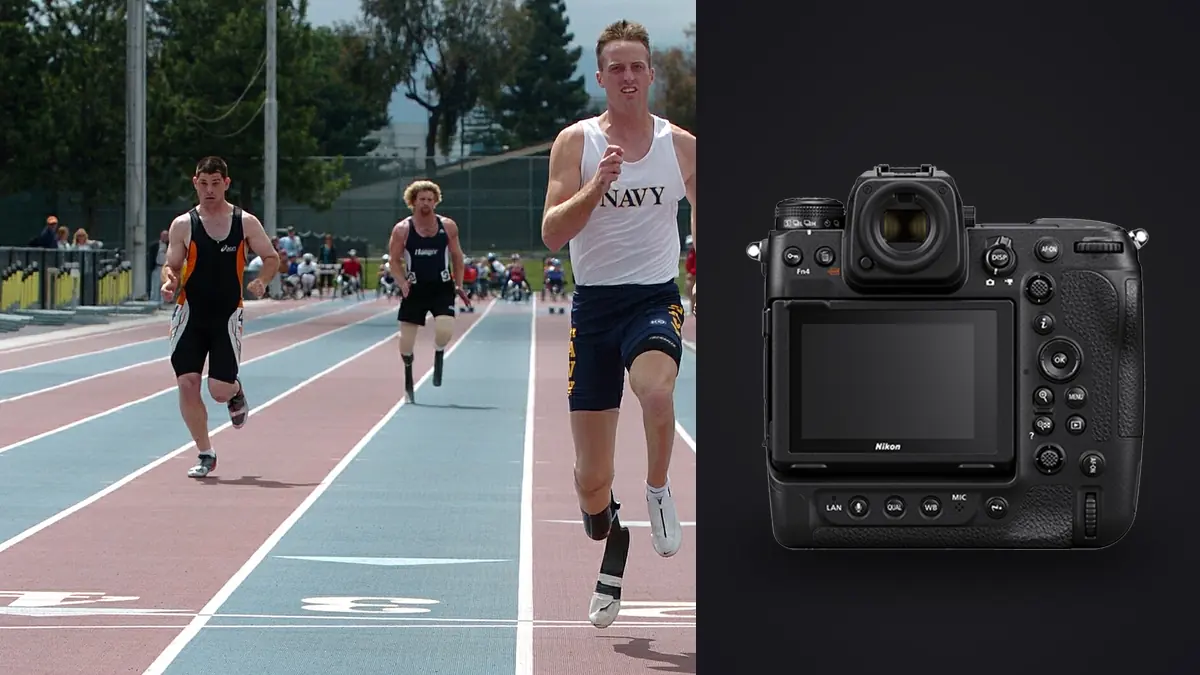
Track meets are brutal on gear and worse on attention. Glare off the rubber at midday, six lanes doing different things at once, a pole vault attempt happening behind you while you're locked onto the finish line, and a shutter button you end up mashing for two or three hours straight without a real break. I've run a Nikon Z9 trackside for two outdoor seasons now, plus one genuinely unpleasant indoor meet in a fieldhouse lit like a submarine. This is what actually matters about that body for this specific job, not the spec sheet version.
The sensor readout is the reason this body works here
The Z9 has no mechanical shutter at all. There's nothing to flap, nothing to wear out, and nothing blocking the sensor between frames, which is why the viewfinder never blacks out mid-burst. For track that matters more than the fps number on the box, because you can watch the runner's stride the entire time you're firing instead of getting a strobing slideshow through the EVF. I noticed this most on the 110m hurdles, where losing the viewfinder for even a fraction of a second between frames means you can drift off the hurdler's lead leg without realizing it until you're reviewing files back at the car.
The stacked sensor reads out fast enough (Nikon quotes roughly 1/270s for a full readout) that rolling shutter skew, which used to be the real argument against electronic-only shutters on fast-moving subjects, isn't something I've had to think about at sprint speeds. I have seen very mild skew on a discus in mid-spin at close range with a wide lens, but it's not something a viewer would clock without being told to look for it.
Buffer and frame rate matter too, obviously. Continuous High Extended will do 20fps at full 45.7MP RAW, and there's a JPEG-only mode that goes to 30fps if you're willing to give up raw files for a race you know you'll only ever need a handful of frames from. The pre-release capture function, which buffers up to a second of frames before you fully press the shutter, is genuinely useful at the blocks. Reaction time on a human trigger finger is around 200 milliseconds, which used to mean I'd occasionally miss the exact moment a sprinter left the blocks. With pre-release capture switched on, that's no longer a real risk.
Setting the body up before the gun goes off
I keep three of the four custom banks configured for different parts of a meet, because reaching into the menu between events wastes time you don't have. Bank A is sprints and relays: Continuous High Extended, 3D-tracking, auto ISO capped around 6400. Bank B is field events: single-point or a small dynamic-area group, because a wide subject-tracking box will happily grab the sandpit or the crossbar instead of the athlete. Bank C is distance events, where I drop the frame rate on purpose to keep the buffer from choking during a race that might last four minutes.
On AF, the "People" subject-detection mode is good but not perfect in a crowded field. When a pack of eight sprinters bunches up coming off the blocks, the tracking box has a habit of latching onto whichever bib number has the most contrast rather than the face or torso of the athlete you actually want. I've started the habit of picking my runner and half-pressing to lock 3D-tracking on them before the gun rather than trusting auto-area to sort it out itself. It's a small workflow change but it's saved more usable frames than any menu setting has.
Silent shooting is worth turning on for indoor meets out of basic courtesy (there's no mirror to slap anyway, so it costs nothing), but check your venue's lighting first. Some indoor arenas still run older LED or fluorescent fixtures with a flicker frequency the sensor's fast readout can catch as banding across a burst. The Z9's flicker reduction setting mostly handles it, but I still shoot a test burst before the first event to confirm the banding is actually gone rather than assuming it.
Sprints and relays
1/3200s or faster for the 100m and 200m if you want every muscle fiber frozen, though I'll drop to 1/2000s for the 400m where a touch of motion in the trailing leg doesn't hurt the shot. Continuous High Extended at 20fps for the first ten meters out of the blocks, where the story is happening fast, then I'll often ease off the shutter button for the middle of the race and pick it back up again fifteen meters from the line. Firing 20fps continuously for an entire 400m turns into an absurd number of nearly identical frames to sort through later.
Field events
Long jump and triple jump want the approach tracked with 3D-tracking, then a hard switch to a tight AF point right at takeoff, because that's the frame that actually sells. Pole vault is the hardest event on the infield to shoot well. You need enough shutter speed to freeze the pole's flex at the top of the vault (1/2500s minimum) while also catching the bar clearance itself, and the vaulter's position relative to the bar changes fast enough that a wide tracking box will jump to the standard instead of the athlete. Throws (discus, shot, hammer) are almost the opposite problem: pre-focus on the release point with a single AF point, fire a short burst timed to the release, and don't bother trying to track the whole windup.
Distance races
This is where I actively throttle the camera down. There's no reason to burn buffer at 20fps for three minutes of an 800m when the moments that matter are the start, any lead changes, and the final straight. I'll drop the release rate to around 10fps for these and save the full extended rate for the last 100 meters.
Settings by event
| Event | Shutter speed | AF area mode | Release rate | Rough frames per attempt/race |
|---|---|---|---|---|
| 100m / 200m sprints | 1/3200s or faster | 3D-tracking, locked pre-gun | 20fps (Cont. High Ext.) | 180-220 |
| 400m | 1/2000s | 3D-tracking | 10-20fps, feathered | 250-400 |
| Long / triple jump | 1/2500s | Dynamic-area, small | 15fps from takeoff | 40-60 |
| Pole vault | 1/2500-1/3200s | Small tracking, switched at bar | 20fps | 90-130 |
| Discus / shot / hammer | 1/2000-1/2500s | Single-point, pre-focused | 10fps burst at release | 15-25 |
| 800m and up | 1/1000-1/1600s | 3D-tracking | 10fps, ramped up in final straight | Varies widely by lap coverage |
Glass that actually earns its spot in the bag
For anything on the backstretch or far turn, a 400mm f/2.8 with the built-in teleconverter is the single most useful lens I own for track. It gets you tight enough on a runner at 60 meters without cropping the frame down to nothing in post. A 600mm f/4 covers the far side of a full-size stadium track better still, but it's a lot of glass to be swinging around a crowded infield for three hours, and I only bring it for meets I know will have media positions with real space.
Closer in, the 100-400mm S is what lives on the second body for jumps, vault and the finish line, since those events happen close enough that a fixed 400mm or 600mm can actually be too much lens. The 70-200mm f/2.8 S earns its keep at relay exchanges, where the handoff zone is close to the infield rail and you need to react fast to a changing distance. For a stadium big enough that even 600mm doesn't reach the far turn, the 800mm PF is worth the rental cost, mainly because it's light enough to hand-hold for a whole session in a way the older 800mm f/5.6 never was.
Indoor meets and the light problem
Outdoor day meets are the easy case. Indoor arenas are where the Z9's native ISO range from 64 to 25,600 (expandable to 32-102,400) actually gets used rather than just quoted. A lot of fieldhouses and indoor tracks are still lit for spectators, not photographers, which in practice means I'm shooting 1/1000s at f/2.8 and ISO 6400 just to keep shutter speed high enough for a sprint. Noise at that ISO is manageable, detail holds up fine for web and print at reasonable sizes, but I do notice color shift under mixed sodium and LED fixtures that takes a deliberate white balance pass afterward rather than trusting auto white balance to sort it out shot to shot.
What happens after the meet ends
The part nobody warns you about with a camera this fast is the sheer volume of files a single meet produces. A 100m final at 20fps for eleven seconds is over 200 raw frames from one race. Multiply that across eight heats, four relay legs, six field events running simultaneously, and a three-hour meet, and it's routine to walk away with fifteen to twenty thousand frames on a single card. Most of those are near-duplicates from the same burst, and sorting that manually is a full evening lost before you've even started actual editing.
This is the part of the workflow where I stopped fighting it by hand. I run everything through imagic before I open a single frame in an editor. It does its sharpness and focus scoring locally on the machine, which matters at 400mm and 600mm because a runner's face can drift half a step out of the plane of focus mid-burst and you want that flagged automatically rather than caught by eye on a laptop screen at a folding table trackside. The duplicate and burst clustering groups each race or each jump attempt together instead of leaving you to scroll through two hundred nearly-identical frames one at a time, which for a meet the size I described is the difference between an hour of culling and most of a day.
It also stays fully offline, which is worth more at a track meet than it sounds. Most stadiums and fieldhouses have terrible public wifi, and I'm not interested in uploading a card's worth of RAW files to anyone's cloud between events even if the connection could handle it. Once I've got a season of culled and edited meets behind me, the apply_my_style preset (trained on my own past edits rather than a generic filter) gets new galleries into a consistent look fast, which matters when a coach wants a same-day gallery from a Friday night meet. If you're trying to build a faster culling habit generally, not just for track, it's worth reading through how AI photo culling actually works and the more general tips for a faster photo workflow, since a lot of what applies to weddings and events applies just as directly to a stack of burst sequences off an infield.
Frequently Asked Questions
Do I actually need 20fps RAW for track, or is JPEG fine?
For sprints, yes, use the full RAW burst rate. The window where a stride, a baton exchange or a bar clearance looks right is often three or four frames wide, and JPEG-only high-speed modes drop you to 11MP, which is fine for a web gallery but thin if a parent or a coach wants a print. For distance events I'll often shoot RAW at a reduced fps rather than switch formats, since the buffer math works out better than people expect.
Will the electronic-only shutter cause banding under stadium lights?
It can, but it's not the given it used to be on older mirrorless bodies. The Z9's flicker reduction setting catches most indoor LED and fluorescent flicker, but I still shoot a short test burst before the first event of an indoor meet to confirm, because not every venue's fixtures behave the same way and I'd rather find out before the 60m final than after.
Is this camera overkill for a local high school meet?
Honestly, for a single weekly meet, probably. Where it earns its price is meet density: if you're shooting multiple meets a week across a season, the buffer depth and AF reliability mean fewer blown races and less time spent culling misses, which adds up fast once you're doing this every weekend rather than occasionally.
How many photos should I expect to walk away with after a full meet?
Realistically somewhere between ten and twenty thousand raw frames for a three-hour meet with a full events schedule, most of it in bursts of a few hundred frames per race or attempt. Plan your culling workflow around that number before the meet, not after, or you'll spend longer sorting files than you did shooting them.