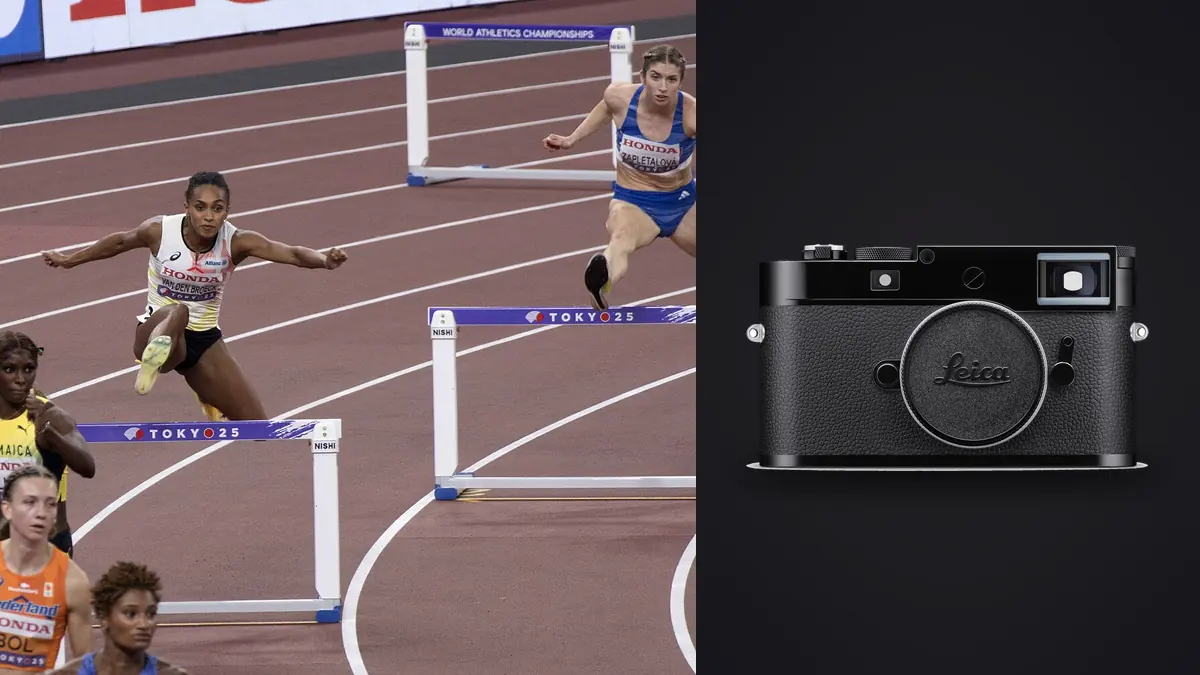
I get asked some version of the same question every time I show up to a meet with a Leica M11 hanging off my shoulder instead of a big mirrorless body with a 400mm bolted to it: why would you bring a manual-focus rangefinder to shoot people running as fast as they can? It's a fair question. The M11 has no autofocus, no subject tracking, no eye-detect, none of the things that make modern sports bodies genuinely effortless at freezing a sprinter at full stride. On paper it is close to the worst camera you could pick for track and field.
And yet I keep bringing it, because a chunk of track and field is more predictable than people assume, and because there's a real payoff in image quality and discretion that a longer telephoto AF rig doesn't give you. This isn't a puff piece for the camera. It's what I've actually learned shooting maybe a dozen meets with it, where it falls apart, where it holds up, and the specific settings and habits that make the difference.
Where the M11 genuinely struggles
Let's not pretend the limitations aren't real. Three things bite you hard at a track meet.
First, there's no autofocus at all. Focus comes from lining up the double image in the rangefinder patch by turning the lens focus ring, which is fine for a still portrait and genuinely difficult for a body moving laterally across your frame at 10 meters per second. You cannot chase a sprinter's face through the viewfinder and expect sharp frames. You have to stop trying to focus on the subject and start focusing on a point in space, which is a completely different skill and the one this whole article is really about.
Second, the frame rate is modest. The M11 does roughly 4.5 frames per second in continuous mode, and at full 60-megapixel DNG the buffer runs dry uncomfortably fast, somewhere around a dozen to fifteen frames in my experience before the camera starts stuttering while it writes to the card. Compare that to a modern sports body doing 20-30fps with a buffer that barely matters, and you can see why nobody shoots pole vault finals with a rangefinder at a national meet.
Third, there's no image stabilization in the body, so with longer glass like a 90mm or 135mm you need faster shutter speeds than you'd otherwise get away with, which eats into your ISO headroom on an overcast day.
Where it actually holds up
Track and field, unlike most other sports, has a lot of fixed geometry. A sprinter in lane 4 runs through a specific, known strip of track. A long jumper's takeoff happens within inches of the same board every single jump. A shot putter's release happens from inside a 2.135-meter circle that does not move between throws. A hurdler clears the same ten barriers in the same lane at roughly the same stride pattern every race. None of that is true in basketball, football, or hockey, where the ball and the players can be anywhere on a large, unpredictable surface. That predictability is what makes a manual-focus rangefinder workable. You're not tracking a moving target through the viewfinder. You're pre-focusing on a point the action is guaranteed to pass through, and you're pressing the shutter when the athlete arrives there. It's the same underlying idea as zone focusing on a street camera, just applied to an athlete instead of a doorway.
Zone focusing a sprint
For the 100m and 200m, I don't try to focus during the race at all. I pick a spot on the track, usually a lane line intersection about 12-15 meters from my shooting position, focus the lens there before the gun goes off, and stop down enough that my depth of field covers a couple of meters either side of that point. With a 90mm at f/5.6 from that distance you get maybe a meter and a half of usable sharpness, which sounds tight but is actually plenty because sprinters are moving in a straight line through your pre-focused zone, not drifting toward or away from you.
Hurdles reward patience more than reflexes
Hurdles are the single best event for this camera. Every hurdler clears the barrier in roughly the same spot relative to the hurdle itself, which gives you a fixed focus target that doesn't move race to race. I focus on the hurdle top rail, wait for the athlete to rise into frame, and fire a short burst right at the peak of the clearance. Because the hurdle itself never moves, this is close to autofocus-easy once you've done it a few times.
Field events are almost easier than sprints
Long jump and triple jump give you the takeoff board as a fixed point. Pole vault gives you the bar. Shot put and discus give you the front edge of the circle. In every case I'm pre-focusing on a static object and waiting for a human to intersect with it, which removes the hardest part of manual-focus sports work entirely.
Lens and settings by event
This is roughly what I actually dial in before each event, based on distance from the fence and how much room I have to stop down without losing shutter speed.
| Event | Typical lens | Aperture / focus approach | Notes |
|---|---|---|---|
| 100m / 200m sprint | 90mm APO-Summicron | f/4-5.6, pre-focus on lane marking 12-15m out | Fire in the last third of the zone, not the moment you see them enter it |
| 110m / 100m hurdles | 75mm or 90mm | f/5.6-8, focus on the hurdle rail | Best event for this camera by a wide margin |
| Long / triple jump | 35mm or 50mm | f/8-11, focus on the front edge of the board | Wider aperture range because you're closer and depth matters more |
| Pole vault | 135mm APO-Telyt | f/5.6, focus on the crossbar | Shoot the ascent, not the clearance itself, misses are common at the bar |
| Shot put / discus | 90mm | f/8, focus on the front of the circle | Release point is consistent throw to throw once an athlete warms up |
| 4x100/4x400 relay exchange | 75mm | f/5.6, focus on the painted exchange box | Two runners converging on a fixed zone, easiest handoff shot in the sport |
Resolution and the buffer problem
The M11's triple resolution DNG (60, 36, or 18 megapixels captured natively, not cropped after the fact) is more useful here than the spec sheet makes it sound. I shoot most meets at 36MP rather than the full 60. It's still more resolution than I need for anything short of a large print, and the smaller files clear the buffer noticeably faster, which matters when you're firing four or five frame bursts across a dozen heats in an afternoon. On a bright day I'll drop to 18MP for field events where I'm bracketing a lot of near-misses at the bar or the board, since those frames rarely need to be cropped tight anyway.
Shutter speed doesn't get much negotiation. 1/2000s minimum for sprints and hurdles, 1/1600s is the lowest I'll go for jumps and throws where the peak moment has less lateral blur. That pushes ISO up fast under cloud cover, but the M11's sensor is clean enough at ISO 3200-6400 that I don't think twice about it anymore.
The part nobody mentions: you will miss a lot of frames
Here's the honest tradeoff. Even with good zone focusing technique, a rangefinder sports session produces a much higher percentage of soft or off-target frames than an autofocus body would. On a good day I'm keeping maybe a third of what I shoot as genuinely sharp. On a bad day, less. That's just the cost of the format, and it means the sorting job after a meet is bigger than it would be with a modern AF camera. This is where I stopped trying to eyeball focus accuracy on a laptop screen at 100% zoom for three hundred frames after every meet. I run the day's card through imagic and let it score sharpness locally before I look at anything. It's not doing anything magical, it's measuring actual focus accuracy pixel by pixel, but when a third of your frames are legitimately soft because you focused the zone half a stride too early, having that separated out automatically before you start editing saves a real chunk of an evening.
The other habit that's paid off is leaning on imagic's burst and duplicate clustering rather than manually paging through near-identical frames. When I fire four or five shots across a hurdle clearance or a vault ascent, those get grouped as one cluster instead of five separate thumbnails competing for attention, so I'm comparing the sharpest of that specific moment rather than re-deciding "is this one sharp" five times per jump. Given how many small bursts a single meet generates across a dozen heats and a handful of field events, that alone probably cuts my culling time by half.
Because none of this is running through a cloud service, I can do the sorting pass on a laptop in the stands between events with no signal, which at most school and club-level meets is the actual wifi situation you're dealing with.
Color across a full meet
One thing that's easy to underestimate: a track meet can run from harsh midday sun through to overcast dusk over four or five hours, and the M11's out-of-camera JPEGs don't give you much of a starting point for grading a consistent gallery across that. I built a preset from a batch of my own previously graded meet photos and now run new imports through imagic's apply_my_style feature, which applies that look based on how I've actually edited similar frames before rather than a generic sports preset. It gets me to a consistent gallery faster, and I'm still doing manual adjustments on the frames that matter, just not starting from zero on every single one.
If you're new to culling workflows generally and want the underlying mechanics rather than just my opinion on it, how AI photo culling actually works is worth a read before you commit to any particular tool. And if the bigger issue in your workflow is time spent per shoot rather than which camera to bring, these workflow tips cover the adjacent ground I haven't gone into here.
Who this actually makes sense for
I wouldn't recommend the M11 to someone shooting a Diamond League final where every frame needs to land and a missed shot costs a client relationship. For that, rent or borrow a proper AF sports body, it's not close. But for club meets, high school invitationals, or anyone building a personal project around track photography where the discretion and image quality of a rangefinder matter more than a guaranteed hit rate, it's a genuinely good match once you've put in the reps on zone focusing. The camera also draws far less attention than a 400mm lens on a monopod, which matters at smaller venues where officials are touchy about big glass near the track.
Frequently Asked Questions
Does the Leica M11 have any autofocus assist for sports at all?
No. The M11 is a fully manual-focus rangefinder body with no autofocus system, no focus peaking overlay in the optical viewfinder, and no subject tracking. Live View on the rear screen does offer focus magnification, but it's too slow to use during actual competition and is realistically only useful for setting up a pre-focus zone before an event starts.
What frame rate should I actually expect shooting track events?
Roughly 4.5fps in continuous mode, with the buffer at full 60MP DNG typically running out somewhere in the low teens of frames before write speed becomes the bottleneck. Dropping to the 36MP or 18MP DNG setting extends usable burst length noticeably, which is why I default to 36MP for most meet coverage.
Is a rangefinder actually an advantage at smaller track meets?
In my experience, yes, mostly for practical reasons rather than image quality ones. It's quieter than a mirrored DSLR shutter, smaller and less intimidating than a long AF telephoto setup, and doesn't draw the same scrutiny from meet officials who are often protective of infield access at school and club-level events.
Which M-mount lens is the best single choice if I can only bring one?
A 90mm APO-Summicron covers sprints, relays, and most field events from typical spectator or infield-adjacent shooting distances without constantly swapping glass. It's not ideal for every event (pole vault benefits from more reach, long jump from less), but as a one-lens answer it's the one I'd default to.