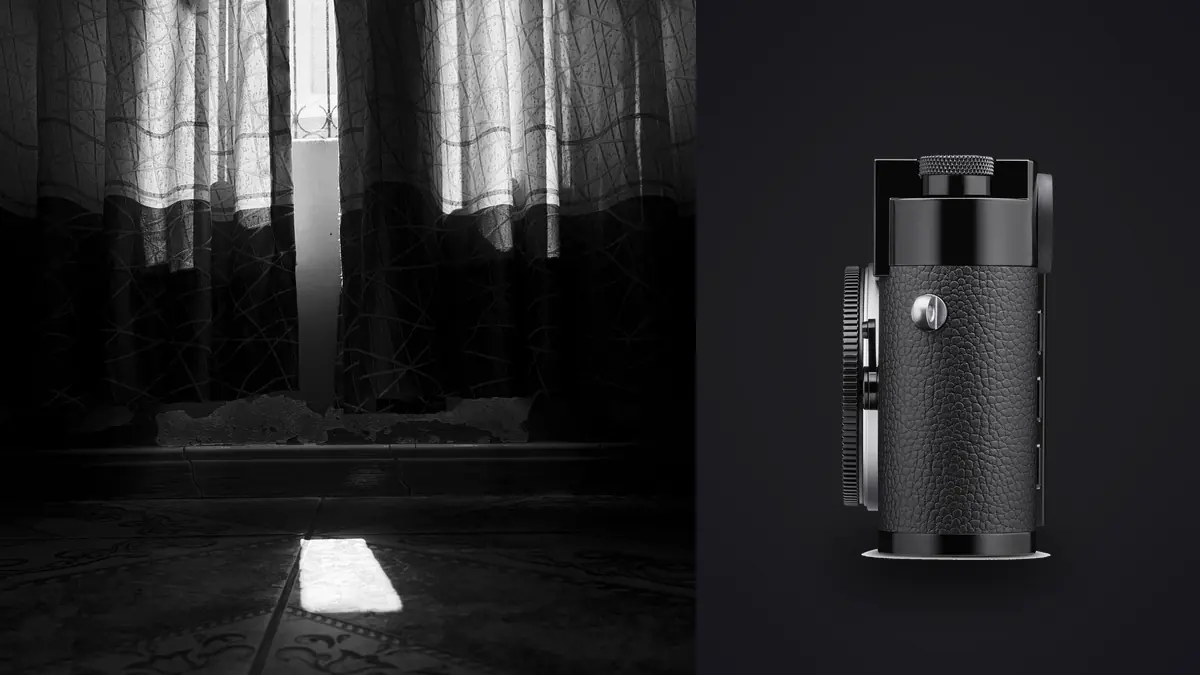
I get asked at least once a month whether a Leica M11 makes sense for boudoir and intimate portrait work, usually by someone who already owns one and wants permission to use it professionally, or by someone eyeing a used M11 as a dedicated second body for this kind of session. The honest answer is that it's a genuinely good tool for this genre, but not for the reasons most gear write-ups lead with. The megapixel count and the brass-and-glass reputation get all the attention. What actually matters in a bedroom or a hotel suite with one client and one lamp is quieter than that: how the camera sounds, how it moves, and how forgiving it is when you have thirty seconds between poses to nail focus by eye.
This guide covers shooting boudoir portraits with an M11, mostly as a second body alongside a mirrorless kit, sometimes as the only camera in the room when the sitter specifically wants that. This isn't a spec sheet. It's what changes about the actual shoot when you swap in a rangefinder, and where it makes the work harder rather than easier.
Manual focus changes the rhythm of the session, not just the technique
The M11 has no autofocus. You're aligning a rangefinder patch by eye, twisting a focus ring, and trusting your own judgment on where the plane of focus actually lands. At f/4 that's forgiving. At f/1.4, which is where a lot of boudoir work happens because you want the background to disappear, the margin for error on eye focus can be a couple of centimeters. Miss it and you've got a beautifully lit frame with soft eyes and a sharp collarbone.
What this does to the session is less obvious than the technical challenge. With an autofocus camera you can chase a subject's small movements, recompose on the fly, fire a burst and sort it out later. With the M11 you slow down. You pick a focus plane, you ask the client to hold roughly still or to move within a plane you've pre-focused on, and you shoot with intent rather than volume. For boudoir specifically, that slower rhythm tends to read as calm rather than clinical. Clients pick up on whether you're rushing them, and a rangefinder physically cannot rush you the way a 20fps burst mode can.
The tradeoff is real, though. If a client shifts her weight, turns her head, or exhales and drops her shoulders between the moment you focused and the moment you pressed the shutter, you've lost the frame. I shoot more frames per pose with the M11 than I do with an autofocus body, specifically to cover that drift. It's not a faster way to work. It's a different way to work that happens to suit a genre where the pace was never supposed to be fast.
The 60-megapixel sensor is a mixed blessing for skin
The sensor resolves an enormous amount of detail, and for boudoir that's a double-edged sword. Every pore, every bit of texture in fabric, every stray hair shows up. Some clients want that kind of honesty in their images. Most don't, and that means more retouching time per image than a lower-resolution body would demand, not less. I've had sessions where I switched the in-camera DNG setting down to the 36-megapixel or even 18-megapixel option specifically because I knew the final delivery was web and print sizes that didn't need 60 megapixels of skin detail, and the smaller files meant less time waiting on exports and less storage eaten per session.
Where the sensor earns its keep is dynamic range at base ISO. Boudoir sessions lean heavily on window light and practical lamps rather than strobes, because strobes in a bedroom tend to flatten the intimacy of the setting. The M11's low-ISO files hold onto shadow detail in a way that lets you expose for the highlights on a client's skin near a window and pull the room back in post without banding. Where it gets less forgiving is the absence of in-body stabilization. In a curtained room at 6pm with only lamp light, you're choosing between a wider aperture (and thinner focus margin), a higher ISO (files stay clean well past 3200, but you're spending dynamic range you don't need to spend), or a slower shutter speed and the very real risk of motion blur from your own hands, since there's nothing in the body correcting for it.
Lens choice matters more here than with almost any other genre
M-mount glass has a mechanical limitation that autofocus shooters rarely think about: rangefinder coupling caps out at 0.7 meters on most lenses, which in a small bedroom or hotel room can be a real constraint. You can't always back up far enough for a 75mm lens to reach its minimum focus distance and still frame a tight portrait. This pushes a lot of boudoir shooters toward 35mm and 50mm glass for anything close, and toward 75mm or 90mm only when the room actually has the depth for it.
| Lens | Max aperture | Min focus distance | How it renders for this genre | Typical used price |
|---|---|---|---|---|
| Summicron-M 35mm f/2 ASPH | f/2 | 0.7 m | Environmental, keeps the room in frame in tight quarters, forgiving focus margin | ~$1,800 |
| Summilux-M 50mm f/1.4 ASPH | f/1.4 | 0.7 m | Classic portrait compression, natural skin rendering, my most-used lens for this work | ~$3,600 |
| APO-Summicron-M 75mm f/2 ASPH | f/2 | 0.85 m | Very clean and contrasty, needs room depth, less forgiving of small spaces | ~$4,200 |
| Noctilux-M 75mm f/1.25 ASPH | f/1.25 | 0.85 m | Dreamy falloff wide open, gorgeous when it lands, brutal focus margin for handheld work | ~$8,000 new |
My honest recommendation to someone building a boudoir kit around the M11 is to start with the 50mm Summilux and only add longer glass once you know the rooms you'll actually be shooting in. The Noctilux is a beautiful lens and it suits maybe one in ten sessions, on days when you have a sitter who can hold very still and a room with enough space to work at 1.5 meters or more. It is not a lens I'd hand to someone still learning to trust a rangefinder patch.
Why the size and the sound actually matter to clients
This is the part that gets underrated in most gear discussions. Boudoir clients are, almost without exception, nervous at the start of a session, and a lot of that nervousness is about the camera itself as much as the vulnerability of the content. A big mirrorless body with a fast 85mm lens and a hood the size of a coffee can looks and sounds like professional equipment doing something to you. The M11 is small, it's quiet (the mechanical shutter is closer to a soft click than a clunk, and you can drop into fully electronic and silent shooting if you want it), and it doesn't hunt or beep. A sitter is likely to find the camera less intimidating than expected, and I think that's largely down to the fact that it doesn't behave like a machine that's actively working. It just sits there until you press the button.
The flip side is handling speed. Menu navigation on the M11 is not fast, and if a client does something spontaneous and beautiful for two seconds, you need to already be in the right exposure and focus zone, because there's no time to chase settings. I zone-focus more aggressively on this camera than I would on an autofocus body, picking an aperture like f/2.8 or f/4 for movement-heavy segments of a session and reserving f/1.4 for posed, held moments where I have time to confirm focus through the rangefinder patch or, for critical work, the optional Visoflex electronic viewfinder clipped onto the hot shoe.
What happens after the shoot is the part nobody warns you about
A boudoir or intimate portrait session produces files that need to be handled differently from a standard portrait job, and this is where the M11's habits create real downstream work. Because I'm shooting more frames per pose to cover for manual-focus drift, and because those 60-megapixel DNGs are large, a typical two-hour session can leave me with several hundred files where a handful per pose are actually sharp on the eyes and the rest are close-but-not-quite. At full resolution, focus misses on this camera are genuinely hard to spot on a laptop screen at import size. You think you nailed it, and then you zoom to 100% during editing and the eyelashes are half a step soft.
This is the one part of my workflow I don't do by eye anymore. I run the session through imagic before I start any real editing, specifically for its local sharpness and focus scoring, because it catches the frames where rangefinder focus drifted just enough to matter, the ones that look fine at a glance and fail up close. It also clusters the near-duplicate frames from each pose into groups, which matters a lot on a shoot where I'm bracketing focus across five or six frames per setup rather than relying on a burst mode to sort itself out. Because everything runs locally with no cloud upload, it also suits this genre specifically, since sensitive images shouldn't be leaving your drive to get culled. If you're new to the idea of software doing the first sharpness pass instead of your own eyes, how AI photo culling actually works covers the mechanics in more depth than I will here.
The other thing that's changed my editing pace is building a consistent look once and applying it across a whole set rather than grading each session from a blank slate. I trained imagic's apply_my_style feature on a batch of my own finished boudoir edits (warm shadows, slightly lifted blacks, skin tones pulled a touch toward gold rather than the M11's default rendering, which leans a little cool and neutral out of camera), and it's saved me a genuine amount of time on the color pass for every session since. It's not a replacement for finishing an image by hand, but it gets the starting point close enough that I'm nudging sliders instead of building a look from zero on every single file.
A few practical notes from actual sessions
- In rooms under roughly 3 meters deep, plan around the 35mm and 50mm. A 75mm will fight you on minimum focus distance more often than you'd expect.
- Pre-focus on a fixed point (a headboard corner, a doorframe) and let the client move into that plane rather than trying to track focus onto a moving subject. It's a completely different mental model from autofocus tracking and it takes a few sessions to stop fighting it.
- Window light through sheer curtains is the most forgiving light source I've found for this genre with a rangefinder, since the falloff is soft enough that small focus misses read less harshly than they would under a hard key light.
- Bring a second body if the session includes movement-heavy segments (getting dressed, walking, hair being brushed). Zone focusing on the M11 handles this fine, but it's a different skill from posed work and mixing the two mid-session slows you down.
- Budget more culling time than you would for a mirrorless shoot, not less. This is where a lot of new M11 users underestimate the workflow cost of manual focus, and it's worth reading through tips for a faster photo workflow if the post-shoot backlog is the part that's wearing you down rather than the shooting itself.
Frequently Asked Questions
Is manual focus too slow for a boudoir session where poses change quickly?
For posed work, no. You'll actually find yourself shooting fewer throwaway frames because you're focusing with intent rather than relying on a camera to guess. For movement-heavy segments (a client walking, adjusting hair, changing position quickly), zone focusing at a smaller aperture like f/2.8 or f/4 covers most of the drift. Where it genuinely struggles is fast, unpredictable motion at wide apertures, which is a real limitation and not something a lens upgrade fixes.
Do I need the Visoflex viewfinder, or is the rangefinder patch enough?
The rangefinder patch is enough for most of a session, and it's faster once you're used to it. I clip the Visoflex on specifically for wide-aperture work where I want magnified confirmation on the eyes before I commit to a frame, and for reviewing exposure histograms in mixed light. I don't leave it mounted all session because it adds bulk and slightly undercuts the small, quiet profile that makes the M11 comfortable for sitters in the first place.
How much does the 0.7-meter minimum focus distance actually limit close-up boudoir portraits?
More than most people expect going in. A lot of intimate portrait framing wants a tight crop from close range, and rangefinder coupling simply won't focus closer than 0.7 meters on most M-mount lenses (0.85 meters on several longer ones). You end up either shooting a bit wider than you'd planned and cropping in post, which costs you resolution, or switching to a macro-capable lens and using the Visoflex to focus past the rangefinder's limit. It's worth testing your specific lens and typical room sizes before booking a shoot that depends on very tight framing.
What's the right way to handle these files for client privacy after the shoot?
Treat it like any sensitive client data: keep the working files off shared drives, avoid cloud photo services with automatic sync, and cull and edit locally rather than through a browser-based tool that uploads originals to a server. That's a large part of why I moved my first-pass culling to something that runs entirely offline. It removes one more point where a client's images could end up somewhere they didn't agree to.