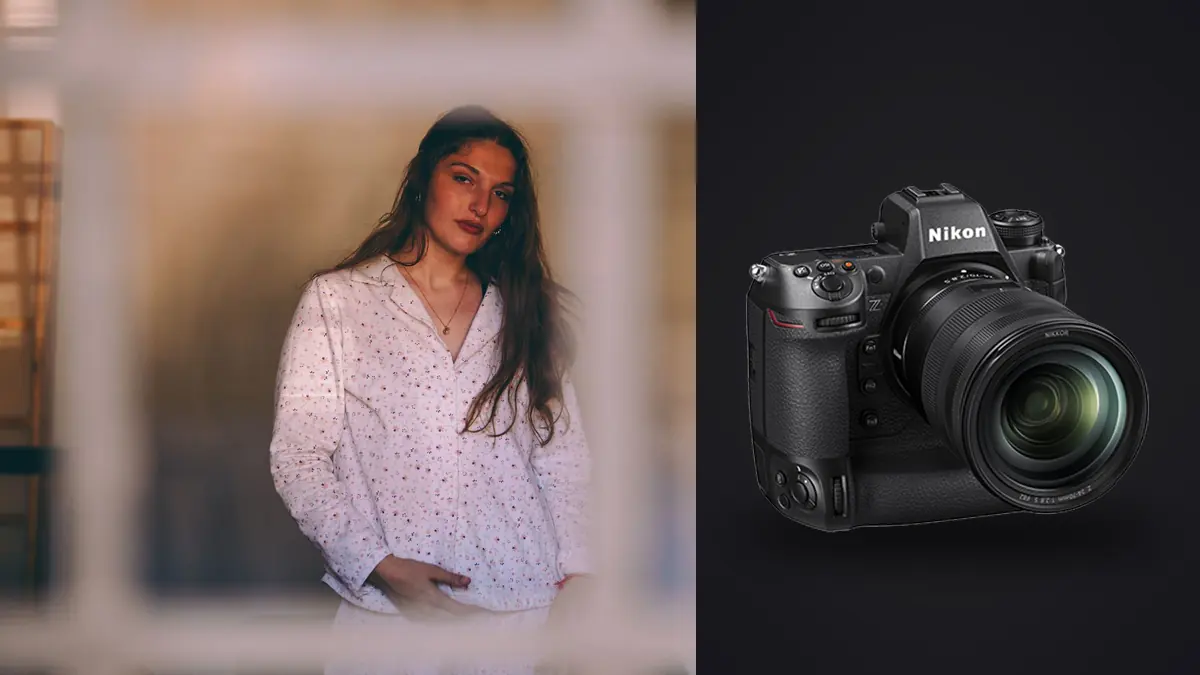
Boudoir work is a different animal from a studio portrait session or a wedding day, and gear that gets recommended for one doesn't automatically make sense for the other. I get asked a lot, usually by photographers thinking about adding boudoir or intimate portraiture to their offerings, whether the Nikon Z9 is worth the money and the bulk for this specific kind of shoot. Short answer: yes, but for reasons that have almost nothing to do with the spec sheet Nikon puts on the box. The things that matter in a hotel suite or a client's bedroom with the curtains half drawn are not the same things that matter on a sports sideline, even though the camera is identical.
The shutter sound problem nobody puts in a review
Every camera review of the Z9 mentions the fully electronic shutter and the blackout-free viewfinder as sports and wildlife features, frame rate this, buffer depth that. Nobody talks about what it does to the mood in a room where your subject is in various states of undress and already nervous about being photographed. A traditional mechanical shutter has a clack to it. It's not loud, but in a quiet bedroom with two people in it, every frame announces itself. Clients notice. Some flinch. Some just stiffen up a little, and stiff is the opposite of what you're chasing in this genre.
With the shutter set to fully silent, you can shoot a continuous sequence through a laugh, a shifting pose, a breath, and the only sound in the room is your own voice talking the client through it. That changes the energy of a session more than any lighting setup does. Clients can forget they are being photographed for stretches at a time, and the silence is likely half of why. The blackout-free EVF matters here too, in a way it doesn't for a portrait shooter working at three frames a second: you can hold eye contact with the client between and during frames instead of your face disappearing behind the camera every time the mirror or shutter cycles. For a genre built on trust and rapport, that's not a gimmick.
Autofocus when the room only has one window
Most boudoir work does not happen in a controlled studio with three modifiers dialed in. It happens in a hotel suite with heavy drapes and one lamp, or a client's own bedroom with whatever ambient light is coming through a single window, sometimes supplemented with a small continuous LED panel bounced off the ceiling. That's a genuinely hard autofocus environment, and it's where a lot of otherwise capable cameras start hunting. The Z9's low-light AF rating (down to around -8.5 EV with the right lens and wide-area AF selected) holds up in these conditions in a way I did not expect the first time I tested it. Eye-detect tracking through a shifting pose, shot wide open on an 85mm at f/1.2, in a room lit mostly by one bedside lamp, is the kind of thing that used to require a flash and a modeling light just to get the AF system to commit. I still miss frames, nobody's autofocus is magic in near-dark conditions, but the miss rate dropped enough that I stopped bringing a second light purely as an AF crutch. I keep it for shaping shadows now, which is a better use of a light anyway.
One habit worth mentioning: I shoot back-button focus with 3D tracking locked to a small AF area rather than the widest subject-detection zone, because in a small room with fabric, pillows, and skin all close to camera, wide-area tracking occasionally locks onto the nearest high-contrast edge instead of the eye you actually want. Narrowing the area costs a little speed but buys accuracy, and accuracy is what you're actually being paid for.
The weight argument, and why I stopped making it
For a long time I told other photographers not to bother with the Z9 for boudoir specifically because of the size and weight. It's a big, integrated-grip body, over 1,300 grams before a lens goes on, and that used to feel like a bad fit for a genre where you're often handheld for two or three hours in a cramped room, crouching, kneeling, shooting from a chair to get a low angle. I now think I had that backwards. The integrated vertical grip is actually a benefit for handheld work at odd angles, because there's more mass to steady the camera and a grip shape that stays comfortable no matter which way you're holding it. The bigger factor is the battery. A boudoir session doesn't pause cleanly for a battery swap the way a wedding reception does. You're mid-pose, mid-conversation, sometimes mid-wardrobe-change, and stopping to dig a spare battery out of a bag breaks the flow you just spent twenty minutes building. The Z9's battery life means I go through an entire two-hour session, sometimes two sessions back to back, without touching the door on the grip. That's worth more to me now than the weight costs me.
| Body | Shutter type | Body weight | Typical CIPA battery life | Realistic use case here |
|---|---|---|---|---|
| Nikon Z9 | Fully electronic, no mechanical option | ~1,340g body only | ~700+ shots in real mixed-light sessions | Full-time boudoir/intimate work, back-to-back bookings |
| Nikon Z8 | Fully electronic, no mechanical option | ~910g body only | ~340-400 shots, needs spares | Same image quality, lighter travel kit, budget spares |
| Nikon Z6III | Mechanical + electronic option | ~760g body only | ~380 shots | Starting out, lower upfront cost, still capable low-light AF |
What that table doesn't show
Numbers like these come from real sessions, not a lab, so treat them as a working range rather than a guarantee. Mixed ambient and LED light, continuous eye-AF tracking, and a warm room all pull battery life down from the official CIPA figures, sometimes by a lot. The Z8 gets you the same sensor and largely the same AF system in a noticeably smaller body, and for a lot of photographers starting out in this niche it's the more sensible buy. I still reach for the Z9 because I don't want to think about batteries or buffer depth mid-session, but that's a workflow preference, not a quality gap between the two.
Lenses that actually earn their keep
An 85mm f/1.2 S is the lens I use for the bulk of a boudoir set. The compression flatters at typical shooting distances, and wide open it separates the subject from a busy hotel-room background without needing to clean the whole room first. In smaller spaces, especially budget hotel rooms where you can't back up more than eight feet from the bed, I switch to a 50mm f/1.2 S. It's less flattering at close range if you're not careful with angle, but it's the only option when the room won't give you the distance an 85mm wants. For detail shots (jewelry, lace texture, hands) I keep a 105mm macro in the bag, though it comes out for maybe ten percent of a session. What I've stopped carrying is anything longer than 85mm. In a genre defined by proximity and intimacy, a telephoto just puts too much physical and emotional distance between you and the client.
Getting through the card without losing the evening
Shoot at 20 frames per second through a posing sequence and you end up with a lot of near-identical frames: same pose, three or four variations in expression or hand position, one or two where the eyes are actually sharp and open. Boudoir generates this problem worse than most genres because so much of the direction is continuous movement rather than held poses, which means bursts instead of single frames. I stopped trying to cull these manually after a session that took me almost four hours to get through on a laptop at midnight. These days I run the card through imagic first, which groups the burst sequences and near-duplicates together and ranks them by actual focus sharpness rather than making me eyeball a grid of thumbnails at 2am. It's local, nothing leaves my machine, which matters more for this genre than almost any other kind of photography I shoot given how sensitive the content is. If you haven't looked into how that kind of automated culling actually works under the hood, it's worth a read: how AI photo culling works covers the mechanics better than I can here. What it's done for me practically is cut a four-hour cull down to under forty minutes, which is the difference between editing a shoot the same night while the look is still fresh in my head and putting it off for three days.
Consistency in the edit, not just the shoot
Clients booking boudoir sessions are usually shopping by look before anything else. They've seen a gallery online and they want their images to feel like that gallery, warm skin tones, soft contrast, a specific kind of grain and grade. Getting that consistent across a hundred delivered images from a two-hour session used to mean either batch-applying a preset and hand-fixing the outliers, or redoing the grade from scratch every time and hoping I remembered what I did last time. What's actually solved that for me is training a preset on my own past edits rather than downloading someone else's LUT pack. imagic's apply_my_style feature builds the preset from a set of images I've already graded the way I want, so new shoots come in already close to my finished look instead of flat and generic. It's not a replacement for actually looking at every image, skin tones shift with the room's ambient light and you still have to catch that, but it cuts the starting-from-zero work out of every edit session. If color grading itself is where you're stuck rather than consistency, this guide on color grading is a reasonable place to start.
Where the Z9 doesn't actually help
I'd rather be straight about the downsides than pretend this body is perfect for the job, because it isn't. 45.7 megapixels is more resolution than boudoir delivery needs. Final images get delivered as web galleries or small prints almost always, and the file sizes add up fast across a two-hour, six-hundred-frame session, which means more storage, slower backups, and a heavier cull. There's no built-in ND filter, so if you're shooting near a bright window wide open you'll want variable ND glass in the bag. Flash sync speed doesn't move for the electronic shutter, so if your lighting approach leans on off-camera flash more than mine does, that's a real consideration. And for some clients, walking into the room and seeing a camera that size can be genuinely intimidating before a word is even spoken, which is the opposite of the reassurance you're trying to project in the first five minutes of a session. A smaller body sometimes reads as friendlier, even if the images coming out of it would be identical.
Frequently Asked Questions
Do I actually need the Z9, or would a Z8 do the same job for boudoir work?
For most photographers starting out, the Z8. It shares the sensor and most of the autofocus system, costs meaningfully less, and the smaller body is easier to manage in tight hotel rooms. The Z9 earns its keep mainly through battery life and buffer depth on high-volume days, which matters more once you're booking sessions back to back than it does for your first year in the genre.
Is the electronic-only shutter really silent, or just quieter than a normal shutter?
It's genuinely silent from the client's side of the room. There's no mechanical movement to hear. The only audio cue is whatever the camera's beep or AF confirmation sounds are set to, and I turn those off entirely for this kind of session. Rolling shutter distortion on fast movement is the tradeoff, but at the movement speeds typical in posed boudoir work I haven't found it to be an issue.
What ISO range is realistic for available-light sessions with this body?
I stay comfortable up to ISO 6400 in most rooms, and will push to 12800 for a handful of frames if the alternative is missing the shot entirely. Above that the shadow noise starts fighting with the soft, low-contrast look most boudoir clients want, so I'd rather bring in a small continuous light than lean on ISO past that point.
How should I handle culling and storage given how sensitive this content is?
Keep everything off the cloud until you're ready to deliver a final, client-approved gallery through a private, permissioned link. I run culling locally through imagic specifically because the sharpness scoring and burst grouping happen on my own machine with nothing uploaded anywhere in the process. For a genre where a leak isn't just embarrassing but potentially damaging to a client's life, that's not a nice-to-have, it's close to a non-negotiable part of how I choose software.