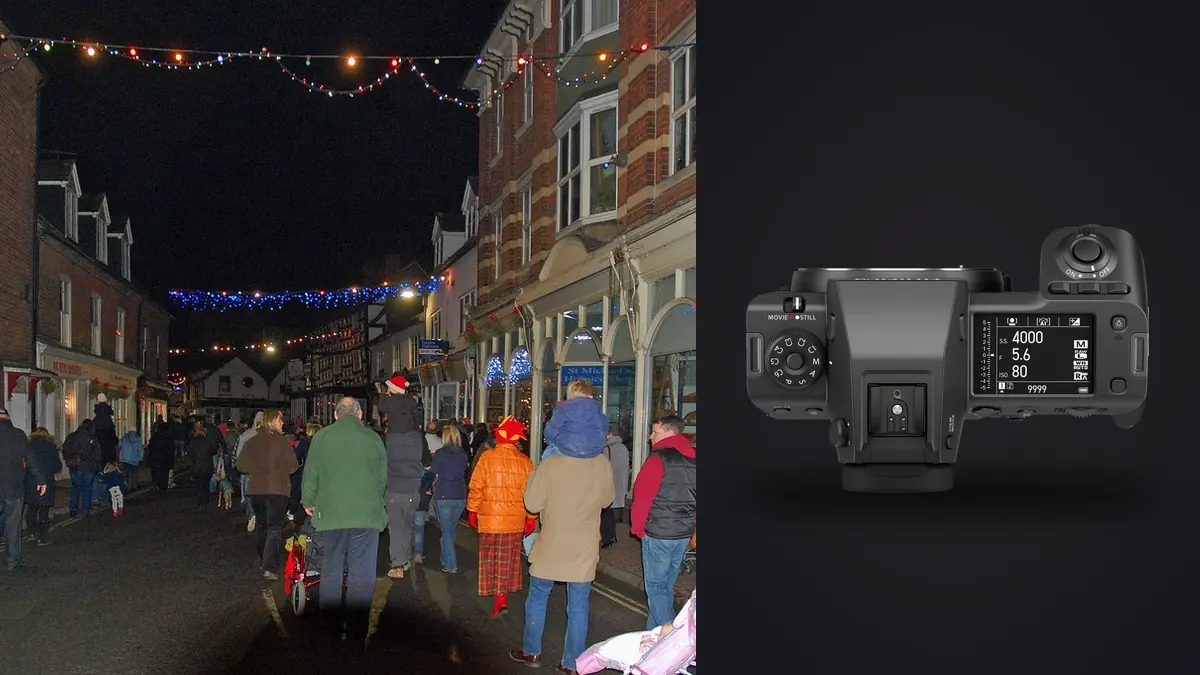
Two years ago I spent a rainy week in Porto shooting a small documentary project on a family-run tannery, and for reasons that made sense at the time I brought a Fujifilm GFX 100 II as my only body. Every other photographer working the same story carried something smaller: a Leica, an X100, one guy with a battered X-T4 wrapped in gaffer tape. I got a lot of raised eyebrows in doorways, and one shop owner flatly refused to be photographed by "the big camera." That week taught me more about what the GFX 100 II is actually good for in street and documentary work than any spec sheet ever could, and it is not quite the camera the marketing photos suggest.
The size and weight tax you pay before you take a single frame
Start with the honest problem. The GFX 100 II body alone weighs about 1,030 grams with battery and card loaded, and once you mount something like the GF 35-70mm f/4.5-5.6 you are carrying close to 1.5kg around your neck for eight or ten hours. Compare that to a Fujifilm X100VI at 478 grams or a Leica Q3 at 743 grams, and the difference stops being abstract by lunchtime on day two. My right shoulder still remembers that week in Porto.
For pure reflexive street photography, the kind where you are reacting to a gesture on a corner in under a second, the GFX 100 II asks you to slow down whether you want to or not. Raising it to your eye takes a beat longer than a rangefinder-style body, the shutter button travel is longer, and the electronic viewfinder blackout during a burst is more noticeable than on a smaller mirrorless camera. None of that is a flaw exactly. It is a mismatch between what the camera wants you to do, which is compose deliberately, and what classic street photography often demands, which is react instantly. Documentary work that unfolds over minutes rather than seconds is a much more natural fit.
Autofocus and rolling shutter once a crowd starts moving
Fujifilm meaningfully improved autofocus with the 100 II, adding phase-detection points across nearly the whole sensor and a dedicated AI processing unit for subject recognition. It is good for a portrait, for a hand gesture, for someone lighting a cigarette in a doorway where you have a second or two to let focus settle. It is not especially good for a kid on a bicycle weaving through a night market.
Switch to the electronic shutter to get the faster burst rate and the pre-shot buffering mode, and you will see rolling shutter skew on anything crossing the frame quickly, because a sensor this physically large simply cannot read out as fast as a stacked full-frame chip built for exactly that job. The mechanical shutter tops out in the 1/4000s range and burst speed sits well behind what a Sony or Canon body twice as cheap can manage. If your documentary work leans toward protest marches, transit stations, or sports-adjacent street chaos, plan your shutter mode before you need it, not while you are missing frames.
The file size problem nobody mentions until you are the one carrying it
Here is the part that changed my workflow more than the autofocus did. A single uncompressed 102-megapixel RAW file off the GFX 100 II runs somewhere around 200MB, and even switching to lossless-compressed RAW only brings that down to roughly 100 to 130MB per frame depending on scene detail. Shoot a five-day documentary assignment at a modest clip of three or four hundred frames a day and you are closing in on a terabyte before you have opened a single image on a screen.
Turn on the pre-shot burst mode, which buffers frames before you fully press the shutter so you don't miss the exact instant someone looks up, and you can double or triple that number fast, because now you have five or six nearly identical frames for every real moment worth keeping. Culling that by eye on a laptop in a hotel room after a twelve-hour shoot day is genuinely miserable, and it's a different problem than what most street photography gear reviews prepare you for.
This is where I actually lean on imagic now. It runs entirely on my own machine rather than routing anything through a cloud service, which matters when the files are documentary footage of real people who didn't sign a model release for a tech company's servers. Its local sharpness scoring catches soft frames at 102 megapixels that look acceptable on a laptop screen at fit-to-window but fall apart the moment you check focus at 100%, which happens more than I'd like to admit with a sensor this demanding of technique. The duplicate and burst clustering also handles the tedious part of grouping those five-frame pre-shot sequences, so I'm picking one keeper from a labeled group instead of scrolling past four near-identical frames for every one that matters. If you want the mechanics of how that kind of local scoring actually works under the hood, we've written about it separately at how AI photo culling works.
How it stacks up against the cameras people actually carry on the street
| Camera | Body weight | Sensor / resolution | Fastest burst | Quietest shutter | Typical RAW size | Body price (approx.) |
|---|---|---|---|---|---|---|
| Fujifilm GFX 100 II | ~1,030g | 55mm medium format, 102MP | ~8fps (e-shutter, pre-shot) | Leaf-shutter GF lenses, near silent | 110-200MB | $7,499 |
| Leica Q3 | 743g | Full-frame, 60MP | ~15fps (e-shutter) | Fully silent electronic | ~80MB | $5,995 |
| Fujifilm X100VI | 478g | APS-C, 40.2MP | ~20fps (cropped e-shutter) | Leaf shutter, near silent to 1/4000s | 40-80MB | $1,599 |
| Sony A7CR | 515g | Full-frame, 61MP | ~8fps | Silent electronic (rolling-shutter tradeoffs) | 65-120MB | ~$2,999 |
Laid out like that, the GFX 100 II is the outlier on every axis except raw resolution and dynamic range, and it costs roughly the price of the other three combined. That's not a knock on the camera, it's just an honest picture of what you're trading. Nobody buys a medium format body for burst speed or discretion. You buy it for what the files do when they're printed two meters wide or cropped hard in post and still hold detail.
Lenses that actually make sense at documentary pace
The GF lens lineup has a real bias toward slower apertures and moderate zooms, which suits documentary work better than it suits classic street shooting. The GF 35-70mm f/4.5-5.6 (roughly 28-55mm full-frame equivalent, given the 0.79x crop factor on GFX glass) is the one I reach for most, mostly because it's genuinely compact for what it is and cheap enough that losing it to weather or a crowded market doesn't feel catastrophic. The GF 50mm f/3.5 pancake, at about 335g, is the closest thing to a discreet prime in the system, landing around a 40mm equivalent field of view, and it's the lens I mount when I actually want to blend in rather than announce myself.
For wider environmental frames, the GF 20-35mm f/4 is excellent optically but adds another 725g to the kit, which starts to matter on a body that's already heavy. I've largely stopped bringing it on documentary trips unless the story specifically calls for wide interiors. The leaf-shutter primes, like the GF 30mm f/5.6 T/S or the GF 110mm f/2, sync flash at any shutter speed and run nearly silent, which is genuinely useful for portrait-adjacent documentary moments where you want a controlled frame rather than a grabbed one, but they're a different tool for a different pace of shooting than street work usually demands.
What the dynamic range and ISO range actually buy you
Base ISO on the GFX 100 II sits at 80, extendable down to 40, and the extra stop or so of dynamic range over full-frame shows up exactly where street and documentary photographers need it: blown storefront signage next to a shadowed doorway in the same frame. I've recovered highlight detail from neon signs at night that would have been a flat white blob on smaller sensors, and shadow detail pulled up from underexposed alley shots holds together with far less noise than I expected.
Where it doesn't win is at the top end. Native ISO tops out at 12800, and while it's usable, a full-frame low-light specialist like a Sony A7S-series body will out-resolve clean detail at 6400 and above. For handheld night work the 5-axis in-body stabilization rated to roughly 8 stops does a lot of the heavy lifting, letting you drop shutter speed instead of pushing ISO, which is the right tradeoff for static or slow-moving documentary subjects and the wrong one for anything moving quickly through a dark frame.
Matching the files to a look without redoing the work every time
Fujifilm's film simulations are genuinely good starting points, and Classic Chrome or Nostalgic Neg get thrown around a lot in GFX marketing for exactly that reason. But a documentary project usually needs a consistent, personal grade across hundreds of frames shot over days or weeks, not just a filter applied uniformly. What's worked for me is building out a look on a handful of representative frames early in a project, then using imagic's apply_my_style feature, which trains on your own past edits rather than a generic preset, to carry that same grading logic across the rest of the take without re-deciding it frame by frame. It's not a replacement for deliberate editing on your hero images, but it saves real hours on the supporting frames that still need to look like they belong to the same story. If color and grading decisions are the part of your workflow you want to tighten up generally, our guide to photo color grading covers the fundamentals in more depth than I can here.
Who this camera actually suits
Slower, essay-style documentary work suits it well: long-term community projects, portraiture woven into a bigger story, anything destined for a gallery wall or a printed book where the extra resolution and tonal range genuinely show up in the final object. Photographers who work alone, on their own schedule, without needing to react to a fast-breaking scene, get along with this camera fine once they adjust their pace to match it.
Fast reportage, breaking news, anything with unpredictable motion or a need for total discretion in a tense situation is a worse fit. I'd point those photographers toward something smaller and faster, an X100VI or a Q3, and save the GFX for the days when the story allows you to slow down and the light is good enough to make 102 megapixels worth the weight.
Frequently Asked Questions
Is the GFX 100 II fast enough for spontaneous street photography?
It can keep up with slower, more deliberate moments, but for reflexive shooting where you're reacting to something in under a second, the longer shutter lag, viewfinder blackout, and rolling shutter on fast e-shutter bursts will cost you frames that a smaller APS-C or full-frame body would have caught cleanly.
Will people on the street actually notice and react to such a large camera?
Yes, more often than with a compact rangefinder-style body. In my experience the size reads as "professional" or "official" to strangers, which sometimes opens doors for a documentary conversation and sometimes closes them, depending entirely on the community and context. It's rarely neutral the way a small mirrorless camera can be.
How much storage do I really need for a multi-day documentary shoot?
Budget conservatively for 150-200MB per compressed RAW frame and multiply by your realistic daily frame count, including pre-shot burst sequences. A five-day assignment shooting a few hundred frames a day routinely lands between 500GB and 1TB before any editing begins, which is worth planning for in card capacity and backup drives before you leave, not after.
Does the extra resolution actually matter if the work ends up online rather than printed?
Honestly, less than the marketing implies. Most web and social platforms compress images down well below what 102 megapixels can deliver, so the resolution advantage mostly pays off in print, large-format display, or heavy cropping in post. If your documentary work is destined mainly for a screen, a lot of that resolution goes unused.
The verdict from a rainy week in Porto
I kept the GFX 100 II for that tannery project in the end, not because it was the easiest camera in the room, but because two frames from that week, printed at nearly a meter wide for the final exhibition, held detail in cracked leather and steam that nothing else in my bag would have captured the same way. I wouldn't grab it for a fast afternoon of street shooting downtown. I would grab it again for a slow story that deserves to be printed big, and I'd bring a lighter body as backup for the moments the GFX inevitably misses.