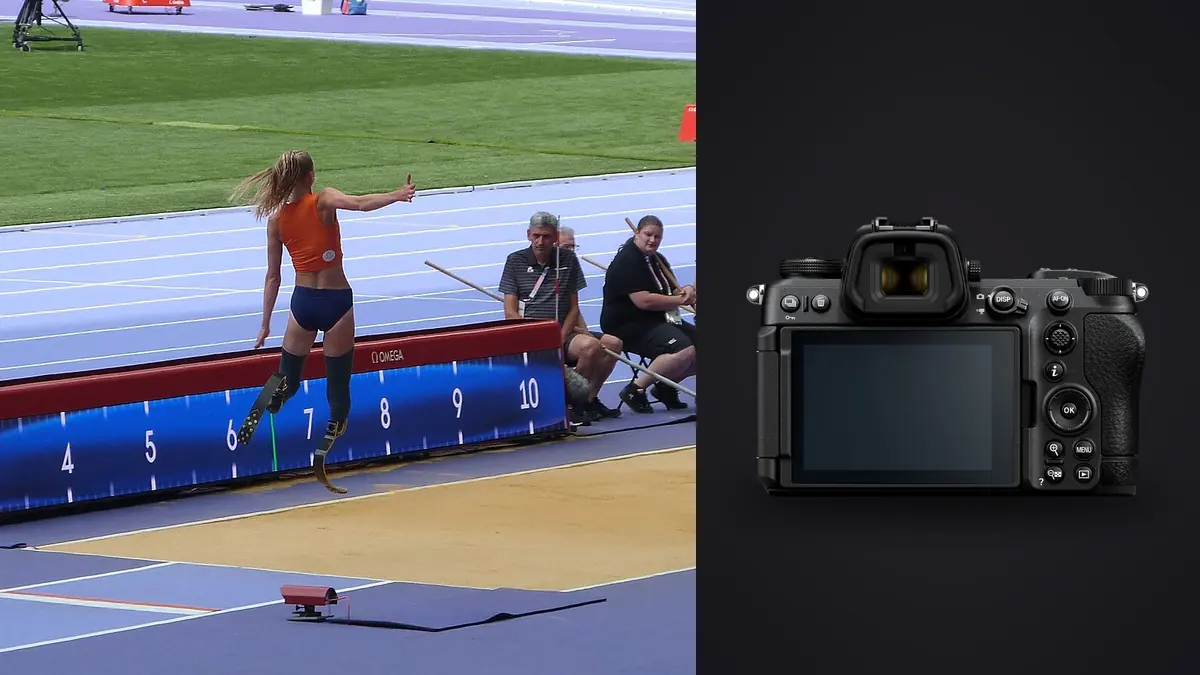
I spent most of last spring standing on the infield rail at a mid-tier regional invitational, elbow to elbow with the local paper's stringer, both of us waiting on the same 100m final. He had a big-body DSLR and a monopod he kept resetting between heats. I had a Nikon Z6 III on a strap, no monopod, and by the third meet of the season I had mostly stopped thinking about the camera at all, which is the best thing I can say about a piece of gear that costs this much. Track and field is a genuinely hard shoot to plan for. You've got eight or nine event groups running in parallel across a stadium, a starter's gun that gives you almost no warning, and light that changes every twenty minutes as the sun drops behind the stands. This is what actually happened when I used the Z6 III for a full outdoor season, from the first sprint prelims in April to a rained-out conference meet in June.
The sensor is the actual news here, not the megapixel count
Nikon calls the Z6 III's sensor "partially stacked," which sounds like marketing until you're panning a 200m runner through the far turn with the electronic shutter engaged. On the Z6 II, that shot came home with visible skew on the legs and the track lane lines bending slightly, the classic rolling shutter signature of a slow sensor readout. On the Z6 III, that same pan at 20fps comes back clean enough that I stopped defaulting to the mechanical shutter for sprint work. It's not on the level of a stacked Z9 sensor, and Nikon doesn't pretend it is, but it closed the gap enough that I trust the electronic shutter for anything moving in a straight line at speed.
The blackout-free viewfinder matters more than I expected going in. Track photography is a lot of tracking a moving target through a viewfinder while your brain predicts where the frame edge should be, and losing the image for even a few milliseconds between shots breaks that prediction. With the Z6 III's 5.76-million-dot EVF running at up to 120fps, panning a relay exchange feels closer to watching it live than shooting it, and I noticed I was clipping heads out of the frame far less often once I stopped fighting blackout.
Autofocus setup changes event to event, not once per meet
I used to run one AF configuration for an entire meet on older bodies and just accept the misses. That's a mistake with this camera because the subject detection is genuinely good enough to lean on, but only if you point it at the right mode for what's actually happening in front of you.
Sprints and hurdles
3D-tracking with human detection turned on is the mode I leave running for anything on the track itself. Lock onto the bib number or the torso as the runner comes out of the blocks, and the camera holds on through the arm swing and the lane changes on the curve far better than I expected from a body in this price range. Nikon's people detection reads more than the face here, it's tracking head, torso, and skeletal position, which is exactly what you need when a sprinter's face is turned away from you for half the frame.
Jumps and vault
Long jump and triple jump I switch to wide-area AF (small) and place it manually on the takeoff board rather than trusting tracking to follow a runway approach, because tracking tends to want to grab the officials standing at the pit. Pole vault is its own problem entirely: the pole itself confuses subject detection at the plant, so I pre-focus on the box and let the vaulter run into that zone rather than trying to track them down the runway.
Throws
Shot put and discus happen fast and close to the photographer if you're positioned in the sector, so single-point AF with a fast shutter beats any tracking mode. There's no runway to predict, just a spin and a release, and I'd rather nail focus on the athlete's hand at release than have the camera hunting between the thrower and the cage.
| Event | AF mode I use | Shutter speed | Drive setting | Lens I reach for |
|---|---|---|---|---|
| 100m / 200m | 3D-tracking, human detection | 1/2500s or faster | 20fps electronic | 70-200mm f/2.8 S |
| 400m / 800m | 3D-tracking, human detection | 1/1600s to 1/2000s | Continuous high, extended | 100-400mm S |
| Long jump / triple jump | Wide-area AF (S), manual placement | 1/2000s | 20fps electronic | 100-400mm S |
| Pole vault | Single-point, pre-focused on the box | 1/2500s | 14fps mechanical | 70-200mm f/2.8 S |
| Shot put / discus | Single-point AF | 1/2000s | 10fps mechanical | 24-70mm f/2.8 S or 70-200mm |
| Relay exchanges | 3D-tracking, human detection | 1/2000s | 20fps electronic | 70-200mm f/2.8 S |
Frame rate and buffer, and why my second card slot mostly sits empty
20fps in 14-bit raw with full AF tracking is the headline number, and it's real, but I rarely run the full 20fps for a whole event because the buffer clears faster than my card slot config can write it. The Z6 III pairs a CFexpress Type B slot with a UHS-II SD slot, and if you're shooting raw to the CFexpress card, Nikon's own figures put you over a thousand consecutive frames before the buffer chokes, which in practice means the buffer is never really the limiter during a single race. What does matter is that I stopped bothering with dual-slot backup during meets. Writing raw simultaneously to both slots at 20fps drags the effective buffer down hard because the SD card can't keep pace, so I run raw to the CFexpress card only and use the SD slot for JPEG backups instead, or leave it out entirely and back up to a laptop between events.
The one place I do dial the frame rate down on purpose is the 400m and 800m, where nothing decisive is happening for most of the lap. Continuous high extended at a lower rate through the back straight, then full 20fps only for the final fifty meters, keeps the take manageable and means I'm not wading through four hundred nearly identical frames of a runner mid-stride when I get home.
Glass that actually earns its keep at a track meet
The 70-200mm f/2.8 VR S lives on the body for probably 70% of a meet. It covers the home straight, the finish line if you're positioned at a decent angle, hurdles, and the pole vault runway without you having to move much. For anything happening on the far side of the infield, the throws sector especially, I switch to the 100-400mm f/4.5-5.6 VR S. It's not as fast as the 70-200, but throws don't need f/2.8 the way a dim indoor gym does, and the extra reach means I'm not the photographer awkwardly standing inside the discus cage's safety radius trying to get close enough with a shorter lens.
For a genuinely tight budget I'd point people at the FTZ II adapter and an older F-mount 300mm f/4E PF, which adapts fine and autofocuses respectably for anything that isn't a sprint. Where the F-mount glass falls behind is exactly the scenario where you need it most: a sprinter closing distance at speed with 3D-tracking engaged. The AF motor in the older lens just can't rack focus fast enough to keep up with the Z6 III's tracking algorithm, and you'll see it in a noticeably higher miss rate on the finish line specifically. If sprints are your priority, native Z glass on the long end is worth the extra cost.
Stadium lighting is where this camera either holds up or doesn't
Most of the meets I shot in daylight were straightforward, base ISO or close to it, plenty of shutter speed headroom. The Friday night conference meets under mixed LED and old sodium-vapor stadium lighting are the real test, and this is where the flicker reduction setting stopped being a menu item I ignored and became something I turned on by default. Electronic shutter at 20fps under flickering LED banks will absolutely give you banding and inconsistent exposure frame to frame if you leave flicker reduction off, and on a body capable of this frame rate, that's a real risk rather than a theoretical one. With it enabled, exposure across a burst stayed consistent enough that I could edit a whole sequence with one set of adjustments instead of fixing individual frames.
ISO 6400 to 12800 is where most of my night meet shooting lands, and the files hold up well enough for web use and print sizes up to about 11x14 without the noise becoming distracting, especially once you're working in raw rather than trusting in-camera JPEG. Push past 12800 and you start losing shadow detail in dark team jerseys, which matters more at track meets than you'd think given how many teams run navy or black uniforms.
What happens after the gun goes off for the last time
The unglamorous truth about shooting a full track meet is that the camera work is maybe a third of the job. A single afternoon meet with six or seven events I've covered start to finish generates somewhere between three and five thousand raw frames once you add up every burst. Multiply that across a season and you've got a genuine sorting problem, and most stadiums still don't have wifi you'd trust with fifty gigabytes of raw files, so anything that depends on uploading your take to a cloud service before you can start working is a non-starter on a Friday night with parents asking for photos before the bus leaves.
This is the part of the workflow where I actually use imagic rather than just having it installed. It runs entirely on the laptop, no upload step, which matters when you're sorting a meet's worth of files from a hotel room with bad hotel wifi. The sharpness scoring is what saves the most time: pull in a folder of six hundred sprint frames and it'll flag which frame in each burst is genuinely in focus versus which ones look sharp at thumbnail size but are actually a touch soft on the eyes. For duplicate and burst clustering specifically, that matters a lot with a camera capable of 20fps, because a three-second burst through a finish line is thirty or forty nearly identical frames that you don't want to click through one at a time. Having those grouped automatically so I'm choosing between five real candidates instead of forty near-duplicates is the difference between a two-hour edit session and a five-hour one.
The other feature I've leaned on more than I expected is apply_my_style. After a few meets I had a consistent edit I liked for stadium lighting, a specific way of pulling shadows and warming skin tones under sodium-vapor light, and rather than rebuilding that look frame by frame on every new meet, I trained the preset on a batch of my own edited files and it carries that look across new takes automatically. It's not magic, and it doesn't replace actually looking at the photos, but it cuts the repetitive part of editing a season's worth of near-identical lighting conditions down to something manageable. If you're trying to get faster at the sorting stage generally, the breakdown at how AI photo culling actually works covers the sharpness scoring side in more depth than I have room for here, and these workflow tips cover more of the general pipeline beyond just track meets.
Custom banks so I'm not digging through menus between events
The Z6 III keeps three recallable custom banks (U1, U2, U3 depending on how you've labeled them) and I use all three at every meet now instead of manually resetting settings between events. One bank is sprint configuration: 20fps electronic, 3D-tracking with human detection, 1/2500s minimum shutter in auto-ISO. One bank is field events: mechanical shutter, single-point AF, slower drive rate. The third is a general-purpose bank for team candids and award ceremonies where I don't need any of the sports settings active. Switching between them is one dial turn, which matters when a field event and a sprint heat are happening ninety seconds apart and you don't have time to dig through the AF menu.
Frequently Asked Questions
Does the electronic shutter really cause problems under stadium lights, or is that overstated?
It's a real issue, not a theoretical one, specifically with older sodium-vapor stadium lighting or cheap LED banks that flicker at a rate the sensor's rolling readout can catch mid-frame. Nikon's flicker reduction setting handles most of it, and I'd call it mandatory rather than optional for any night meet. If you're shooting somewhere with modern, properly dimmed LED fixtures, it's less of an issue, but I turn the setting on by default now regardless of venue because I can't always tell in advance what the lighting rig actually is.
Is 20fps actually necessary for something like a 100m final, or is that overkill?
For the finish line specifically, yes, it earns its keep. A sprinter's torso crosses the line in well under a tenth of a second at that speed, and the difference between catching the exact lean and missing it by one frame is genuinely the difference between a usable finish-line shot and a near miss. For the rest of the race I don't run full 20fps, both to manage file count and because nothing in the middle of a 100m dash needs that level of frame density.
What card should I actually buy before a full day of meets?
A CFexpress Type B card is the one that matters. I run a 325GB card as primary and that comfortably covers a full day of meets shot in raw without swapping mid-event, which is the situation you want to avoid given how unpredictable event timing gets at a track meet. The UHS-II SD slot I treat as a JPEG backup or overflow rather than a primary raw destination, since writing raw to both slots simultaneously noticeably reduces your effective buffer depth at high frame rates.
Will older F-mount telephotos on the FTZ II adapter actually keep up with sprinters?
For field events, generally yes, an adapted AF-S lens with a decent internal motor handles pole vault or throws fine since the subject isn't closing distance at full sprint speed. For the 100m and 200m specifically, where 3D-tracking needs to rack focus continuously as a sprinter closes ground fast, I've had a noticeably higher keeper rate with native Z glass. If sprint finish-line work is the priority and budget allows for it, that's the one lens purchase I'd prioritize as native rather than adapted.
None of this makes the Z6 III a dedicated sports body in the way a Z9 is, and Nikon isn't pretending otherwise given where it sits in the lineup. But for a photographer covering school and club-level track meets rather than an Olympic final, it closes enough of the gap on autofocus, buffer, and rolling shutter that there is little sense of compromise in not carrying the flagship body onto the infield.