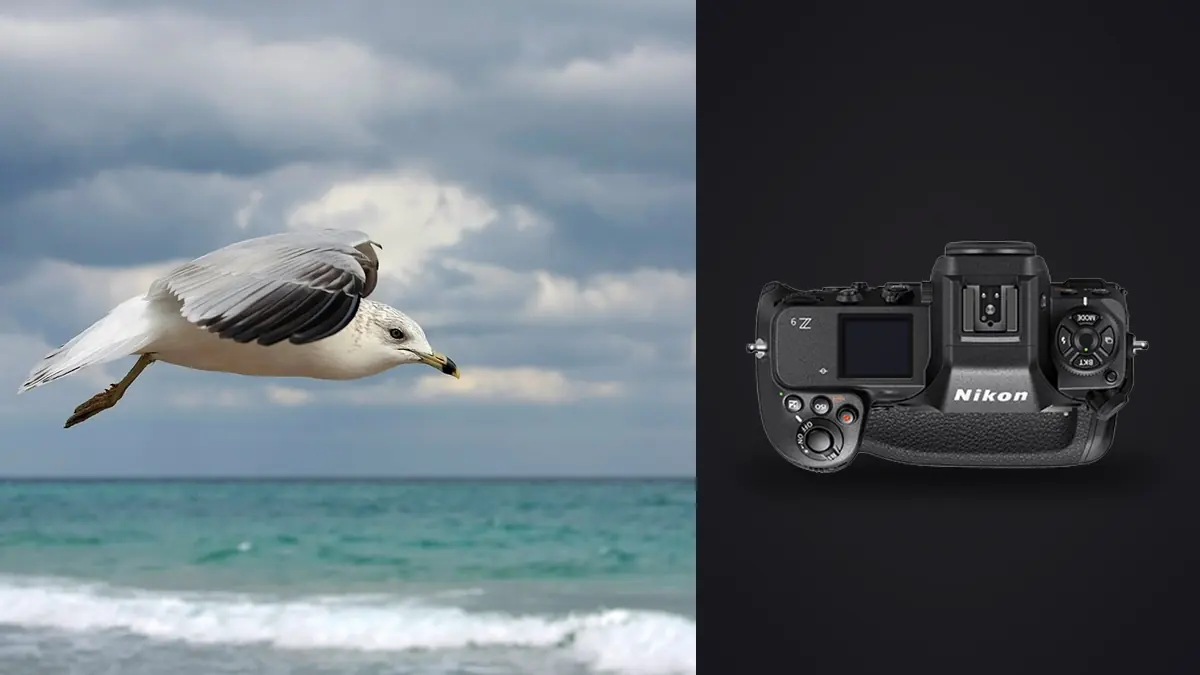
I spent three seasons chasing ospreys and terns with a D850 before switching to the Z9, and the difference wasn't really about resolution or autofocus points on paper. It was that I stopped missing the moment the bird committed to the dive. No blackout, no guessing where the frame line was during a burst, no more coming home wondering if I'd actually tracked the wingtip through the whole sequence or just the memory of it. That's the honest starting point for anyone deciding whether the Z9 is worth the money and the extra weight in the bag for birds in flight work specifically, because a lot of what gets written about this camera is generic gear-review language that doesn't tell you anything about how it behaves when a peregrine folds its wings forty yards away and you have about a second and a half to get the shot.
The sensor and shutter change what "keep shooting" actually means
The Z9 doesn't have a mechanical shutter at all. That's easy to read as a spec sheet curiosity, but for flight photography it changes the physical experience of shooting. There's no mirror slap, no shutter curtain, no blackout between frames, so what you see in the viewfinder during a 20 frame per second burst is a continuous, if slightly compressed, feed of the bird rather than a strobing series of black gaps. On a D500 or D850 I'd lose the bird out of frame maybe one time in five during a fast pass because the blackout hid a direction change for a fraction of a second. On the Z9 that basically doesn't happen anymore. I can follow a swift changing direction at speed and actually see it change direction.
The tradeoff people ask about is rolling shutter, since the sensor reads out electronically rather than all at once. In practice, for birds in flight, I don't see it. Nikon engineered the readout speed on this sensor specifically to kill the wobble and skew that plagued earlier electronic-shutter cameras on fast horizontal pans, and unless you're photographing propeller aircraft (where you'll occasionally get a bent prop blade) it's a non-issue for wildlife. I've panned hard on gulls and shorebirds at 20fps and never once seen a smeared wing.
Autofocus settings that actually matter for flight, not just spec-sheet AF points
The Z9 has an enormous number of focus area modes and I ignore most of them for BIF. Two do almost all the work: 3D-tracking, and Auto-area AF with subject detection set to Birds. Which one I use depends entirely on the background.
Against open sky, Auto-area with bird detection is close to foolproof. The camera finds the eye, boxes it, and holds it through fairly aggressive direction changes. I use it for gulls over water, raptors soaring against clear sky, anything where there's nothing else in frame for the algorithm to get confused by.
The moment there's clutter, reeds, tree branches, other birds in a flock, a second bird crossing behind the one I'm tracking, I switch to 3D-tracking with a manually placed starting point. Subject detection will happily jump to the sharper-contrast branch behind your subject if you let it, and I've lost more keeper frames to the camera "helpfully" refocusing on background clutter than to any hardware limitation. 3D-tracking with a point I place myself and then let the camera carry through the frame gives me control over where tracking starts, which matters enormously when a heron lifts off from a reedbed with a dozen near-identical vertical lines behind it.
The custom settings I actually leave changed from default
A few adjustments I've made in the AF custom settings menu that made a real difference for flight work specifically:
- Blocked Shot AF Response set toward the "quick" end for open-sky work, but dialed back to a steadier setting when I know a wing or a branch is going to cross the subject briefly, so the camera doesn't jump to the obstruction.
- Subject Motion set to "Erratic" for swallows and terns, which are genuinely unpredictable in flight, and left at the steadier default for larger raptors and waterfowl that fly a more constant line.
- I've mapped the AF-On button and a second rear button to two different AF-area modes (3D-tracking on one, Auto-area with bird detection on the other) so I can switch mid-sequence without diving into a menu when a bird goes from perched against clutter to airborne against open sky in under two seconds, which happens constantly with kingfishers and small falcons.
Frame rate and buffer: what the high-speed modes are actually for
Full-resolution 20fps at 45.7 megapixels with continuous AF and AE between frames is where I shoot the vast majority of flight sequences, and on a fast CFexpress Type B card the buffer genuinely does not become the limiting factor in a normal shooting day. I've run bursts of several hundred frames chasing a flock of dunlin wheeling over a mudflat and never seen the buffer counter hit zero. That was simply not true of any DSLR I owned.
The High-Speed Frame Capture+ modes (C30 and C120) get talked about a lot online and I think they're frequently oversold. Here's the practical breakdown of when I actually reach for them versus when I stay in standard continuous high:
| Release mode | Frame rate | File output | Focus/exposure during the burst | When I actually use it |
|---|---|---|---|---|
| Continuous High (extended), electronic shutter | Up to 20 fps | Full-resolution RAW or JPEG | AF and AE recalculated every frame | Default for essentially all flight sequences, dives, and takeoffs |
| Continuous Low | 1 to 10 fps (adjustable) | Full-resolution RAW | AF and AE recalculated every frame | Perched birds, slow flight, conserving card space on a long stakeout |
| High-Speed Frame Capture+ (C30) | 30 fps | Reduced-resolution JPEG only | Locked from the first frame of the burst | A raptor stoop or a single explosive takeoff where I've already got focus locked and just need more time slices |
| High-Speed Frame Capture+ (C120) | 120 fps | Reduced-resolution JPEG only, DX crop | Locked from the first frame of the burst | Wingbeat-freezing detail shots of hummingbirds or small passerines at a feeder, where the subject barely moves position |
The reason C30 and C120 aren't my everyday flight setting is that focus locks at the moment you start the burst. That's fine for a hummingbird hovering at a feeder six feet away. It's a liability for a falcon closing distance on you at speed, because the plane of focus you locked on frame one won't match where the bird actually is by frame ninety. For genuinely unpredictable flight paths, standard 20fps with continuous tracking beats a higher number that stops adjusting.
Glass that actually keeps up with the body
The Z9's autofocus and frame rate are only useful if the lens can resolve the bird in the first place, and for BIF specifically, reach and handholdability matter more than raw aperture speed in most daylight conditions. My rotation:
The Z 800mm f/6.3 PF is the lens I reach for most often now for anything skittish, ospreys, eagles, distant raptors on migration. It's genuinely handholdable for extended stretches, which changes how you shoot compared to a gimbal-mounted 600mm f/4. You can swing it fast to pick up a bird that just flushed unexpectedly, which happens more often in the field than any of us plan for.
The Z 600mm f/4 TC S is sharper wide open and the built-in teleconverter is genuinely useful, but at over 3.2kg it wants a gimbal or at minimum a monopod for anything beyond short bursts, and I find myself slower to react to a surprise takeoff with it mounted.
For general birding where I don't know in advance whether I'll need reach or a wider field for a bird lifting off close, the Z 100-400mm f/4.5-5.6 S stays in the bag as a walk-around, and the Z 180-600mm covers similar ground at a lower price point if the extra weight and slightly softer corners at 600mm aren't dealbreakers for you.
Batteries, cards, and the logistics nobody puts in the spec sheet
The EN-EL18d battery in the Z9 is a genuinely different proposition from typical mirrorless batteries. CIPA numbers undersell it badly for burst shooting specifically, since CIPA testing methodology doesn't reflect how a wildlife shooter actually uses the camera (short bursts, long gaps, viewfinder rather than screen). I regularly get through a full cold-weather morning on one charge with several thousand frames shot. I still carry a spare because a dead battery on a migration morning is not a risk worth taking, but I've stopped treating battery anxiety as a daily concern the way I did with older bodies.
Card choice matters more than people expect. The dual CFexpress Type B slots are what actually let that buffer stay effectively bottomless at 20fps, and a slower card will absolutely become your limiting factor before the camera does. I run matched fast CFexpress cards in both slots, one set to overflow, and I've had exactly zero card-related failures across two winters of shorebird season, which is the kind of unglamorous reliability that matters more than any spec once you're standing in a blind at dawn.
What actually happens when you get home with four thousand frames of one flight sequence
This is the part that doesn't get talked about enough in gear reviews. A good flight session with the Z9 doesn't produce a hundred photos, it produces thousands, and a huge fraction of any given burst is near-duplicate frames of the same wingbeat separated by a fiftieth of a second. Culling that manually is the actual bottleneck in a wildlife photographer's week, not the camera.
This is where I've started leaning on imagic rather than scrubbing through a folder frame by frame in Lightroom. It runs entirely on my own machine, no upload queue, no waiting on a cloud service to chew through four thousand RAW files before I can even start picking, which matters when I'm reviewing a card in a camp kitchen on a birding trip with no real internet. It scores sharpness and focus locally on the actual eye and feather detail rather than a whole-frame average, which is the distinction that matters for BIF, because a technically sharp background and a slightly soft eye should not score the same as a tack-sharp eye with a blurred wingtip. It also clusters the burst into groups automatically, so instead of four thousand individual thumbnails I'm looking at maybe sixty clustered sequences and picking the best one or two frames out of each. That's the actual time savings, not the culling itself but the reduction in how many individual decisions I have to make.
If you want more detail on how that kind of local scoring actually works under the hood rather than taking my word for it, I wrote about the mechanics separately in how AI photo culling works. Once the picks are made, I lean on the apply_my_style preset, trained on my own past edits rather than some generic wildlife preset pack, to get a consistent starting point across a set that was shot across three different light conditions in one morning, and then finish each one individually from there. It's not a replacement for actually editing the photo, but it kills the tedious part of getting sixty images to a similar starting exposure and white balance before the real work starts. There's a broader rundown of shaving time out of this kind of high-volume workflow in 10 tips for a faster photo workflow if the culling bottleneck sounds familiar.
Frequently Asked Questions
Do I need an 800mm or 600mm lens for birds in flight, or will a zoom work on the Z9?
A zoom like the 100-400mm or 180-600mm will get you plenty of usable flight shots, especially for larger birds like raptors, herons, and waterfowl where you don't need extreme reach. Where a prime like the 800mm f/6.3 earns its keep is with small, distant, or skittish subjects, songbirds crossing a field, shorebirds that flush at fifty meters, where the extra reach is the difference between a frame-filling shot and a crop that falls apart at 100%. If you're starting out, a zoom paired with the Z9's autofocus will teach you more about flight tracking technique per dollar spent than a prime will.
Should I shoot electronic shutter for birds in flight, or is there ever a reason to avoid it on the Z9?
The Z9 only has an electronic shutter, so this isn't really a choice you make the way you would on a Z8 or other Nikon bodies that retain a mechanical option. The good news is that Nikon's engineering on this specific sensor readout makes rolling shutter a non-issue for the vast majority of bird photography. The one place I'd flag caution is photographing anything with a very fast rotating element in frame, like an aircraft propeller, where you can occasionally see distortion.
Is Auto-area AF with bird detection reliable enough to trust, or should I always place my own focus point?
Against clean backgrounds, bird detection is reliable enough that I trust it completely and don't second-guess it. Against cluttered backgrounds, branches, reeds, mixed flocks, I switch to 3D-tracking with a manually placed starting point, because subject detection will occasionally lock onto contrast in the background rather than the bird itself. Knowing which situation you're in before the bird takes off, and having your button mapped to switch quickly, matters more than picking one mode and sticking with it all day.
How many CFexpress cards do I actually need for a full day of flight photography?
For a single day of active flight shooting, two 325GB or larger fast CFexpress Type B cards run in overflow has been enough for me even on genuinely busy migration days, but I'd rather carry a third spare than find out mid-morning that I'm wrong. The bigger practical point is card speed rather than capacity, since a slow card is what actually creates buffer bottlenecks at 20fps, not a lack of storage.