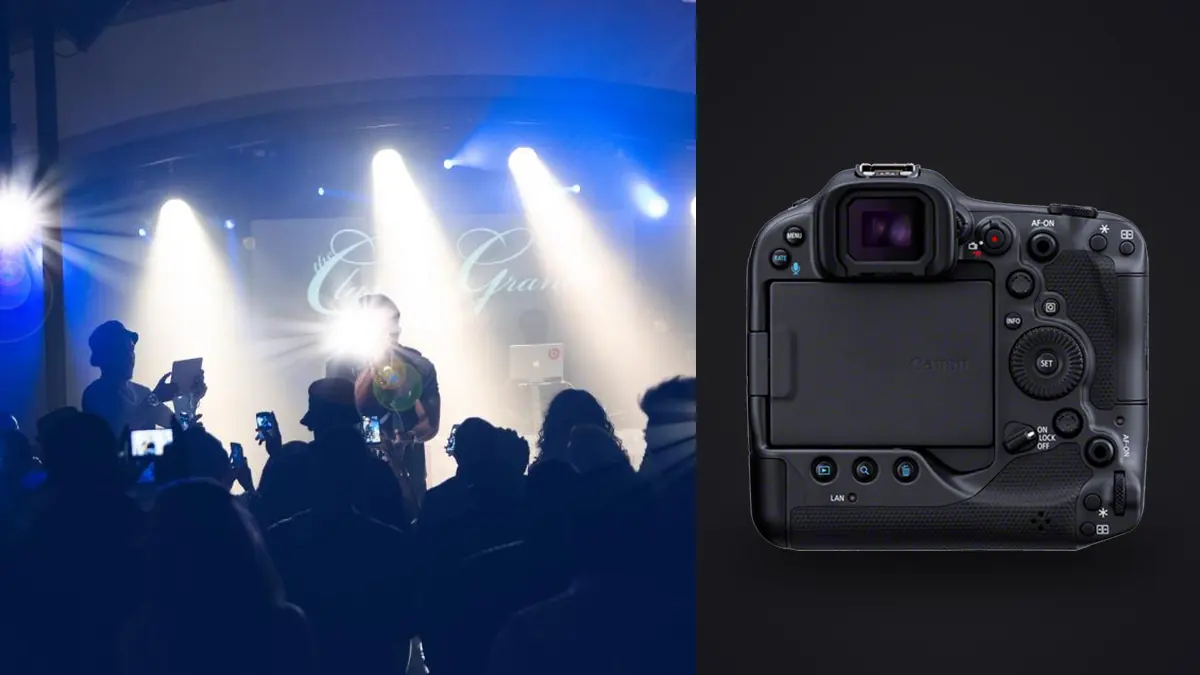
Why I Kept Reaching for the R3 in the Pit
I picked up a Canon EOS R3 about a year after it started showing up used at a price that made sense for an enthusiast instead of just a Canon-sponsored shooter on the sideline of a stadium. The number that sold me wasn't the frame rate, it was the electronic viewfinder. Every other body I had used in a pit blacked out for a fraction of a second after every shot, which sounds trivial until you are trying to track a singer's hand mic swinging past their face on beat four. The R3's stacked sensor keeps the finder live through the burst, so you are watching the actual moment happen instead of a frozen frame from a tenth of a second ago. That single feature changed how many usable frames I got out of a three-song set more than any lens swap did.
The rest of the spec sheet matters too, but in a different order than most reviews suggest. Twenty four megapixels is plenty for a magazine spread or a two-story banner, and it keeps file sizes manageable when you are shooting a festival that runs fourteen hours and you are dumping four cards a night. The 30fps electronic shutter is fun to have but I rarely use it above 12fps for actual coverage, because at 30fps you end up with hundreds of near-identical frames of a guitarist's strumming hand and almost nothing extra of their face. More on that later, because sorting through that volume is its own problem.
Settings That Actually Hold Up Under Stage Lighting
Shutter speed and the LED flicker problem
Concert lighting rigs are almost entirely LED now, and LED fixtures pulse at a frequency tied to their driver, not to your shutter speed. Shoot with the electronic shutter at the wrong speed and you will get banding, a horizontal stripe of underexposure that shows up differently in every frame of a burst. The R3 has an anti-flicker mode that helps with mechanical and first-curtain shutter, but it does not fully solve electronic shutter banding at high frame rates under everything. My workaround is boring but reliable: I test the venue's lighting during soundcheck at 1/125, 1/160, 1/200, and 1/250, and I pick whichever one shows the least flicker on a couple of test bursts, then I lock it for the set unless the lighting design changes dramatically (which happens more than you'd think once a show hits its big chorus moment and every fixture in the room fires at once).
For most rock and pop shows I land around 1/200 to 1/320 at f/2.8, ISO floating between 3200 and 8000 depending on how aggressive the followspot operator is with blackouts. Metal and hardcore shows tend to run darker and more strobe-heavy, which pushes me into the 10000 to 20000 range more often than I'd like. The R3's high ISO files hold up fine through about ISO 12800 for web and small print use; past that I am shooting for the moment, not the pixel quality, and I know it going in.
Autofocus case settings for people who won't stand still
I run Case 2 or a custom case with tracking sensitivity turned up and acceleration/deceleration tracking set to respond quickly, because a singer lunging toward the crowd barrier is a much faster subject change than anything Canon's default cases were tuned for on sports. Eye detection works well on a frontlit face but struggles the moment someone turns into a hard backlight or a single moving gel wash, which is often. When that happens I switch off eye tracking and just use a single expand point on the torso, because chasing an eye that the camera keeps losing burns more good frames than it saves. Drummers are the easiest subject in the band and the hardest to make interesting; I usually leave them for wide shots and spend my AF attention on whoever is closest to the edge of the stage.
Lenses That Pair With It in a Real Pit
Three songs, no flash, often less than ten feet of room to move: that's the pit brief everywhere from a 300-cap club to an arena. I carry the RF 24-70mm f/2.8 on the body for most of the set and a 70-200mm f/2.8 on a second body or a quick swap for tighter shots from the barrier. The RF 70-200 is smaller than the EF version was and it makes a real difference when you're also carrying a monitor, water, and a second camera on a strap for three hours before your own set even starts if you're also crewing. I have shot with the 50mm f/1.2 for atmospheric wide shots when a venue only allows one song and you need to come away with something usable fast, but it's not a lens I'd default to for tracking a moving performer at f/1.2, the focus plane is too thin to be forgiving.
If the show allows more access, a 35mm prime from the stage side gets you the shots that make a gallery interesting instead of just competent: the crowd's hands, the side of the stage, the moment before a song starts. Most concert work still comes from the 24-70 and 70-200 combination though, because getting the performer in focus matters more than art.
The Three-Song Rule, Battery Math, and Buffer Reality
Most tours still run the first-three-songs-no-flash pit policy, which means you get roughly ten to twelve minutes to come away with a full gallery. That's not a lot of time to be fighting your gear, which is the real argument for a body like the R3 over something cheaper: you are not managing autofocus hunt or a viewfinder blackout mid-set, you are just shooting. Battery life has been solid for me, one LP-E19 gets me through a two-hour headline set with the EVF on the whole time and a healthy amount of chimping between songs, though I always carry a spare for anything with an opener plus headliner and a possible encore.
Buffer depth is the thing nobody tells you about until you run into it. Shooting RAW at 30fps electronic, the R3's buffer clears fast enough with a good CFexpress card that I have never actually hit a hard stop mid burst in three songs of shooting, but I also don't shoot 30fps continuously, I burst in short two or three second bites timed to a specific movement. If you hold the shutter down for a full ten seconds at max frame rate on a slower card you will feel it slow down, and that's exactly the moment you don't want a frozen buffer, so match your card to your actual shooting style rather than the spec sheet number.
How the R3 Stacks Up Against Other Concert-Ready Bodies
People ask me constantly whether the R3 is worth it over a cheaper Canon body or a Sony alternative for this specific job. Here's how the bodies I've actually shot shows with compare on the things that matter in a pit, not on paper spec sheets.
| Camera | Blackout-free EVF | Usable electronic-shutter fps for real coverage | LED banding risk | ISO I'll actually deliver from | Approx. used price (2026) |
|---|---|---|---|---|---|
| Canon EOS R3 | Yes (stacked sensor) | 10-12fps | Low, occasional at 30fps | Up to 12800 | 3200-3800 EUR |
| Canon EOS R6 Mark II | No, mild blackout | 8-10fps | Moderate, non-stacked sensor | Up to 8000 | 1700-2100 EUR |
| Sony A9 III | Yes (global shutter) | 15-20fps | None, global shutter | Up to 12800 | 5300-5900 EUR |
| Nikon Z9 | Yes (stacked sensor) | 12-15fps | Low | Up to 12800 | 4500-5000 EUR |
The A9 III's global shutter genuinely eliminates the banding problem, which is a real advantage if you shoot under LED-heavy production lighting every week. I don't own one because the price gap over the R3 is hard to justify for the amount of touring work I do, but if I photographed festival mainstages full time I'd probably feel differently. The R6 Mark II is the honest budget answer, it will get you through a pit shift, but the finder blackout and the extra banding risk cost you frames you'll notice when you're culling at 1am.
Sorting the Wreckage After a Show
Here's the part nobody warns you about before you buy a fast camera: a three-song set shot in short bursts at 10-12fps easily produces 1,200 to 1,800 frames, and a full festival day crewing multiple stages can push past 6,000. Scrolling through that in Bridge or Lightroom one at a time is how you lose your evening. I run everything through imagic before I touch a proper editor now, mostly for two things. The sharpness scoring catches the frames where a fast pan or a bad AF grab left the singer's face just soft enough to fail at print size, which is easy to miss on a laptop screen at 1am after four hours of shooting. And the burst clustering groups the near-duplicate frames from a held-down shutter into one stack instead of forcing me to eyeball forty variations of the same guitar solo, which is exactly the situation a 30fps electronic shutter creates.
The other feature I actually use for live music is apply_my_style. Every venue lights a set differently, warm tungsten wash in one club, cold blue LED wall in the next arena, and getting a consistent look across a multi-venue gallery used to mean re-building the grade from scratch each time. I trained a preset on a batch of my own edited concert photos and now new imports from a new venue land close to my look before I've touched a slider, which saves real time when a gallery has to be delivered before the band leaves town. It also runs everything locally, no upload step, which matters more than people think when you're backstage on a venue guest network you don't trust with unreleased tour photos before a label's embargo lifts.
If you're building out a faster culling workflow generally rather than just for concert work, the breakdown in how AI photo culling actually works covers the sharpness and duplicate detection side of this in more depth than I can here.
Frequently Asked Questions
Is 24 megapixels enough resolution for concert photography?
For 95 percent of concert work, yes. Magazine spreads, festival recap galleries, artist social media, and most print sizes up to a large poster all work fine at 24MP. The only time I've wanted more resolution is heavy cropping on a telephoto shot from far back in a large venue, and even then a well-composed 70-200 frame rarely needs it.
Does the R3's electronic shutter cause banding under stage lighting?
It can, especially at the top frame rates under mixed LED fixtures with different driver frequencies. It happens less often than on non-stacked sensor bodies, but it's not eliminated the way it is on a global shutter camera like the A9 III. Testing your shutter speed during soundcheck is still worth doing rather than trusting anti-flicker mode to catch everything.
Should I rent the R3 for a single festival gig instead of buying it?
If it's a one-off, renting makes more sense financially. Where owning pays off is repeated pit access over a season, when the blackout-free finder and buffer headroom start saving you frames across dozens of sets rather than one, and the cost per show drops enough to justify it against a rental rate that adds up fast over a full summer.